
In AI Search, There Is No Ranking — Only Trust
A learn article arguing that AI search rewards citations and trust rather than rankings. It explains query fan-out, why updating existing pages beats mass-publishing new ones, why AI descriptions of brands are often inaccurate, and how to vet GEO vendors' quick-win claims.
A couple of days ago, a friend who works in consumer products showed me an email.
A case study from a service provider: one week of work, and their client's AI visibility jumped. There was even a pretty curve to go with it. My friend asked me — does this check out? Should we give it a try?
I said, don't rush to pull out your wallet. Let's first get one thing straight: how does AI search actually work? Once we've talked it through, you'll be able to judge for yourself.
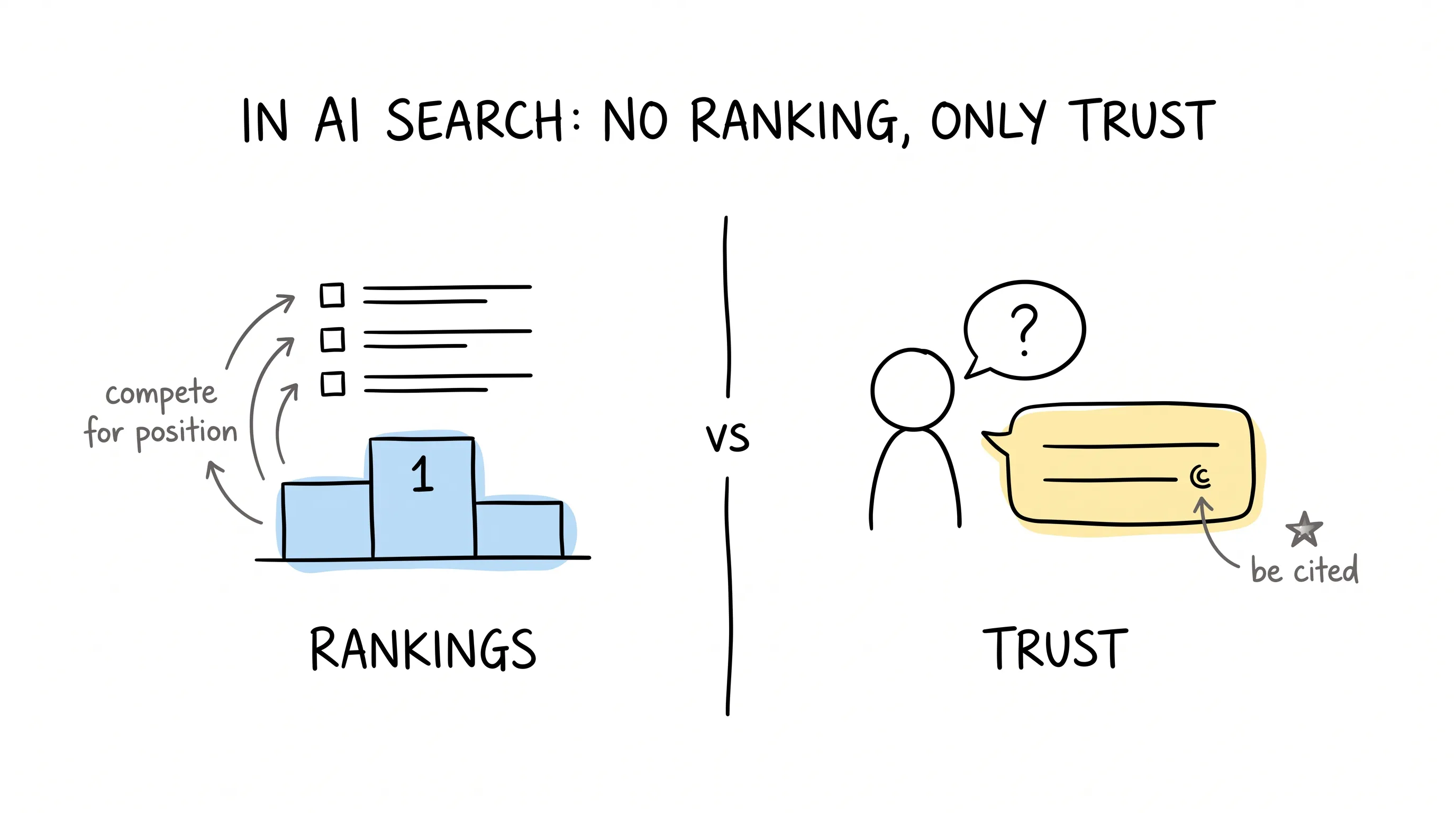
Is There Such a Thing as "Ranking" in AI Search?
No.
In the Google era, you had rankings. Position was sorted out, first place was first place.
AI search is different. When a user asks ChatGPT a question, it generates an answer on the spot and cites a few sources along the way. You can't rank up; you can only "be cited."
And being cited is something you earn, not something you rank into.
Search engines give you rankings. AI engines give you trust.
An Experiment That Made Me Sit Up
There's a digital marketing agency in the US called Seer Interactive. They've been studying AI search since early 2023, running experiments on generative engine optimization (GEO, as it's now commonly known) since 2024, and in the first half of this year alone they published four studies.
One of them has a particularly brilliant detail.
What is "query fan-out"? When you ask an AI a question, it doesn't think about it just once behind the scenes. It splits your question into dozens of smaller ones and fans out to look for material on each. The splitting action spreads like a fan — hence the name.
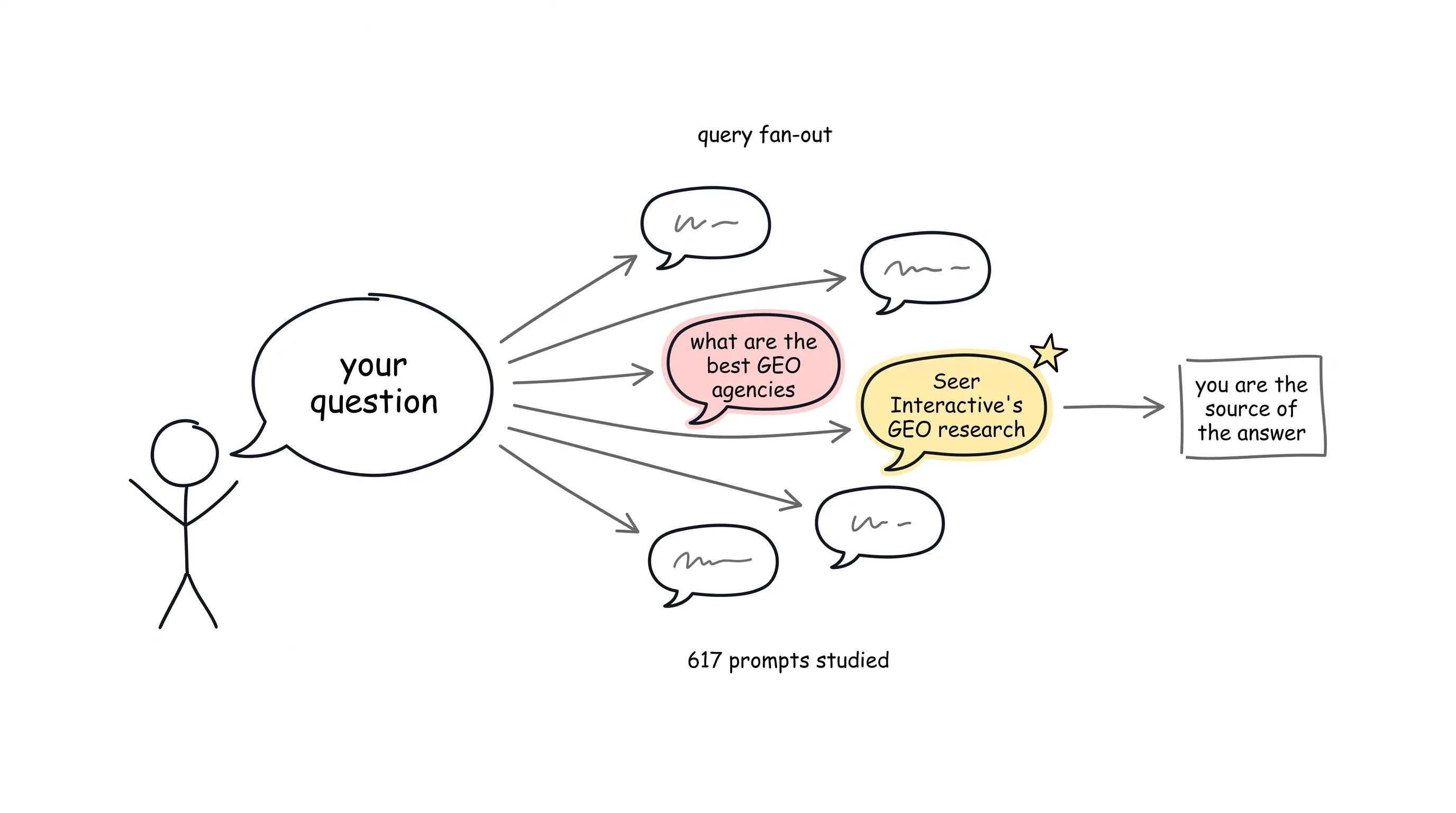
Seer ran an experiment: 617 prompts, one of which they reran 30 times. What they found: among the decomposed sub-questions, more and more were carrying brand names outright.
The sub-questions used to come out as "what are the best GEO agencies." Now they come out as "Seer Interactive's GEO research."
The gap between those two? Enormous.
With the former, you're competing in a crowd of peers, fighting over who shows up in the answer.
With the latter, the user never even asked "which one is good" — the AI has already named you on their behalf.
Once your brand shows up in the fan-out, you're no longer a competitor for the answer. You are the source of the answer.
A Counterintuitive Ledger: Publishing New Content Isn't Necessarily Worth It
People hear that AI loves fresh content and start frantically churning out new articles.
Seer pulled the books on it: 4,124 pages that had been cited by ChatGPT, Gemini, and Perplexity — pages where both the publish date and the update date were visible — over a statistical window from March to June of this year. The math:
72% of the pages had been updated within the past year.
But only 42% were newly published within the past year.
What does that mean? What AI cares about is "is this page still alive," not "how new is this page."
What AI rewards is not diligent publishing. It's sustained maintenance.
So instead of agonizing daily over new topics, dig out the old pages you already have — update the data where it needs updating, fill in the details where they're missing. This path has been validated by more than four thousand pages.
An Even Harder Truth to Swallow: What AI Says About You May Be Wrong
Since Seer started experimenting in 2024, they have almost never encountered a single brand whose description across the major models is completely accurate.
Here's one example.
A company where the average employee tenure is over ten years — as stable as stability gets. Yet when one large language model introduced it, it said the company had high employee turnover. The evidence? A single negative review.
Think about it: if that's how potential customers come to know you, then whatever optimization you do afterward, you're building on the wrong foundation.
So Seer's advice runs in the opposite order: don't fixate on your AI share of voice, and don't rush to grab category rankings. First, count one thing: of all the brand attributes the models use to describe you, what share is actually correct.
Make that "factual accuracy rate" your top-priority metric.
First get the AI to say who you are — correctly. Then get it to recommend you.
Now, Back to That Email
A case that delivers in one week — how do you check the goods? Three steps.
Step one: make them show the actual list of pages they published, and see what they actually did.
Step two: check whether that visibility peak is still there later. The kind that shoots up and then falls back down doesn't count.
Step three: put this in historical context. Back in the day, Google penalized both BMW and J.C. Penney, and the charge in both cases was mass-producing pages to game results. This playbook was never new.
And what does the credible approach look like? Seer's alternative takes three weeks: nail down answer accuracy for brand-related questions, back it up with page-level data, then write content in the language of real users.
Three weeks is slower than one week — but it's something you can take to the board.
If speed is manufactured, it isn't speed. It's a landmine you've buried.
Are GEO and SEO the Same Thing?
No. But they are two pillars that prop each other up.
SEO gets the foundation of your website in order. GEO makes everything about you across the web — your official site, PR, social media, user reviews — legible to AI.
The mistake many brands make right now is treating the two words as synonyms. If you're serious about AI visibility, you should pull every marketing team into it, not just tack GEO onto the SEO team's plate.
How Do You Make the Case to Your Boss?
The old SEO ROI formula breaks down in AI search. Positions shift daily, search volume can't be measured accurately, and even the answer your CEO sees isn't the same as the one you see.
Here are the signals you can watch: AI share of voice, citation counts, growth in branded search, direct traffic, and conversions coming through AI channels. Wherever the data is solid enough, connect it to business outcomes.
Not perfect. But for now, this is what there is to work with.
Finally, Let Me Be Straight with You
Someone will ask: is there a one-and-done solution?
No. Even Seer, after more than three years of experiments, still calls its own method "experimental."
Their founder has a line that stuck with me: anyone who tells you they have a silver bullet for GEO — keep your distance.
Which is also why, even though they make their living doing exactly this, they never guarantee results: since 2025, 15% of their inbound lead conversions have come from people who discovered them inside some large language model. Some clients use ChatGPT to build a shortlist of agencies — and they really do get listed. But for visibility manufactured through mass-produced listicle-style content, they'll always remind you to ask one question: when the models start penalizing this kind of content, what's your plan?
What you can truly hold on to are the things that don't change: content that is genuinely useful, viewpoints that are genuinely original, structure that is genuinely clear, brand signals that are consistent enough — and then showing up in enough places.
Back to that friend at the beginning.
This is what I told him in the end: rather than spending the money on "results in one week," spend it on "getting the AI to say who you are — correctly." The former buys you a curve. The latter earns you trust.
In AI search, there is no ranking, only trust. And trust is earned.
Here's to you becoming that source the AI names.
Continue reading
Related articles

Cross-Border Business: Time to Upgrade Your AI Toolbox
A learn article explaining how AI tools help cross-border e-commerce sellers clear five hurdles: language, regulation, logistics, payments, and fraud. It outlines a five-compartment toolbox, a five-step adoption path, and metrics such as conversion rate and CLV, while cautioning against over-reliance on AI.

AI Is Taking Over the Dirty Work of Social Media Marketing, One Task at a Time
This learn article outlines four social media marketing tasks AI can handle — audience analytics, content drafting and design, ad targeting and creative testing, and spam moderation — and cautions that taste, judgment, and data security remain human responsibilities.

AI Is Already This Good — Why Is Your Social Media Marketing Still Pure Manpower?
An overview of 18 AI tools for social media marketing, organized into six categories covering audience research, content creation, scheduling, comment and DM handling, ad management, and visual production, plus notes on personalization, prediction, and emerging trends.