
In AI Search, There Is No Ranking — Only Citations
A learn article explaining AEO: how answer engines choose citations instead of rankings, covering content structure, trust signals, freshness, schema, platform-specific tactics, and measurement approaches.
Recently, I went through a report HubSpot published called State of AEO. They analyzed thousands of citation data points across more than six answer engines, and surveyed over 4,000 marketers worldwide.
When I was done, I sat staring at one pattern for a long time.
The brands cited most often in AI answers aren't necessarily the ones with the biggest domains or the most backlinks. They're the ones whose content has grown into a shape that is "especially easy to tear a clean piece from."
What does being cited mean? You ask ChatGPT a question, and its answer mentions a certain brand or article — with the source attached. That's one citation.
This is quietly reshuffling the pecking order of traffic.
Let's start from the beginning.
First, Let's Be Clear: What Is AEO?
AEO, Answer Engine Optimization. In plain language: making AI more willing to mention you and cite you when it answers user questions.
You might say, isn't that just SEO wearing a new coat?
It really isn't. The underlying logic of the two is far apart.
Traditional SEO rewards "being findable." You rank first, the user clicks you, done.
AEO rewards "being quotable." The engine has to be able to tear a clean passage from your page, drop it into its answer, and not worry about getting it wrong.
One word of difference, and the whole game changes.
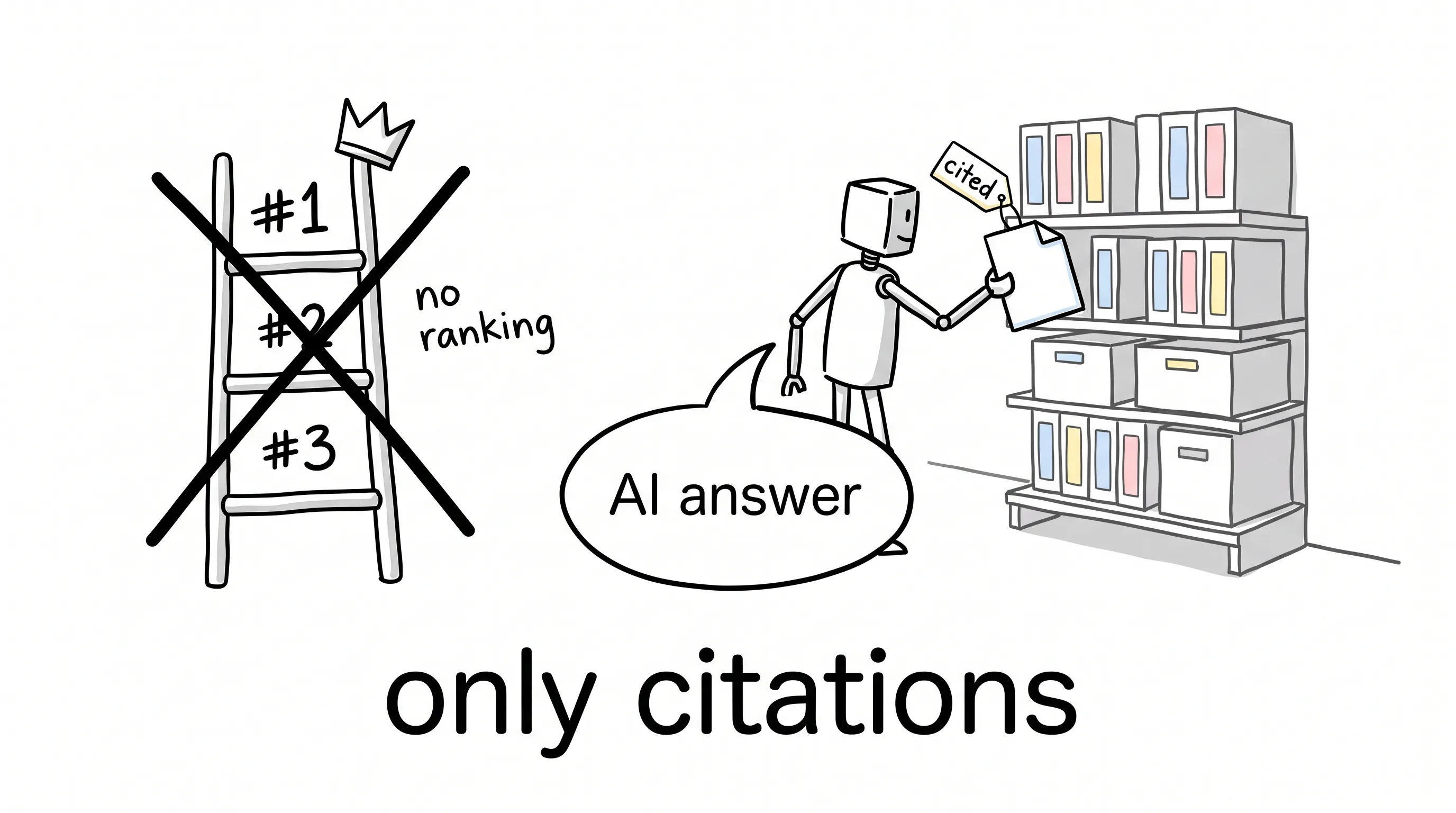
AJ Ghergich, who leads Botify's AI and consulting business, said something spot-on in a podcast: in AI, you don't have a ranking — it's random.
What does that mean?
In traditional search, you can grind your way to position one. In AI answers, there is no position one. All you can do is work to become the kind of source an engine instinctively reaches for the moment a relevant question comes up.
In AI search, there is no ranking — only citations.
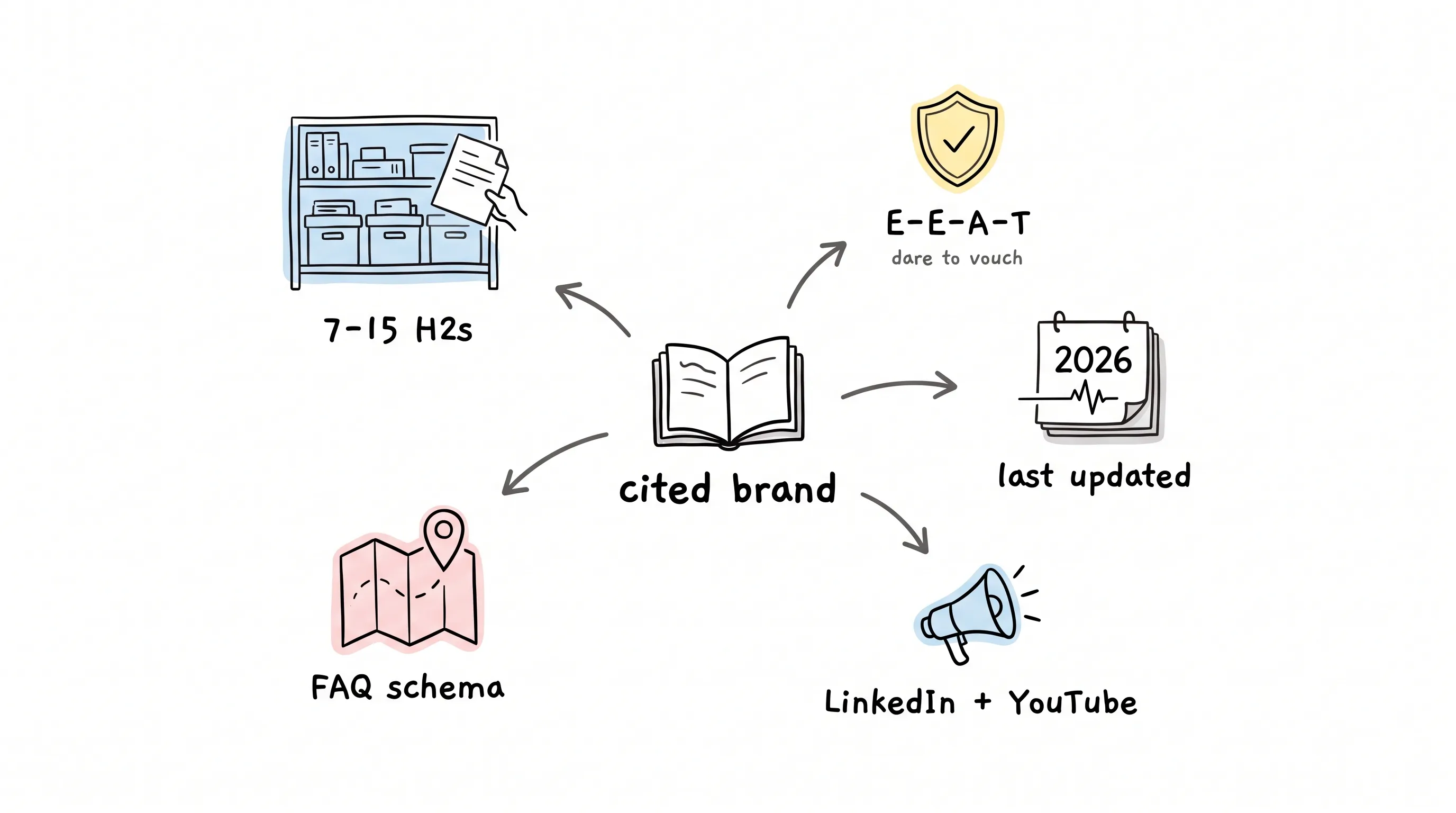
So, what kinds of brands get cited again and again? I turned this report over back and forth, and the behavior of highly cited brands is strikingly consistent. Counted up, it comes down to five things.
The First: Grow Your Content Into a Shape That "Can Be Torn Off"
Think about it — how does AI actually read your article?
It doesn't sit down with a coffee and read from start to finish. It slices your page into pieces, and whichever piece answers the question, it takes that one.
If your content is a mess and it can't tear off a clean piece, it goes and tears off someone else's.
Here's a data point from the report: pages with 7 to 15 H2 subheadings have the highest citation rates. The deeper the heading hierarchy (using H3s and H4s too), the higher the citation rate.
Why?
Every additional clear subheading is one more neatly labeled box with a complete answer inside. The engine can reach out and grab it.
So the way highly cited brands write is: definitions up front, short paragraphs, plenty of lists, subheadings that say exactly what they mean — so the machine finds the sentence it needs without any effort.
Put bluntly, you're not writing an article, you're stocking the shelf for AI. The tidier the display, the more likely it gets taken.
The Second: Make AI Dare to Vouch for You
There's an old term, E-E-A-T. Experience, Expertise, Authoritativeness, Trustworthiness.
An old term from the Google era that hasn't gone stale in the AI era — it's being gripped even tighter.
Why?
Because when an engine cites you, it's putting its own credibility up as your guarantee. If it cites wrong, the engine is the one that loses face.
So before an engine decides whether to cite you, it's really asking itself one question: this one — do I dare vouch for it?
Pages that get cited usually carry visible trust marks: real author bios with credentials; outbound links to data sources in the body; original research nobody else has; brand information consistent across the web.
This work has to go into every corner of your website, blog, and social content. The more often AI encounters your name across the web, and the more legitimate the settings, the easier it is for AI to accept you as an authority in your field.
The Third: Let AI Know You're Still Alive
Engines favor content that's being cared for.
Note — not the diligence of publishing five posts a day, but the freshness of "someone is still minding the work."
In the report, pages that put the year into the main headline and the meta title earned higher citation rates, especially visible on Google AI Overviews and Copilot. Displaying a "last updated" date on the page helps too.
Brands that collect citations treat their best pages as assets: revisit them regularly, add new data, re-stamp the year.
Here's a small trick to share: if a page genuinely has nothing to update, add a line like "As of 2026, here's what comes next." You're telling the engine: this page still has someone minding the store.
The Fourth: Hand the Engine a Map
Structured data, also known as schema, is an annotated map you hand the engine yourself, so it doesn't have to guess.
In the report, FAQ schema shows an especially strong relationship with citation rates.
Think about why. When you package content in a question-plus-answer format, the engine can carry it off almost verbatim. It's packaging tailor-made for AI answers.
Add every schema that applies: Article schema, author schema, FAQ schema. Keeping the technical housework tidied up is one of the small things highly cited brands quietly get right.
The Fifth: Don't Stay Cooped Up on Your Own Little Plot
When engines hunt for answers, they don't just comb your website. Social media and community forums are all within view.
In the report's data, the most-cited social channels are the text-dense ones and the ones that can host long video: LinkedIn and YouTube lead by a wide margin.
Krista Doyle, founder of Fan Out, put it perfectly: LinkedIn proves you're a serious practitioner; YouTube proves you actually know how to do this work.
Sharp.
And it's not only the big platforms. Engines also indirectly scoop up content from small vertical communities: a Slack community discussion gets turned into a blog post, a niche industry newsletter gets indexed.
Especially in B2B. Word-of-mouth inside a niche industry community outweighs a whole pile of generic high-authority backlinks from the old days.
Highly cited brands do this: they appear both in the answers and in the places that corroborate those answers.
Which Pages Get Torn Off Most Easily?
The five things are the mindset. At the level of page types, five kinds of pages are natural citation magnets.
One: definition pages. "What is X" — answer first, then expand. The engine's favorite.
Two: tutorial pages. Clearly numbered steps, explicit labels — you've pre-formatted everything for the engine.
Three: list pages. "Best X" roundups are naturally structured; item by item, each one can be taken on its own.
Four: comparison pages. How to choose between X and Y. In ChatGPT, this format's citation rate is frighteningly high. Buyers ask AI to compare products every day — a clean comparison table is gold.
Five: original research. Data nobody else has is the ultimate credential. The moment you publish original research, you become the source, and others cite you in return.
How you write titles matters too, and different engines have different tastes: "Best" listicles work in AI Overviews, Gemini, and Perplexity; comparison content works in ChatGPT and Gemini; "What is" pieces work in AI Overviews, AI Mode, Gemini, and Perplexity; tutorials work in AI Overviews, AI Mode, Gemini, and Perplexity.
There are universal principles too: keywords in the main headline, a deep heading hierarchy, and an H2 count that lands between 7 and 15.
Each Engine Has Its Own Taste — Don't Try to Win Them All in One Bite
This section may be the most valuable insight in the whole piece.
There's no such thing as generically "optimizing for AI search."
Because answer engines aren't even the same species.
Google AI Overviews feeds on structured, authoritative content, and correlates most strongly with traditional Google rankings. Your existing SEO equity cashes in most directly here: pages that already rank well are the easiest to get into AI summaries.
Gemini leans on Google's trust system, but it's conversational and loves multi-turn follow-ups. It cites blogs, product pages, and lists alike, favoring content that can sustain back-and-forth exchanges.
ChatGPT has an appetite for comparison content — its citation rate ranks first among all content types — and it also loves user reviews, PR pieces, and clearly sourced content, favoring well-known brands and original research.
Perplexity loves fresh, specific, vertical content the most, and it's generous with outbound links. A citation there is the easiest to turn back into real clicks.
How do you turn this into strategy? Match each asset to its engine.
Comparison pages, aim at ChatGPT. Definition pages, aim at AI Overviews and Gemini. Fresh vertical content, aim at Perplexity.
Spray-and-pray "optimize everything" spreads thin and wins little.
What Users Ask Decides Who Gets Cited
Who gets cited has a great deal to do with what users ask.
Ask "What is AEO" — informational intent. The battlefield of definition and tutorial pages.
Ask "What's the best project management tool" or "Monday vs. Asana, which is better" — commercial intent. Comparisons, lists, and reviews take over the battlefield.
Ask "How much does project management software cost" — transactional intent. Product pages and landing pages.
Ask for a specific brand outright — navigational intent. Your official pages need to be so unmistakable they can't be mistaken for anything else.
Then look at industry differences, and there's a data point that surprised me: B2B brands get cited far more often than pure B2C.
Among the highly cited B2B brands, Monday.com racked up more than 106,000 citations — most of them, surprisingly, from its blog; Wix relied mainly on list pages; Adobe mainly on product pages.
See it? There's no standard answer to the playbook — you grow into whatever shape your category gets asked about.
On the B2C side, reviews, forums, and credible editorial content carry more weight. And consumers are more cautious: they treat AI answers as one reference among several, then turn around and verify with traditional search before making a decision.
If you do both B2B and B2C, split into two playbooks by intent and content type. One script for everything won't win.
90 Days: From Invisible to Within Reach
That's the theory. How do you execute? Compress it into 90 days, three phases.
Week 1: Take inventory.
You can't improve what you can't see. "We're probably fine in AI search" — that's not measurement, that's wishful thinking.
First find out clearly: which pages are already being cited? On which engines? That's the starting line.
Then circle 10 to 20 target questions — the ones buyers commonly ask before they pay. Run the comparison: who is answering them on your behalf right now?
Along the way, set up monitoring for brand mentions and AI traffic, so attribution becomes possible later. For a quick look at the whole picture, HubSpot has a free AI Search Grader that scores your brand's current standing in answer engines.
Weeks 2–6: Rework the priority pages.
Prioritize the types with the highest citation potential: B2B builds comparison and definition pages; B2C-leaning brands build reviews and lists.
Then do all the structural moves in one pass: keywords in the main headline, H2 count between 7 and 15, definitions up front, FAQ schema attached, author bios displayed, data sources linked out, update dates marked.
And one more piece of plain truth: refresh first, build new second.
Upgrading an old page that already has some authority usually gets cited faster than launching a brand-new URL from zero. Don't just polish the pages that already work — go win back the answers you're losing.
Weeks 7–12: Go out and make noise.
Citations don't only grow on your website, and your moves shouldn't happen only there. Show up more on Reddit, YouTube, and LinkedIn, do PR, participate seriously in the industry communities where buyers actually show up, and accumulate third-party brand mentions.
By day 90, you've gone from "guess how we're doing in AI" to holding a baseline, a batch of reworked pages, and a channel that keeps feeding signals.
Your Dashboard Is Lying
The next part is the piece that stung me most in the entire report.
In the State of AEO survey, "how to measure" is the number-one obstacle to doing AEO for B2B marketers, and number two for B2C.
Why is it hard? Because your old dashboard doesn't just stay silent about AEO — it's actively deceiving you.
Ghergich ran the numbers. How often AI crawlers crawl your website versus how often they send you people is completely out of proportion: for one retailer, OpenAI made about 198 crawls for every 1 visit it sent. Google? Roughly 1 to 6.
198 to 1. Wow.
The result: inflated impressions, unremarkable clicks, conversion rates that look broken — and not one of these numbers means what you think it means.
His actual words were harsher: your dashboard is lying.
In traditional search, a click is only a proxy metric; the real goal is a qualified buyer choosing you. Answer engines hand you the result without needing a click. Measuring AEO with a click-era ruler isn't rigor — it's nostalgia.
So what should you watch? Five numbers.
One: brand visibility. Across the questions you track, how often you appear in AI answers, and where you stand versus competitors. This is the closest thing to a "ranking" in the answer-engine world.
Two: sentiment. When engines mention you, are they saying good things, neutral things, or bad things — scored from -100 to +100. One citation that distorts you hurts more than no citation at all.
Three: question tracking. The specific questions buyers ask — did you appear, and what exactly did each engine say. A real-time scoreboard.
Four: citation analysis. In your category, which domains, which pages, which content types are being cited — look at yours and your competitors'. This is the direct answer to "what do we do next."
Five: the business. Conversions and pipeline brought in by AI channels, wired into your CRM, so visibility data and closed deals sit at the same table.
The fifth number matters most, because it's the one that unlocks budget. One set of figures from the report: in global e-commerce, AI-channel visitors convert at 11.4%, while traditional organic search manages only 5.3%. And 44% of marketers say they've placed a business purchase order because of a brand they first got to know in an AI answer.
HubSpot itself is the living example: applying this playbook to itself, its leads from AI grew 1,850%.
On cadence: check the fast signals once a week — visibility ups and downs, citations newly won and lost, AI traffic trends. Check the strategic picture once a month — share changes against competitors, sentiment direction, pipeline contributed by AI channels.
Winning a Citation Isn't Winning — Keeping It Is
Winning a citation is easier than holding it.
Engines are constantly recrawling and reshuffling. A page cited today can quietly vanish from the answers next month — if you let it go stale, or if a competitor answers the same question more crisply.
So raise citations the way you'd raise a portfolio of assets.
Check schema and technical details regularly — tags will break, and you want to spot them before the engine does. Keep a refresh cadence so the freshness signal is still lit at every round of recrawling. Most critical: make explicit who is accountable for content accuracy and who owns the refresh calendar. Having nobody in charge is how every project starts to rot.
HubSpot also has a Loop Marketing framework, four steps: Express, Tailor, Amplify, Evolve. Express — establish a clear, consistent brand identity. Tailor — keep content glued to intent. Amplify — push content to where engines can see it. Evolve — feed citation data back into the next round. Keep it spinning, and each turn of the loop gets smarter.
There's another layer of governance that most companies' org charts simply haven't drawn yet: who has the authority to decide how AI accesses your brand, and how your brand gets presented?
Many teams treat this as an IT matter — an "allow or block" switch on a server.
Wrong.
When your product specs, positioning, or facts show up with errors in some AI answer, it stops being a technical problem and becomes a brand problem.
Ghergich's advice is that governance should be decided with marketing, IT, and legal sitting at the same table. Today — including at some of the world's largest companies — most enterprises can't say clearly who is using their brand data, whether it's accurate, or whether there's a contingency plan.
If you want to win citations, you have to have a stance on what these citations are allowed to say about you.
Finally, Back to That Report
Highly cited brands have no magic. They've simply thought through one thing:
Citations aren't grabbed the way rankings are grabbed — they're accumulated the way trust is accumulated.
The report has a reassuring number: 58% of marketers say their companies are already optimizing for answer engines. But honestly, most are still in the experimental stage.
What does that mean?
It means the people getting serious now — those who've built a baseline, adopted a playbook, and set up measurement — are taking the high-intent traffic on one side while waiting for everyone else to finish arguing about "whether AEO is even real."
This doesn't require an enterprise-level budget. Pick out your pages, shape them so they can be torn off and dare to be cited, show up where engines can see you, then keep your eyes on the numbers that move.
The per-platform citation rates, the headline patterns, the survey of 4,000+ marketers — all of it is in State of AEO.
Here's wishing you become the one AI cites first, without hesitation, whenever your industry comes up.
Continue reading
Related articles

Cross-Border Business: Time to Upgrade Your AI Toolbox
A learn article explaining how AI tools help cross-border e-commerce sellers clear five hurdles: language, regulation, logistics, payments, and fraud. It outlines a five-compartment toolbox, a five-step adoption path, and metrics such as conversion rate and CLV, while cautioning against over-reliance on AI.

AI Is Taking Over the Dirty Work of Social Media Marketing, One Task at a Time
This learn article outlines four social media marketing tasks AI can handle — audience analytics, content drafting and design, ad targeting and creative testing, and spam moderation — and cautions that taste, judgment, and data security remain human responsibilities.

AI Is Already This Good — Why Is Your Social Media Marketing Still Pure Manpower?
An overview of 18 AI tools for social media marketing, organized into six categories covering audience research, content creation, scheduling, comment and DM handling, ad management, and visual production, plus notes on personalization, prediction, and emerging trends.