
In 2026, Data Privacy Isn't a Cost of AI Marketing — It's Your Moat
A learn article arguing that data privacy is a competitive moat for AI marketing in 2026, covering GDPR and CCPA requirements, emerging AI governance rules, and five practical steps from data audits to documenting AI decisions.
A while back, a friend of mine who runs an e-commerce business invited me to dinner. The dishes had barely hit the table before he started venting: he'd recently put AI in charge of his ad campaigns, the targeting was scarily precise, and conversions were climbing fast. But his legal team kept knocking on his door, saying this wasn't allowed, that wasn't either. So who was he supposed to listen to?
My answer: your users.
He froze for a second.
Then I gave him a number. In 2023, Meta was fined €1.2 billion by the Irish Data Protection Commission. 1.2 billion. The cause came down to a single thing: cross-border transfers of user data that failed to actually safeguard users' privacy rights.
Think about it — at a company that size, is the legal team short-staffed? So how does it still stumble in a place like this?
Because legal can't cover for this. Every step of AI marketing feeds on data.
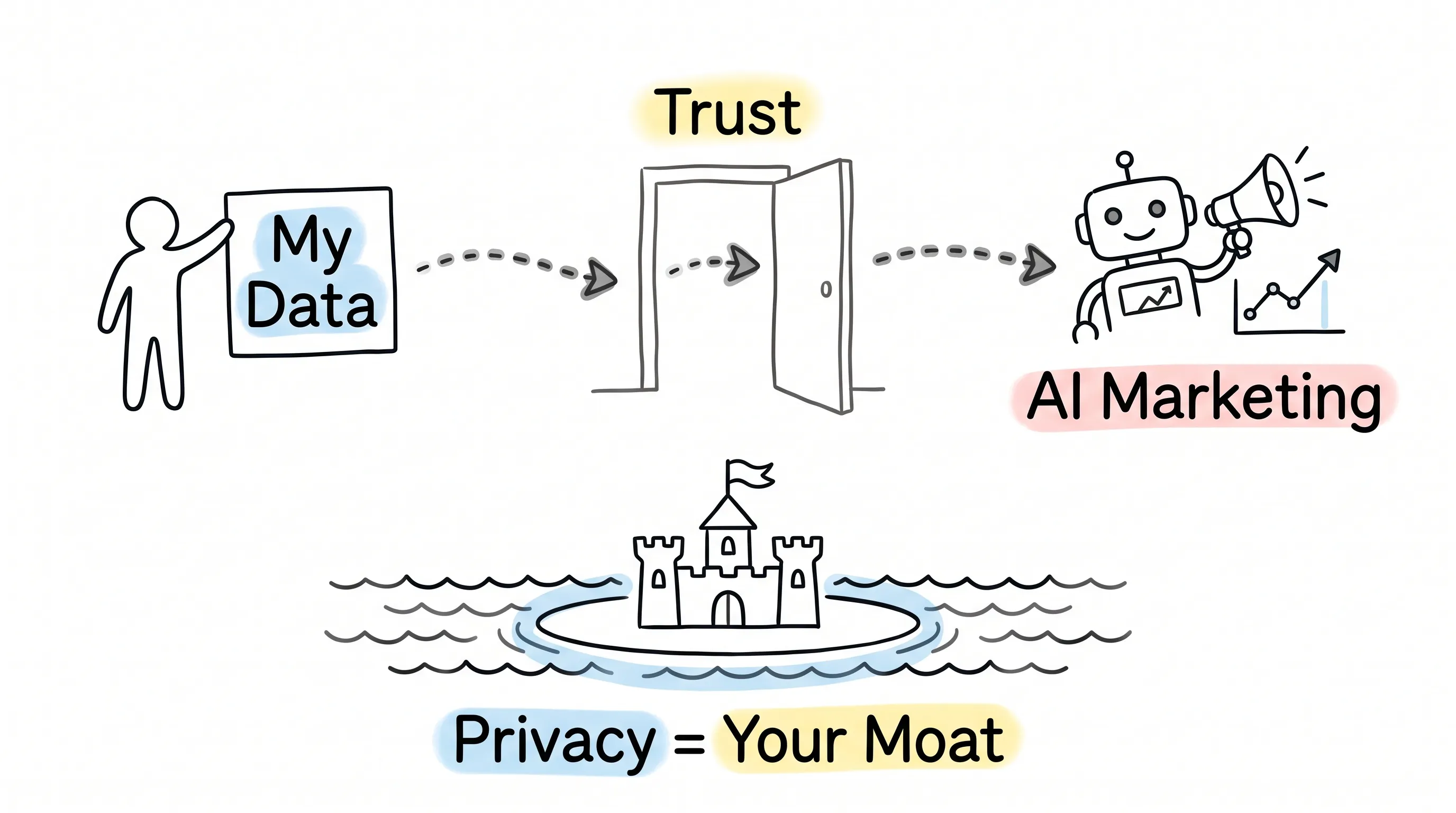
What Does AI Marketing Actually Feed On?
What is AI marketing, really? Put simply: it hands the job of guessing what users want over to machines.
It used to run on human intuition. Now it runs on computation.
Predicting what you'll buy next takes data. Serving you personalized content and products takes data. Ads that find their own audiences and adjust their own bids take data. A chatbot keeps you company and quietly logs the conversation — that takes data too.
Where does the data come from? From users.
A very plain logic surfaces: the ceiling of AI marketing is data, and the doorway to that data is trust.
Why would users hand their data over? Only because they trust you not to misuse it.
So by 2026, data privacy is long past being an internal document locked in a legal drawer. It has become a core competitive capability of the marketing department.
How Serious Is This? Let's Do the Math
Start with the fines.
Under the EU's GDPR, the cap is €20 million, or 4% of global annual revenue — whichever is higher. For a company with €1 billion in annual revenue, the cap is €40 million. Gone, overnight.
Now look at California. There's the CCPA, later toughened up by the CPRA. Don't assume it only governs the U.S. — if your business reaches California consumers, it reaches you. Each violation starts at $2,500; $7,500 if it's intentional. Doesn't sound like much? You have a million users, one notice goes out wrong — multiply it, do the math yourself.
And that's just the money.
The costlier bill is trust. One data breach, and users walk; your brand gets hauled onto social media with comment sections full of screenshots. Pay the fine and the case closes. Lose trust, and even a tenfold marketing budget may not buy it back.
So in 2026, what marketers discuss in meetings is no longer just "how to use AI to move faster," but also "how to use AI without stepping on a landmine."
The Two Biggest Rulebooks: Get These Straight First
Where do you start? With the two frameworks you'll run into most often.
First, GDPR. It governs the personal data of EU residents. Where your company is registered doesn't matter — if European users are among your customers, you answer to it.
It sets a few hard requirements for AI marketing: user data can be collected only with explicit consent; users have the right to view, correct, and delete their own data; if you use AI for automated decision-making — like one-to-one personalized recommendations and pricing — you must be able to explain it clearly to the user; data you can do without, don't collect; and if data was collected to make recommendations, don't quietly move it to some other job.
Second, the CCPA. It's California law, but it reaches far. Users have the right to say no: no selling their data, no using their data for ad matching. What you collect their data for must be stated plainly. And if they exercise their privacy rights, you can't turn around and downgrade their service or raise their prices.
By 2026 there's a new layer on top: quite a few jurisdictions are rolling out AI-specific governance frameworks. What do they govern? Algorithms must be transparent, bias must be findable and fixable, automated decisions must be explainable, and when something goes wrong, someone must be accountable.
In one sentence, data privacy law governs whether you may use it; AI governance governs how you use it. You're compliant only when you pass both.
Compliance Is Just a Passing Grade — Ethics Is the Moat
But my real point isn't even compliance.
Compliance is the floor. Above the floor there's still a wide stretch of room, and it's called ethics.
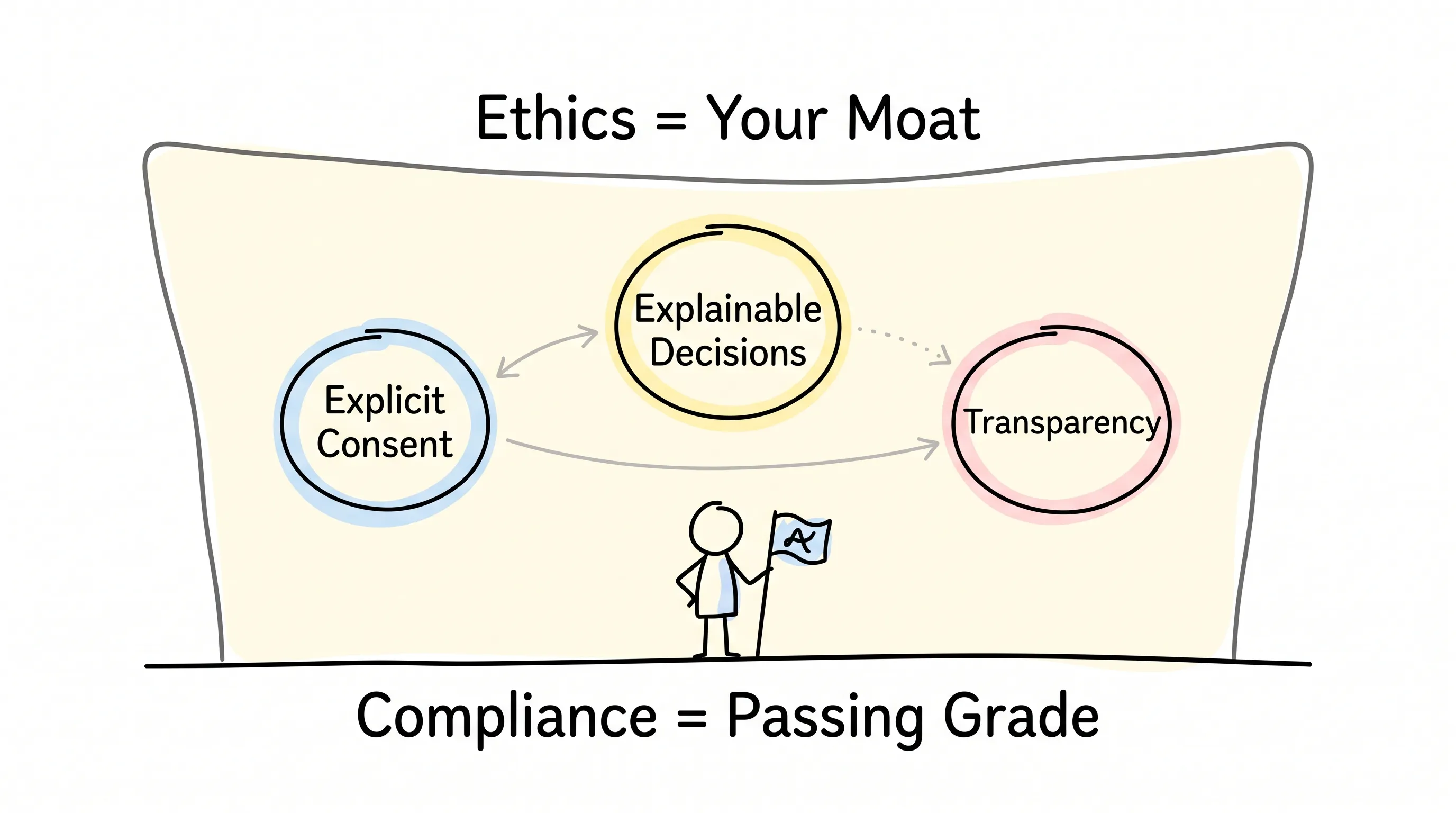
What does using data ethically mean? It means you could exploit the loophole, and you choose not to.
No user is stopping you from tracking their every move — so do you track it anyway? The algorithm carries a slight bias but converts higher — do you tune it? Users can't tell what your AI actually did with their data — do you play dumb?
I've seen too many companies write their privacy policy as a ten-thousand-word legal document, tucked behind a link nobody clicks. That isn't compliance. That's cover-your-back.
The genuinely smart move is to put "here's what data we hold on you, here's what we do with it, here's how you switch it off anytime" in plain human language, right in front of the user.
And guess what? Users can feel it.
Treat users as people, and they'll treat you as a brand. Treat users as traffic, and they'll treat you as harassment.
How to Put It into Practice: Five Moves
Enough principles — here's what you can actually do.
-
Start with a data audit. Go through every piece of user data you hold: where it came from, where it's stored, who's using it, and for what. Plenty of companies come out of this step in a cold sweat.
-
When choosing AI tools, make privacy a hard criterion. Strong features are one thing; whether the tool plays by the rules with data is another. Privacy by design — build the privacy line in from the design stage, rather than patching it on after something breaks.
-
Vet your partners. Every platform you connect to, every data vendor you buy from, is carrying risk on your behalf. When they slip, you go down with them.
-
Train your team. Many violations aren't malice — they're ignorance. Plenty of media buyers don't realize that retargeting also counts as data processing. It happens far too often.
-
Document how your AI makes decisions. Why did the algorithm recommend this, price it that way? Keep it on record. When regulators come asking and you can produce it, you'll sleep at night.
Not one of these five is something you do after disaster strikes.
Finally, Back to My Friend
After that dinner, the first thing my friend did wasn't to buy a new AI tool.
It was to have his legal team and data team trace the user data from start to finish. When it was done, he told me: that scared me half to death — some of this data, I didn't even know we had collected.
You see? That's the reality at most companies.
AI will keep getting stronger, regulation will keep getting finer, and users' eyes will keep getting sharper. Of these three things, not one will wait for your marketing team to be ready.
So here's my judgment: in the years ahead, the companies that do data privacy well won't be the ones paying higher compliance costs — they'll be the ones with higher marketing efficiency. Because users will give their trust to the one that dares to be transparent.
Privacy was never the opposite of marketing. Privacy is marketing.
And here's wishing you never have to learn this lesson the hard way, on a fine notice.
Continue reading
Related articles

Cross-Border Business: Time to Upgrade Your AI Toolbox
A learn article explaining how AI tools help cross-border e-commerce sellers clear five hurdles: language, regulation, logistics, payments, and fraud. It outlines a five-compartment toolbox, a five-step adoption path, and metrics such as conversion rate and CLV, while cautioning against over-reliance on AI.

AI Is Taking Over the Dirty Work of Social Media Marketing, One Task at a Time
This learn article outlines four social media marketing tasks AI can handle — audience analytics, content drafting and design, ad targeting and creative testing, and spam moderation — and cautions that taste, judgment, and data security remain human responsibilities.

AI Is Already This Good — Why Is Your Social Media Marketing Still Pure Manpower?
An overview of 18 AI tools for social media marketing, organized into six categories covering audience research, content creation, scheduling, comment and DM handling, ad management, and visual production, plus notes on personalization, prediction, and emerging trends.