
If AI Is So Powerful, Why Do Marketers Still Have No Time?
An analysis of why marketing teams using AI still miss launch dates and lack time, pointing to process bottlenecks like approvals and handoffs rather than drafting speed. It suggests mapping and redesigning the production process before adding more tools.
The other day I read a report, and when I finished, I just sat there for a long while.
The report comes from Knak, a company that builds marketing content production tools. They watch customers turn an email or a landing page from idea to launch every single day, so when it comes to how marketing content actually gets made, they have a firsthand view. This time they published a survey, Marketing Production in the Age of AI, and asked a bunch of marketing teams two very plain questions: over the past year, did you miss any launch dates? And where did your time actually go?
Two numbers, and both of them sting.
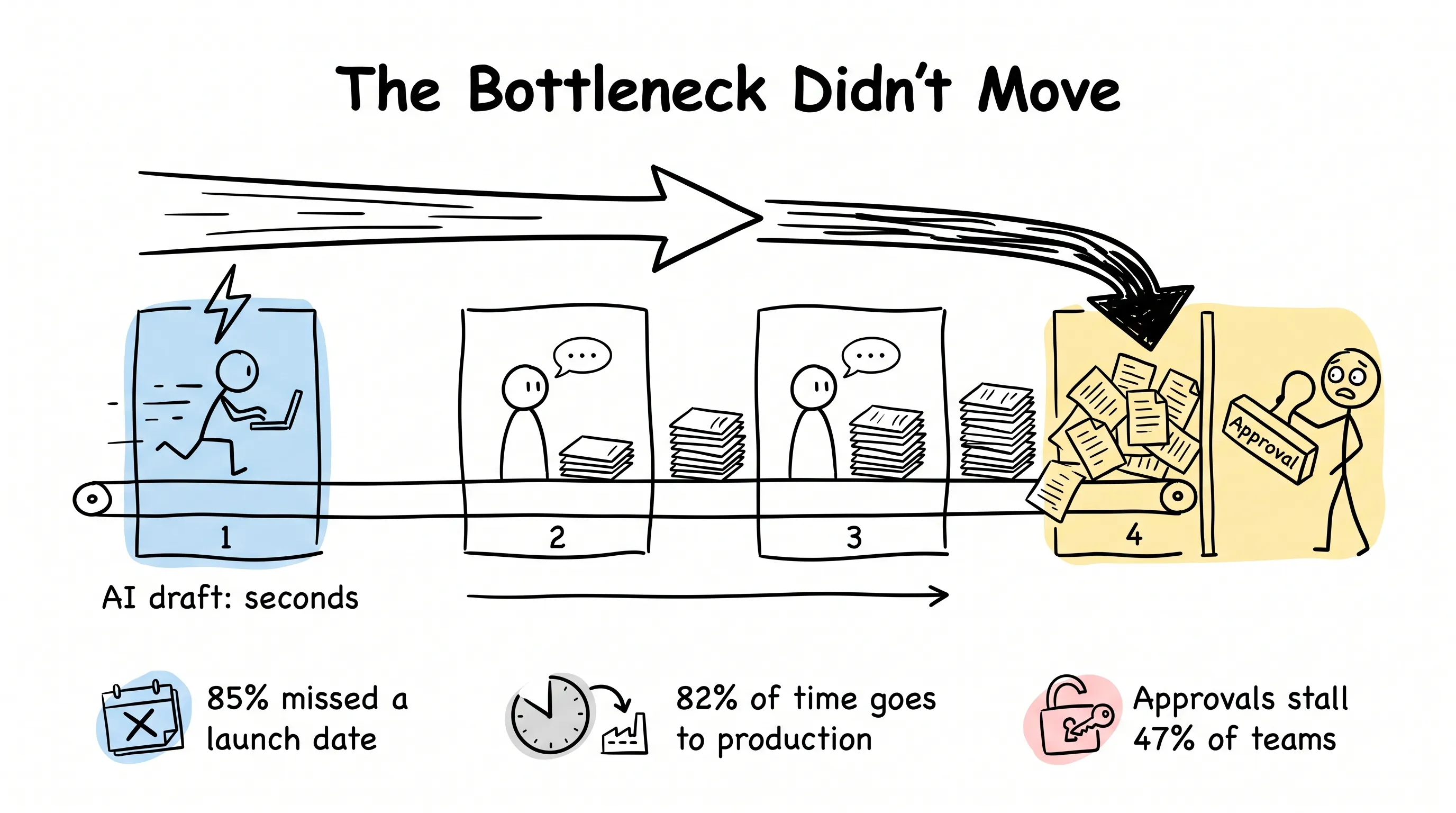
85% of teams missed at least one campaign launch in the past year because of process problems.
82% of teams spend more than half their time on production, not on planning and strategy.
Wait. Isn't this the AI era? First drafts come out in seconds — so how is everyone busier and more rushed instead?
The promise we were given: AI does the grunt work, you do the strategy.
As it turns out, that time still hasn't landed in your account.
Maybe we got the question wrong from the very start.
What Has AI Actually Helped With?
Let's lay out what AI is actually doing. 64% of teams use it to write first drafts of emails and landing pages, 56% use it to generate or retouch images, 56% use it to analyze data and suggest optimizations, and 48% use it to churn out headlines in bulk.
And it feels that way too. You open ChatGPT, and before your tea has gone cold, the first draft is there. A headline used to take half a day of thinking; now one prompt gets you ten.
But.
Generating a first draft is not the same as producing a marketing campaign.
And after the draft? Someone has to rewrite it in the brand's voice. Someone has to design it, build it, proof it, get it approved, test it, schedule it. AI hasn't taken over a single one of those jobs.
AI only shortened the first leg of the process. The long stretch after it hasn't moved an inch.
What's a Bottleneck, Really?
Let me ask you a question: on a production line, if the least busy station speeds up tenfold, how much more does the whole line produce?
Not one unit more.
Because output is decided by the slowest station. Management theory calls it the bottleneck. Optimize any non-bottleneck step, and your contribution to total output is zero.
So where is the bottleneck in marketing production?
The report ranked the causes of delay. Number one: waiting for approvals and sign-offs — it stalls 47% of teams. Then design and creative production, 38%. Then cross-team coordination, 36%.
Notice anything? Not one of them is "the copy took too long to write."
Now let's do the math. For 60% of teams, a single email passes through at least 4 pairs of hands. For 69%, it takes two or three rounds of revisions before it gets approved. 4 people, 3 rounds, and every person has to review it every round. One email, rough math, is 8 to 12 reviews.
Is that a copywriting problem? It's a process problem. Approval chains too long, ownership unclear, too many handoffs.
Bolt AI onto the front of that process so the first draft arrives faster, and there's only one possible outcome: you hit the bottleneck sooner.
You saved an hour of writing time. Where did that hour go?
It will not become strategy time. It falls into another round of revisions, another approval meeting, another new version of the plan. Or it falls into a whole new kind of request: once the boss knows you turn drafts around fast, the work only piles on faster.
More Options, More Decisions
There's a second thing, and it's even more subtle.
What AI brings isn't just the same work done faster. It's that the work itself multiplied.
Choices used to cost something. One version took an hour to produce, so teams made two headlines, one creative route, one version.
Now? 10 headlines, 5 openings, 3 calls to action, several rounds of visuals — a few minutes' work.
What is this? This is progress, right?
Hold on. Every new option is a new decision.
Who compares the 10 headlines? Who makes the final call on which direction to go? And once the comparison is done, a stakeholder says: can we take the opening of version 2, stitch it to the ending of version 7, and get one more version?
See? AI lowered the cost of creating options; it did not lower the cost of making choices. If anything, it made choosing more expensive.
Too many choices, and people fall into two traps. One is choice overload: so many options you don't want to pick any of them. The other is distinction bias: put the options side by side and you'll hunt desperately for tiny differences, then start agonizing: is version 7 just a touch warmer than version 4?
The question you should have been asking: does this campaign hold up strategically? Is it ready to ship?
Instead, everyone spends an entire afternoon huddled around 10 headlines.
The Draft Got Faster. Then What?
One more number, and this one stings even more.
70% of teams are already using AI somewhere in their production process. Yet 88% of teams say AI's output still needs moderate to heavy human editing.
Why?
Because what AI is good at is producing "adequate" content. And adequate is not exceptional. It is not strategic. And it is certainly not you.
No matter how fast the first draft arrives, the judgment is still yours: does this message match the goal? Will the reader feel the pull? Is the offer explained clearly?
The worst case looks like this: the strategy isn't thought through yet, but a first draft is already lying on your screen. It looks like the work is half done, when in fact the hardest step hasn't even been taken yet. Then the team spends three rounds of revisions trying to retrofit the strategy into the copy after the fact.
AI creates an illusion of progress.
Where Does the Saved Time Go?
This is the part I most want you to hear.
Saved time never gets banked. It only gets spent.
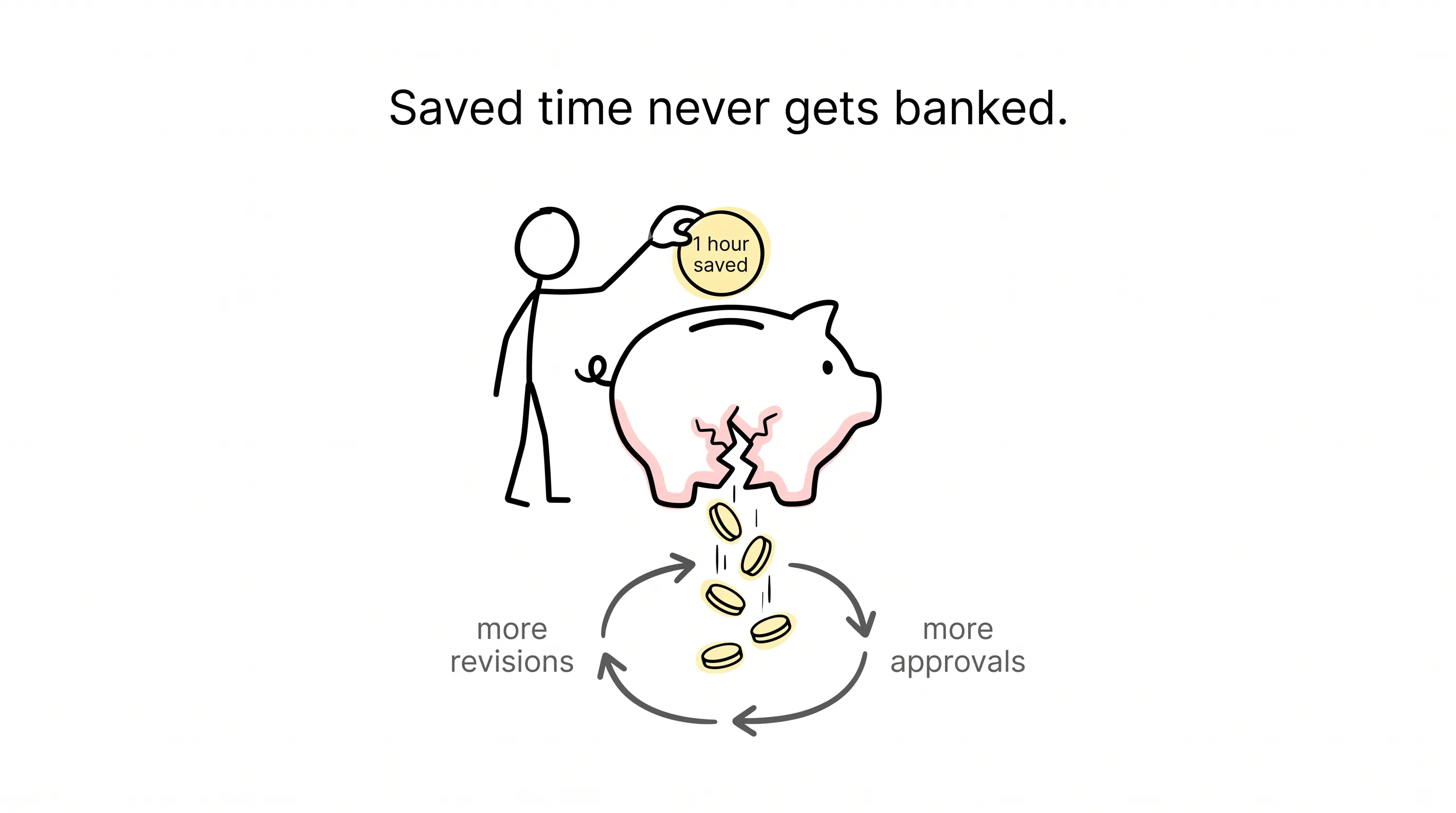
Once production gets faster, that efficiency becomes the new baseline. The extra capacity gets filled up immediately: more campaigns, more channels, more versions, higher expectations.
Nobody stops to ask: is this one even worth doing?
One Group Is the Exception
In the report, there's a group of teams that produces an email in about 4 hours.
Do they have some secret tech?
No. They're just different in two ways: fewer hands touch the work, and they use AI with far more discipline. Not sprinkling AI everywhere — using it deliberately, aiming it at the step that gets stuck the most.
Flip it around: if your problem is one of the following, AI can't help you.
Approvals have to clear 6 people — no matter how fast AI writes headlines, it can't speed up a signature.
Every campaign is built from scratch — no matter how fast the copy comes, the production model hasn't changed.
The brand guidelines are vague — AI can't stop your stakeholders from arguing.
The tools are a scattered mess that don't talk to each other — a first draft arriving ten minutes earlier has zero effect on the launch date.
Same AI: aimed at the right place, it's a lever. Aimed at the wrong place, it's a toy.
Before You Switch Tools, Map the Process
So my advice is: don't rush off to buy the next tool.
First, spread out your whole production process — from "an idea" to "the email goes out" — draw it step by step, then ask yourself a few questions.
- Who is involved in this?
- Who has to sign off?
- Which step gets stuck every single time?
- Which work is being done twice?
- How many tools, how many documents, how many meetings does one email take?
- What could be standardized? Templates, a modular design system, shared strategic principles, clearer approval rules.
- Does your team measure the production process itself?
That last question is the killer.
Marketers are especially good at measuring what happens after sending: open rates, click-through rates, conversion rates, revenue, unsubscribe rates, deliverability.
But "how much time and how many person-days did it cost us to send this email" — almost no team is counting.
Without that ledger, you end up in a genuinely absurd position: celebrating the 20 minutes AI saved you at one step, while completely failing to see the two hours that slipped away somewhere else in the process.
AI Hasn't Failed
Back to the report we started with. Knak's Chief Marketing Officer Jennifer Delevante has an observation: people were promised that AI would give them their strategy time back. The data says it hasn't happened yet.
My take is blunter.
AI hasn't failed. We have — armed with a new tool, running an old, fragmented, sign-off-heavy process, and expecting the tool to fix the system all by itself.
No such luck.
Tools get replaced generation after generation, but if the process is still the same process, the output is still the same output.
AI can deliver on that promise. But not by generating first drafts faster — by you redesigning the road from idea to launch.
Until the process gets better, AI will keep producing more marketing. And the extra time — that's something you'll have to go find in the process yourself.
Here's to getting your time back — soon.
Continue reading
Related articles

Cross-Border Business: Time to Upgrade Your AI Toolbox
A learn article explaining how AI tools help cross-border e-commerce sellers clear five hurdles: language, regulation, logistics, payments, and fraud. It outlines a five-compartment toolbox, a five-step adoption path, and metrics such as conversion rate and CLV, while cautioning against over-reliance on AI.

AI Is Taking Over the Dirty Work of Social Media Marketing, One Task at a Time
This learn article outlines four social media marketing tasks AI can handle — audience analytics, content drafting and design, ad targeting and creative testing, and spam moderation — and cautions that taste, judgment, and data security remain human responsibilities.

AI Is Already This Good — Why Is Your Social Media Marketing Still Pure Manpower?
An overview of 18 AI tools for social media marketing, organized into six categories covering audience research, content creation, scheduling, comment and DM handling, ad management, and visual production, plus notes on personalization, prediction, and emerging trends.