
If AI Doesn't Mention You, Users Can't Find You
An explainer on generative engine optimization (GEO): how AI-generated answers are replacing search clicks, what it takes for AI to crawl, understand, and cite a brand, plus an overview of the young GEO market and recent acquisitions.
In a meeting a few days ago, I noticed one small detail — and my stomach dropped.
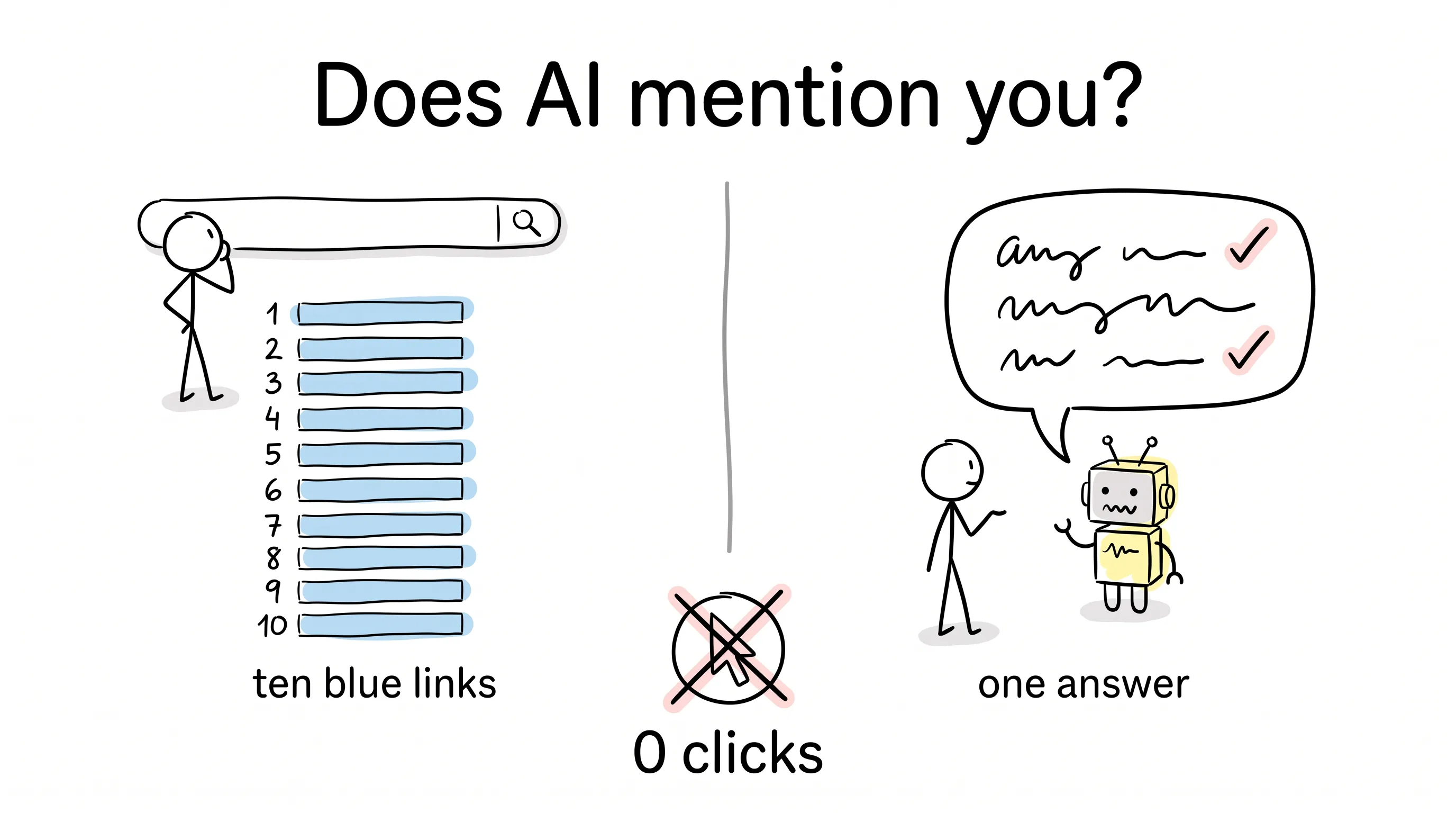
A colleague was looking for a good data analytics tool. He didn't open a search engine or type in keywords. He went straight to AI: what are the mainstream options for this kind of tool?
Three seconds later, the answer came back. A few recommendations, reasons included.
He didn't click a single link.
He read the answer, and the task was done.
In that moment it hit me: the ten blue links on a search results page are being quietly replaced by an answer a few hundred words long.
Users don't click links anymore. So all those search rankings businesses have spent years of money and effort fighting for — who exactly are they for, when nobody's looking?
Which brings me to a brand-new business — one that has only just opened its doors.
What Is GEO?
Generative engine optimization. In English: Generative Engine Optimization, or GEO.
In plain language: it means finding ways to get AI to mention you when it answers users' questions.
First, how things used to work.
The old search engine was like a giant marketplace. Doing SEO — search engine optimization — was essentially about getting your shop the best spot in it: keywords were your signboard, backlinks your connections, page load speed your storefront. Only a good spot gets you foot traffic.
Now an all-knowing personal shopper has walked into the marketplace. ChatGPT is doing it. Perplexity is doing it. So is Google's AI Overviews.
Users don't need to browse anymore. They ask the shopper directly: I want to get this done — what should I use? The shopper answers on the spot, reasons laid out crystal clear. The user listens, gets it done, and never even steps through a store's door.
Here's the question: when the shopper speaks, does your name come up?
That's GEO. The contest used to be over rankings. Now it's over being cited.
What Does It Take for AI to Mention You?
Put simply, it comes down to three questions: your content — can AI crawl it? Can it understand it? Can it trust it?
Around those three questions, a whole row of companies has sprung up. I've roughly sorted them out — the work falls into five categories.
Category one: making content. AI-assisted content production, but the bar has changed: not "people love reading it" — "AI is willing to cite it."
Category two: structure and audits. Semantic structure recommendations for your content, structured data markup, plus another pass to check whether your site is friendly enough to AI crawlers. In plain language: reorganize your content into formats machines read easily. A San Francisco company called The Prompting Company, founded in 2025, has taken this move to the extreme: converting clients' web pages into clean markdown. Markdown is a minimal plain-text format with none of the fancy formatting. Why bother? Machines read it with less effort — and cite it more accurately. This category also includes entity optimization: helping AI figure out "who you are," anchoring your brand firmly to your industry and your products in its knowledge base, so you don't dissolve into a vague word.
Category three: finding the gaps. The technical term is citation gap analysis. Say your competitor gets mentioned ten times in AI answers and you get mentioned twice — where did the other eight go? These companies find out for you.
Category four: scoring. Real-time GEO scores, like a periodic health checkup, telling you where you stand in AI's eyes — what your score is, and where you're failing.
Category five: keeping watch. Monitoring your brand's exposure across the various AI engines. Berlin's Peec AI, New York's Profound, and London's Searchable all do this. The places Searchable watches? The likes of ChatGPT, Claude, and Perplexity.
And some carve the market even finer.
PageMind in Barcelona, founded in 2025, specializes in answer engine optimization for e-commerce, making product information easier for AI to find and understand. Azoma in Toronto (formerly Ecomtent, founded in 2022) goes a step further: it optimizes for the shopping-agent side — organizing product data and generating AI-ready content, so that when agents place orders on a consumer's behalf, they pick you.
This Market Is Scarily Young
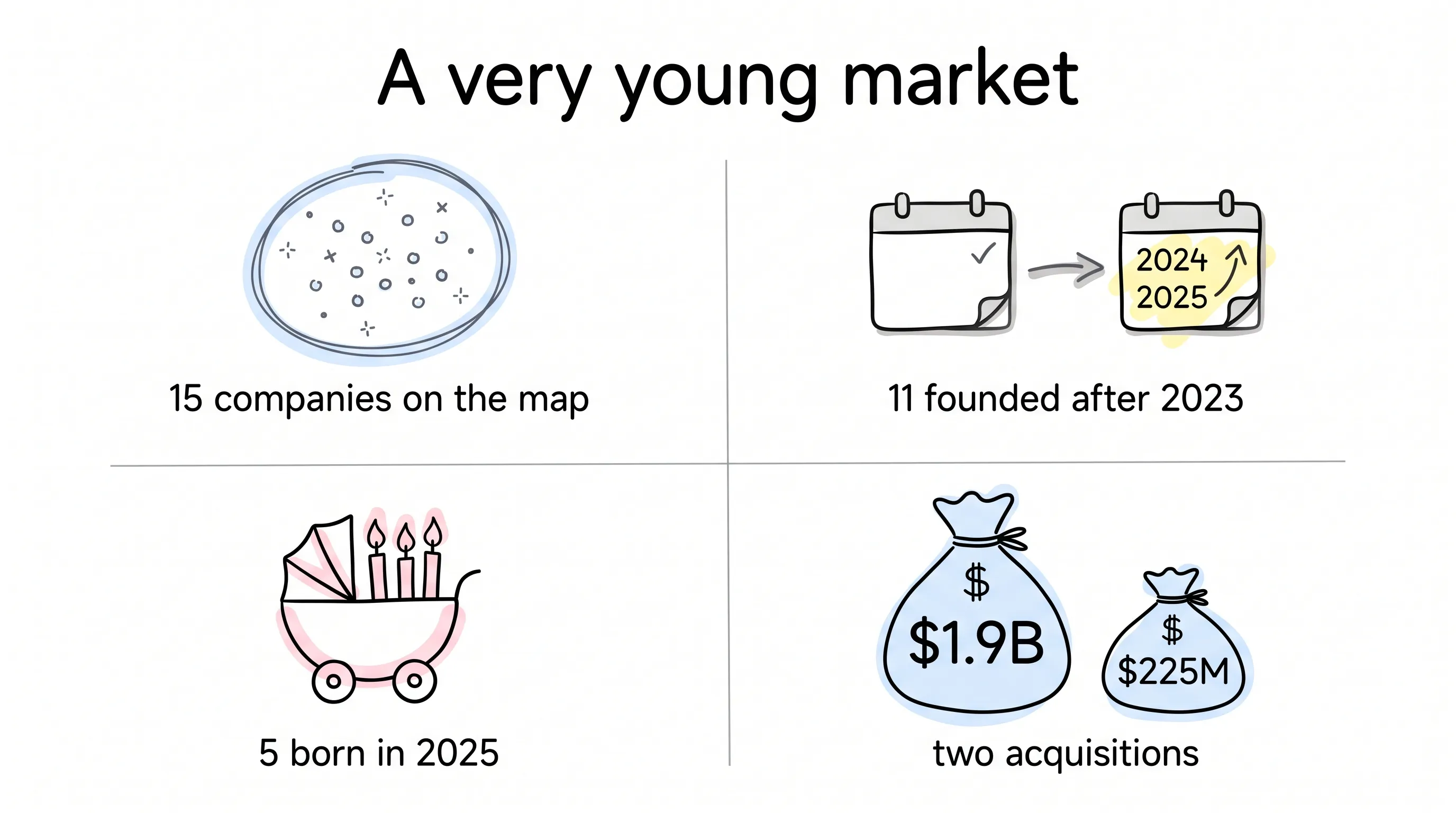
How young exactly? I counted the 15 companies listed on a market map, and the more I counted, the more startling it got.
Of the 15, 11 were founded after 2023.
Five weren't even born until 2025.
Start with the two veterans.
Semrush, founded in 2008 and headquartered in Boston, started out in SEO and grew into a brand visibility platform: search engine optimization, AI visibility, content marketing, paid media, and social media strategy, all under one roof. In April 2026, Adobe bought it for $1.9 billion.
HubSpot, founded in 2006 and headquartered in Cambridge, Massachusetts, offers a full suite of marketing, sales, and customer service software, serving everyone from small startups to large enterprises.
The giants are already voting with their wallets.
And more than once. In June 2026, a Salt Lake City company called Scrunch was acquired by Sitecore for $225 million. Founded in 2023, Scrunch's whole business is monitoring and optimizing brand presence in AI search.
The old guard pivots; the young guns charge.
AirOps in San Francisco, founded in 2021, helps content and SEO teams manage the full content lifecycle — and keeps an eye on AI search performance on the side.
Profound in New York, founded in 2024, does generative AI marketing analytics: brand visibility, competitive intelligence, and AI search monitoring, all in one.
Evertune, also in New York and also founded in 2024, serves clients across finance, retail, pharmaceuticals, technology, and consumer packaged goods.
New York is also home to Bluefish, founded in 2024, an enterprise-grade AI marketing suite: monitoring, optimization, and measurement, helping brands automate their AI marketing workflows.
Unusual in San Francisco, founded in 2024, has the wildest approach of the bunch. It surveys how the various AI models see your brand, then creates content to sway those views.
Good grief — managing what AI thinks of you is now a business all its own.
daydream in San Francisco, founded in 2023, takes the smooth-transition route: SEO strategy and technical audits as usual, with AI visibility tracking added on top.
Berlin's Peec AI and London's Searchable, mentioned earlier. Their birth years? Both 2025.
And there's Flint in San Francisco, founded in 2025, which automatically generates landing pages for marketing teams based on keywords, ads, and audience segments — plugging right into your existing website and analytics tools.
Each one carves the niche finer than the last.
Take another look at the map. Of these 15 companies, 11 are in the United States: Boston, Cambridge, New York, San Francisco, Salt Lake City. The remaining 4 are in Berlin, Barcelona, London, and Toronto.
From the day it was born, this business has been global.
Why Are the Giants in Such a Hurry?
I did the math: Adobe bought Semrush for $1.9 billion; Sitecore bought Scrunch for $225 million. More than $2.1 billion combined — all of it slammed into the youngest market there is.
Because the gateway to traffic is moving. Users' questions are increasingly answered by AI. If AI never mentions a brand, the traditional rankings that brand paid dearly for lose their value a little more every day — down to zero. And if a marketing software company can't grow GEO capabilities of its own, it will be the next middleman to get skipped.
Growing it in-house is too slow. So: buy.
Finally, Back to That Colleague
He asked AI, and that was that — job done. Not a single link clicked the entire time.
When users don't click links, links lose their value. When users ask AI, whoever AI mentions is the one in the room. If AI doesn't mention you, you don't exist in its world.
So stop staring at your rankings. You can run a little experiment tonight: open the AI you use most, ask a professional question from your industry, and see whether you show up in the answer.
If you do — congratulations. You've claimed your spot on the next generation's shelf.
If you don't, don't panic. Even the fastest runners in this space are only two or three years old.
Start now, and you're not late.
Here's to your name always showing up in AI's answers.
Continue reading
Related articles

Cross-Border Business: Time to Upgrade Your AI Toolbox
A learn article explaining how AI tools help cross-border e-commerce sellers clear five hurdles: language, regulation, logistics, payments, and fraud. It outlines a five-compartment toolbox, a five-step adoption path, and metrics such as conversion rate and CLV, while cautioning against over-reliance on AI.

AI Is Taking Over the Dirty Work of Social Media Marketing, One Task at a Time
This learn article outlines four social media marketing tasks AI can handle — audience analytics, content drafting and design, ad targeting and creative testing, and spam moderation — and cautions that taste, judgment, and data security remain human responsibilities.

AI Is Already This Good — Why Is Your Social Media Marketing Still Pure Manpower?
An overview of 18 AI tools for social media marketing, organized into six categories covering audience research, content creation, scheduling, comment and DM handling, ad management, and visual production, plus notes on personalization, prediction, and emerging trends.