
If AI Doesn't Cite You, You Wrote It for Nothing: What Is GEO, and How to Get AI to Cite You
A bilingual explainer on GEO (Generative Engine Optimization): how AI engines pick citation sources, how GEO differs from SEO, and practical tactics for getting content cited in AI answers.
Last week, I had dinner with a friend who runs a B2B software company.
Their content team is a dozen or so people. Three years of blogging, more than 500 articles, Google rankings perennially in the top three. By any measure, that's a foundation most companies would envy.
Then he said something that stuck with me: "Our rankings haven't dropped. But clients keep asking — why aren't you in the solutions AI recommends?"
He went back and tried it himself. Asked ChatGPT. Asked Perplexity. Asked how companies in his industry should choose software.
A list of recommendations. A row of cited sources.
He wasn't there.
I turned it over the whole way home. Today, let me walk you through what I figured out.
This new discipline is called GEO.
What Is GEO?
Generative Engine Optimization — GEO for short.
The name sounds intimidating, but it boils down to one sentence: when AI answers a user's question, make it treat your content as a citation source.
The industry has a pile of aliases for it too: AEO, LLMO, GSO, AIO. Don't get lost in the alphabet soup. They're all the same thing.
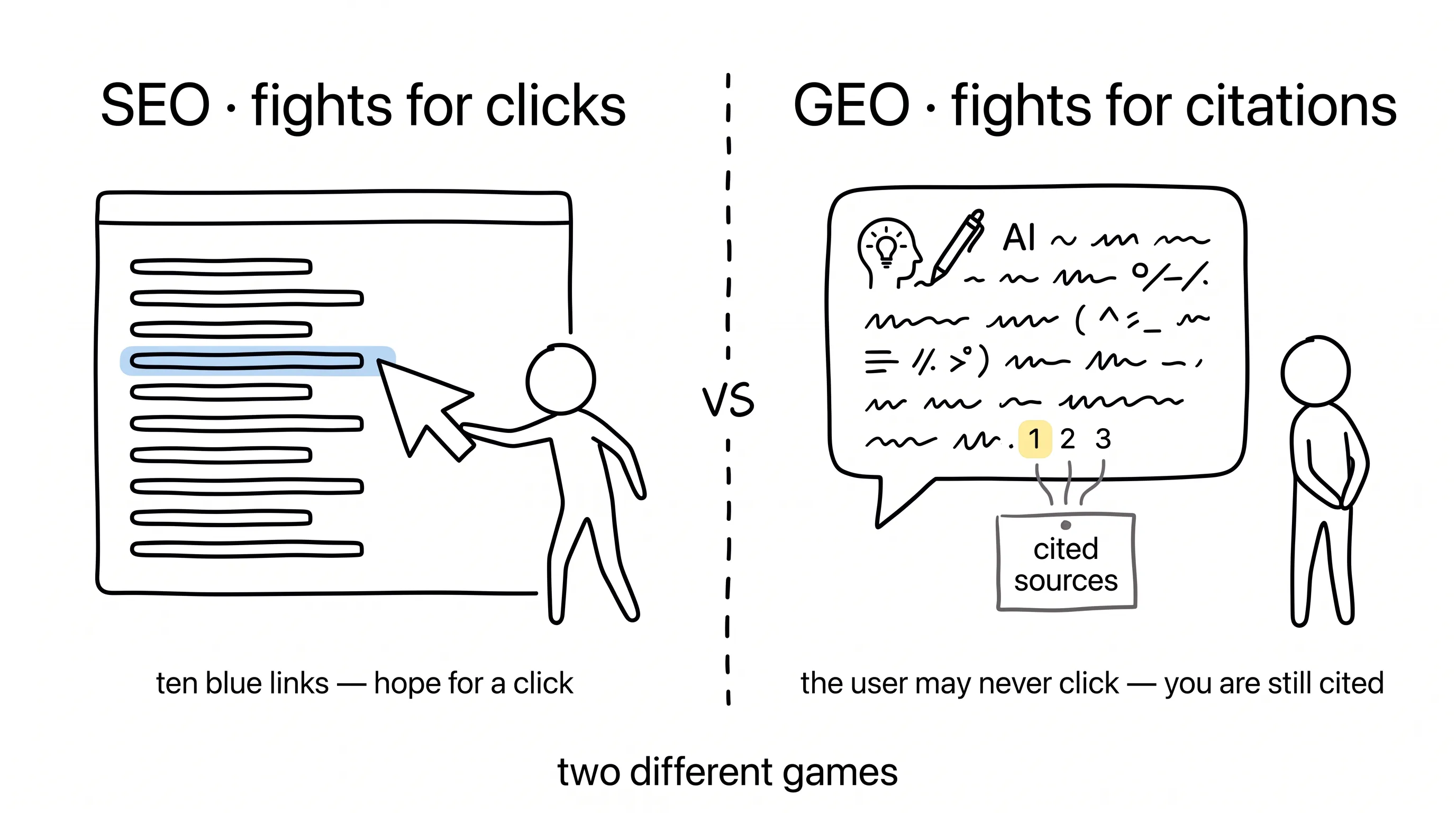
SEO used to be a fight for clicks: a user searches, sees your link, clicks through. Now the user asks AI a question, and AI doesn't hand over ten blue links. It writes the answer out for them — casually noting who each claim came from.
The user might not click a single link.
But if you're cited, your brand and your expertise are alive inside the answer.
SEO fights for clicks. GEO fights for citations.
These are two different games.
Too Big to Keep Pretending You Don't See It
First, a few numbers.
In the first five months of 2025, traffic that AI sent to websites grew 527% year over year. That's from Previsible's AI traffic report. Up more than fivefold — and still climbing.
By mid-2025, ChatGPT was handling 2.5 billion prompts a day. Perplexity was processing 780 million queries a month.
Meanwhile, industry stats say 65% of Google searches now end "zero-click": the user gets the answer on the results page itself and never enters anyone's website.
What does that mean?
The front door is moving. Users used to browse the shelves themselves and comparison-shop. Now they bring a personal assistant: ask once, and the assistant serves up the answer.
A shop the assistant hasn't read might as well not be on this street.
One detail I find especially worth chewing on: nearly 80% of top news outlets now block at least one AI crawler.
It's getting harder and harder for AI to find source material.
Scarce things command a premium. Right now, whoever's content is AI-friendly — clearly structured, easy to extract — gets the edge on this street.
How Does AI Pick Content? An Open-Book Exam
If you want to be cited, first understand how AI picks who makes the cut.
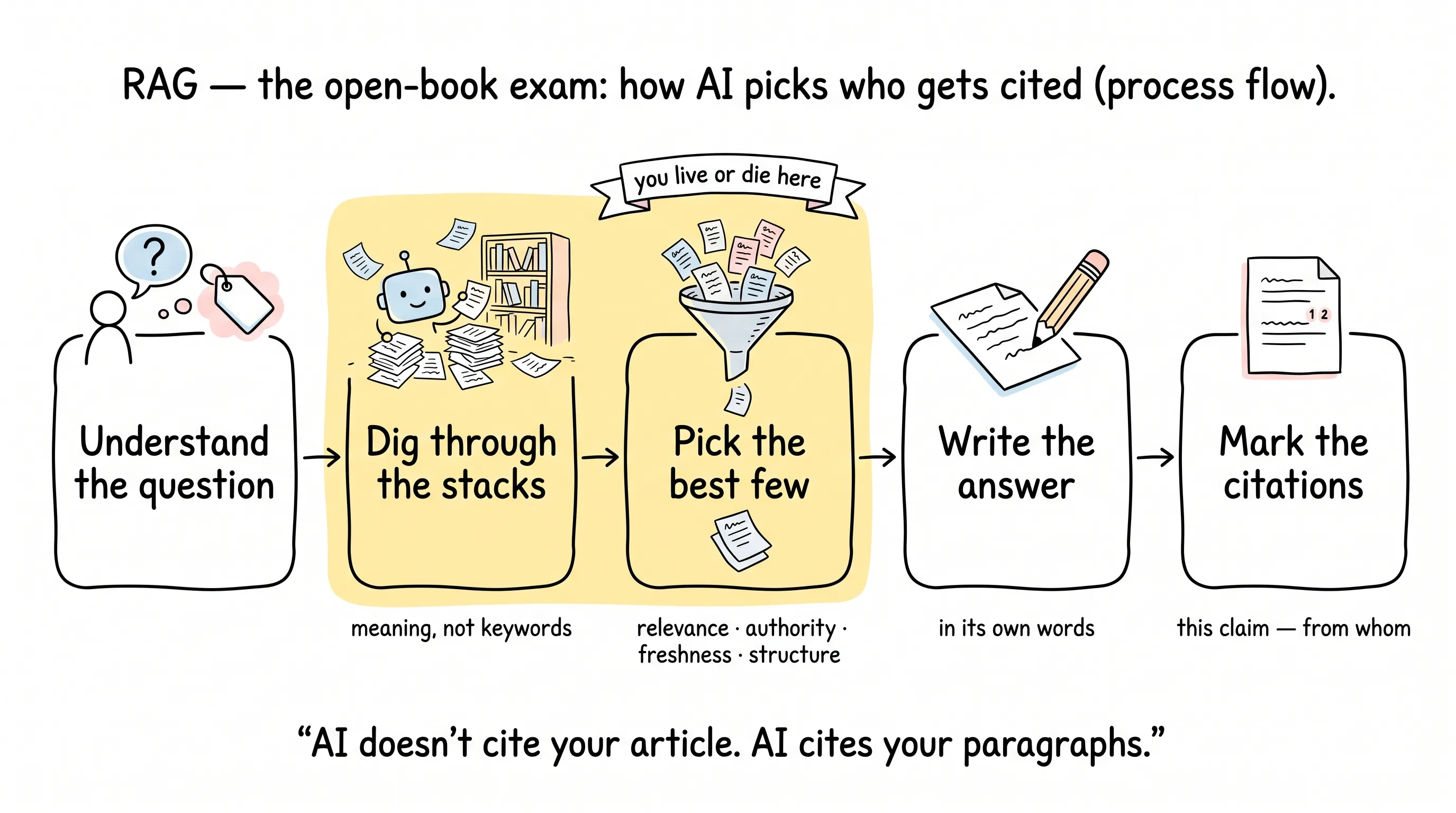
The technology behind it is called RAG (Retrieval-Augmented Generation). Equally intimidating name, but it translates into plain speech: an open-book exam.
When AI answers your question, it takes five steps.
Step one, understand the question. You ask "how do I do content marketing?" It first translates that into a format a machine can search.
Step two, dig through the stacks. It goes to its library of sources to find relevant content. Note: it's not looking for keywords, it's looking for meaning. If you never once wrote the phrase "AI search" but explained generative engine optimization thoroughly, you can still be pulled out of the pile.
Step three, pick. From everything it retrieved, it scores by relevance, authority, freshness, and structural clarity, and keeps the best few.
Step four, write the answer. It mashes the sources together and retells them in its own words. It does not copy the original text.
Step five, mark the citations. In the answer, it notes: this claim — from whom.
Of the five steps, the two that decide whether you live or die are steps two and three.
Think about it: what does AI actually want?
Self-contained passages it can lift straight into an answer.
AI doesn't cite your article. AI cites your paragraphs.
From a 3,000-word article, AI might lift only the 60-word definition at the top — the rest, it won't even glance at.
Once this clicks, you've got the basics of GEO.
Rankings Are Real Estate. Citations Are Yogurt.
Let me boil the difference between GEO and SEO down to three things.
First, different goals. SEO wants clicks: ranked third with a weak title, you get few clicks. GEO wants presence: users may never visit your site, but they remember your name.
Second, different unit of optimization. SEO optimizes the "page": keywords in the title, the more comprehensive the better. GEO optimizes the "paragraph": every stat, every definition has to be able to stand on its own. AI lifts paragraphs, not whole pieces.
Third — and the most overlooked: the shelf life is completely different.
A Google ranking can hold for months, even years. An AI citation is fresh produce.
The research firm Amsive ran the numbers: half of the content cited in AI answers is less than 13 weeks old. Last month ChatGPT was citing your article; this month, something fresher may have bumped it.
Rankings are like real estate. Citations are like yogurt. Real estate passes to your children. Yogurt past its date gets tossed.
So with GEO, there's no such thing as "done." You watch it. You keep it alive.
Oh, and one more thing: in May 2026, Google officially stepped onto the field for the first time, teaching people how to optimize for AI search. The conclusion was blunt: don't mystify this. Underneath AI Overviews and AI Mode sits the same search-quality system as before — the SEO you should be doing, you still have to do, every bit of it.
It also lifted the lid a little: the AI features run on RAG and query fan-out (splitting one question into several related searches, looking each up, then stitching the results into an answer).
So what your content has to withstand isn't one keyword. It's a whole string of questions.
Three Tactics, Up to 40% More Citations
So how do you actually change your content?
One study gets cited a lot: Princeton University and the Indian Institute of Technology Delhi (IIT Delhi) analyzed 10,000 queries across domains and tested a pile of optimization methods. Three tactics delivered the most solid gains, lifting the odds of being cited by up to 40%.
Tactic one: cite authority.
In your articles, cite high-authority sources: universities, governments, serious research institutions, even reputable industry white papers. The heavier the sources you cite, the more AI reads you as real scholarship. Same logic as academia: the more rigorous a paper's references, the more credible it is.
One caution: link to the original source. Citing a statistic? Link straight to the study itself — not to someone else's secondhand write-up.
Tactic two: use quotes.
Don't write "many content teams struggle to keep up their publishing cadence." Anyone could say that.
Write: "We surveyed 500 content teams. Keeping up their publishing cadence was their number-one problem."
A sentence with a survey, a number, something a real person could have said. Quotes carry authority built in — and AI can lift them out on their own. Two birds, one stone.
Tactic three: add numbers.
Every 150 to 200 words, place a data point: percentages, absolute figures, multiples, year-over-year change — rotate them. A 3,000-word article should carry 15 to 20 sourced data points.
Why do numbers work so well?
Think about what users actually ask AI: How much? How fast? What share? Did it go up?
All number questions. If your article happens to hold those answers — with sources noted — who would AI cite, if not you?
Beneath all three tactics sits one idea: turn your content into something AI can inspect on delivery and lift straight into the answer.
Three Platforms, Three Temperaments
That said, within AI search, the three major platforms have very different temperaments.
ChatGPT is the old-school professor.
One organization tallied it up: for factual questions, Wikipedia alone accounts for 47.9% of its top cited sources. Think about what that means: a definition right up front, neutral throughout, third person. That Wikipedia style of writing is precisely its flavor.
So when you write for it, define your term within the first 60 words. Shout "we strongly recommend" less; write "research shows" more. Go deep, not shallow.
Perplexity is the neighborhood-news chief with a taste for what's new.
Reddit accounts for 46.7% of its top cited sources — nearly half. I know. And it strongly prefers content less than 90 days old. No need for a stiff tone; write like you're explaining something to a colleague, and use plenty of real cases: here's how we did it, here's where we tripped up.
Google AI Overviews is the civil-service examiner.
It checks your traditional SEO foundation first, then E-E-A-T (that is, Experience, Expertise, Authoritativeness, Trustworthiness — the trust-signal set), then your structured data markup.
But one shift deserves a highlighter: in earlier analyses, 76% of AI Overview citations came from pages in Google's top ten. In recent analysis, that's down to 38%.
The gate is opening wider. Pages that don't rank that high but have solid content and complete signals — there's room for them now.
One foundation, three very different clients to serve: a complete 2,500-to-3,000-word piece, definition up top (feed ChatGPT), real cases and human speech in the body (feed Perplexity), full structured data markup (feed Google), refreshed once a quarter.
One more heads-up: in January 2026, OpenAI's Operator went live. AI no longer just answers questions — it can go research the web on its own, compare options, and get the task done for the user. Crystal-clear pricing tables, feature comparisons, step-by-step instructions — machine-readable content like this keeps getting more valuable.
A Checkup Sheet: Score Your Content First
That's a lot. Where do you start?
I've compressed it into a self-audit checklist. Five items, 20 points each, 100 total.
- Do the first 40 to 60 words answer the core question directly?
- Can every H2 section be understood on its own, without reading what came before? AI lifts paragraphs; paragraphs have to be self-sufficient.
- Is the number density high enough? One per 150 to 200 words — a 3,000-word article should carry 15 to 20 sourced data points.
- Do you have 5 to 8 outbound links to high-authority sources? One link to a serious study outweighs five opinion blogs.
- Have you updated within 90 days? Publish dates and update dates, displayed proudly; structured markup like
ArticleandFAQPagein place. They don't directly earn citations, but when several sources tie, they're the credentials AI uses to pick you out.
Anything below 60 goes into the rework queue; 80 and above becomes the benchmark to push. Re-score every quarter.
Citations Dropped — How Do You Win Them Back?
Citations are yogurt. They expire. So what do you do when they do?
First, how to notice. Two ways.
The dumb way — but the most accurate: list the 10 to 15 questions your content should be able to answer, ask them once a month on ChatGPT, Perplexity, and Google, and note whether you were cited, where you ranked, and who displaced you.
The smart way: check GA4 (Google Analytics 4). Build a custom segment watching these crawlers: ChatGPT-User, PerplexityBot, Claude-Web. Many AI platforms don't honestly identify themselves, so it's only a directional signal. But thirty straight days of decline means it's time to worry.
Once you spot the drop, repair in this order:
Step one, swap the data. Every statistic, every source link, updated to the latest. Often this one step brings citations back within two or three weeks.
Step two, add examples. Two or three recent cases; keep the classic old ones.
Step three, audit outbound links, fill out the FAQ, refresh the structured markup — and swap the FAQ questions for the ones people are actually asking now.
If there's no improvement after four weeks, odds are a competitor's deeper content displaced you. Then it's not repair — it's thickening: expand coverage, publish your own original data, build up authority signals.
If the library is small, you can muscle through by hand. But if you've got fifty or five hundred pillar posts and need to run the full cycle every quarter, no content team has that bandwidth.
Which is why one tool deserves its own mention: Frase.
It turns that whole mess into a closed loop. AI Visibility watches eight platforms daily — ChatGPT, Perplexity, Claude, Gemini, Google AI Overviews, Copilot, Grok, DeepSeek — tracking where you're cited. The moment a citation slips, Content Guard diagnoses why: stale data, or a competitor bumping you? Then it generates a fix plan, applies the edits automatically, and pushes them straight back into your CMS.
Monitoring tools are everywhere. Ones that also ship the fix live for you are rare.
That's the gap between "telling you your citations are falling" and "the fix was already live Monday morning."
And one more thing: it also connects through MCP (Model Context Protocol), letting AI agents take over the entire workflow. Tell Claude Code: research this topic, draft the piece, score it, publish it. It genuinely gets it done.
Can Small Companies Still Find a Bargain?
Someone will ask: is GEO a big-brand game?
It really isn't.
AI cites content based on quality, not brand size. The places big companies fight hardest are the head terms like "what is CRM." Narrow questions like "how to avoid pitfalls in manufacturing ERP implementation"? Competition is thin there.
Small companies should do two things: answer the long-tail questions they know best, and turn the questions customers keep asking into an FAQ.
Oh, and the FAQ is the easiest entry point. Five to ten questions, each answer 40 to 60 words, self-contained, with FAQPage markup. This is a one-weekend job.
How long until it works?
Perplexity is fastest — new content can get cited within a week or two. ChatGPT is slower: six to twelve weeks. Overall, expect the first citations in four to eight weeks, and a stable citation portfolio in six to twelve months.
While we're at it, one more question I hear a lot: does this work for e-commerce?
Yes — but you play it differently. Product pages themselves rarely get cited; AI doesn't like recommending specific products outright. But shopping guides and category primers have a real shot. Before buying running shoes, a user asks AI "how do I pick running shoes?" If your buying guide gets cited, your brand just entered the decision chain.
For e-commerce, GEO means: don't hawk. Educate.
Finally, Back to That Friend
The advice I gave him was deliberately small: don't get greedy. Pick the 10 to 15 questions your industry asks most, write the answers solid, put the conclusion in the first 60 words, add FAQ markup, ask the AIs once a month, and track the citation changes.
Last week he messaged me, excited: they'd refreshed the data in one old article the month before, and this week, when Perplexity answered a question, it cited them.
He said: turns out it's not too late.
Yes. There's still time.
Competition is still thin. The land-grab stakes haven't been planted yet. Citation rights are the new deed to the land.
The early movers put pen to paper first.
Here's wishing your content an early seat in AI's answers.
Continue reading
Related articles

Cross-Border Business: Time to Upgrade Your AI Toolbox
A learn article explaining how AI tools help cross-border e-commerce sellers clear five hurdles: language, regulation, logistics, payments, and fraud. It outlines a five-compartment toolbox, a five-step adoption path, and metrics such as conversion rate and CLV, while cautioning against over-reliance on AI.

AI Is Taking Over the Dirty Work of Social Media Marketing, One Task at a Time
This learn article outlines four social media marketing tasks AI can handle — audience analytics, content drafting and design, ad targeting and creative testing, and spam moderation — and cautions that taste, judgment, and data security remain human responsibilities.

AI Is Already This Good — Why Is Your Social Media Marketing Still Pure Manpower?
An overview of 18 AI tools for social media marketing, organized into six categories covering audience research, content creation, scheduling, comment and DM handling, ad management, and visual production, plus notes on personalization, prediction, and emerging trends.