
I Ran a Three-Week AEO Experiment on LinkedIn: At AI's Citation Table, the Little Guy Finally Gets a Seat
A solo practitioner documents a three-week AEO experiment on LinkedIn, tracking how ChatGPT, Perplexity, Gemini, and Google AI Mode cite personal content and sharing practical takeaways on visibility in AI answers.
A while back, I was using Perplexity to look up a few B2B reports for a project.
Here's the source list it handed me:
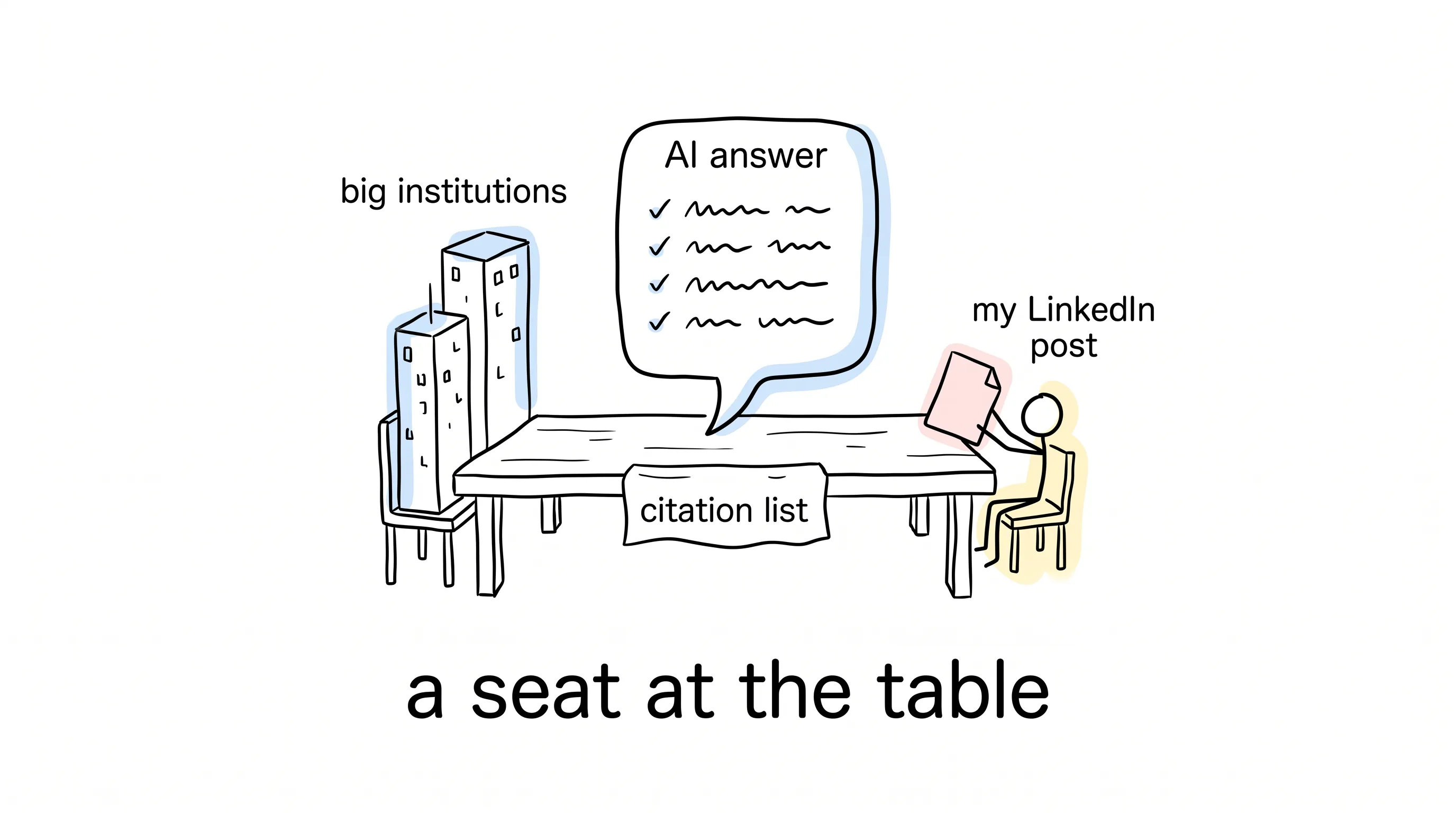
Gartner. McKinsey. A peer-reviewed paper. And then... a regular person's post on LinkedIn?
I stared at the screen for a few seconds.
The first few were research and consulting giants. The last one was an ordinary professional with hardly any followers.
How did they end up in the same list?
That's what today's piece is about: in the age of AI search, ordinary people's content is sitting at the same card table as the big institutions — for the first time.
What Is AEO?
First, a quick definition.
So what is AEO? Answer Engine Optimization.
What was old-school SEO fighting over? The ten blue links on Google's search page. Whoever ranked higher took the traffic.
So what does AEO fight for?
The citation slot inside the AI's answer.
Ask ChatGPT "how do you write a client case study," and beyond the answer itself, it attaches a few sources. Make that list, and you get seen. Don't, and in the world of AI, you pretty much don't exist.
Under the traditional search playbook, a one-person operation like me could never out-compete the big institutions and platforms. Budget, backlinks, content output — outgunned on every front.
But when it comes to AI citations, the rules seem to be loosening up.
Who Does AI Actually Love to Cite?
Gut feeling doesn't pay the bills. So I dug up the data first.
Both SEMrush and Meltwater have run the numbers: among the web pages cited by generative AI, LinkedIn is the second-most-cited website, behind only YouTube. SEMrush gets more specific: 11% of the pages cited by ChatGPT, Perplexity, and Google AI Mode come from LinkedIn.
Google AI Mode is LinkedIn's biggest fan of all — 14.3% of its answers cite the platform.
What really got me excited were two other numbers.
Meltwater found that of the LinkedIn content cited by AI, 75% comes from personal profiles, not company pages. And 51% comes from accounts with fewer than 10,000 followers.
Let that sink in.
AI doesn't care how many followers you have. It only cares what you're saying.
The most-cited content formats are long-form articles of 500 to 2,000 words and mid-length posts of 50 to 299 words. The most-cited type: educational, practical content that gives advice.
Put simply: articles that sincerely share experience are exactly the homework AI loves to copy.
So what was I waiting for? I decided to get in the game myself.
Why Was I Willing to Bet on LinkedIn?
Some background first. I'm an independent professional. My client acquisition runs on referrals from past clients, industry communities, cold outreach, plus day-to-day interaction on LinkedIn. Now there's a new channel in the mix: AI search.
A Loginix survey found that 73% of B2B buyers already use AI tools during purchase research. In other words, your potential clients are asking AI "who should I go to for this?"
I ran a few numbers of my own.
First: of my four most recent new clients, three came from LinkedIn. When a platform keeps delivering results, you double down.
Second: AI search converts at 5.1 times the rate of Google organic search. For clients coming through the door, the ones from AI show far stronger intent.
Third: fighting big institutions for organic traffic with my own website's blog? Never mind whether I could even produce enough content — even if I did, I'd never outrank them. And organic traffic is declining across the board anyway.
So that's where the effort goes: LinkedIn.
How Was the Experiment Designed?
An experiment starts with scope.
I didn't go broad and optimize for a giant keyword like "marketing." Instead I picked a service I'd been delivering all along but never actively promoted: writing client case studies.
Why go narrow? AI identifies people by labels. The narrower the label, the easier it sticks. More on that later.
For the record, here's my starting point: I was a very lazy LinkedIn publisher. My last long-form article went up in 2016.
Can someone who hasn't written a long-form piece in a decade become visible to AI?
First, measure the baseline. I used HubSpot's AEO tool and was up and running in under ten minutes: enter your brand, domain, services, and ideal customer profile, then list a few competitors. Next I put together a set of questions target clients might actually ask — some with brand terms ("can you recommend someone who writes case studies for [industry]?"), some without ("what are the best practices for writing case studies?"). The tool then took those questions and ran them through ChatGPT, Perplexity, and Gemini.
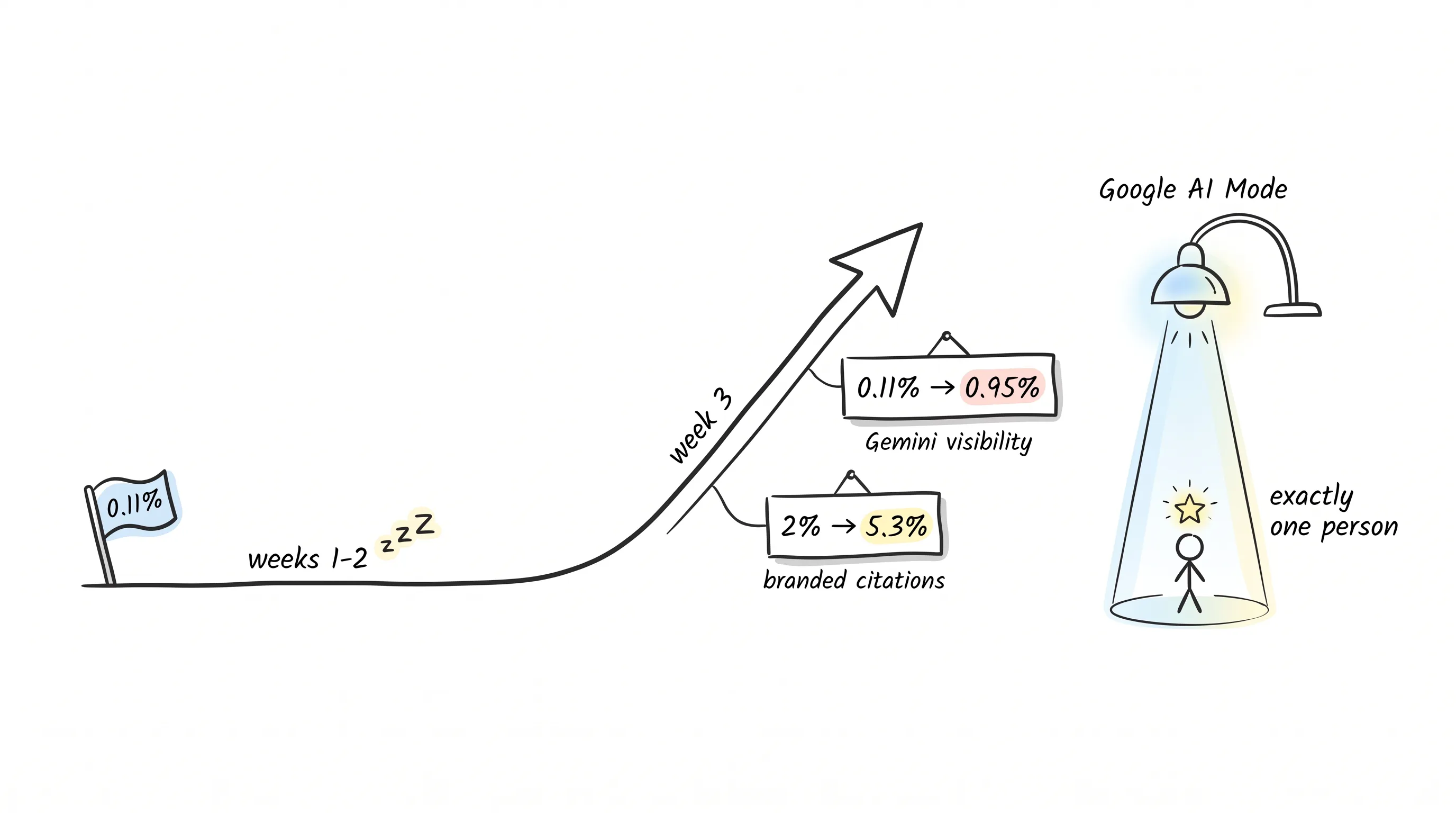
The result: 0.11%.
Low. But not zero. A game worth playing.
Over the next three weeks, I did only three things.
One: overhaul my profile. I worked the "case study writer" identity into several sections of my LinkedIn profile. Why the obsession? Because AI cross-checks. If someone talks about nothing but case studies, yet their profile contains no record of it, why would AI trust them?
Two: publish. Two long-form articles and two posts, all about case studies. I borrowed topic ideas from the tool, but every bit of the content came from mistakes I'd made the hard way — I didn't let AI write a single word. Each piece got a cover image, a short bio at the end, and replies to every single comment.
Three: watch the data. I checked metrics once a week, and manually searched ChatGPT, Perplexity, and Google AI Mode in incognito mode to see with my own eyes how the AI actually answered.
What Happened After Three Weeks?
For the first two weeks, the numbers didn't budge.
Honestly? It rattled me a little.
In week three, they moved.
Visibility on Gemini climbed from 0.11% to 0.95%. ChatGPT and Perplexity basically stayed flat. My share of branded-mention citations and own-domain citations (versus competitors) rose from 2% to 5.3%.
All small numbers. But the biggest Easter egg was hiding in Google AI Mode.
When I searched "recommend a case study writer" on Perplexity and ChatGPT, they'd name three to five other writers first, then reel off a bunch of platforms and institutions. I didn't make the cut.
The same search in Google AI Mode? It spotlighted exactly one person:
Me.
Remember that 14.3% from earlier? Google AI Mode and Gemini were already partial to LinkedIn. My three weeks happened to land right on their preference.
Five Things These Three Weeks Taught Me
The numbers aren't pretty. But several discoveries dug up along the way are worth more than the data.
1. Narrow is how you get picked.
Ask AI to "recommend a marketing consultant," and it will most likely ask back: can you be more specific? Which industry? What focus?
AI files people under labels. The narrower the label, the easier it sticks — and the easier it sticks, the more confidently AI recommends you. A generalist who "does everything" can't be classified. And what can't be classified can't be recommended.
Figure out the one or two services or industries you most want to be remembered for, then go all in.
2. Branded mentions are the gold medal; non-branded ones are the silver.
The highest prize in AEO is AI saying your name outright. But listicle games like "top ten vendors in [field]" are basically a game only the big companies get to play — individuals can't afford the table.
That's fine. Someone researching "how to write case studies" finds my article, clicks through, follows me along the way — nobody loses in that deal.
I'm playing a long game. I'll take the silver, too.
3. Claude doesn't recommend individuals.
This was my biggest surprise.
Claude is the AI my target clients (marketers) use most. When I asked it to recommend freelance writers, it flat-out refused — then handed me a "list of hiring platforms" and "things to watch when outsourcing."
For now at least, Claude doesn't recommend individuals. If you're betting everything on it, know that first.
4. Beyond the citations, everything else was a pleasant surprise.
This is the most interesting part.
During the experiment, my LinkedIn profile views grew more than 200% in 28 days. Post impressions rose 237%, and engagement 340%. An old contact even made a point of coming to ask about case study writing, because he'd seen those exact words in my profile.
All that experience had been sitting in my head the whole time. What I was never missing was knowledge — what I was missing was a deadline.
5. Three weeks is too short.
Data shows that among authors who have been cited by AI, three-quarters had published at least 5 pieces in the four weeks prior. Frequency is the price of admission. Three weeks' worth clearly isn't enough.
What's trickier still: AI answers shift daily. Research has found that the average lifespan of an AI citation is just 11 to 15 days — about the shelf life of a carton of fresh milk.
So this is a game you have to keep playing.
Here's How I'm Playing It From Here
Three things.
Keep publishing. Long-form articles and posts without pause — keep writing about case study work, and start writing about my other services. Tools can spark topic ideas, but the opinions have to be my own.
Study the competition. The experiment handed me a list along the way: a batch of freelancers who rank highly in AI search. Over the next few weeks, I'll dig through their LinkedIn profiles, websites, and content one by one to see what they're doing right.
Extend AEO to my own website. Right now my site only has overview pages for four services and three industries; it lacks service-specific, industry-specific landing pages like "case study writing for SaaS," "content writing for edtech," or "sales enablement copy." Every precise page is one more chance to be recognized by AI.
If You're Fighting Solo Too
Just three sentences.
Don't wait. Don't wait for things to quiet down, don't wait for the perfect idea. Neither is coming.
Take a snapshot first. HubSpot has a free AI Search Grader — in a few minutes you can see where you stand in AI's eyes. If you want to track things more closely, trial its AEO product and watch mentions, sentiment, and changes.
Use AI to find topics, but don't let AI speak for you. Of the hundred topics a tool hands you, the ones truly worth writing are the ones where you've actually been in the trenches. Your first-hand experience is the homework AI can't copy.
Back to that search page from the beginning.
Gartner. McKinsey. A paper. An ordinary person's LinkedIn post.
Here's hoping your name shows up on that list soon.
Continue reading
Related articles

Cross-Border Business: Time to Upgrade Your AI Toolbox
A learn article explaining how AI tools help cross-border e-commerce sellers clear five hurdles: language, regulation, logistics, payments, and fraud. It outlines a five-compartment toolbox, a five-step adoption path, and metrics such as conversion rate and CLV, while cautioning against over-reliance on AI.

AI Is Taking Over the Dirty Work of Social Media Marketing, One Task at a Time
This learn article outlines four social media marketing tasks AI can handle — audience analytics, content drafting and design, ad targeting and creative testing, and spam moderation — and cautions that taste, judgment, and data security remain human responsibilities.

AI Is Already This Good — Why Is Your Social Media Marketing Still Pure Manpower?
An overview of 18 AI tools for social media marketing, organized into six categories covering audience research, content creation, scheduling, comment and DM handling, ad management, and visual production, plus notes on personalization, prediction, and emerging trends.