
I Let AI Take Over My Browser and Read Hundreds of LinkedIn Comments for Me
A firsthand walkthrough of using AI browser automation in the ChatGPT desktop app to read and summarize hundreds of LinkedIn comments, showing how AI-assisted social listening can surface quieter majority opinions, with cautions about supervised use and platform terms of service.
A few days ago, I was scrolling and came across a post whose comment section had blown up.
The poster is an overseas entrepreneur who has spent years immersed in AI education. The topic itself was explosive: New York City public schools had decided to ban generative AI in the classroom.
Hundreds of comments poured in. Some argued in good faith, some dripped with snark, some went straight to name-calling. Quite a scene.
All that spectacle aside, a practical question emerged: what were these hundreds of comments actually saying? Was there more support than opposition? The loudest arguers had the biggest microphones — but did they represent most people?
To answer seriously, you would have to read every comment one by one, sort them, dedupe them, and cross-check. Do the math: at ten seconds per comment, just reading takes over an hour, and sorting adds several more hours on top.
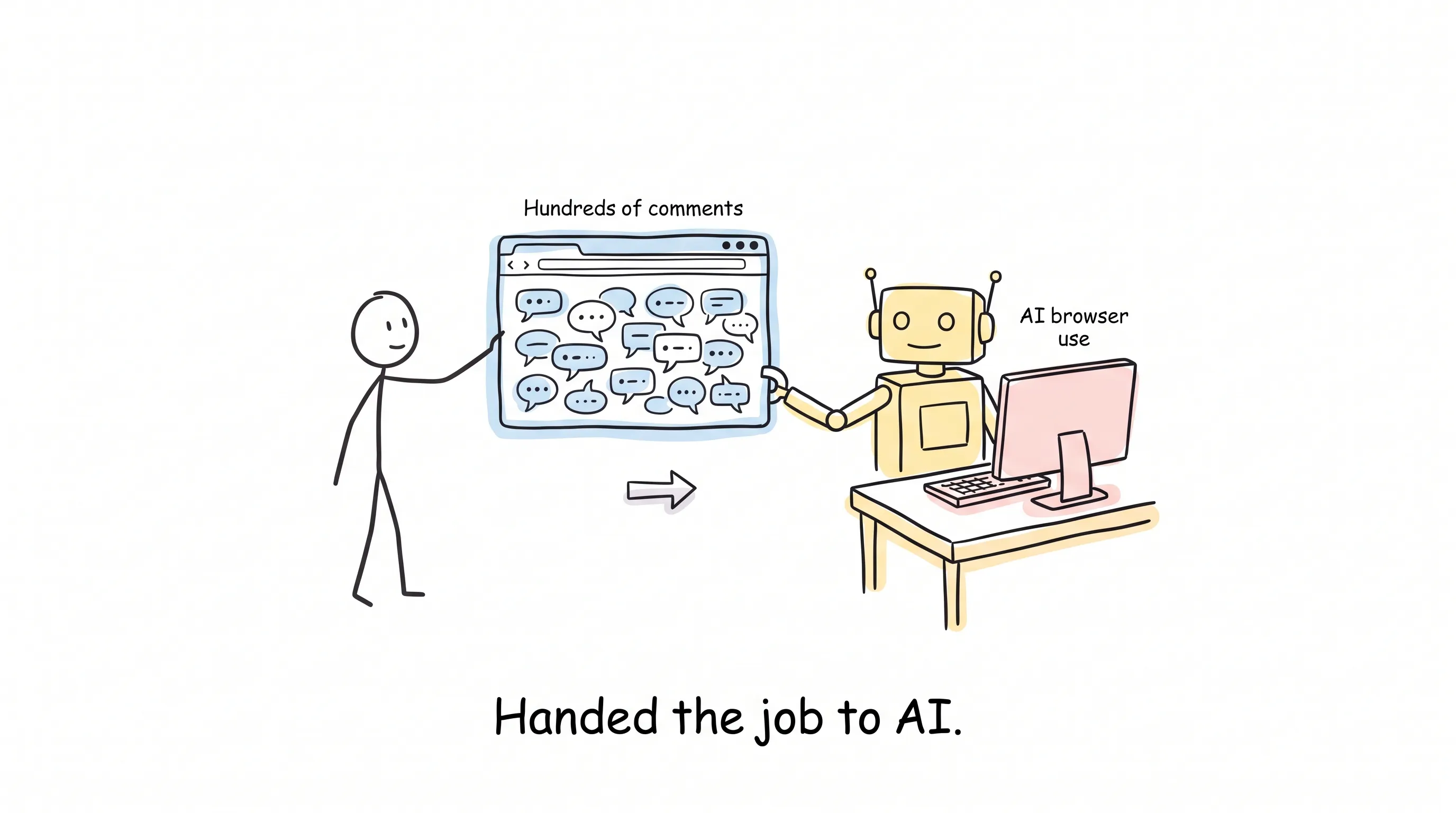
Eventually, I handed the job to AI.
What Does AI Browser Use Actually Mean?
This time I used GPT-5.6 Sol's browser use capability, running inside the ChatGPT desktop app.
Put plainly, the AI stops being just a chat partner and takes direct control of your browser: it opens web pages, clicks links, scrolls, and expands collapsed sections, the way a person would. You sit beside it and watch it work, like watching a quick-fingered intern seated at your computer.
How did it actually do the job? I watched the screen the whole time and followed the entire process.
It opened that LinkedIn post on its own. Inside my logged-in browser session, it went straight to the comment section.
LinkedIn defaults to a "Most relevant" sort; it switched to the full comment stream view by itself.
Then, starting from the first comment, it read its way down in order. Comments not fully loaded? It scrolled and triggered "Load more." Nested replies in the threads? It expanded them. A comment too long, collapsed to a teaser with a "View more" button hiding the rest? It clicked that too, and read the long comment in full.
By then I was already impressed. But the real surprises were the next two details.
First, it proactively separated the original poster's own replies from the audience's comments. Why? The original poster is not part of the audience; mixing his words into the stats would contaminate the conclusion.
Second, it could tell "a comment" from "a person." If someone posted five comments in a row expressing the same position, it did not count that person's opinion five times.
Finally, the synthesis: supporters of the ban on one side, opponents on the other; recurring arguments distilled; representative examples pulled out.
Oh, and one more discipline: when the AI is operating inside your logged-in account, you do not walk away. The entire time, I sat in front of the screen watching it.
And the Result?
When it finished, the AI's sentiment tally came back: support versus opposition, roughly fifty-fifty.
Honestly, the number itself is not very interesting.
What's interesting is something else.
The loudest voices do not represent the most people.
The angriest, loudest comments looked absolutely overwhelming. But once every commenter was counted equally — one person, one count — the picture changed completely: a large mass of moderate, reasonable, drowned-out voices surfaced.
The noisy are a minority. The silent middle is the majority.
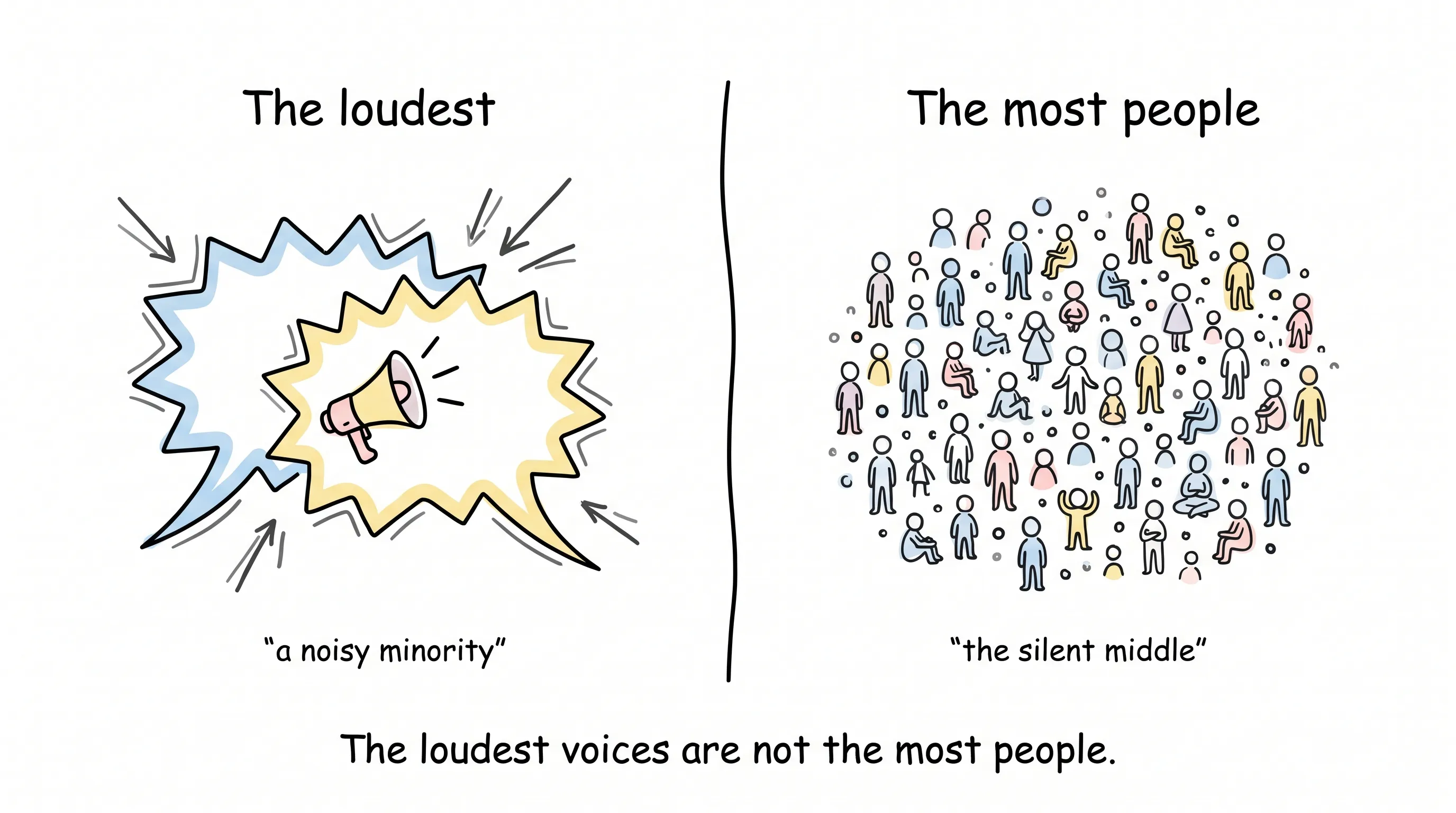
Think about it: if you only looked at the comment section, you would believe the world is torn apart beyond repair. Count by "people," and you find the world's patience runs far deeper than you imagined.
What Does This Mean for Marketers?
Social listening is not a new concept. Big companies have been buying tools and staffing teams to do it for years.
What's new is the barrier to entry.
AI does this job fast and accurately, and cheaply enough that one person can finish it in an afternoon. The wall between "I want to know what users are saying" and "users have told you what they are saying" has crumbled considerably.
Push the idea further out, and the same playbook works in plenty of places.
For a product launch, skip the formal research and sweep the launch post's comments — there's your sentiment read. Under competitors' content, distill the recurring objections, and they turn straight into your messaging strategy. After a campaign goes out, read the community reaction first, then decide whether to double down or adjust. If there's an industry debate you can't sidestep, look at which arguments keep resurfacing. And any high-traffic comment pool: the loudest aren't the most numerous — someone has to pull the signal out of the noise.
The underlying principle comes down to one:
If a job requires you to copy-paste out of a browser and then analyze what you got, AI browser use can take it over.
But There Is Always Another Side
This capability ships with responsibility attached.
When AI operates inside your logged-in session, it is working under your identity. So keep the environment controlled, keep a human watching the whole time, and narrow the task down to one specific thing. The right approach today is to use it supervised, not to run it unattended.
Let me also say the ugly part plainly: many platforms, LinkedIn included, state clearly in their terms of service that running this kind of automation broadly and at scale can get your account banned.
What I did this time was a very small-scale test. I'm describing it so you know where the boundaries are and how real the capability is — not to urge you to let it run loose.
The Ceiling Is Rising Fast
The accuracy and autonomy GPT-5.6 Sol showed in this task would have been startling a few months ago.
And OpenAI's just-launched GPT-6 Astra (it was not yet live when I ran this experiment) is all about computer operation: faster, more accurate, more reliable.
Marketers who practice early and carefully in controlled environments will already be sitting in the front row when this capability becomes an industry standard.
Back to the post from the beginning.
The comment pool is still the same comment pool; the quarrels go on. What changed is the way you look at it. Change the way, and the conclusion changes.
Next time you come across a post whose comment section is at war, don't rush to pick a side. Ask yourself one question:
Am I seeing the loudest voices, or the most people?
Here's to always seeing the latter.
Continue reading
Related articles

Cross-Border Business: Time to Upgrade Your AI Toolbox
A learn article explaining how AI tools help cross-border e-commerce sellers clear five hurdles: language, regulation, logistics, payments, and fraud. It outlines a five-compartment toolbox, a five-step adoption path, and metrics such as conversion rate and CLV, while cautioning against over-reliance on AI.

AI Is Taking Over the Dirty Work of Social Media Marketing, One Task at a Time
This learn article outlines four social media marketing tasks AI can handle — audience analytics, content drafting and design, ad targeting and creative testing, and spam moderation — and cautions that taste, judgment, and data security remain human responsibilities.

AI Is Already This Good — Why Is Your Social Media Marketing Still Pure Manpower?
An overview of 18 AI tools for social media marketing, organized into six categories covering audience research, content creation, scheduling, comment and DM handling, ad management, and visual production, plus notes on personalization, prediction, and emerging trends.