
How to Pick a Marketing Automation Tool in 2026: I Walked You Through This Ranking
A walkthrough of a 2026 marketing automation tool ranking from ElevatIQ, explaining how marketing automation differs from transaction-layer execution and which tools suit small businesses, DTC brands, the mid-market, and large enterprises, with a reminder to review billing models before choosing.
A few days ago, a friend of mine in B2B messaged me: his company was about to buy marketing automation, the budget was approved, and he had to pick the tool. He drew up a shortlist, and the more he looked at it, the more overwhelmed he got — so he came to ask me.
I said, don't rush into comparing prices and features.
First, get one thing straight: do you actually need "marketing," or do you need "execution"?
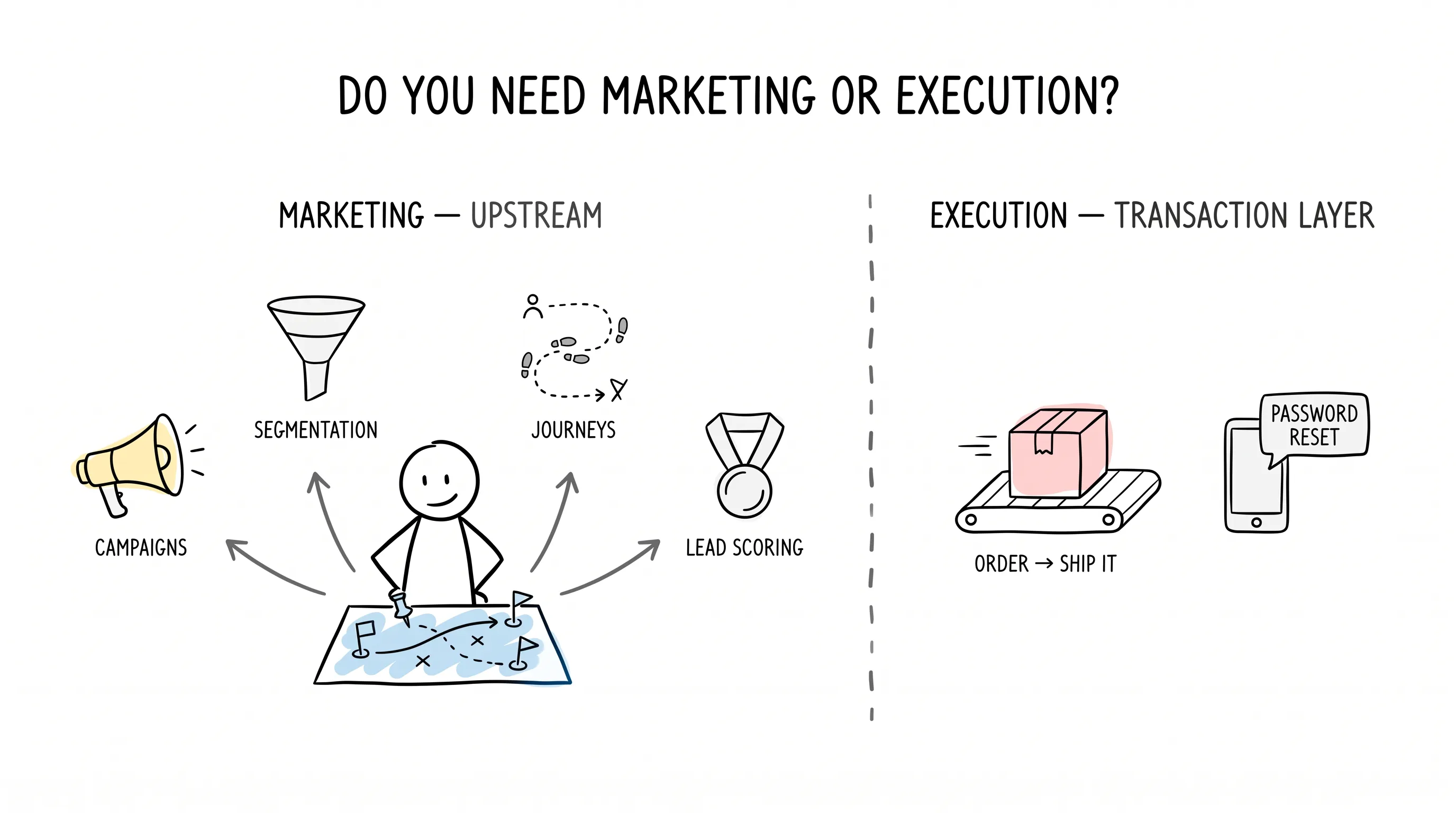
What is marketing automation, exactly?
Put simply, it's everything upstream — deploying your troops: campaign orchestration, audience segmentation, customer journeys, lead scoring, channel attribution, cross-channel reach.
And what's execution? An order comes in, you ship it. A password gets lost, you send a text. Those are transaction-layer matters, and they're outside today's scope.
Why does this distinction matter?
Because nearly every CRM now ships with a marketing module. A lot of people take one look and think: oh, it's all there, why buy something separate?
Here's an analogy. The marketing features built into a CRM are like the minibar in a hotel room. When you're thirsty, there's water. But if you want a proper drink, you still have to go down to the bar.
The minibar is about having something; the bar is about having a good one.
And the marketing automation category has a distinctive trait: unlike core transaction systems, it's far less complex to integrate. So you can absolutely go with an independent, specialized tool instead of being locked into a suite. The industry calls this best-of-breed — meaning: for every link in the chain, use the best tool for that job.
What counts as "best"? This ranking, out in early 2026, comes from an independent consulting firm called ElevatIQ, and it weighs these things: product share, product roadmap, community and partner ecosystem, win rates, technology strategy, and investors. Across industries, across sizes — no single dimension dominates.
Top ten on the list — let me walk you through them one by one.
No. 10 to No. 7: Each Has Its Own Pitfall
No. 10: Zoho.
Zoho is an all-in-one suite aimed at small and mid-sized businesses. Its product philosophy: don't over-engineer integrations. What do small businesses want? Cheap, easy, fast to launch. Deep, transaction-grade traceability? It's expensive to implement and hard to pull off — small businesses simply don't need it.
Feature-wise, nothing's really missing. Landing pages, secure flows, subscription email — it has most of what mainstream CRMs have.
So where's the pitfall? The ecosystem.
Go ask a data provider like ZoomInfo who their first integration targets are: Salesforce, HubSpot. Where does Zoho rank? Third, fourth, further down.
Why? For one, its market share isn't big enough; for another, Zoho leans closed, and many vendors aren't keen on deep integrations with it. And day to day, it isn't as smooth to use as the HubSpots of the world.
No. 9: Mailchimp.
A rung below Zoho, serving even smaller companies. Simple workflows, shallow reporting. Once workflows get complex, product complexity goes up — it just doesn't go there, and the segmentation ceiling sits fairly low.
But it holds two strong cards.
First, pedigree. It belongs to the same parent company as QuickBooks, and its B2C workflows with Shopify come pre-wired — you don't have to spend money building the integration yourself.
Second, ubiquity. On integration platforms like Zapier, Mailchimp's reach is famously high. Zoho trails noticeably here.
In one line: for very small companies doing B2C, it's genuinely appealing. Move any further up, and it stops being competitive.
No. 8: Microsoft Dynamics 365's marketing application.
Microsoft has deep pockets and sprawling reach, and it piles on marketing workflows for you. But upstream marketing vendors integrate with its ecosystem noticeably less than they do with HubSpot and Salesforce.
The most typical example is CMS. HubSpot has CMS built directly into the platform, working out of the box. Microsoft? You rely on third-party CMS.
And what does third-party mean? It means your implementation budget and configuration budget take another hit.
No. 7: Brevo.
The name may not ring a bell, but in the Shopify ecosystem, it's a serious player.
Many platforms waver between B2C and B2B, or try to do a hybrid. Brevo is crystal clear: I do B2C, period. Pricing, packaging — everything follows the logic of B2C companies.
But keep a close eye on how it bills.
How is email send volume counted? How are contact lists counted? It can be pricier than the others. If you send a lot of email but don't have many contacts — or the reverse — your bill grows in a completely different way.
And one more thing that's easy to miss: transactional email. Some platforms include it free; others charge separately. This matters mainly for B2C — shipping notifications, delivery updates, repurchase nudges, and the upsell and cross-sell behind them all run on it. B2B scenarios don't generate nearly as many transactional emails; the customer profiles are different, and so is the communication rhythm.
So if you're in B2C, Brevo deserves a serious look. As for billing — confirm it line by line.
No. 6 to No. 4: Higher Up, the Story Changes
No. 6: ActiveCampaign.
It used to be famous for being affordable. But after being acquired by private equity, the pricing algorithm changed — it's no longer the aggressive discounter it once was.
Still, keep this in mind: cheap is relative. Even today, it remains quite a bit cheaper than Klaviyo.
Its real distinctiveness: the workflows carry both a B2C and a B2B flavor at the same time. Companies with hybrid business models fit it perfectly.
There's also a niche scenario: franchise businesses. With dozens or even hundreds of franchise locations, how do you manage brand compliance? You need centralized monitoring and reporting. ActiveCampaign is exceptionally solid in franchise chains, nonprofit retail, and settings like that.
No. 5: Klaviyo.
If DTC — the direct-to-consumer track — allowed only one pick, many people would point at it without hesitation.
It has the deepest penetration in the Shopify ecosystem, and the workflows B2C innovators want are essentially all there. On the customer-experience line, just about any journey you need, it has.
The price? It's expensive.
Deep features, complex journeys, a granular permissions system — all that refinement ends up on your bill.
No. 4: Oracle Eloqua.
At this point, the picture changes abruptly. Everything above was small-and-midsize business territory; Eloqua is another world entirely.
When does it become your turn? When your enterprise needs to consolidate its brand globally.
Say you need to cover Europe: GDPR compliance, privacy — you can't dodge a single one. Small companies don't have these headaches; large enterprises live under the regulator's gaze. Traceable data, auditable processes — non-negotiable.
Platforms like HubSpot and Klaviyo hold up until a certain size, and beyond that, it's Eloqua's turf. In enterprise-grade marketing automation, it's one of the most dependable options, covering both B2B and B2C.
No. 3 to No. 1: Three Plays by the Giants
No. 3: Adobe Marketo Engage.
Adobe has deep penetration among media-type companies, and plenty in SaaS too.
Its strength is enterprise-grade granularity — its security framework is extremely fine-grained. And there's one easily overlooked point: event and webinar workflows are built in.
What's so special about that? Look at HubSpot: webinars and event-type platforms are precisely its weak spot — you basically have to source third parties and handle the integration yourself. Marketo ships all of that inside the platform, and its integrations with upstream marketing tools are smooth too.
No. 2: Salesforce Marketing Automation — formerly known as Pardot.
The biggest change there over the past two years? Even the slogan changed: it's no longer called Marketing Cloud — it's called agentic marketing.
What does "agentic" mean? Agent-driven.
What's traditional email marketing? You fire off an email with replies disabled — take it or leave it. What Salesforce is doing is turning email into a real conversation.
Even better: it uses Slack as a marketing channel. Internal communities use it, and so do external channel communities and customer communities — all driven by agents running inside workflows.
The verdict in this ranking: the entire category is moving from "one-way broadcast" to "two-way conversation," and Salesforce is charging at the front of the pack.
If you want enterprise-grade plus AI-native workflows, it's currently the frontrunner.
No. 1: HubSpot.
No surprise there.
For content-driven companies, especially B2B, HubSpot is the default answer. It has the deepest foothold in the mid-market, and further up, upper mid-market and quite a few enterprises use it too. The investment it has poured into AI workflows and data-driven capabilities in recent years is visible to the naked eye.
So is it flawless?
No. Whatever you do, don't use it as the core CRM of a large enterprise.
How intricate the operational workflows of large enterprises are — anyone who's been through it knows. HubSpot's data model was never designed to carry that kind of complexity. In marketing automation it's the king; the heavy transaction-grade lifting is more than it can shoulder.
For pure marketing automation, picking it is very unlikely to be a mistake.
So, How Do You Choose?
Back to my friend.
Here's what I told him in the end: with this ranking, the order doesn't matter. What matters is which crowd each company is betting on:
Zoho and Mailchimp bet on small and beautiful; Klaviyo and Brevo bet on B2C and DTC; Eloqua, Marketo, and Salesforce bet on big enterprises; HubSpot bets on mid-market B2B.
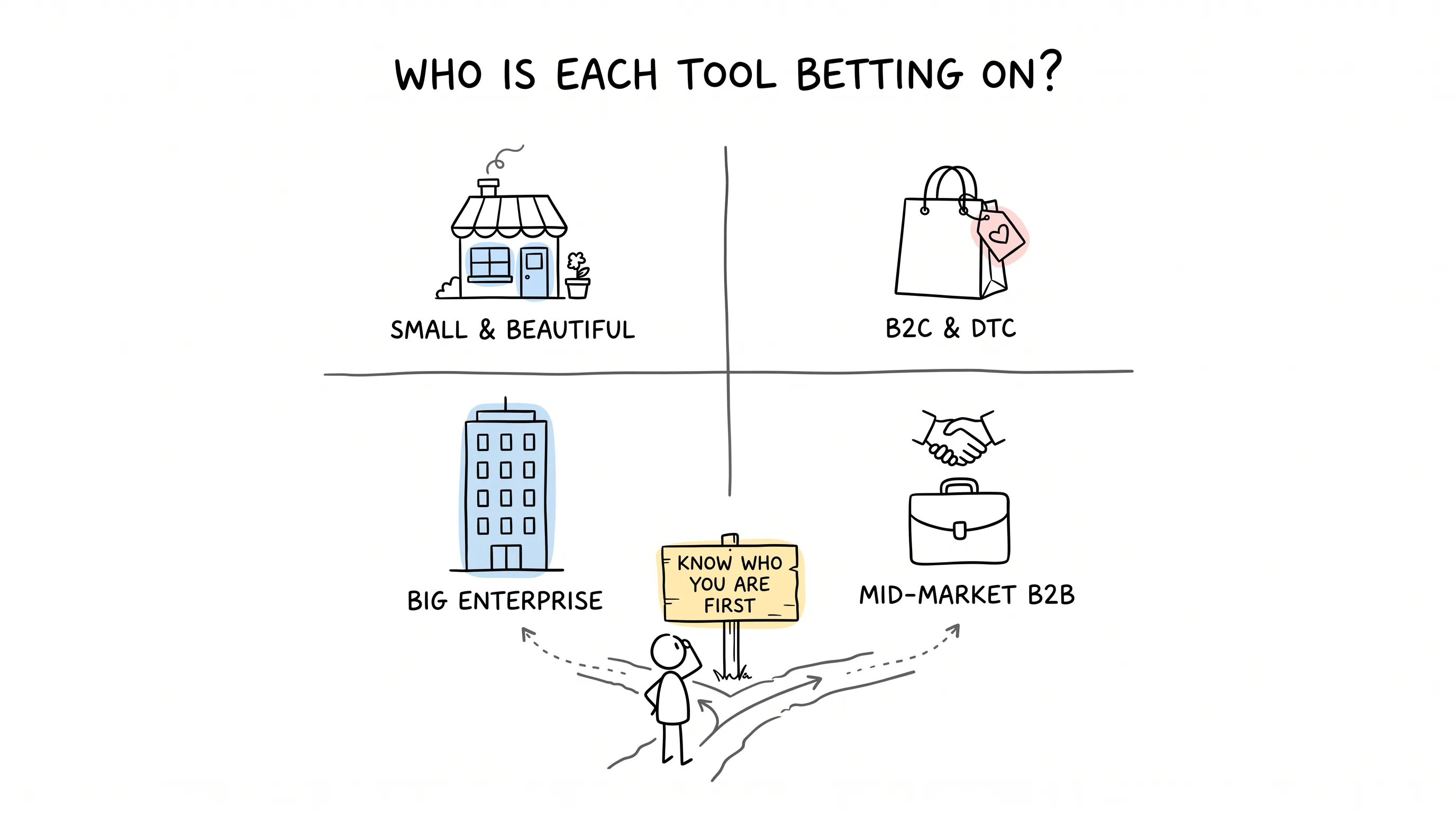
First be clear about who you are, then go look at who's strongest. Get the order backwards, and no choice will feel right.
Oh, and one more thing — when you're evaluating, don't just stare at the feature grid. Go through the billing model with a fine-tooth comb: email volume, contact count, transactional email, the hidden budget for third-party CMS. Half of the pitfalls above are buried in the bill.
Good luck with your selection — may you get it right the first time.
Continue reading
Related articles

Cross-Border Business: Time to Upgrade Your AI Toolbox
A learn article explaining how AI tools help cross-border e-commerce sellers clear five hurdles: language, regulation, logistics, payments, and fraud. It outlines a five-compartment toolbox, a five-step adoption path, and metrics such as conversion rate and CLV, while cautioning against over-reliance on AI.

AI Is Taking Over the Dirty Work of Social Media Marketing, One Task at a Time
This learn article outlines four social media marketing tasks AI can handle — audience analytics, content drafting and design, ad targeting and creative testing, and spam moderation — and cautions that taste, judgment, and data security remain human responsibilities.

AI Is Already This Good — Why Is Your Social Media Marketing Still Pure Manpower?
An overview of 18 AI tools for social media marketing, organized into six categories covering audience research, content creation, scheduling, comment and DM handling, ad management, and visual production, plus notes on personalization, prediction, and emerging trends.