
How to Keep Marketing From Falling Apart at 100+ Locations: Which AI Tools Are Worth the Money
A guide to AI marketing tools for multi-location brands, covering a six-question evaluation framework and four tool categories: local search and reputation, content personalization, ad spend optimization, and customer service CRM.
A while back, a friend of mine who runs a fitness chain invited me to dinner. He's expanded fast over the past two years — dozens of locations now, and still on the road to a hundred.
Halfway through the meal, he sighed. Back when it was a single store, marketing was simple: hand out flyers, run local ads, keep the online listing tidy — and that was that. Now? The stores gripe that materials from HQ don't speak to their street; when stores do their own thing, the brand falls apart. Reviews, ads, and content across dozens of cities — he wakes up every morning to a pile of dashboards.
I told him plenty of chain brands are stuck exactly where he is. And I could pretty much call it on the spot: what he's missing isn't two more hires — it's a system that can do the work on its own.
Over the past couple of years, AI marketing tools have truly come of age. For multi-location brands, they're no longer a nice-to-have — they're the central nervous system of marketing. But the market is crowded, and the money needs to go where it counts. Which tools actually pay off? Today I'll walk through the framework I use when consulting for companies, along with four categories of tools worth a look — all in one go.
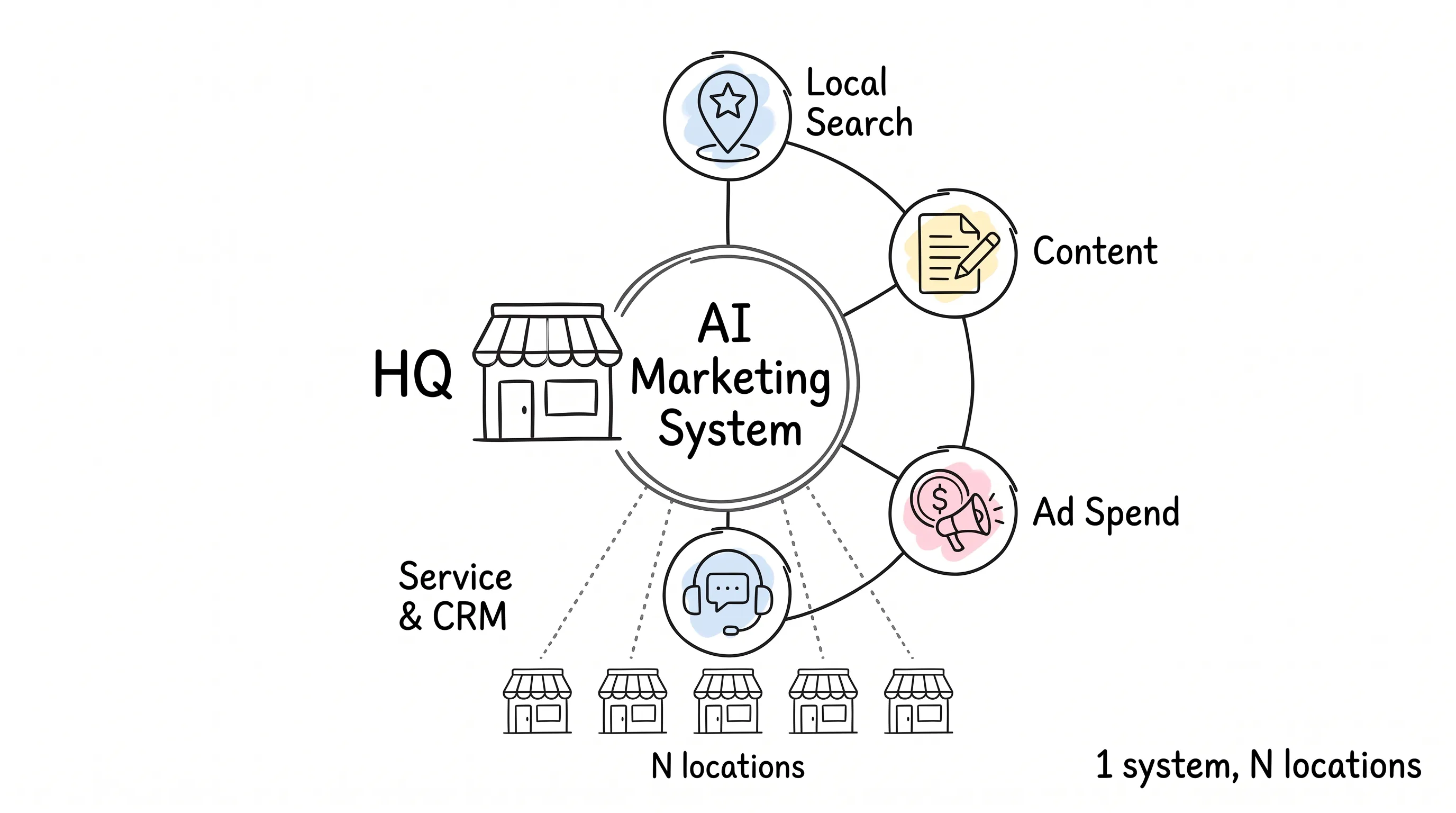
First, Get Clear on Why Multi-Location Marketing Is Hard
What is multi-location marketing? It's doing the same one thing, correctly, N times at once.
One store, you can watch it yourself — no problem. Ten stores, and you can't be in ten places at once. What about a hundred?
The difficulties come in clusters. The brand needs to stay unified, yet customer preferences differ street by street. Every location has its own customer data, locked in its own system, and no one can piece together a complete customer picture. Rely on manual labor, and every new store adds another chunk of work — costs climb in a straight line. Local search has to be optimized store by store, budgets split location by location, performance checked one by one.
Think about it: of these six problems, which one does "hiring another person" solve? None. They share the same traits — repetitive, fiddly, and spread across the entire map. And this is exactly the kind of work AI is best at.
So here's my first call: when a multi-location brand buys AI tools, it's buying the knife that pushes marginal cost down.
How I Pick Tools: Six Questions First
With that many tools out there, where do you start? My habit: skip the feature checklist and ask six questions first.
First, does it plug into your existing systems? CRM, point of sale, marketing automation, local business listing platforms. If it doesn't connect, people end up hauling data by hand — and moving data by hand is the fastest way to kill your ROI.
Second, can it grow with you? Ten stores today, a hundred tomorrow, a thousand the day after — will it hold up, or will you have to start over from scratch?
Third, will the money come back? Subscription fees plus implementation costs, weighed against hours saved and business gained — the math has to be clear.
Fourth, will store managers actually use it? However good the tool, if the local team can't learn it or won't touch it, it ends up gathering dust in a dashboard.
Fifth, is customer data safe in its hands? Compliant? The more locations you have, the messier the mix of markets and regulations — this question can't be dodged.
Sixth, are the reports any good? HQ needs the big picture; each store needs to see itself. Both ends have to be served.
Once all six check out, then talk features. Never the other way around.
Category 1: Local Search and Reputation — The Money Closest to the Money
For a multi-location business, what's most valuable? The moment a customer walks up to your front door.
Where do a store's customers come from? A large share comes from search. Someone types in "gym near me" — whether your listing is complete, how high your rating is, whether anyone replied to the reviews — that directly decides whether they walk in. One store, you can babysit by hand. A hundred Google Business Profiles and thousands upon thousands of reviews? No human can keep up.
This category of tools exists to automate exactly that: it auto-optimizes listings and posts updates on its own; AI drafts review replies with a human giving final sign-off; it reads the sentiment behind hundreds of reviews, tracks local search keywords, and — while it's at it — cleans up duplicate listings.
In this space, look at Yext and BrightLocal. Both have been layering in AI these past few years — automatic suggestions, dynamically generated location content — and can manage hundreds or thousands of listing pages without descending into chaos. Then there's Podium, which takes a different angle: it pulls messaging, payments, and feedback between stores and customers into one interface, with an AI assistant triaging inquiries and drafting replies.
Why do I call this the AI closest to the money? Because it moves three things directly: walk-ins, captured leads, and word of mouth in the neighborhood. And it frees local teams from robotic replying, so people can go do the things only people should do.
Category 2: Content and Personalization — A Local Flavor for Every Store
The second bind for chain brands: when HQ standardizes content, it loses local flavor; when content goes local, the brand falls apart.
AI content tools exist to untie it. An ad, a post, an email: generate it to brand guidelines first, then spin out variants for different cities and audiences. One blog post from HQ becomes dozens of social posts for individual stores. One brand voice, content that fits each street's customers like a glove.
Who specifically? Jasper and Copy.ai — both enterprise editions are doubling down on producing content to brand guidelines, and both offer APIs to hook into your existing stack. When comparing, look hard for "generation by location" as a capability. A layer up sit marketing automation platforms like Optimove and Braze, whose strength is personalizing the customer journey: the right person, the right message, the right place, the right time — all four hitting at once. Potent stuff.
Where's the return? Content output multiplies several times over with no extra headcount — and engagement rates climb too.
Category 3: Ad Spend — Let the Machines Watch the Money
Once you have many stores, ad budgets turn into a muddle. Dozens or hundreds of local markets, each with different audiences, competition, and bids — humans simply can't tune it all.
The value of this category fits in one sentence: move every dollar from underperforming channels to the stores that perform. It manages bids in real time, allocates budgets dynamically, predicts which campaigns are about to go sideways, runs A/B tests automatically — and filters out ad fraud while it's at it.
At the enterprise level, look at Marin Software and Skai — both veterans at managing large-scale campaigns, with cross-channel bidding and automated reporting; hand them your multi-location accounts and you can stop worrying. Skai used to be called Kenshoo, and has been in the game even longer. Separately, Google Ads' Smart Bidding is already strong on its own, but my experience says stacking it with a third-party AI platform buys you an extra layer of cross-channel visibility and localization tweaks — something Google natively can't give you.
Category 4: Customer Service and CRM — The Second Half of Retention
That's acquisition. Now, retention.
Customer service at a multi-location brand is the hardest kind to run: customers can't tell HQ from the store — they just want an answer. An AI service bot is on 24/7, catches the common questions first, and routes the complex ones to the right store's people. Along the way it does lead scoring (ranking prospects by how likely they are to buy), sends hot leads to the team closest to the customer, and mines history to figure out what to recommend next.
Here, if your brand already lives in the Salesforce ecosystem, Einstein is the natural choice — insights for sales, service, and marketing in one place. If not, look at Zendesk and HubSpot. Both are packing AI into service: auto-routing tickets, self-service, and helping human agents reach answers faster.
Run the numbers and it's obvious: faster responses, higher satisfaction, lower support costs — plus cross-selling opportunities dug out of the data. One tool, three payoffs.
Buying the Tools Is Only Half the Job
That's all four categories. But here's the cold water: tools don't turn into returns on their own. I've watched too many brands spend the budget, roll out the systems, and six months later look back to find the data silos exactly where they were.
Where does it go wrong? In mistaking "buying tools" for "going digital."
The playbook that actually makes AI pay off comes down to these steps.
Don't roll out everywhere at once. Pilot in two or three stores, get real data, then decide how to scale. Launching everything in one go is burying landmines for yourself.
Unify the data first. AI runs on data; if each store's data stays walled off, even the smartest model can't cook without ingredients. This step is the driest, least glamorous work — but it's the foundation.
Train, then train again. Whether a tool gets adopted comes down to whether someone teaches it. Skip the HQ sermon for store managers; talk in terms they understand: a few hours saved each week, a few more leads coming in, more money in the till by month's end. Train the first wave hands-on, let the pilot stores set the example, and the rollout goes smoothly on its own.
Keep humans in the loop. AI can drive, but the steering wheel stays in human hands: brand voice, sensitive complaints — the machine drafts, a person signs off.
Finally, look back on a regular basis. This space changes every few months. Review periodically which tools are earning their keep and which features were a waste of money, and swap when it's time.
Oh, and one more thing most people miss: make the tools talk to each other. Connect the local search platform to content generation; feed customer service data back into ad buying. Chain the tools into an assembly line, and returns don't add — they multiply.
And a quick answer to a question I hear often: does any of this matter for a small business with a single store? Yes — and it pays off faster. Local search, review management, content generation: get it running at small scale now, and when the locations multiply, you already have a playbook that works.
Back to My Friend
My friend, following this line of thinking, did one thing first: he didn't rush to buy any new tool. He pulled the customer data from his dozens of stores into one pool, then picked a single scenario — review management — and piloted it in three stores.
A month later he messaged me: the response-time rate at the three pilot stores had climbed, and for the first time, his store managers felt the dashboard was helping them, not grading them.
See — every one of these roads gets walked open, one step at a time.
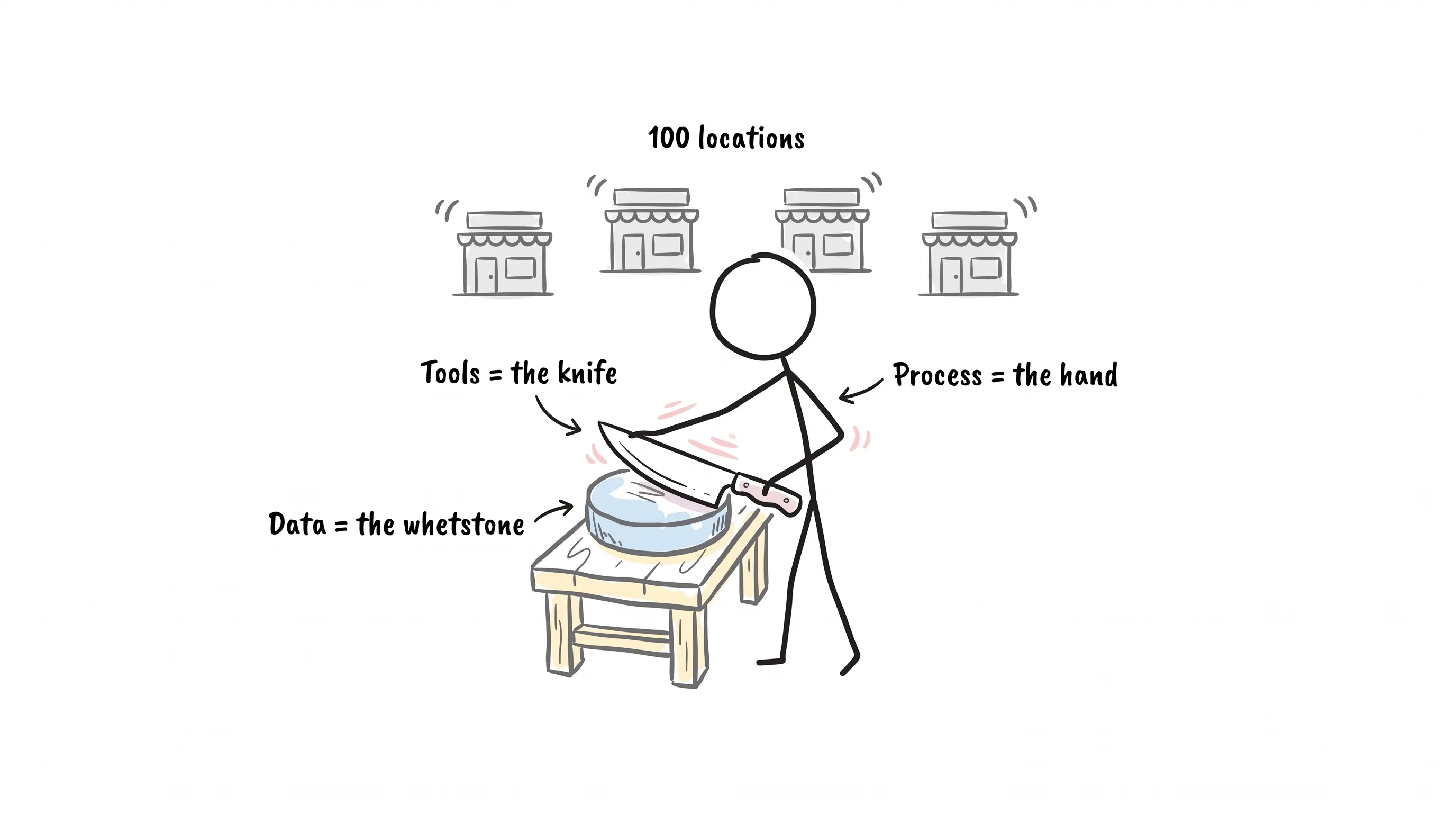
In multi-location marketing, the endgame isn't about who owns the most tools — it's about whose system knows how to grow itself. Tools are the knife, data is the whetstone, process is the hand that holds the blade. Have all three, and you can sip coffee at HQ while marketing at a hundred locations runs itself. Miss one, and the most expensive tools are just icons gathering dust in a dashboard.
Here's wishing that on the day you open your hundredth store, the marketing machine is already humming along for you.
Continue reading
Related articles

Cross-Border Business: Time to Upgrade Your AI Toolbox
A learn article explaining how AI tools help cross-border e-commerce sellers clear five hurdles: language, regulation, logistics, payments, and fraud. It outlines a five-compartment toolbox, a five-step adoption path, and metrics such as conversion rate and CLV, while cautioning against over-reliance on AI.

AI Is Taking Over the Dirty Work of Social Media Marketing, One Task at a Time
This learn article outlines four social media marketing tasks AI can handle — audience analytics, content drafting and design, ad targeting and creative testing, and spam moderation — and cautions that taste, judgment, and data security remain human responsibilities.

AI Is Already This Good — Why Is Your Social Media Marketing Still Pure Manpower?
An overview of 18 AI tools for social media marketing, organized into six categories covering audience research, content creation, scheduling, comment and DM handling, ad management, and visual production, plus notes on personalization, prediction, and emerging trends.