
How to Choose an Enterprise Marketing Automation Platform? Get the Three Ledgers Right First
A learn article on choosing an enterprise marketing automation platform, built around three ledgers—money, time, and AI answer visibility—comparing HubSpot, Salesforce, Marketo, Eloqua, and Braze with a GEO-driven approach, and ending with scenario-based selection guidance.
A while back, an old friend of mine who works in enterprise software invited me out for coffee.
His company was about to buy a marketing automation platform. The conference room table was buried under comparison sheets: one vendor quoting seven figures, another with an implementation timeline measured in years, plus one Excel spreadsheet listing dozens of feature modules.
He asked me: take a look and tell me — which one do we pick?
I said: hold on. Your math may be wrong from the very first line of the spreadsheet.
What math? Let's peel it back layer by layer.
What Are You Actually Buying?
Start with the most basic question: when an enterprise buys marketing automation, what is it actually buying?
Most people's answer: managing email, customer journeys, and lead nurturing.
Correct — but only half right.
Think about it: how long is an enterprise B2B sales cycle? Three to eighteen months. Behind any purchase decision stand six to ten decision-makers. You can't spend all those months pestering people with calls, so you need a system: one that keeps leads warm when the customer goes quiet, and reignites the fire the moment they stir.
That was marketing automation's original mission. Veteran platforms like Marketo and Oracle Eloqua grew out of exactly this scenario: deep Salesforce integration, account-based marketing, revenue cycle analytics — the trusted old workhorses of countless enterprise B2B teams.
B2C is the mirror opposite. Purchase cycles are measured in hours and days, and the game is real-time triggering. That's why Braze and Iterable thrive on mobile — Braze can carry consumer apps with over 10 million monthly active users and billions of events.
Each makes sense in its own world. The first step of any platform selection has always been knowing what kind of business you run.
But in 2026, where buyers start has changed.
What Is Zero-Click?
It used to be that a buyer researching a category would type keywords into a search engine and click through ten blue links.
Now? He asks ChatGPT directly: "Which enterprise marketing automation platforms are worth evaluating?"
The AI answers on the spot. He never clicks a single link.
That is zero-click.
Have you noticed — whether you show up in that answer has little to do with how many nurture emails you sent.
What does it depend on? On what the AI model can find, what it trusts, and whom it chooses to cite.
This is a new battleground. The trouble is, none of those old workhorses — Marketo, Eloqua, Salesforce Marketing Cloud, HubSpot, Braze — can reach it. Their turf is the campaign layer: audience segmentation, journey orchestration, real-time personalization, all done well. But the campaign layer only works on people already inside the funnel. For buyers still outside it, busy asking AI for answers, these platforms are powerless.
More on that later. First, the math.
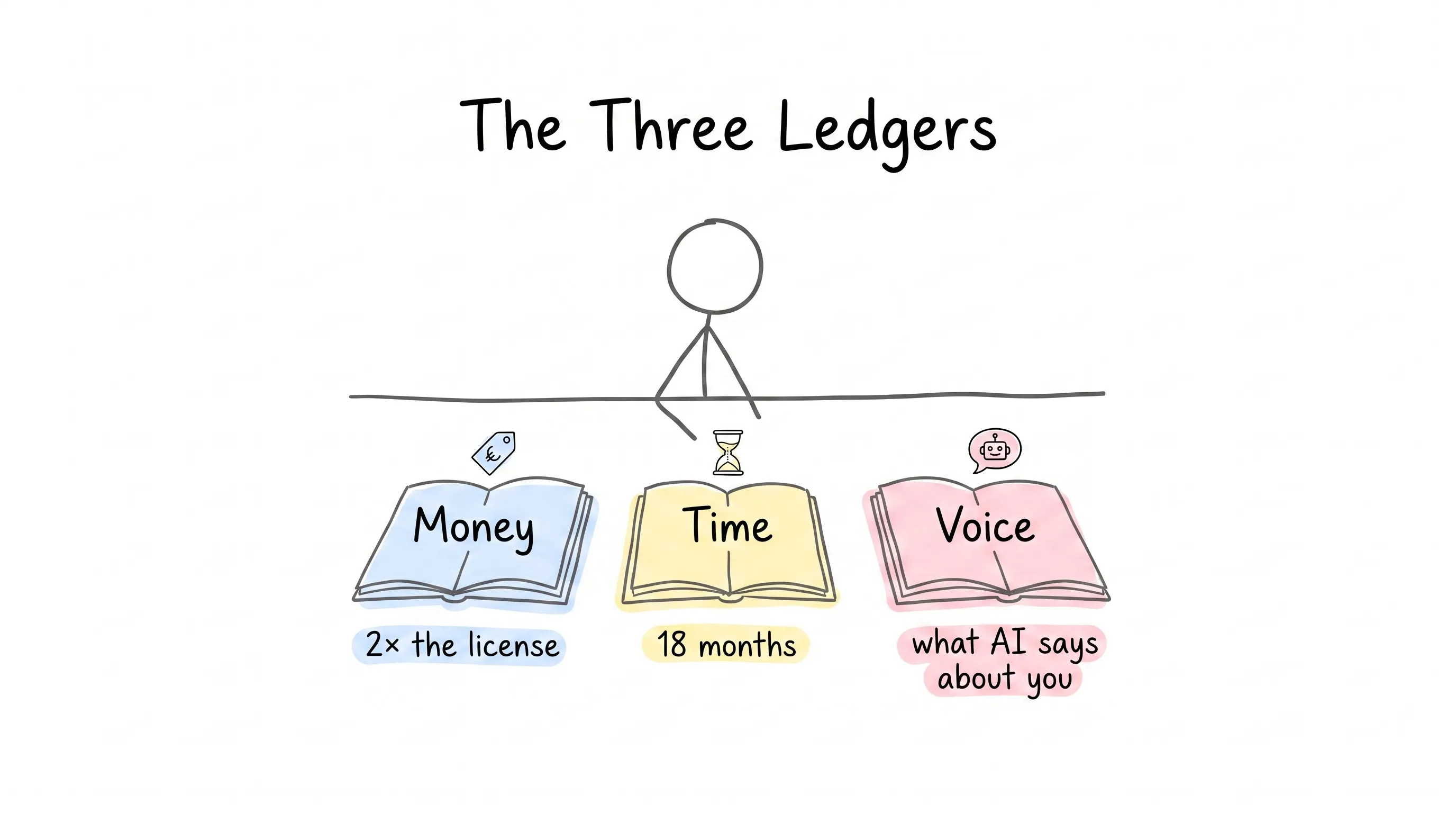
Enterprise platform selection comes down to three ledgers: money, time, and voice.
The First Ledger: The License Price Is Just the Admission Ticket
Money first.
Many companies look at a quote and see only the license price. Wrong. The license is just the admission ticket; the hidden spending has barely begun.
A few examples with public numbers. HubSpot Marketing Hub Enterprise lists at roughly $117,000 a year for a mid-market deployment — and that's the bare subscription; add onboarding and implementation, and the first-year total climbs noticeably higher. Salesforce Marketing Cloud implementation and professional services packages start at $4,500 to $15,000 and go up from there, negotiated by quote. And for enterprise marketing automation overall — license, mandatory onboarding, consulting fees, and staffing combined — first-year total cost routinely exceeds $300,000.
Then comes overage billing. Platforms that charge by contact count grow your bill as your database grows, and plenty of teams hit the pricing-tier wall within their first year.
Next, utilization. Most enterprise teams use only about 20% of their platform's features — paying six figures a year to keep 80% of the functionality gathering dust. What does waste look like? This.
And then there's a subtler one: data lock-in.
Salesforce's MCAE (Marketing Cloud Account Engagement) won't run without an activated Salesforce CRM license. Teams not yet on Salesforce have to bind themselves to an entire CRM first, lifting total cost another notch. Already on it? The common complaint is sync lag: an activity happens, and it doesn't show up in Salesforce until hours later. Others discover they've paid twice — one feature set in Salesforce, another in MCAE, and they're billed again for the overlap.
HubSpot fares better: CRM and the marketing hub share one database, so when sales opens a contact record, every marketing touchpoint is right there — no API maintenance, no sync lag. That architectural advantage is real. But it has a ceiling: once your contact count crosses the native tier, overage billing kicks in, and cost nibbles the advantage away bit by bit.
Compliance has become another place money goes. US state privacy laws, the EU's ePrivacy, and the Privacy Sandbox migration have elevated consent management into a first-class platform requirement. Eloqua serves regulated industries with fine-grained data controls and custom objects; before Salesforce Marketing Cloud goes live, the IP warm-up plan alone has to be scheduled starting from the Discovery phase. All of this needs people watching it. And people are money.
To put it bluntly, the cost of traditional platforms comes a la carte: one bill for the license, another for implementation consultants, another for an SEO agency, another for content tools, another for a website agency, another for GEO (generative engine optimization) monitoring, another for schema plugins, another for the analytics stack — plus a PR firm. Every item bills separately.
That's why for many companies, the first-year bill runs more than double the license price.
The Second Ledger: Time, Which Never Comes Back
Money can be earned again. Time can't.
The Starr Conspiracy, a B2B marketing research firm, analyzed more than 150 enterprise deployments and concluded: from platform selection through procurement, data migration, workflow build-out, training, and optimization, the median for the full process is 18 months.
What does 18 months mean? A B2B sales cycle runs three months at the short end and eighteen at the long end. By the day your system goes live, the customers you set out to serve may have already signed with someone else.
The optimistic cases? A full enterprise deployment of Salesforce Marketing Cloud commonly takes 6 to 12 months. Multi-region, multi-product-line Marketo or Eloqua also starts at 6 to 12 months. The fastest: HubSpot, where most B2B teams reach full functionality in 8 to 12 weeks; MCAE with Salesforce integration can wrap in 6 weeks if all goes smoothly.
And that's just the system going live. People knowing how to use it is another story. The certification courses these platforms publish run 29 to 80 hours to start. What an enterprise deployment really needs is a dedicated marketing automation owner: someone with cross-departmental standing, responsible for process architecture, integration standards, segmentation, and performance reporting. A permanent headcount, not a temporary project hire. Salesforce Marketing Cloud's own best practices say it outright: every workflow needs a dedicated internal owner, or the learning curve and competing priorities will stretch the timeline longer and longer.
Don't forget migration. Old and new systems run in parallel for 3 to 6 months, contact records split, attribution models break, and the data debt stacks up line by line.
There's a statistic that makes me sigh every time I see it: 70% to 85% of AI projects fail to deliver the expected results, mainly because of fragmented data and manual processes. Why? Because automation creates nothing — it amplifies what's already there. Weak content, amplified, is noise. A fuzzy target customer profile, amplified, is waste.
Automation is a multiplication sign. If the number before it is small, the product can only be smaller.
The Third Ledger: What AI Says When It Talks About You
The first two ledgers are about fighting the old war more efficiently.
The third is about the new one.
First, look at which way the wind is blowing. Gartner predicts that by the end of this year, 40% of enterprise applications will ship with task-specific AI agents. In 2025, that figure was under 5%.
Applied to marketing automation, the incumbents deliver predictive segmentation, journey orchestration, and real-time personalization: segmentation is no longer a static list refreshed once a week — AI analyzes behavioral, transactional, and contextual signals in real time and picks the audience on the spot. Among published enterprise cases, some report 27% conversion lifts, others 20% open-rate lifts. Genuinely good. Real, tangible gains.
But think about who those gains happen to. They happen to audiences the platform already knows.
When a buyer asks AI "which platform is worth choosing," your platform isn't in the room.
So what do you do? One company has taken a different approach. It's called AI Growth Agent, and it doesn't touch CRM or email sequences. It does exactly one thing:
It maps every question buyers in your industry might ask AI — from seed terms to long tail — into one complete picture, built on real-time Google and ChatGPT data. It calls this map the "query universe." Then, for every single question, it produces well-sourced content, so that AI cites you when it answers.
New accounts start with three to four hundred queries and grow from there; mature customers' universes hold more than 1,600. The system runs over 3,000 searches a week to refresh the map. Queries are never billed — you won't be penalized for wanting the full picture.
How fast is go-live? From kickoff to the first published article: about a week. Indexing of content: as fast as 10 days. The only thing the customer does is one reverse proxy configuration, hosting the blog in a subdirectory under its own domain. No RFP, no 18-month wait, no new hires for this.
All the technical chores run on their own: schema, the WordPress plugin, robots.txt, sitemaps, instant indexing, automatic redirects, 404 monitoring — the engine handles them. On the publishing side, it ships a set of AI-facing technical SEO, including Blog MCP, llms.txt and llms-full.txt, and OpenAI's /.well-known/ discovery protocol. Client teams only need to give feedback in plain language; the system remembers it, and never makes the same mistake twice.
Compliance works differently too: legal disclaimers, messaging priorities for sensitive industries, and anti-hallucination controls are configured once in a Company Manifesto, then carried automatically on every article that follows. Set that beside the IP warm-ups and dedicated owners described earlier, and you can feel these are two different species.
Commercially, it's one flat price. Not billed per article, not per credit, not per prompt. What it replaces is precisely the a la carte purchasing stack itemized in the first ledger. Content ownership belongs to the client. The content is alive — it updates itself and repairs itself — and every article's relationships, performance, bot data, and Search Console data sit in one place, so authority compounds instead of decaying over time.
And the numbers it reports for itself?
This is where I most want to remind you to stay calm. Their published figures: in the first 12 weeks, customers on average added 12,000+ new AI citations and mentions, 100,000+ new bot visits, and a 20%+ lift in impressions.
Impressive numbers. But note: these are self-reported, with no third-party endorsement. How seriously should you take them? Take them as a sense of direction, nothing more. There is a way to verify, though: content is published in a separate environment, incremental visibility is reported weekly, and clients can reconcile the numbers themselves in Google Search Console. That design counts as good faith.
Finally, what it can't do — and it doesn't hide this either: it is not a CRM, not an email sequence tool, not a paid attribution tool. Teams that need transactional messaging and CRM process automation still need a traditional platform. Also, organic content has its own time constants: indexing takes as little as 10 days, but the compounding of a fully built universe is measured in weeks and months. The standard pilot is three months; if you're only chasing a handful of head terms, you basically won't earn the compound interest.
So How Do You Choose?
With the three ledgers settled, the choice actually gets simpler.
If your business runs Salesforce-centric enterprise B2B lead nurturing, your first-year budget is above $150,000, and you can afford a dedicated operations hire: Marketo Engage or MCAE are old friends — they were born for exactly this.
Large B2C players already all-in on Salesforce, needing cross-channel journey orchestration, able to stomach 6 to 12 months: look at Salesforce Marketing Cloud.
B2B companies under 500 employees that want native CRM integration, faster results, and a first-year cost below the Salesforce stack: look at HubSpot.
Mobile-first consumer brands with over 10 million monthly active users, event volume in the billions, and engineers to maintain the integrations: look at Braze, or Iterable.
Global enterprises in regulated industries, multi-brand, needing fine-grained control: look at Oracle Eloqua.
And if your core anxiety is whether AI, when it talks about you, says what you want it to say — if you want to swap the a la carte vendor pile for one engine without adding headcount: that is AI Growth Agent's scenario. Right now, it's the only headless engine built specifically for this.
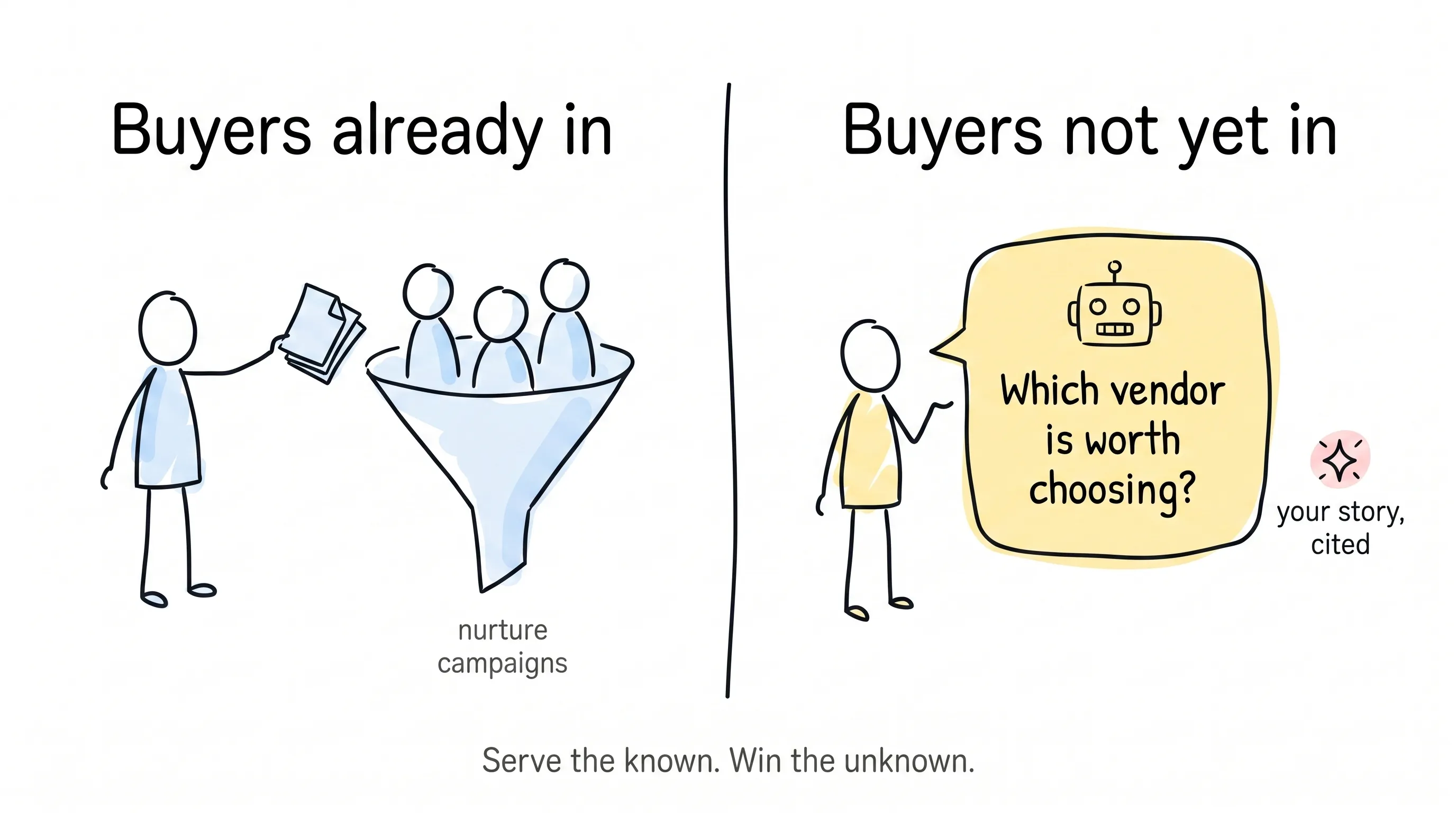
One-sentence summary: ask yourself first whether you want to manage the journeys of the buyers already in — or decide what buyers not yet in get to hear. For the former, take your pick of the incumbents; for the latter, the traditional toolbox is empty.
The incumbent platforms serve the customers you already know better. The query universe wins you the customers you haven't met yet.
Before that coffee ended, I told my friend: set the comparison sheets aside for now, and answer one question first. Six months from now, when your customers ask AI "which vendor of this kind of enterprise software is worth choosing," do you want your name in the answer?
He said: of course.
I said: then work backward from that question. Don't spend 18 months chasing an answer AI gives in ten seconds.
Brands being cited by AI right now are training the next generation of models on their own story. Brands watching and waiting are training them too — just on other people's stories, scraped off the open web.
And may you, when you run the numbers, leave none of the three out.
Continue reading
Related articles

Cross-Border Business: Time to Upgrade Your AI Toolbox
A learn article explaining how AI tools help cross-border e-commerce sellers clear five hurdles: language, regulation, logistics, payments, and fraud. It outlines a five-compartment toolbox, a five-step adoption path, and metrics such as conversion rate and CLV, while cautioning against over-reliance on AI.

AI Is Taking Over the Dirty Work of Social Media Marketing, One Task at a Time
This learn article outlines four social media marketing tasks AI can handle — audience analytics, content drafting and design, ad targeting and creative testing, and spam moderation — and cautions that taste, judgment, and data security remain human responsibilities.

AI Is Already This Good — Why Is Your Social Media Marketing Still Pure Manpower?
An overview of 18 AI tools for social media marketing, organized into six categories covering audience research, content creation, scheduling, comment and DM handling, ad management, and visual production, plus notes on personalization, prediction, and emerging trends.