
How to Choose an Enterprise Growth Marketing Platform: Get the Order Wrong and the Money's Gone
A guide to selecting enterprise growth marketing platforms for B2B teams, covering growth motions, a four-layer tool architecture, and comparisons of intent, data, attribution, and automation vendors. It closes by arguing that brand visibility in AI answers remains unaddressed by these platforms.
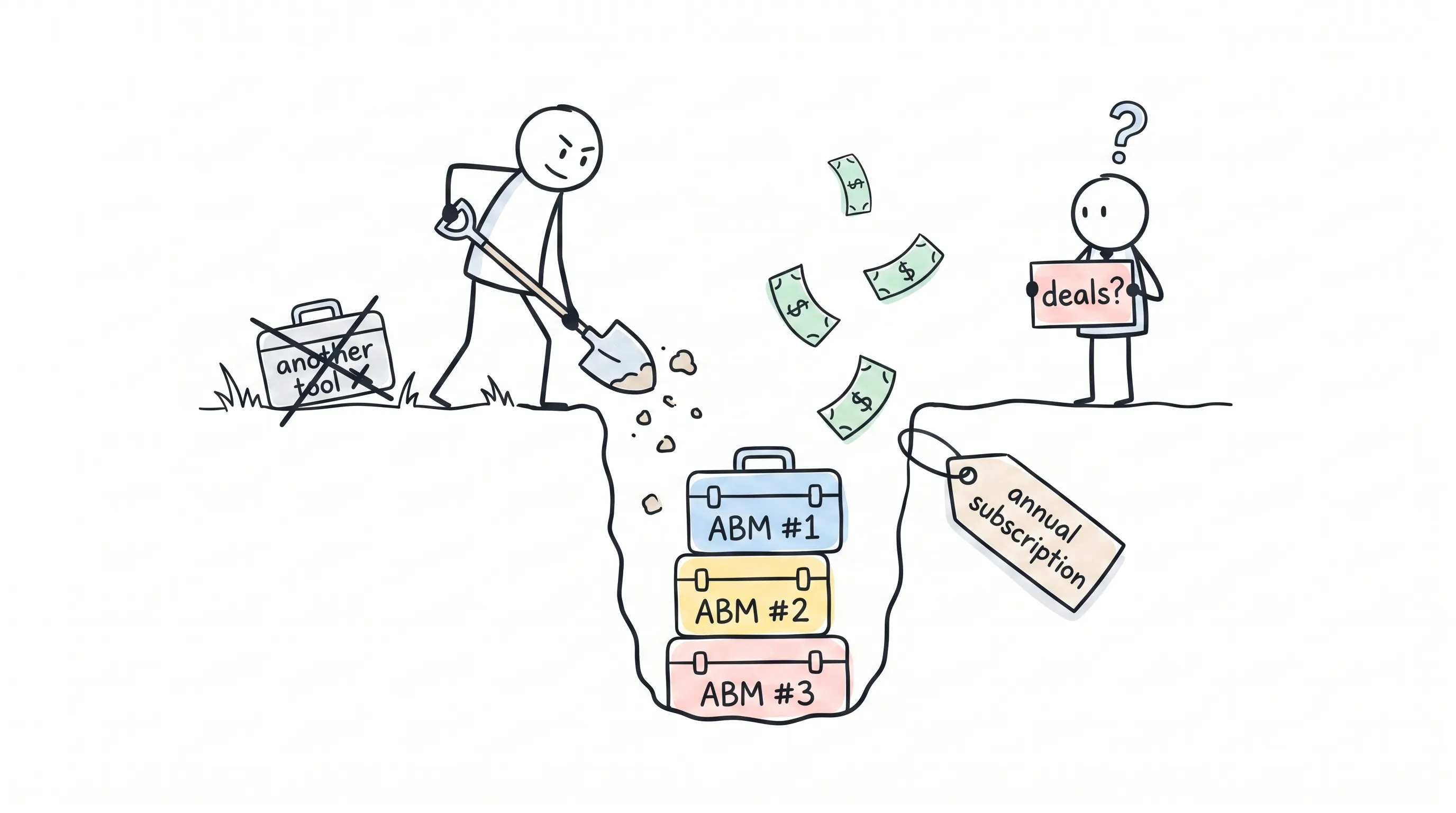
A while back, a friend of mine at a B2B SaaS company invited me out for drinks. The moment the conversation turned to their marketing tools, his face fell.
They were spending tens of thousands of dollars a year on their ABM operation. ABM, account-based marketing, means — in plain terms — treating each target company as a market of one. Core platform, data enrichment, sales outreach, ad spend, everything included.
The result? A pile of tools, every signal telling a different story. Then, at the pipeline review, the CFO asked one question: how many deals did all that money actually buy?
Nobody could field it.
Even more absurd was their fix: buy another ABM tool.
I said it right then: you're not patching the hole, you're digging it bigger — and paying for it on an annual subscription.
I've been watching more and more companies step in that exact hole lately. So today I want to walk you through this properly: 6sense, Demandbase, ZoomInfo, HockeyStack, Factors.ai, HubSpot, Marketo — these enterprise growth marketing platforms. How to choose one, how to arrange them, and how not to burn the budget to ash.
Let's start from the top.
First: Don't Pick a Platform — Figure Out How You Grow
What is a growth motion?
It's whatever your company relies on to get deals signed. Sounds like a platitude, but most platform-selection tragedies begin with never thinking this step through.
If your sales team wins deals one by one, you're sales-led. That play runs on MQL scoring, CRM handoff automation, sales alerts, and multi-stage nurturing that follows opportunity stages — and the platform has to orbit the CRM. What's an MQL? A lead marketing has judged worth handing to sales.
If users adopt the product on their own and end up paying as they use it, you're product-led. The critical action happens inside the product; workflows have to be triggered by user behavior, not by waiting around for a form submission.
The tricky case is the hybrid play. Most enterprise B2B SaaS today runs a hybrid model where self-serve acquisition feeds the sales team for expansion. Pick a platform that serves only one side, and the other side will sooner or later force you to tear it all down and start over — a cycle of roughly 18 months.
So how do you pair them? The most common combinations in the market are already pretty clear.
Sales-led companies running Salesforce as their CRM, with ARR (annual recurring revenue) above $50 million, overwhelmingly land on Marketo Engage. If your CRM is HubSpot, you pair it with HubSpot Marketing Hub — it runs like one team, one system. Pure product-led companies in the early-to-mid stage fit behavior-triggered tools like Customer.io better. And ABM-first mid-to-large companies stack an intent platform — 6sense or Demandbase — on top of the automation layer.
But this pairing comes with one precondition: your growth motion has to be right in the first place. Get the motion wrong, and every dollar after that is working for the wrong boss.
Define the motion first, then choose the platform. Reverse the order, and the money's wasted.
Second: Stacking Tools — You're Not Buying Capability, You're Buying Disaster
Back to my friend's story. Why does buying another ABM tool make things worse?
Picture running 6sense and Demandbase side by side. What happens?
Both are feeding on third-party intent data with heavily overlapping sources. Both apply their own scoring models to grade the same batch of customer accounts. Then two sets of mutually contradictory scores pour into the same CRM at the same time.
Who should sales believe?
Coverage doesn't double; cost does. On one side, the money spent on duplicate purchases; on the other, a team burning energy flip-flopping between two sets of signals. A mid-market ABM budget of $40,000 to $130,000 a year goes up in smoke, just like that.
So what does a clean architecture look like? In four lines:
One intent and orchestration layer — 6sense or Demandbase, pick one. One automation platform that follows the CRM and the growth motion. One attribution engine. One data enrichment source.
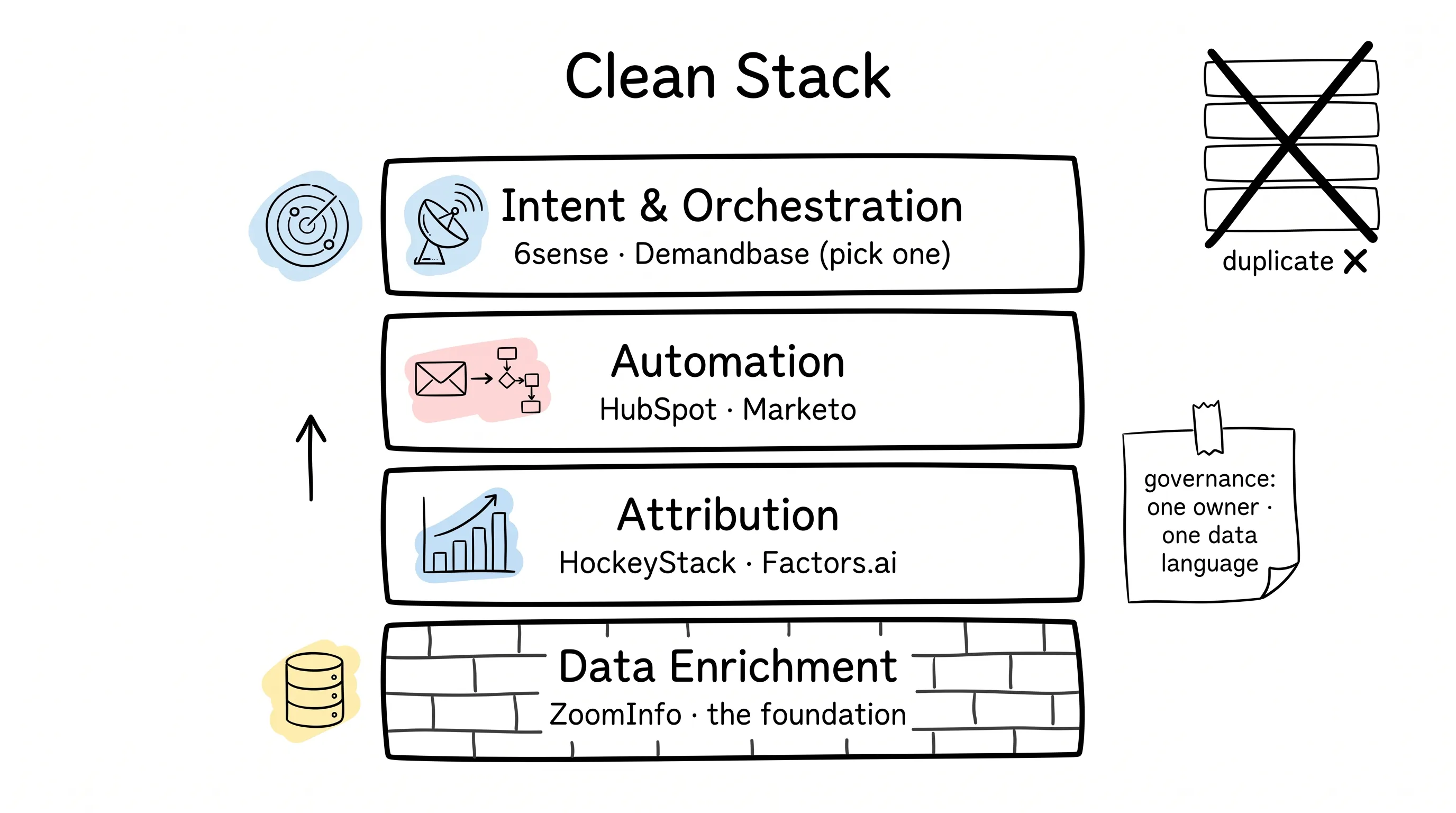
Anything you add beyond those four layers needs a named governance owner, one unified set of data definitions, and a written rule for settling conflicts. That overhead grows faster than the capability does.
Tools are bought; order is governed into existence. The first without the second is paying for chaos.
The Intent Layer: 6sense or Demandbase — How to Choose
Start with 6sense.
It's an account orchestration platform: predictive intent data, AI-driven account scoring, and cross-channel activation, stacked in three layers. It sits on top of your existing automation platform and feeds account intelligence into Salesforce and HubSpot.
Its most valuable capability is lighting up the so-called "dark funnel" — what buyers researched before they ever found you, and which stage of the buying journey they've reached. Traditional tools can't see any of it; 6sense gives you a prediction. For companies with big buying committees and long sales cycles, that information is worth a fortune.
The price? Median annual contracts run about $55,000 to $63,000, with individual deals ranging from $12,000 to north of $300,000 — depends on the modules, depends on the scale.
But there are two conditions you need to weigh.
First: it's expensive, and it's slow. Initial deployment takes weeks to months, and once you add up implementation services, training, and data credits, total cost of ownership is often double the initial budget.
Yes — twice.
Second: it's picky about who it works for. You need a clearly defined list of 200 to 2,000 target accounts, and every account needs a designated sales owner. Without those, 6sense is a rented anti-aircraft gun — for shooting mosquitoes.
And Demandbase?
Demandbase One takes a different route: advertising, personalization, and account intelligence packed into one interface. It fits best for teams spending $500,000 or more a year on programmatic advertising. Ad buying and ABM orchestration normally live with two different teams on two different platforms; Demandbase folds both into a single contract.
Entry pricing starts around $24,000 a year — a lower bar than 6sense. Implementation typically runs 6 to 12 weeks.
The catch is that the platform is so all-in-one it swallows teams whole. Without dedicated ABM operations staff, it's remarkably easy to buy it and never get it moving.
One-line summary: intent-heavy, sales-led companies with mature RevOps (revenue operations — the people who run sales, marketing, and data as one operation) should look at 6sense; teams with big ad budgets that want advertising and ABM under one roof should look at Demandbase.
The Data Layer: ZoomInfo Is the Foundation, Not the House
ZoomInfo deserves its own section, because it's fundamentally not the same species as the two above.
What it sells is data: firmographics, tech stacks, contacts with direct-dial phone numbers. When CRM records need enriching and deduplicating, and ABM platforms and sales outreach tools need clean data to run on, this is the layer underneath.
Why can't you skip this layer? Gartner has estimated that poor data quality costs the average enterprise $12.9 million a year.
Twelve point nine million. And that's the average.
The most pointless purchase I've ever seen was buying ZoomInfo as an ABM platform, then cursing it for being useless. It doesn't run campaigns, doesn't score anything, doesn't nurture anyone. It's the foundation. Expect the foundation to double as a house, and disappointment is guaranteed.
You can't skip paying for the foundation. But a foundation can't do a house's job.
The Attribution Layer: HockeyStack and Factors.ai — a Math Problem
Marketing spends the money; somebody has to account for what the money became. That's attribution. This layer has two leading options, an order of magnitude apart in price.
HockeyStack is a multi-touch attribution engine built for complex pipelines: first-touch, last-touch, linear, W-shaped, and custom models, plus account-level journey visualization, plugging straight into Salesforce and HubSpot. In a Salesforce-centric revenue organization where marketing has to prove its contribution to revenue in meetings — that's exactly what it's for. Its original attribution product ran about $1,400 to $2,200 a month; the current Revenue Agents offering is custom-quoted, with no public pricing.
Factors.ai goes the other way: the Basic plan starts at $399 a month, aimed squarely at heavy LinkedIn players. Beyond attribution modeling, it ships AdPilot to automatically optimize your LinkedIn spend, and it can pull in intent data from G2 and Bombora. For mid-market teams where LinkedIn dwarfs every other channel and enterprise-level prices are out of reach, it hits the sweet spot.
Which one? Channels numerous and messy, pipeline structure complicated — go HockeyStack. LinkedIn-dominant — Factors.ai is enough, and cheaper.
But attribution has a built-in flaw, and I'll tell you up front: every fixed-model attribution tool has to wait for the deal to close before it can do the math, and it only sees channels that generate clicks.
A buyer asks AI, and AI hands over the answer directly — no click, no session. Where did that deal come from? Your attribution tool? Pitch dark.
Remember that hole — it's coming back on the exam later.
The Automation Layer: HubSpot Trades for Speed, Marketo Trades for Depth
At the automation layer, the real showdown is between exactly two: HubSpot Marketing Hub and Marketo Engage.
The difference between them is, at bottom, a trade of speed for depth.
HubSpot is the fast one. CRM, marketing, nurturing, attribution in one interface; mid-market teams built on HubSpot CRM get sales-led MQL scoring and handoff automation out of the box. But it has two ceilings: contacts are billed by volume, so the bigger your database, the more it hurts; and somewhere above roughly $20 million ARR, Salesforce-centric RevOps teams start finding its sync depth insufficient. And don't let "simple" fool you — enterprise implementations with multiple Hubs, custom objects, and complex integrations start at 12 to 16 weeks.
Marketo is the deep one. Smart Lists for segmentation, reusable Program templates, and a two-way native sync with Salesforce that's among the most mature in the industry — it even maps opportunity stages. Complex operations above $50 million ARR, multi-region, 100,000-plus contacts: it can carry them. The cost is just as blunt: implementation takes 3 to 9 months, mostly landing at 4 to 6, and you must have a dedicated marketing operations person to keep it alive.
How to choose? My call is simple.
Under $20 million ARR, need speed, no dedicated ops: HubSpot. Above $50 million ARR, Salesforce is your lifeline, RevOps on staff: Marketo. In between, lean toward your CRM's native ecosystem — don't fight it.
One layer deeper: where's the dividing line between an intent suite and an automation platform?
Where they sit in the funnel. 6sense and Demandbase solve the before-they-raise-their-hand problem: which accounts are already wandering the market but haven't raised a hand yet. HubSpot and Marketo solve the after-they-raise-their-hand problem: how to nurture, how to convert, how to move in step with sales.
And there's one shift you should watch a little closer. In 2026 ABM practice, first-party signals are clearly overtaking third-party intent data in value. A target account that wanders onto your pricing page — that signal sits much closer to a closed deal. Whoever can catch those signals on their automation platform and act immediately often extracts more value than anything the third-party layer of an intent suite can offer.
Before You Go Live, Finish the Math
Picking the right platform only gets you the entry ticket. The quality of the rollout decides whether this investment compounds — or becomes an ornament gathering dust in a cabinet.
I've compressed it into six checks. Run through every one before you sign.
First check: data. Before launch, clean your key CRM fields to a high accuracy bar. Dirty data is the most common culprit behind delayed and abandoned automation projects — and this particular landmine tends to blow up inside the first 90 days.
Second check: mapping. Email, lifecycle stage, lead score, lead source, opportunity owner, unsubscribe status — the field contract for two-way sync between CRM and platform, documented before any work starts. This isn't ceremony; it's the translation dictionary between two systems.
Third check: people. There must be one named owner with the authority to rule on data definitions across systems. An ownerless project always falls apart.
Fourth check: money. The license fee for an ABM platform is usually only half the real cost. Add implementation services, training, data credits, and integration maintenance, and the total often doubles. Budget for double, and the surprises shrink by half.
Fifth check: compliance. Unsubscribe status must sync two ways between CRM and platform — GDPR, CASL, and CCPA all watch this spot. This is legal territory now.
Sixth check: pilot. Before full deployment, run a 90-day pilot with success criteria locked in writing beforehand.
While we're here, a question that comes up often: can you hand all this to an agency? You can. But do the math: agency pitches take three months, the first batch of deliverables another three — nearly a year before anything moves. A platform can go live in weeks, with the data and workflows staying in your own hands; the price is needing in-house people to configure it. One is slow but worry-free, the other fast but people-hungry. It comes down to which one you're shorter on.
Finally: a Hole No Platform Can Fill
Remember the hole the attribution layer left behind?
Buyers don't search much anymore. They ask AI. The answer used to be a page of blue links, and brands competed on ranking. Now the answer is a paragraph. Whether your brand shows up in that paragraph depends on whether AI can find you, trust you, and cite you.
Look back at every platform in this piece: intent, data, attribution, automation, advertising. Each one solves the problem of its own stretch of the funnel. Not a single one has put this on its product roadmap.
The whole category is playing blind, together.
So my advice is still the same: nail down the growth motion first, build the four-layer architecture clean, finish the six checks. Then lift your head and look past the funnel: your brand, in AI's answers — what role does it play?
That's a question you can go check on today.
Oh, and that friend from the beginning — he returned the duplicated layer of tools and straightened out the four-layer architecture. Last week he told me the question nobody could answer at the pipeline review? The CFO doesn't ask it anymore.
Now the CFO asks how to allocate next year's budget.
Here's to a clean pick — and a launch that never flips over.
Continue reading
Related articles

Cross-Border Business: Time to Upgrade Your AI Toolbox
A learn article explaining how AI tools help cross-border e-commerce sellers clear five hurdles: language, regulation, logistics, payments, and fraud. It outlines a five-compartment toolbox, a five-step adoption path, and metrics such as conversion rate and CLV, while cautioning against over-reliance on AI.

AI Is Taking Over the Dirty Work of Social Media Marketing, One Task at a Time
This learn article outlines four social media marketing tasks AI can handle — audience analytics, content drafting and design, ad targeting and creative testing, and spam moderation — and cautions that taste, judgment, and data security remain human responsibilities.

AI Is Already This Good — Why Is Your Social Media Marketing Still Pure Manpower?
An overview of 18 AI tools for social media marketing, organized into six categories covering audience research, content creation, scheduling, comment and DM handling, ad management, and visual production, plus notes on personalization, prediction, and emerging trends.