
How to Choose an Enterprise AI Marketing Automation Platform? Put 5 Vendors Side by Side and Run the Numbers
A guide to choosing an enterprise AI marketing automation platform, comparing HubSpot, Salesforce, Adobe Marketo, ActiveCampaign, and Braze on pricing, AI features, and fit for B2B or B2C teams.
A couple of days ago, a friend of mine who runs a B2B company invited me out for tea. Halfway through, he sighed.
His company employs several thousand people, and its contact database holds well over 100,000 records. Every AI marketing tool's website claims to be "AI-powered" and "intelligently orchestrated." He asked me: which one do I actually pick?
I said, don't rush to pick a tool. Plenty of people never get clear on what they're actually looking for.
So what is AI marketing automation?
Mention the phrase and many people still picture the old routine: set a rule — user visits page A, and three days later email B goes out automatically. It fires on schedule, regardless of how the user happens to feel that day.
That's workflow automation.
What are today's enterprise platforms actually doing? Predictive segmentation (splitting your audience into groups using machine models instead of manually defined rules), content personalization at scale, cross-channel orchestration. The machine makes the calls itself: what time should this message go out to him for the highest open rate? Which copy works on which people? Is this customer quietly slipping away?
Traditional automation executes the rules you wrote. AI automation makes the judgments for you.
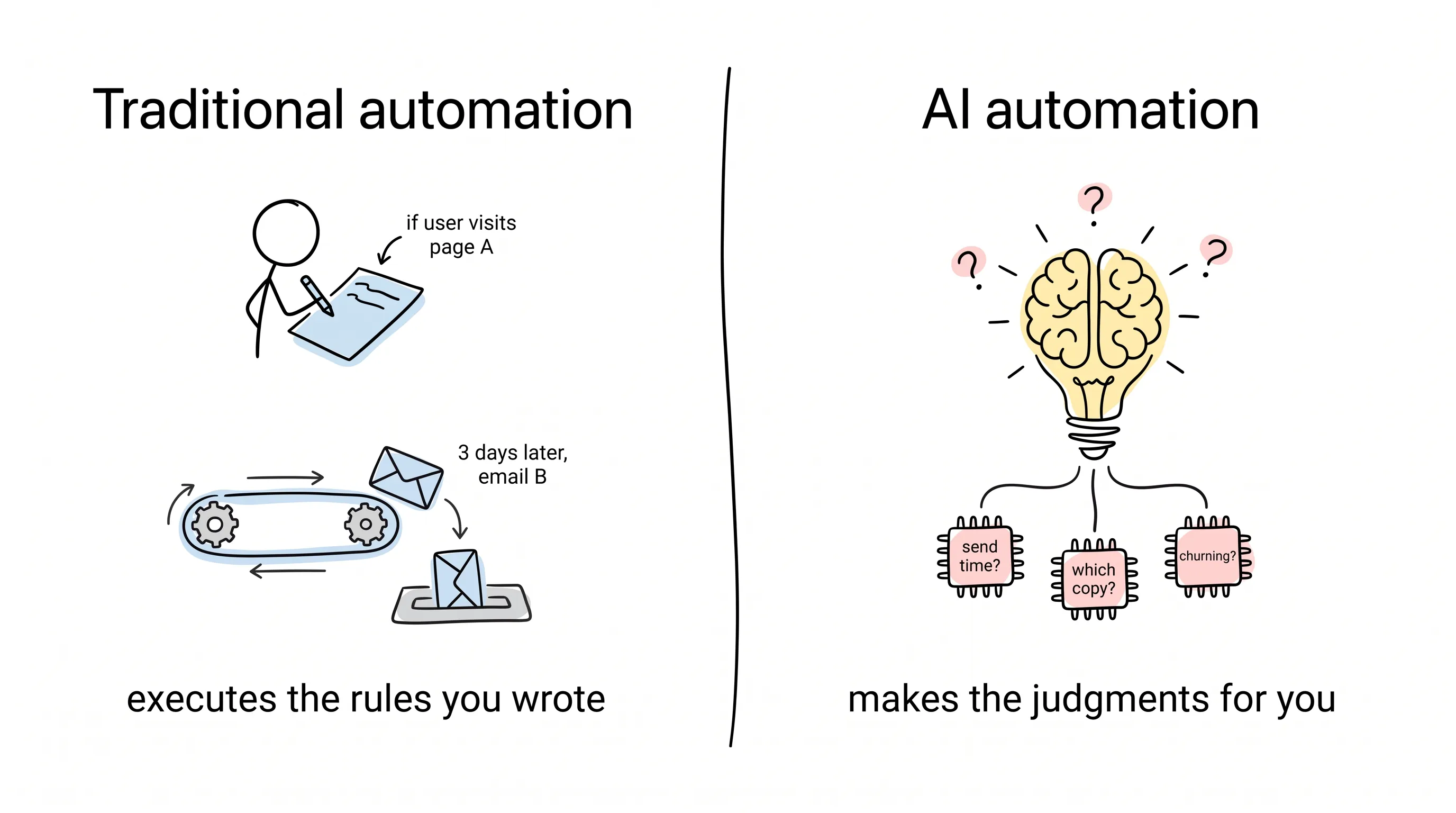
That sentence is the dividing line of this entire article. The differences among the five platforms below all grow out of it.
What Counts as "Enterprise-Grade"? I Ran It Through a Sieve First
"Enterprise-grade" is a phrase the SaaS industry has worn completely threadbare. Anyone can stamp those two words on a slide deck.
So before choosing, set the sieve. I gave my friend four criteria: a contact database of at least 50,000 records; native integration with your CRM (customer relationship management system — the central database of all your customer records); multi-team collaboration with real permission management; and finally, AI features that deliver quantifiable results in the field.
The first three are hard gates. The fourth is the real litmus test.
Because a large share of the platforms on the market are, at their core, if-this-then-that engines with a machine learning label stuck on the outside, used for nothing more than scoring leads. That kind of "AI" won't hold up in an enterprise setting.
After the sieve, five vendors are still standing: HubSpot, Salesforce, Adobe, ActiveCampaign, Braze.
Let's take them one at a time.
HubSpot Marketing Hub Enterprise: One Pot Carries Every Dish
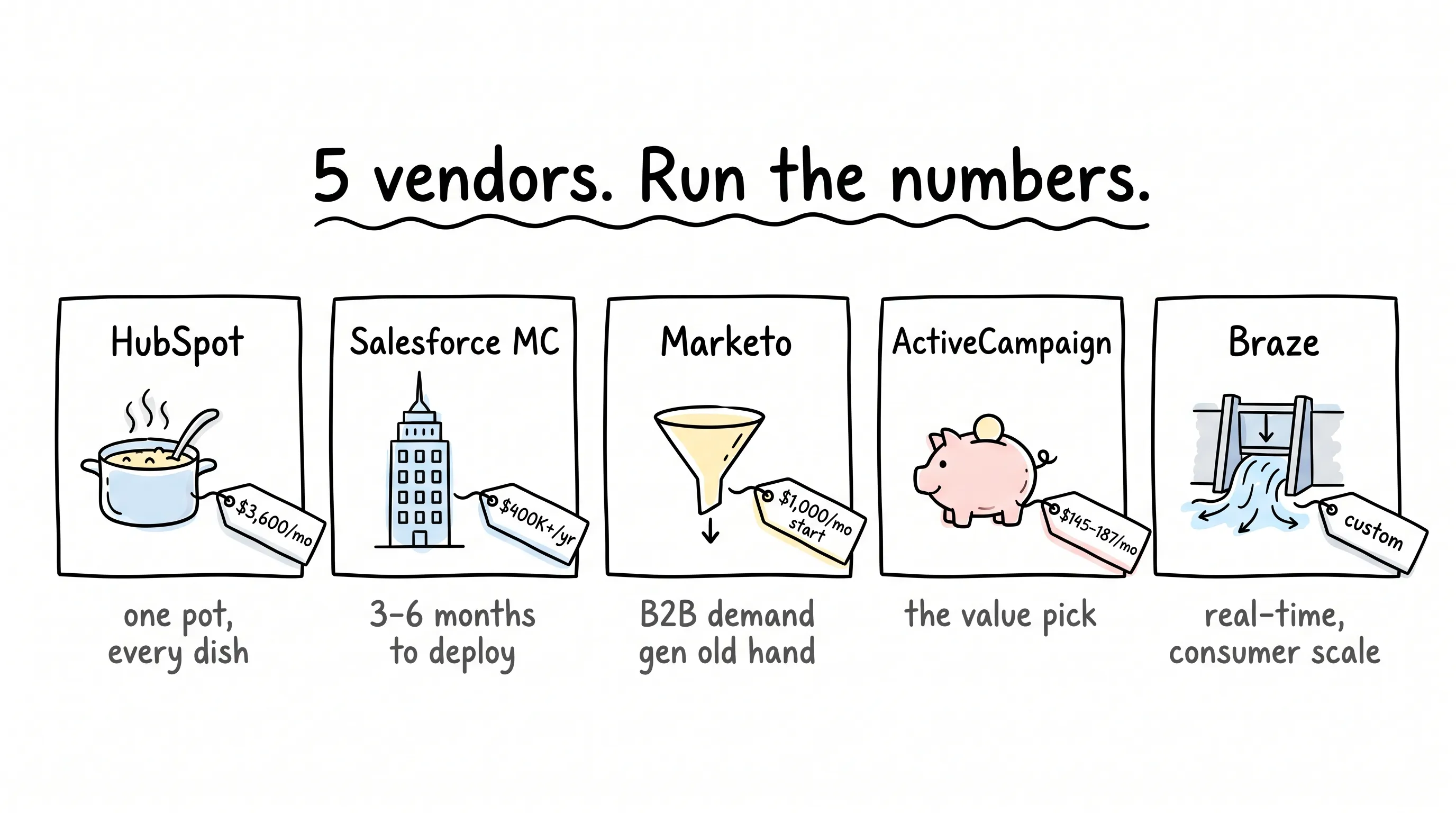
HubSpot's enterprise tier costs $3,600 a month and includes 10,000 contacts.
What are you buying? CRM, CMS, email, social media, automation — one platform covers it all. Its AI has genuinely matured in recent years: Content Assistant helps you generate and sharpen copy, ChatSpot lets you query your data through conversation, and the predictive scoring model draws on behavioral data and company profiles across the entire HubSpot ecosystem.
The connected data is especially rare. Marketing, sales, and customer service all looking at the same data — how many companies actually manage that?
But you should also know the cost of that convenience.
Once your contact count climbs, the price climbs steeply. Want deep customization? Salesforce is more flexible. Large B2B companies with genuinely non-standard data models will feel cramped living inside it.
My verdict: a company of 200 to 2,000 people that wants one-stop everything and can live by HubSpot's playbook — this is the smoothest road.
Salesforce Marketing Cloud: Complex, but Complex for a Reason
Salesforce Marketing Cloud — formerly ExactTarget — is the veteran player inside large enterprises.
Its Einstein AI spans the whole platform: send-time optimization, engagement scoring, product recommendations, journey analytics. How flexible is it? Almost any fiendishly complicated customer data structure can be modeled. Heavily regulated industries like finance and healthcare even get dedicated editions.
Sounds perfect?
First, the money. Enterprise contracts start at $400,000 a year. I won't even bother converting that into RMB — the figure itself already says its customer was never the small or mid-sized business.
Second, the time. Implementation typically takes 3 to 6 months, and you'll need professional consultants. The interface has improved a lot in recent years, but it remains complex.
So who should choose it? Enterprises with more than 100,000 customers that have already spent serious money on Salesforce CRM and can afford a dedicated marketing operations team. Three conditions — fall short on one and you'll feel it.
Adobe Marketo Engage: The Old Hand of B2B Demand Generation
In B2B demand generation, Marketo Engage has been the standard for over a decade.
After Adobe acquired it, it put on serious AI muscle. Sensei brings content recommendations, predictive audiences, and attribution modeling, plus account-based marketing (ABM — targeting entire companies rather than individual leads) capability that can go toe-to-toe with dedicated ABM platforms. And its signature strength remains the depth of its lead lifecycle management and nurturing logic. For B2B deals with long chains and many decision-makers, that logic is real craft.
The price? The Growth tier starts at $1,000 a month; enterprise contracts run well above that.
Two honest caveats: parts of the interface really are showing their age, and the email editor has needed a refresh for years.
B2B companies with long procurement cycles, long nurture sequences, and teams that live inside marketing data every day — pick this one.
ActiveCampaign Enterprise: Pricing That Feels Almost Unsporting
ActiveCampaign doesn't even try to package itself as a "Fortune 500" platform. Yet its enterprise tier runs $145 to $187 a month, covering 2,500 contacts.
What does that price buy? Predictive sending, predictive content, lead scoring — even a CRM thrown in. What would it cost to get Salesforce or Marketo to do the same things? Many times over.
Its visual automation builder is genuinely good — clear logic, easy to follow. Its AI predictions are accurate enough for most scenarios. Its deliverability (whether emails actually land in inboxes instead of spam folders) record has long been solid.
Of course, count the whole bill. Data environments above 500,000 contacts are beyond it. Reporting is improving but still trails HubSpot. Heavily regulated industries: proceed with caution.
Companies graduating from Mailchimp-level tools without the budget for HubSpot Enterprise or Salesforce — look here first. Quite possibly, this is your answer.
Braze: When Messages Flow Like Water, the Platform Must Work Like a Sluice Gate
The four above all carry, to some degree, a "marketing department" lens. Braze is different — it was born for real-time messaging.
Mobile push, in-app messages, email, SMS, web — every channel. Canvas Flow handles journey orchestration; Sage AI handles real-time segmentation, send-time personalization, and churn prediction. For consumer products with huge user bases and massive message volume, it is often simply the strongest option.
Fintech, gaming, e-commerce, media — its home turf.
But there are gates: implementation requires deep developer involvement; pricing is custom, and once message volume climbs, the bill gets seriously hefty. B2B and low-frequency messaging scenarios — stay out of this one.
Consumer apps, e-commerce, and media companies with large user bases that need real-time interaction — look at it.
Back to That Cup of Tea: No "Best," Only the Right Fit
After tea that day, I took the question back: which one, really?
The answer comes down to three variables: your current tech stack, the scale of your customer data, and whether you're B2B or B2C.
A finance app with 5 million users should look at Braze. A B2B SaaS company with 50,000 contacts almost certainly shouldn't. It's that simple.
But don't stop at the comparison table. Before signing an enterprise contract, run a structured pilot on your own real data. Most platforms offer 30-day trials or proof-of-concept programs. Choose metrics you genuinely care about: deliverability rate, conversion lift, operational hours saved. Don't trust a single checkbox on a feature list.
Oh, and one last reminder: enterprise contracts are negotiable — especially implementation fees and contact-tier pricing. Walk into that negotiation holding competitor quotes.
As he was leaving that day, my friend asked: what if I choose wrong?
I said: run it for a month on your own data, and you won't.
Tools make judgments about your customers for you. But choosing the tool — that judgment is still yours to make.
Continue reading
Related articles

Cross-Border Business: Time to Upgrade Your AI Toolbox
A learn article explaining how AI tools help cross-border e-commerce sellers clear five hurdles: language, regulation, logistics, payments, and fraud. It outlines a five-compartment toolbox, a five-step adoption path, and metrics such as conversion rate and CLV, while cautioning against over-reliance on AI.

AI Is Taking Over the Dirty Work of Social Media Marketing, One Task at a Time
This learn article outlines four social media marketing tasks AI can handle — audience analytics, content drafting and design, ad targeting and creative testing, and spam moderation — and cautions that taste, judgment, and data security remain human responsibilities.

AI Is Already This Good — Why Is Your Social Media Marketing Still Pure Manpower?
An overview of 18 AI tools for social media marketing, organized into six categories covering audience research, content creation, scheduling, comment and DM handling, ad management, and visual production, plus notes on personalization, prediction, and emerging trends.