
How to Choose a Marketing Automation Platform? Get Clear on Your Business First
A guide to choosing a marketing automation platform by business type, covering Klaviyo, Omnisend, HubSpot, Marketo, Pardot, ActiveCampaign, Brevo, and Mailchimp, plus pricing models, total cost factors, and AI capabilities.
A while back, I had dinner with a friend who runs a cross-border e-commerce business. He sells through his own store on Shopify, and in two or three years he's built it into a business with an annual turnover in the tens of millions.
Halfway through the meal, he pulled out his phone and asked me: "I'm about to buy a marketing automation platform. Which one should I get?"
I said there's no direct answer to that question.
He wasn't having it: "Don't you start dodging on me too."
I really wasn't dodging. The question itself is wrong. It's like asking me "which car should I buy" without telling me whether you drive for a ride-hailing service, do the school run, or haul cargo. There's no best car — only the right car for the job. Marketing automation platforms are the same.
Today, let's settle this properly. What exactly is marketing automation? The seven mainstream platforms — who is each one for? Where does the money actually go? And finally, that variable you can't get around in 2026: AI.
First, Let's Be Clear: What Exactly Is Marketing Automation
What is marketing automation?
Put simply, it means letting a system watch your customers' behavior for you and automatically trigger the next action.
A shopper adds to cart but doesn't pay — half an hour later, a reminder email goes out on its own. A new user signs up — on day three, a nurture email lands in their inbox. Someone keeps hovering over the pricing page — first thing the next morning, sales gets a lead alert.
You set the rules once, and it runs by itself. That's marketing automation.
It stopped being a nice-to-have a long time ago. Nearly half of all marketers use it; among mid-size B2B teams, that figure is 78%. It has become as essential as running water and electricity — table stakes.
Table stakes means you no longer agonize over "whether to adopt one" — only over "which one". And the market itself keeps snowballing: the global marketing automation software market is worth roughly $8.16 billion this year, projected to climb to nearly $15 billion by 2031.
So what's the answer to "which one"? It depends on another question.
What kind of business are you running?
Running E-commerce on Shopify: Klaviyo
If you're in e-commerce or D2C (direct-to-consumer), and your store lives on Shopify, the answer takes almost no deliberation.
Klaviyo.
Why? One word: fit.
About 67% of American D2C brands with 10 to 100 employees run on Shopify. Klaviyo and Shopify keep the product catalog, purchase history, and inventory status in real-time sync. A customer places an order at 3 a.m. — the event hits the system instantly, and the workflow fires right away. General-purpose platforms sync through API integrations, always half a beat behind.
Most of the money in e-commerce automation comes from behavior triggers. For mature e-commerce teams, that piece accounts for sixty to eighty percent of automation revenue. So the first criterion for an e-commerce platform isn't a long feature list — it's how fast and how accurately events get processed. On that front, Klaviyo is the ceiling: it handles more than 2 billion events a day. In the benchmark data it published in 2023, its abandoned-cart recovery emails averaged a 50.5% open rate and a 3.33% conversion rate.
Fifty point five percent. Let that sink in. What's the open rate on the posts you so carefully craft for your social feed?
But.
Klaviyo has two soft spots.
First, price. Billing is per active contact — the bigger your list and the more often you send, the steeper the bill climbs. In February 2025 it changed the rules so that only contacts who actually receive an email get billed. For stores sitting on big dormant lists, that's a relief; for large stores sending at high frequency, the pressure is still very real. Paid plans start at $45 a month.
Second, it only understands e-commerce. If you're B2B, don't even look at it.
One more signal worth chewing on: over the past year, Klaviyo's customer growth was just 5.1%, below the market average. The Shopify-era land grab is over, and challengers like Omnisend and Brevo are picking off small and mid-size customers from below.
Which brings us to the next one.
The Value Pick in E-commerce: Omnisend
Business still early, lifecycle flows still simple, and you'd rather not take on a Klaviyo-size bill on day one? Take a look at Omnisend.
The free tier gives you 250 contacts and 500 emails a month, with all automation workflows unlocked. Pro is $59 a month for 2,500 contacts, with unlimited email sends.
Yes — unlimited.
Its welcome-flow templates hold their own. By Omnisend's own data, welcome series generate far more revenue than ordinary promotional emails. For a new store's cold start, getting the welcome flow running first is the highest-ROI move available.
The weak spot is scalability. The event architecture doesn't go very granular, there's no customer lifetime value prediction or similar modeling, and the integration ecosystem is narrower than Klaviyo's. If your business is simple, it's enough. If your business grows fast, you'll hit its ceiling first.
Mid-Market B2B: HubSpot
Now, a different kind of business. You're in B2B — SaaS or services — with annual revenue between $1 million and $25 million.
The most commonly recommended platform at this level is HubSpot Marketing Hub. As far back as 2023, it alone held about 37% of this category.
When B2B picks a marketing automation platform, what's the number-one criterion? That it's fused with your CRM.
Think about it: B2B deals take a long time and involve many decision-makers, and marketing has to hand off cleanly to sales. If your marketing tool holds one set of data and your customer data lives in another, and the two never reconcile, automation just spins its wheels. HubSpot puts CRM, email, landing pages, lead scoring, and reporting in a single interface — a marketing team of 3 to 15 can get it running without hiring an implementation consultant.
Its trap, as ever, is money — specifically, the money that shows up after you grow.
Professional tier: $890 a month at 2,000 contacts; $5,890 a month at 100,000 — same tier. And there's a mandatory $3,000 onboarding fee for new customers that you cannot dodge.
Picture it: you come back from a trade show with a stack of scanned leads, import them all excitedly — and then the bill arrives. That gut-drop moment plays out at countless companies every year. If your list is growing fast, run the contact-tier math before you sign.
Where HubSpot is placing its bets now is Breeze, its AI suite: content generation, predictive lead scoring, agentic execution. More on that later.
What about growing beyond that? Companies with thousands of employees and a dedicated marketing-ops team on payroll — many of them migrate to Marketo or Pardot.
Enterprise: Marketo and Pardot
At the enterprise level, the selection logic changes. The question shifts from "which features are nice" to "which system can handle the CRM I already run".
Ninety-five percent of large enterprises are already using marketing automation this year. At this level, the only contest left is whose ecosystem you follow.
Is your company rooted in the Salesforce ecosystem? Then Pardot (now called Salesforce Marketing Cloud Account Engagement) is the standard answer. The Growth tier is $1,250 a month including 10,000 contacts, and higher tiers run up to $15,000. Note the fine print: you must already hold a Salesforce CRM license. A 10-person team can easily spend more than $30,000 in the first year.
What you get in return is zero-latency fit with the CRM, and pipeline visibility clear down to every stage.
Not in the Salesforce camp? Or already past $15 million in revenue and starting to play with account-based marketing (ABM)? Then look at Adobe Marketo Engage. Multi-touch attribution, advanced segmentation, massive data volumes — heavyweight capabilities only enterprises can put to use.
But Marketo's barrier to entry is half money, half people.
The money half: it starts at around $895 a month; a database of 100,000 contacts runs $2,500 to $3,500 a month — and that's before implementation. Implementation fees run $10,000 to $50,000, with a 60-to-90-day go-live.
The people half: it demands a marketing-ops lead who genuinely knows the craft. Without that person, Marketo becomes an expensive stranded asset. How many companies buy enterprise tools and end up using them to blast a monthly newsletter? Honestly — if you don't have a dedicated person, look at HubSpot's enterprise tier first. Don't force it.
Small and Mid-Size Teams on a Budget: ActiveCampaign and Brevo
These next two reflect the reality of most small and mid-size teams: limited budget, long list of wants.
First, ActiveCampaign. What it sells is the most automation depth per dollar.
It starts at $15 a month, with a visual workflow canvas plus more than 900 ready-made automation templates — welcome sequences, churn win-backs, cross-sells — tweak and go. A mid-size team can run it just fine without hiring dedicated marketing ops.
The trap is the same one HubSpot has: per-contact billing with steep tiers. At 10,000 contacts, the Plus tier is about $174 a month. Also, once your workflow library grows, governance — naming conventions, exclusion logic — has to keep up, or a few months in you won't be able to untangle it yourself.
One more move worth watching in 2026: in April 2025 it acquired Hilos, a Mexican company, adding WhatsApp automation and placing its bets on Latin America and the Spanish-speaking market. If your business is in Brazil or the Spanish-speaking world, that goes straight onto the plus column.
Then Brevo. Its superpower is a single pricing rule: billed by send volume, not by stored contacts.
What does that mean? Your list can be as big as you like — no per-contact headcount fee. You pay only for the emails you actually send.
Let's do the math. Fifty thousand contacts, mailed twice a month: Brevo comes to about $69 a month. On a per-contact-billed platform, the same scenario typically starts north of $250.
More than three times the price.
The free tier doesn't even cap contact count, it comes with a built-in CRM, and all three channels — email, SMS, WhatsApp — are included. Entry pricing is around $9. For a budget-tight startup, that's practically free.
The weak spot is depth. On behavioral event architecture and predictive AI, it's no Klaviyo; on CRM muscle for complex B2B sales chains, it's no HubSpot. It fits teams that want omnichannel reach, want to save money, and accept trading depth for price.
One market signal on the side: in June this year, an analysis covering more than 5 million business sending-domain records put Brevo near the front for customer growth, while Mailchimp took first place in absolute new volume. Brevo's strongest turf is Europe: 42% of the email marketing market among French local SMBs, and 33.7% of Germany's CRM market — both leaving Mailchimp far behind.
The One-Person Company: Mailchimp
This last one is many people's first.
Mailchimp.
A drag-and-drop editor, a free tier of 250 contacts and 500 sends a month, plus the familiarity of that monkey mascot. Solopreneurs who do everything alone almost all start here.
But. Starting early this year, the free tier is capped at 250 contacts, and automation features are no longer included. The free plan is basically batch-and-blast — automation is out of the question.
And "outgrowing it quickly" is the shared experience of nearly every Mailchimp user. Teams that need advanced segmentation, event-level data, or more integrations eventually migrate to ActiveCampaign, Brevo, or Klaviyo. It's a perfectly good starting point. Just don't treat it as the destination.
Now, Let's Total Up the Real Cost
That was the price list. Now let me single out the trap people step in most easily.
When choosing a platform, you're staring at the monthly fee. The real bill goes far beyond the monthly fee.
Implementation, data migration, list cleaning, team training, ongoing optimization afterward — added together, these usually eat another 20% to 50% of your first-year budget. Implementation timelines vary just as widely: with the Brevo and Mailchimp types, you can send your first email in a day or two; mid-size platforms take one to three weeks; at the level of HubSpot Professional, Marketo, and Salesforce Marketing Cloud, plan on 60 to 90 days.
A day or two, versus ninety days. Two different species in the same category.
So before you sign, do one thing: project your list size and sending frequency 12 and 24 months out, and price out the total under both models — per-contact billing and per-send billing.
The rule of thumb: a list over 20,000 with fewer than two sends a week means the volume-billed Brevo types will most likely cost less in total. Flip it around — small list, high send frequency — and per-contact billing is actually the better deal.
A small piece of arithmetic can keep you out of the next two years' budget black hole.
Hold On — You Might Not Need to Buy Yet
Having come this far, I have to pour a bucket of cold water.
Not every company needs marketing automation right now.
Startup teams especially. I've watched too many early-stage companies build stacks of elaborate automation flows before their product messaging was even validated. The more elaborate the flows, the higher the maintenance cost — until in the end they become legacy code nobody dares to touch.
Automation is an amplifier. It amplifies what already works; it does not fix what doesn't.
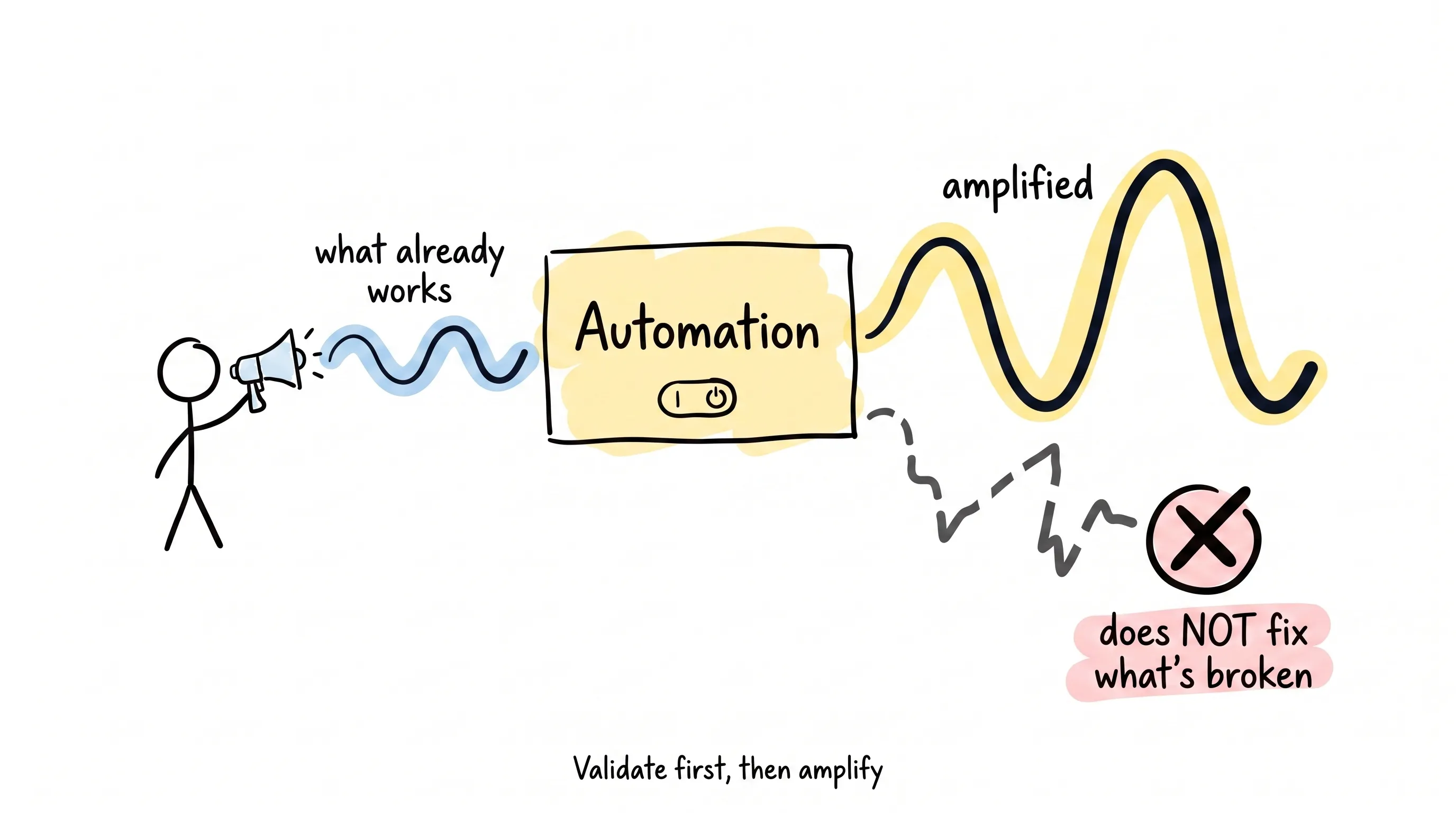
When should you get on board? Here's a bright line to judge by: your messaging is validated, and at least two channels are steadily bringing in inquiries.
Until then, two or three core flows on cheap tools is enough. A welcome sequence, plus a churn win-back. Then watch open rates, click rates, and conversion rates; once the data shows a trend, add more flows.
Validate first, then amplify. Get the order backwards and you burn both money and time.
Finally, That Variable You Can't Get Around in 2026: AI
Back to that dinner at the beginning. My friend's parting question: what about AI then? Don't all these platforms claim to have AI?
Good question. In 2026, AI inside these platforms comes in roughly three layers.
Layer one: content assistance. It helps you write subject lines, draft copy, assemble campaign briefs. This layer is already everywhere — practically everyone has it.
Layer two: prediction. Churn probability, time of next order, customer lifetime value, optimal send time. Klaviyo's predictive models are the poster child for this layer — e-commerce teams lean on them the most.
Layer three: agentic execution. The AI judges the next action itself, drafts the content itself, executes across channels itself — humans only confirm. HubSpot's Breeze, Salesforce's Einstein, and Marketo's AI are all moving toward this layer.
But this layer is the least mature right now. The vast majority of teams today still use AI only to write copy — nowhere near letting AI run campaigns autonomously. Whoever puts layers two and three to work first gets to pull their people out of repetitive labor.
And there's one deeper shift, worth calling out on its own.
Traditional marketing automation governs only "channels you control yourself": email lists, SMS, on-site messages. But customers in 2026 increasingly go straight to ChatGPT, Perplexity, or Google's AI search and ask: "Which of these tools is good?" Whether you show up in the answer is beyond the reach of even the most beautifully written email.
This is the shared blind spot of almost every marketing automation platform today: no tool tracks where your content gets cited or seen across AI entry points. That game has only just begun.
Back to That Dinner
Done writing. Back to my friend's question: which one to buy?
Now I can answer him.
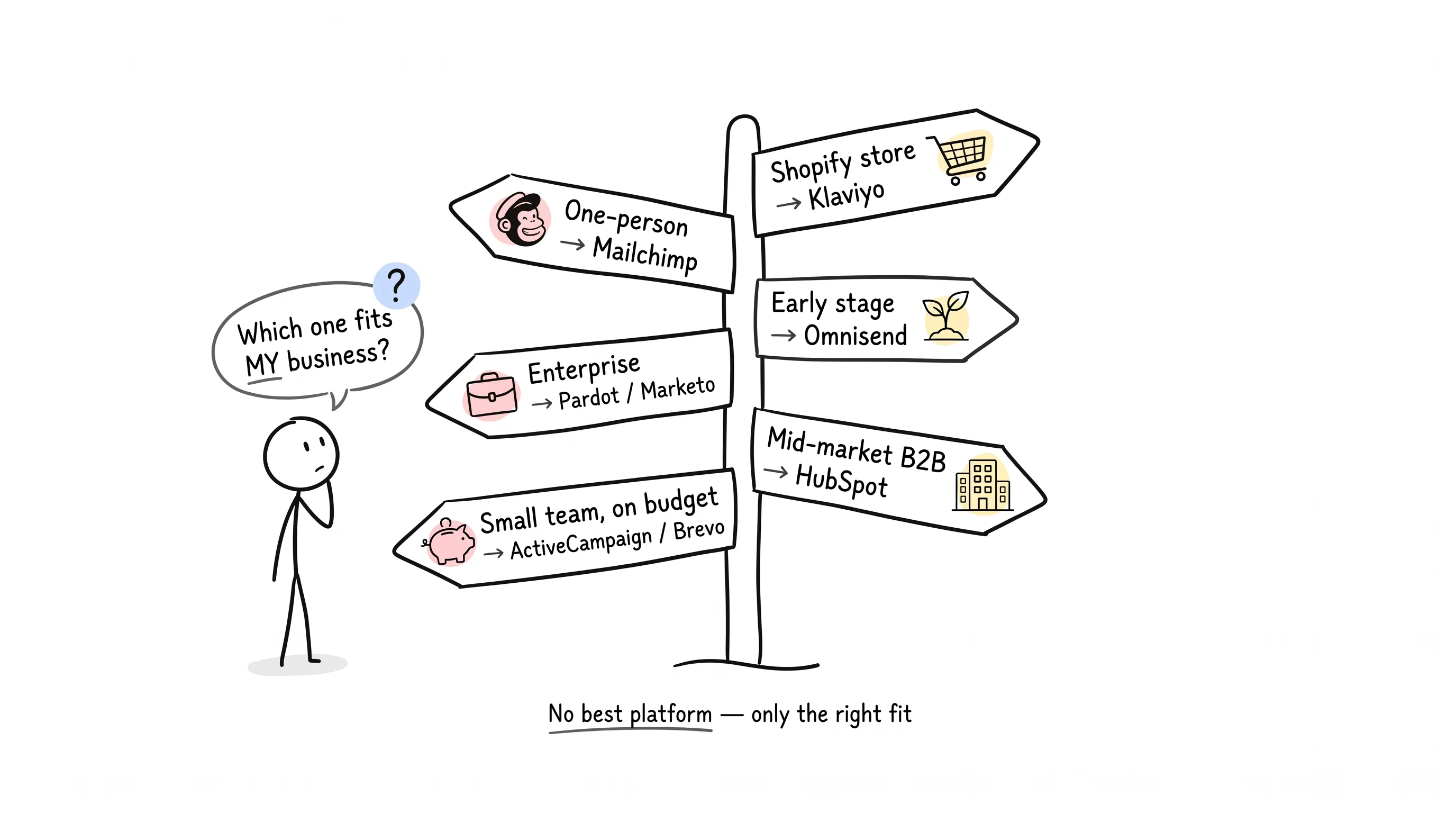
Shopify e-commerce with the budget for it? Go straight to Klaviyo. Early-stage business? Start with Omnisend. Mid-market B2B: HubSpot. Grown into enterprise scale: Pardot if you're in the Salesforce camp, otherwise Marketo. Small and mid-size teams on a budget: ActiveCampaign for depth, Brevo for savings. One-person company: start on Mailchimp — just don't linger.
There is no best platform — only the one that fits your business tightest.
And one more important reminder: get clear on the business first, then pick the tool. A tool can't fix the problems of the business itself.
By the end of that dinner, his food had gone cold, and he was still taking notes. He said if he'd heard all this six months earlier, it would have saved him tens of thousands in tuition.
Here's hoping you never have to pay that tuition.
Continue reading
Related articles

Cross-Border Business: Time to Upgrade Your AI Toolbox
A learn article explaining how AI tools help cross-border e-commerce sellers clear five hurdles: language, regulation, logistics, payments, and fraud. It outlines a five-compartment toolbox, a five-step adoption path, and metrics such as conversion rate and CLV, while cautioning against over-reliance on AI.

AI Is Taking Over the Dirty Work of Social Media Marketing, One Task at a Time
This learn article outlines four social media marketing tasks AI can handle — audience analytics, content drafting and design, ad targeting and creative testing, and spam moderation — and cautions that taste, judgment, and data security remain human responsibilities.

AI Is Already This Good — Why Is Your Social Media Marketing Still Pure Manpower?
An overview of 18 AI tools for social media marketing, organized into six categories covering audience research, content creation, scheduling, comment and DM handling, ad management, and visual production, plus notes on personalization, prediction, and emerging trends.