
How to Choose a Marketing Automation Platform: Five Major Players, Explained Once and For All
A long-form guide to choosing a marketing automation platform, comparing Infobip, HubSpot Marketing Hub, Salesforce Marketing Cloud, Adobe Marketo Engage, and Braze on data unification, channel orchestration, usability, integrations, and total cost of ownership, along with common selection pitfalls.
A while back, an old friend of mine who runs a home-goods e-commerce business invited me to dinner. We weren't even halfway through the meal when he started venting.
His team is small — seven or eight people — and they work email marketing hard: two promotional sends a week, guaranteed blasts on every holiday, subject lines rewritten again and again, images swapped out version after version. And yet their customers kept getting quieter, like the tide going out.
I asked him one question: do your customers all live in email?
He paused for a beat.
I said, go back and get one question straight first: where do your customers actually live? Email, SMS, or WhatsApp? And is your marketing living in just one channel?
After that dinner, I went ahead and combed through the whole subject of marketing automation from start to finish: what it actually is, how to choose a platform, and where each of the five mainstream players — Infobip, HubSpot Marketing Hub, Salesforce Marketing Cloud, Adobe Marketo Engage, Braze — shines and stumbles. Here it is, all in one read.
What Exactly Is Marketing Automation?
Put simply, it's a system that triggers actions automatically based on customer behavior.
Picture this scene. A customer adds a product to the cart, doesn't check out, and leaves.
What's the traditional play? A couple of days later someone looks at a report, notices the order is gone, sighs, and lets it go.
The automated play: the moment a cart is abandoned, the system sends a reminder email within minutes; if it goes unopened, a text message follows two hours later; if that gets no response, a limited-time coupon arrives a few days later on the customer's preferred channel. Nobody babysits any of it, and tens of thousands of customers are running through flows at the same time.
Mass messaging is broadcasting. Automation is conversation.
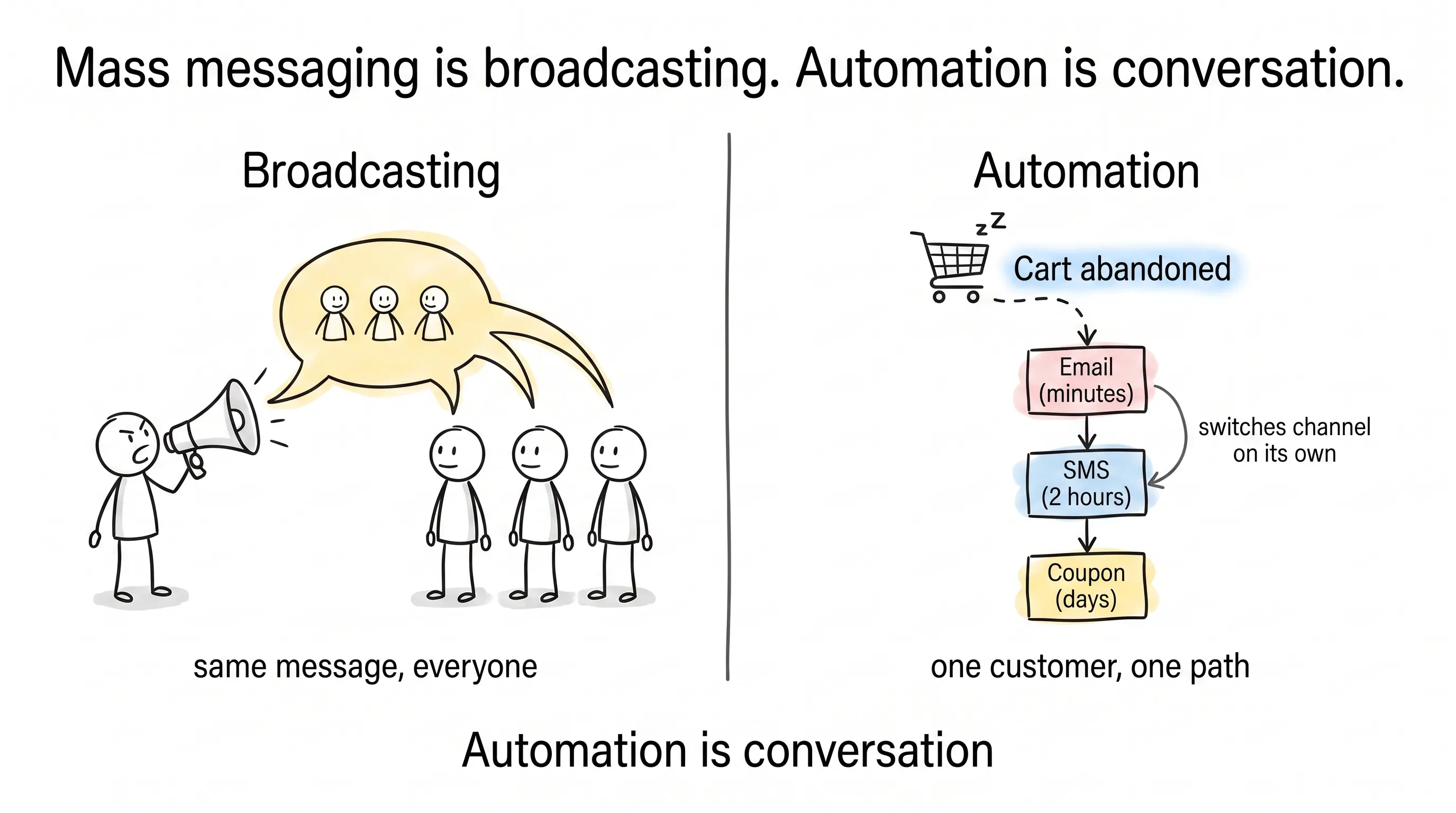
Email marketing is one-to-many: one email, a batch of recipients, delivered all at once, all identical. Marketing automation is one-to-one: what each customer receives, when, and through which channel is decided by their own behavior.
Why You Can't Afford to Wait
Let me run a few numbers by you — all widely circulated figures in the industry.
The first is the reach bill. Email open rates average 20% to 30%, while SMS reach rates can hit 98%. What does that mean? If email is your only channel, more than half your customers are unreachable from the very start. Your effort is discounted from the very first send.
The second is the money bill. One set of figures says customers who interact with a brand across multiple channels have a 30% higher lifetime value than single-channel customers. The logic isn't complicated: wherever your customers are, you can find them there; and if you can find them on every channel, they're naturally more willing to come along.
The third is the time bill. Teams using automation save an average of 6 hours a week on repetitive work. Segmenting lists, scheduling sends, chasing progress — machines do these jobs faster and never complain. Spend the saved hours on strategy and creative. That's what humans are for.
And one more: companies that genuinely put marketing analytics to work saw sales productivity rise 14.5% and marketing overhead fall 12.2%.
These figures come from different sources and not all of them will be exact, but the direction is consistent. The debate over whether to do marketing automation is long over. The questions now are: how to do it right, and how to choose right.
And the cost of choosing the wrong platform is bigger than you think: months of implementation time poured down the drain, a team ground down by hard-to-use processes, revenue opportunities leaking away for nothing.
Choosing a Platform: Five Things That Actually Matter
There's no shortage of platforms out there, and every feature table is longer than the last. But take my advice: the feature checklist is precisely the least important part. What you should really look at are the five things below.
1. Can customer data be unified in one place?
This is, to my mind, the most important criterion — and the easiest one to overlook.
What does unified data mean? Your marketing engagement history, your sales follow-ups, your support tickets, your e-commerce orders — all in the same pool. Which emails a customer clicked, what they bought, what they complained about: all of it visible when decisions get made.
Many platforms are the exact opposite: one system for email, another for SMS, another for WhatsApp. Three data sets, three contact lists, none of them reconcilable with the others. The result: a customer has just finished arguing with your support agent, and the very next moment receives one of your effusively cheerful promotional emails.
2. Channel coverage — and the ability to orchestrate
Covering lots of channels isn't the skill. Orchestration is what counts.
What's orchestration? The customer didn't open the email, so the system switches to SMS on its own; they clicked a link, so you follow up on the channel they actually use. One workflow adjusts itself across channels — instead of you manually coordinating timing across three systems.
When evaluating, make a checklist: which channels do your customers actually use? Email and SMS are table stakes — what about WhatsApp, RCS (Rich Communication Services, the upgraded messaging channel on Android phones), push notifications, social media? Customer preferences shift; can the platform keep up?
3. Can it be both easy and powerful?
The marketing folks need to be able to drag and drop their own workflows without lining up for developer time; the developers need APIs and hooks to wire custom logic in.
With only the former, complex scenarios are out of reach; with only the latter, marketing files tickets all day. You need both. Template libraries count under this criterion too: for common scenarios like welcome series and cart-abandonment recovery, ready-made templates get you started a lot faster.
4. Integrations and modularity
Your platform is not an island. It has to connect to your CRM — Salesforce, HubSpot, Microsoft Dynamics and the like — to your e-commerce stack, Shopify, Magento, WooCommerce, and then to your support, order, and inventory systems. Otherwise what happens? The promoted item has sold out, and the messages keep going out.
Native integrations first. Third-party connectors work in a pinch, but they're slow and prone to dropping the ball.
Modularity is a bonus: start with email and SMS, add WhatsApp once volume picks up, connect the support center next year. No need to go all in on day one.
5. Pricing — or, more precisely, total cost of ownership
This is the one I most want to flag for you.
Many teams look only at the monthly fee and end up tripping over hidden bills. Here's the list of items some platforms charge extra for: implementation and onboarding training, support beyond the base ticket quota, API calls over the limit, seats beyond the base allowance, data storage — and features your business genuinely needs that are gated behind the premium tier.
Usage-based pricing is usually more honest than fixed packages: pay for what you use, it doesn't hurt when volumes are small early on, and it won't cap you when volumes take off.
Before buying, factor in implementation time, training costs, and ongoing maintenance. Do the math on the total — not just the monthly fee. Implementation timelines vary enormously: a simple email-only platform can be running in days; omnichannel plus CRM integration usually takes 4 to 12 weeks; big projects with compliance requirements and custom development routinely take months. Press a little harder, too: if your list grows tenfold, what happens to the price? Can it take the traffic spikes of a big sale?
Oh, and one hidden dimension: AI. Send-time optimization, automatic channel recommendations, automatic identification of high-value segments — these capabilities are moving from nice-to-have to standard. It's worth asking one separate question during evaluation: is your AI bolted on the surface, or grown into the data?
Five Platforms, Five Playbooks
The framework is set — now aim it at the five mainstream platforms. Every one of them plays a different game.
Infobip: the full-stack player. It builds marketing automation, communications platforms (CPaaS — communications platform as a service), and a customer data platform on the same layer. Its trump card is the network: 9,700+ global connections reaching 7 billion people, with SMS, WhatsApp, RCS, email, voice, and chat apps all native channels. Because massive message volume flows through its own network, its AI is fed on real interaction data. Which channel to pick, what time to send, what to send — optimized against behavior patterns across the whole network, not just your own historical data. 40+ data centers, something companies with compliance-sensitive, multi-market operations will value. Modular architecture, usage-based pricing, and most customers get their first workflows running in 2 to 4 weeks. A fit for mid-size and large companies that need global reach and want marketing, sales, and support data connected.
HubSpot Marketing Hub: the everything-under-one-roof player. Inbound marketing, CRM, content management, SEO — all under one roof. Easy to pick up, rich with templates, and there's a free tier to try before you commit. For teams just starting out the barrier is nearly zero: follow the templates and you're running. The weaknesses are in plain sight too: SMS and WhatsApp capabilities are weaker than a dedicated communications platform's, orchestration revolves mainly around email and web; and, what stings more, the moment your contact list grows, the bill grows with it. A fit for small and mid-size businesses that lean content- and lead-heavy.
Salesforce Marketing Cloud: the deeply-wired player. Data flows between it and Salesforce CRM at the native level; Einstein AI produces the predictions, Journey Builder handles multi-step orchestration. For companies already heavily invested in the Salesforce ecosystem, it's the natural choice. But you pay three prices: a long implementation cycle, a steep price tag, and a steep learning curve. Without a dedicated marketing operations team, it's hard to use well. A fit for large enterprises inside the Salesforce ecosystem, especially SaaS companies with complex customer journeys.
Adobe Marketo Engage: the B2B specialist. Lead scoring, lead nurturing, ABM (account-based marketing), revenue attribution — the heavy lifting of long sales cycles is its home turf, and its integrations for event marketing and webinars are strong too. The costs: pricing sits at the high end of the industry, it takes dedicated operations staff to unlock its power, and the interface looks its age beside a wave of newer products. A fit for B2B companies with long sales cycles and many decision-makers.
Braze: the mobile-first player. Its real-time messaging engine is the signature: customer data comes in, triggers fire with near-zero latency. Push notifications and in-app messaging are finely crafted, and the experimentation framework is complete — run multivariate tests to your heart's content. But it makes real demands on technical resources, and implementation requires deep developer involvement. If your company has no app — or runs mainly on email — you can essentially rule it out. A fit for B2C brands whose app is the main battlefield.
Impressive lineups, every one — yet not a single all-around champion among the five.
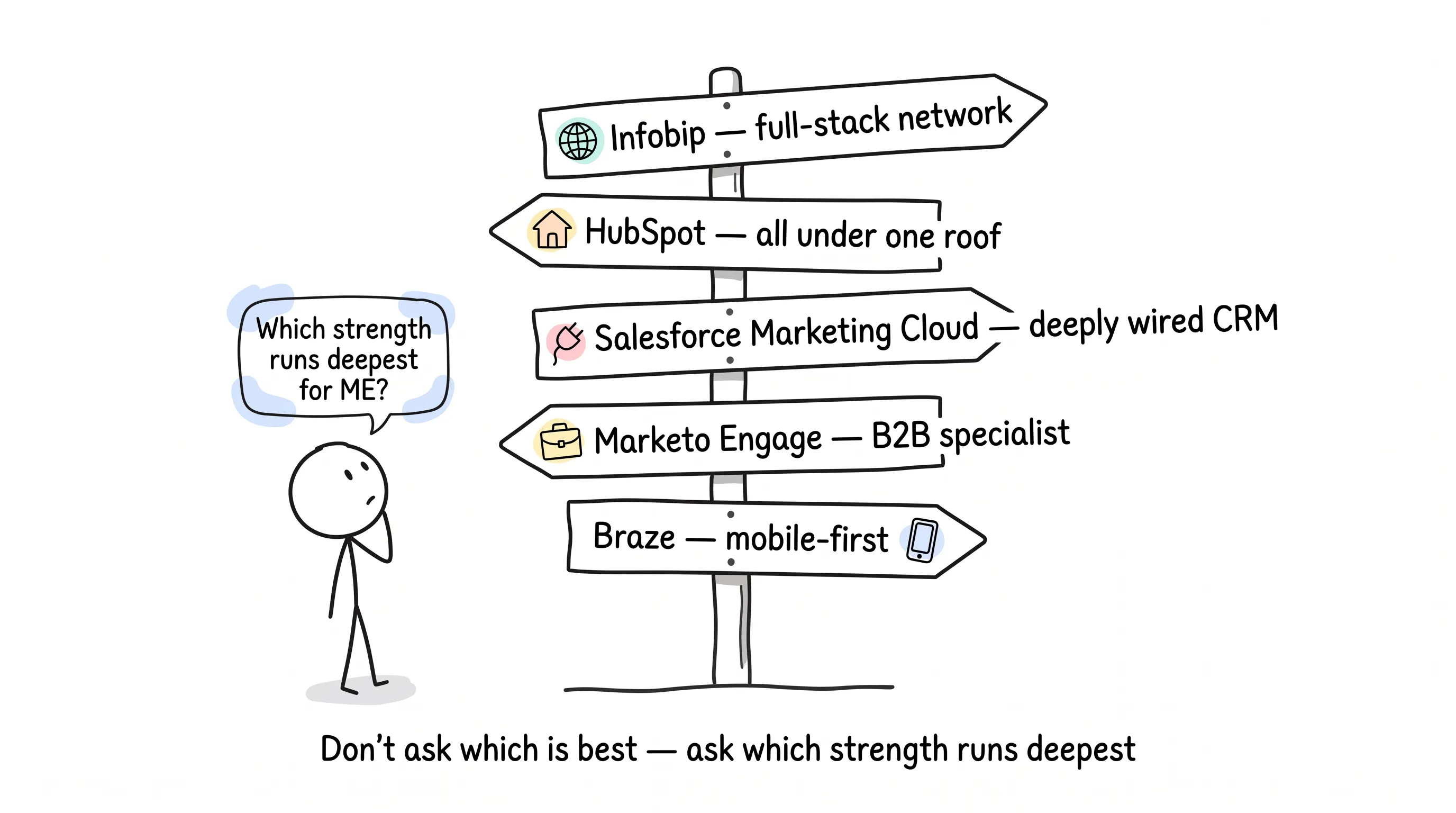
See the pattern? Each one trades on its deepest strength to win its market: Infobip's depth is network and omnichannel, HubSpot's is ease of use and ecosystem, Salesforce's is CRM, Marketo's is B2B, Braze's is mobile.
So don't ask which is best. Ask: in my scenario, which strength runs deepest?
Five Pitfalls: Don't Step in a Single One
There are five pitfalls on the selection road. I'll take them one at a time.
Pitfall one: buying for today's needs only. You only need email right now, so you pick a tool that only does email. Six months later you need WhatsApp and push — can't add them, have to replace the whole thing. The migration bill is frightening: money for the new platform, time for implementation, moving the data, rebuilding the workflows, retraining the team, plus all the productivity that leaks away during the switchover. Before buying, think 18 to 24 months out: how will your channels expand? How much will your list grow?
Pitfall two: treating your existing systems as the enemy. Some people buy a new platform aiming to "rip out all the old systems." You won't be replacing them. Your CRM holds data your sales team uses every day, your e-commerce system is processing orders, your support system is taking complaints. These systems don't need to be replaced; they need to be connected to marketing automation. Before you place the order, verify: is it a native integration, or a third-party connector in a native costume? Does data sync in real time, or land a day late?
Pitfall three: building complex flows on day one. A new tool lands and excitement takes over: every customer scenario gets drawn into the flow map — 20-plus touchpoints, dozens of conditional branches. Flows like this almost always shatter: when something breaks you can't trace it, the team can't read it, and there's no place to start optimizing. The right move is to run the few flows that have best stood the test of time: welcome series, cart-abandonment recovery, dormant-user win-back. Once those run smoothly, add triggers, add personalization, add channels. Simple but precisely aimed flows convert better, in fact.
Pitfall four: letting go after launch. Automation is not autopilot. Customers change, markets change; the subject line that worked last quarter may go silent this quarter. Set KPIs and baselines before launch, review at least once a month, watch key campaigns weekly. Make A/B testing routine: subject lines, content, send times, offer depth — test them one by one. Let the data talk, not your gut.
Pitfall five: assuming enterprise-grade platforms aren't for you. Many small teams won't even look at the big platforms, figuring those are playthings for the elephants. But most enterprise-grade platforms today support modular adoption: start with email and SMS, templates are ready-made, pay by usage, add capability as you grow. The real question isn't "how big am I" but "how big will I need to be in 18 months." If channels will expand, markets are heading overseas, personalization needs to level up — choosing a platform that can carry the load now beats moving house a year from now by a wide margin.
What Happens Next
Finally, a word on direction. Four trends worth writing down.
First: AI is starting to write copy for everyone. The same product message becomes parameter detail for technical buyers, a comparison list for the price-sensitive, a materials story for the eco-minded. One product, N versions of the pitch, generated automatically by machine. One step further are conversational AI agents: they don't follow a script, they understand intent, they steer the conversation toward the goal — and the brand voice never slips. In the past, you couldn't have bought that with several times the budget.
Second: prediction shifts from reading reports to seeing the future. Predict which new customer holds the most long-term value, and tilt acquisition budget their way; spot customers about to churn early, and retention actions fire automatically; who to nudge with what next — the system simply tells you.
Third: personalization gets fine-grained down to "this very moment." Reading on your phone on the subway? The copy gets shorter and the buttons get bigger. What arrives in the daytime differs from what arrives at night. Browse a product, and the very next touch follows it.
Fourth: the walls between marketing, sales, and service are coming down. Customers don't care how you divide the work internally; they only want consistent service. Support can see their marketing interactions, sales knows what content they've read, and whatever the bot can't resolve gets handed to a human with zero context lost.
Notice anything? All four trends point at the same thing: whoever unifies customer data first, whoever builds omnichannel orchestration first, eats the AI dividend first.
For companies whose data isn't unified, even the strongest AI can only stare helplessly at one isolated island after another.
One Last Thing
The friend from the beginning of this article — what happened to him?
He went back and did three things: first listed the channels his customers actually use, then screened platforms against the integration checklist of his existing systems, and finally did the math on the total, not the monthly fee.
He told me later that just getting the cart-abandonment flow running smoothly recovered a good chunk of the orders that had been leaking away. Those weeks of wrangling were worth it.
The answer to choosing a platform was never hiding in some feature table.
It lives in your customers.
May every message you send reach the person who's waiting to hear from you.
Continue reading
Related articles

Cross-Border Business: Time to Upgrade Your AI Toolbox
A learn article explaining how AI tools help cross-border e-commerce sellers clear five hurdles: language, regulation, logistics, payments, and fraud. It outlines a five-compartment toolbox, a five-step adoption path, and metrics such as conversion rate and CLV, while cautioning against over-reliance on AI.

AI Is Taking Over the Dirty Work of Social Media Marketing, One Task at a Time
This learn article outlines four social media marketing tasks AI can handle — audience analytics, content drafting and design, ad targeting and creative testing, and spam moderation — and cautions that taste, judgment, and data security remain human responsibilities.

AI Is Already This Good — Why Is Your Social Media Marketing Still Pure Manpower?
An overview of 18 AI tools for social media marketing, organized into six categories covering audience research, content creation, scheduling, comment and DM handling, ad management, and visual production, plus notes on personalization, prediction, and emerging trends.