
How Sprout Social Caught the Influencer Marketing Business
An analysis of Sprout Social's 2025 rebrand of its influencer marketing platform, covering market figures, adoption challenges, AI features, and market reaction. It also weighs what platforms can and cannot solve for brands working with creators.
A while back, I had dinner with a friend who runs a consumer goods business.
He sells mother-and-baby products on a tight budget, and he scrutinizes every dollar of ad spend. The dinner had exactly one topic on the agenda: is paying influencers to move product actually worth it?
Halfway through the meal, he pulled out his phone and showed me a news story.
In February 2025, a company called Sprout Social (Nasdaq: SPT) officially rebranded its influencer marketing platform as Sprout Social Influencer Marketing. The platform's previous name was Tagger Media, one it had previously acquired.
Just a name change — does that really warrant its own press release?
It does. Because this business is far bigger than most people realize.
First, Let's Run the Numbers
What exactly is influencer marketing?
Put simply: a brand pays someone with a following to speak on the brand's behalf, on that person's own turf.
How big is this business? The announcement contained a few figures — let me walk you through them one by one.
Nearly half of consumers make a purchase at least once a month because a post from an influencer landed on their feed.
Eight out of ten marketers admit that influencer content converts better than the material they publish themselves.
The industry is projected to reach $199 billion by 2032.
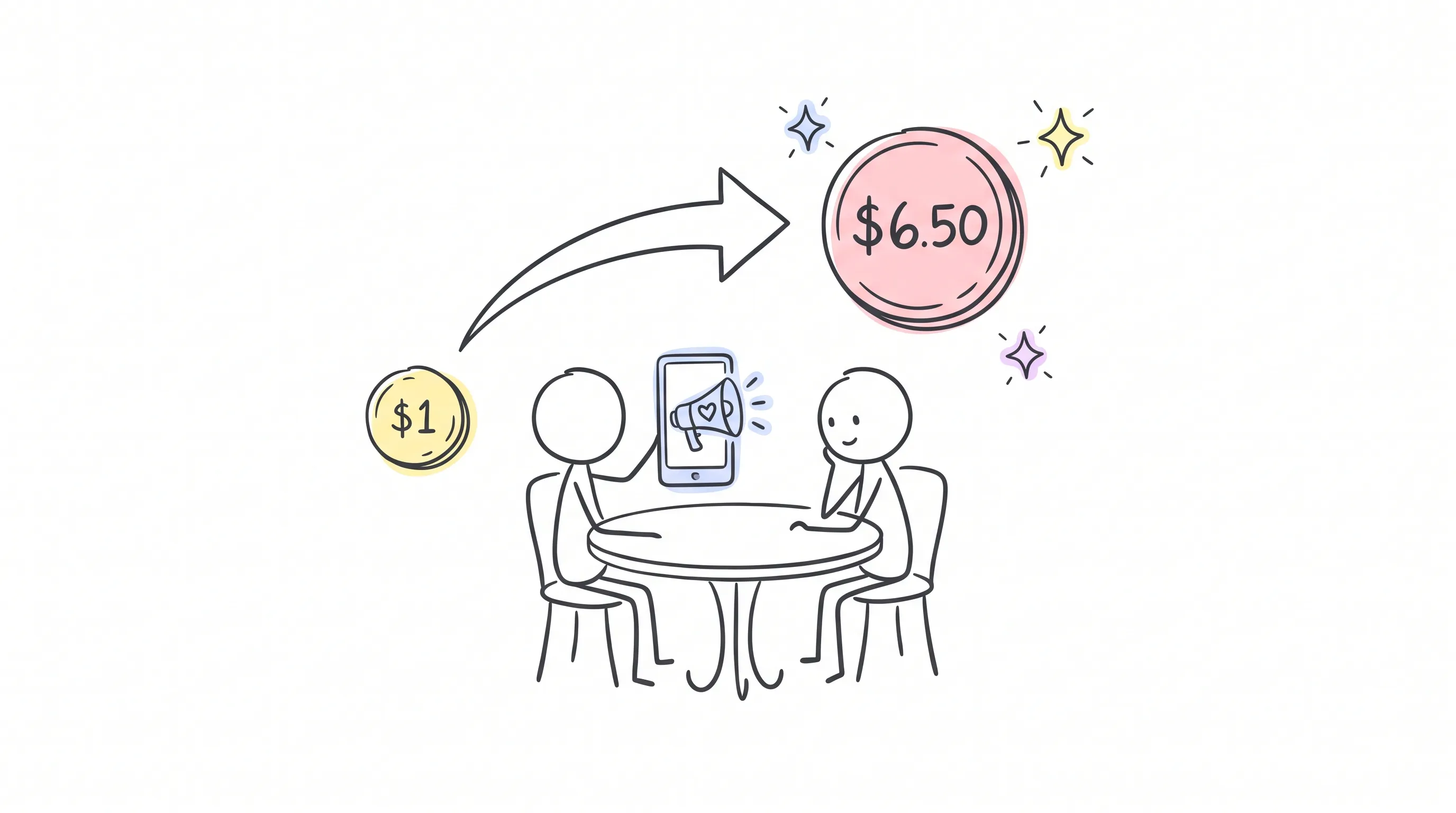
And here's the most interesting one: on average, businesses earn $6.50 back for every $1 they put in.
A one-to-6.5 ratio.
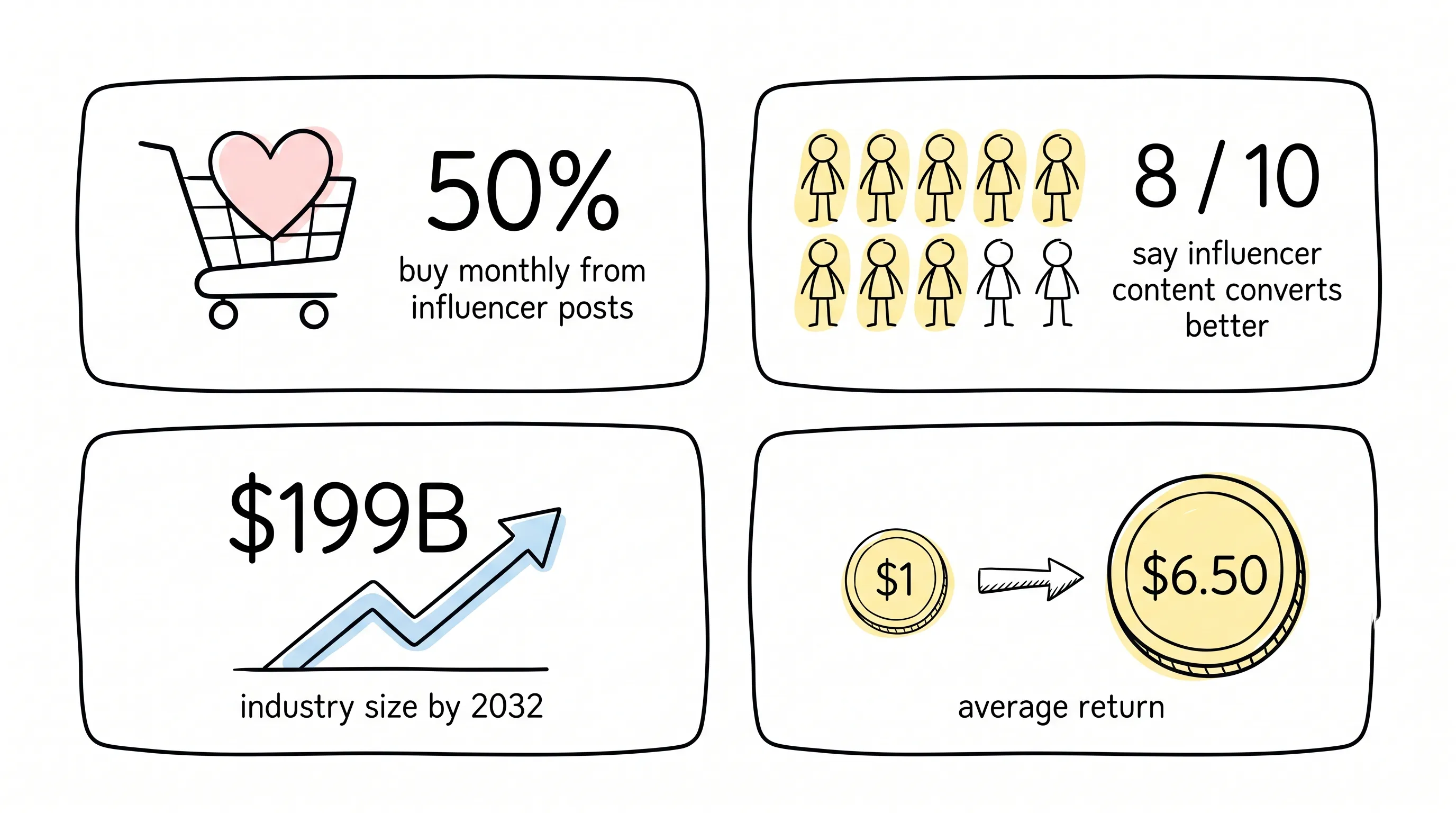
A market with an average 6.5x return, still heading toward $200 billion — who wouldn't want to catch it?
But the Money Isn't That Easy to Make
By now, you might be rolling up your sleeves.
Hold on. One to 6.5 is an average. And an average means some people are raking it in while others are quietly paying for the lesson.
Where does that tuition go? My friend said the hard part comes down to three things.
First, picking the wrong people. A big following doesn't mean a good fit. A fashion blogger with a million followers may not be able to move your baby-food maker.
Second, managing the work. Every collaboration is a full workflow: align on requirements, review scripts, chase deadlines, verify numbers. Stack up enough partnerships and your spreadsheets explode.
Third, unclear attribution. The money's been spent — but which influencer actually drove the conversions? Hard to say.
Think about it: which of these three doesn't drain you?
The opportunity is real. It's just buried under mountains of repetitive work.
What Sprout Social has its eye on is precisely the work hiding behind all that.
So What Can AI Actually Help With?
So what does this platform actually do?
It pulls finding creators, vetting them, managing campaigns, and measuring results into one place, with AI and data analytics under the hood.
That description probably doesn't land. Let me give you an analogy.
What was finding influencers like before? Like old-fashioned matchmaking: asking around, flipping through photos, listening to a matchmaker's sweet talk — and only meeting face to face after the deal was struck. Get lucky, and it's a match made in heaven. Get unlucky, and you're left with a mess to clean up.
Now, it's like hiring an assistant who understands headhunting and knows how to run background checks. Whose values align with your brand, whose followers overlap with your buyers, how solid their past collaborations were — screen first, then meet.
Does it work? Yes. In 2025, Forrester Consulting ran a study (it was commissioned by Sprout, and that part has to be said plainly), concluding that companies using the platform save an average of 25% of their time on two tasks: discovering and managing influencers.
Kroger, a large U.S. retailer, put it this way after their social media team used the platform: the creators it surfaces align with the company's values, and the content they produce feels more authentic — and more human.
Time saved plus the right people found — stack those two together and you're saving real money.
The Interesting Part: The Market Wasn't Buying It
By all rights, the story should end happily here.
But there's one detail I find particularly worth chewing on.
On the trading day the news broke, SPT stock fell 6.21%.
You see the irony here: the company tells the story of a 6.5x-return business, and the market votes with its feet first.
My read: the market has never cared how good a story you tell today — only whether that story eventually shows up in the financials. A rebrand, a new product launch — those aren't the answer. Renewal rates, customer counts, and time are.
Oh, and one more thing: by Sprout Social's plan at the time, a steady stream of AI features would roll out throughout 2025, streamlining each step of discovery, vetting, and collaboration.
As for how all of that actually turned out — well, that's a story for later.
Finally, Back to That Dinner
After dinner, my friend pocketed his phone and said: look, they've put the tools right in our hands — the only question left is whether I'll use them right.
I said, exactly — that's just it.
Tools can help you find the right people and save you time, but they can't compute the trust between you and your customers.
And consumers increasingly trust "people" more than "brands" — that's the real foundation this whole business rests on.
Platforms solve for efficiency. Trust is something you have to earn yourself, bit by bit.
Here's hoping you, too, find the creator whose values truly match your own.
Continue reading
Related articles

Cross-Border Business: Time to Upgrade Your AI Toolbox
A learn article explaining how AI tools help cross-border e-commerce sellers clear five hurdles: language, regulation, logistics, payments, and fraud. It outlines a five-compartment toolbox, a five-step adoption path, and metrics such as conversion rate and CLV, while cautioning against over-reliance on AI.

AI Is Taking Over the Dirty Work of Social Media Marketing, One Task at a Time
This learn article outlines four social media marketing tasks AI can handle — audience analytics, content drafting and design, ad targeting and creative testing, and spam moderation — and cautions that taste, judgment, and data security remain human responsibilities.

AI Is Already This Good — Why Is Your Social Media Marketing Still Pure Manpower?
An overview of 18 AI tools for social media marketing, organized into six categories covering audience research, content creation, scheduling, comment and DM handling, ad management, and visual production, plus notes on personalization, prediction, and emerging trends.