
How Should You Actually Spend Your Marketing AI Money?
A recap of a Uniphore webinar on getting ROI from marketing AI, covering maturity assessment, North Star goals, use-case prioritization, and roadmap alignment. Includes the speaker's vendor-reported figures and a note to treat them with caution.
A while back, I watched a 36-minute online seminar put on by Uniphore, led by the director of their strategic AI consulting practice. You could sum up the theme in one sentence: how do you actually get ROI back from marketing AI?
Honestly, I wasn't expecting much. You've surely scrolled past this kind of content too — buzzwords flying everywhere, "empowerment," "closed loops," "cost reduction and efficiency." You finish listening and remember nothing.
But this one was different. It opened with a splash of cold water.
95% of AI pilots fail.
That's a widely circulated statistic, and they used it straight as the opener. They didn't cite a source — just take it as a sense of magnitude.
And the cause of death? The speaker explained it himself: most pilots were never connected to business strategy in the first place. The technology was secondary.
The result: AI projects turn into one "science project" after another. A small team cooks up a cool demo and earns a round of applause in the internal email thread. And then? There is no "then." The money is spent, the people are worn out, and nothing sticks in the organization.
What does AI hype look like? This.
Uniphore listed a few hallmarks of hype, and every one of them stings: paying repeatedly for the same thing, three departments each buying their own copy; shadow projects running everywhere with no governance, where compliance can't even reach them; high investment, low returns — and what's burning isn't just money, but the time of your most expensive people.
Think about it. Does that scene feel familiar?
So how do you spend the money right? The speaker laid out their playbook for walking clients through AI transformation. My takeaway after listening: no black magic, all unsexy grind-it-out work — but the sequence is exactly right.
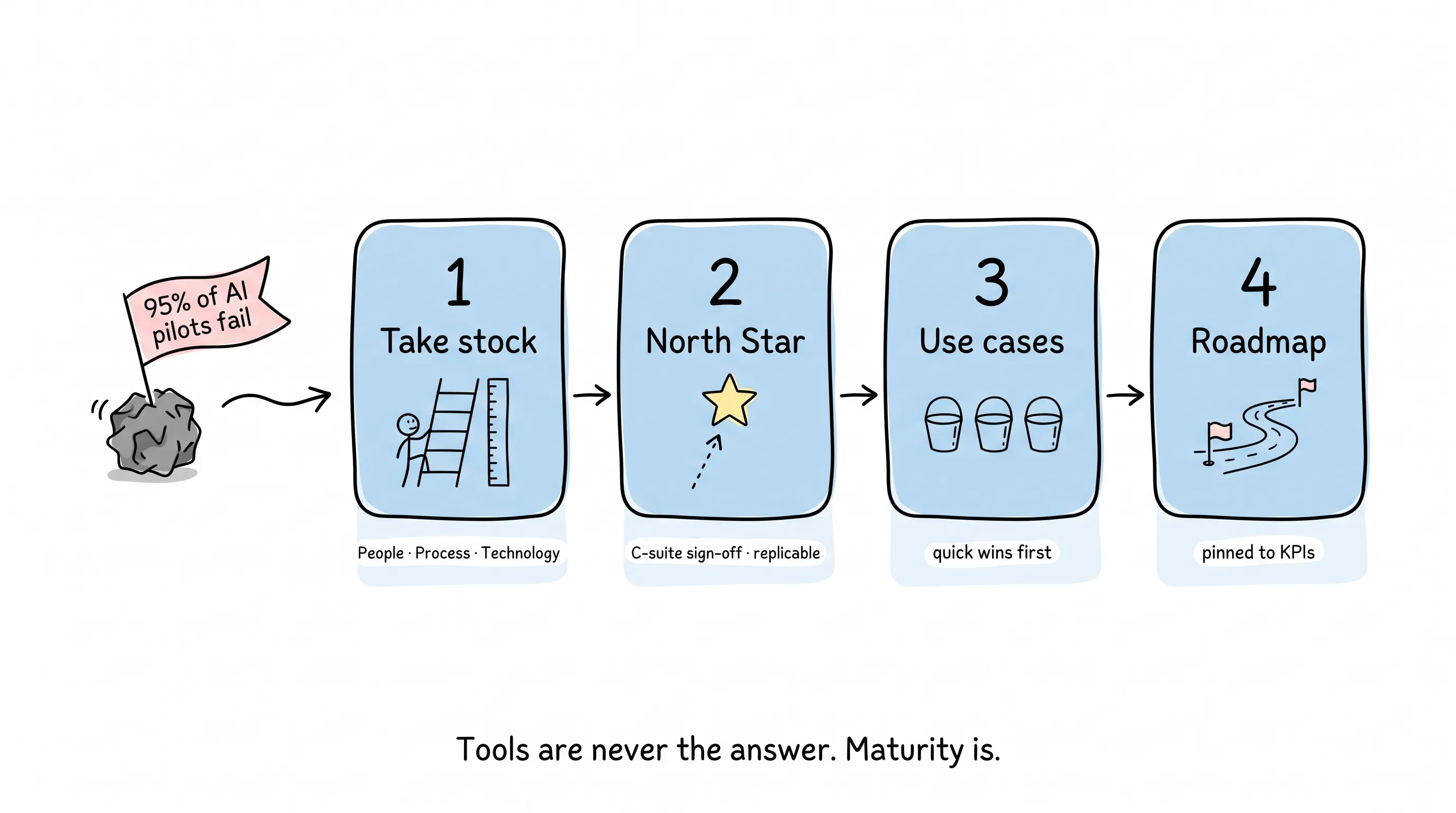
1. Take Stock First, Don't Rush to Buy
A lot of people do AI in reverse order: buy the tools first, then figure out what to do with them.
The right order is to first get clear on: where you are now.
Uniphore splits enterprise AI maturity into five levels. The lowest is "exploring AI" — just dipping a toe in the water with small-scale trials. The highest is "orchestrating AI" — the whole organization, front office and back office, multiple business lines, all running on AI.
Grading alone isn't enough. They pair it with seven assessment dimensions, which boil down to three things:
People. Does the team have the skills? If not, where's the plan to fill the gaps?
Process. Are you centralized, decentralized, hybrid, or federated? Each organizational shape calls for a different game plan.
Technology. Not just the tech stack and interoperability, but governance for the AI era. One line from the speaker stuck with me: on an AI-first battlefield, managing cybersecurity alone is no longer enough — you also have to manage AI security, traceability, and auditability.
The point of this step is to measure the gap between you and your goal. If you don't know your starting point or your destination, the road in between is pure guesswork.
2. Anchor the North Star — Without the C-Suite's Nod, Everything Is Zero
Stock-taking done, time to set the goal.
What's a North Star goal? It's the single highest-priority business outcome — revenue, cost, risk — anchored to the top-level KPIs.
This step comes with a reality many people would rather not face: the money for AI transformation ultimately needs C-level sign-off.
Team-level small improvements won't convince a CEO. You have to prove: this can optimize operations, accelerate revenue, cut costs, or reduce risk — and it can be replicated in other departments.
That last part, "can be replicated," is especially critical. Uniphore hammers this repeatedly: pilots shouldn't be build-it-and-forget-it. The technology needs to be reusable, and so do the processes, the playbook, the training. However pretty the single-point ROI looks, without horizontal scaling, returns at scale are just talk.
They also remind you not to fixate the North Star on revenue and marketing ROI alone — customer lifecycle KPIs, growth KPIs, even brand KPIs should all be covered. And every category of KPI has to land on concrete use cases.
Put plainly: every place money gets spent has to be able to say what it earns back.
3. Pick Use Cases — Win a Few Small Ones First
Goal set, time to pick your use cases. They offered a priority matrix that sorts use cases along two dimensions: one is business impact and scalability, the other is implementation cost.
That sorts them into roughly three buckets.
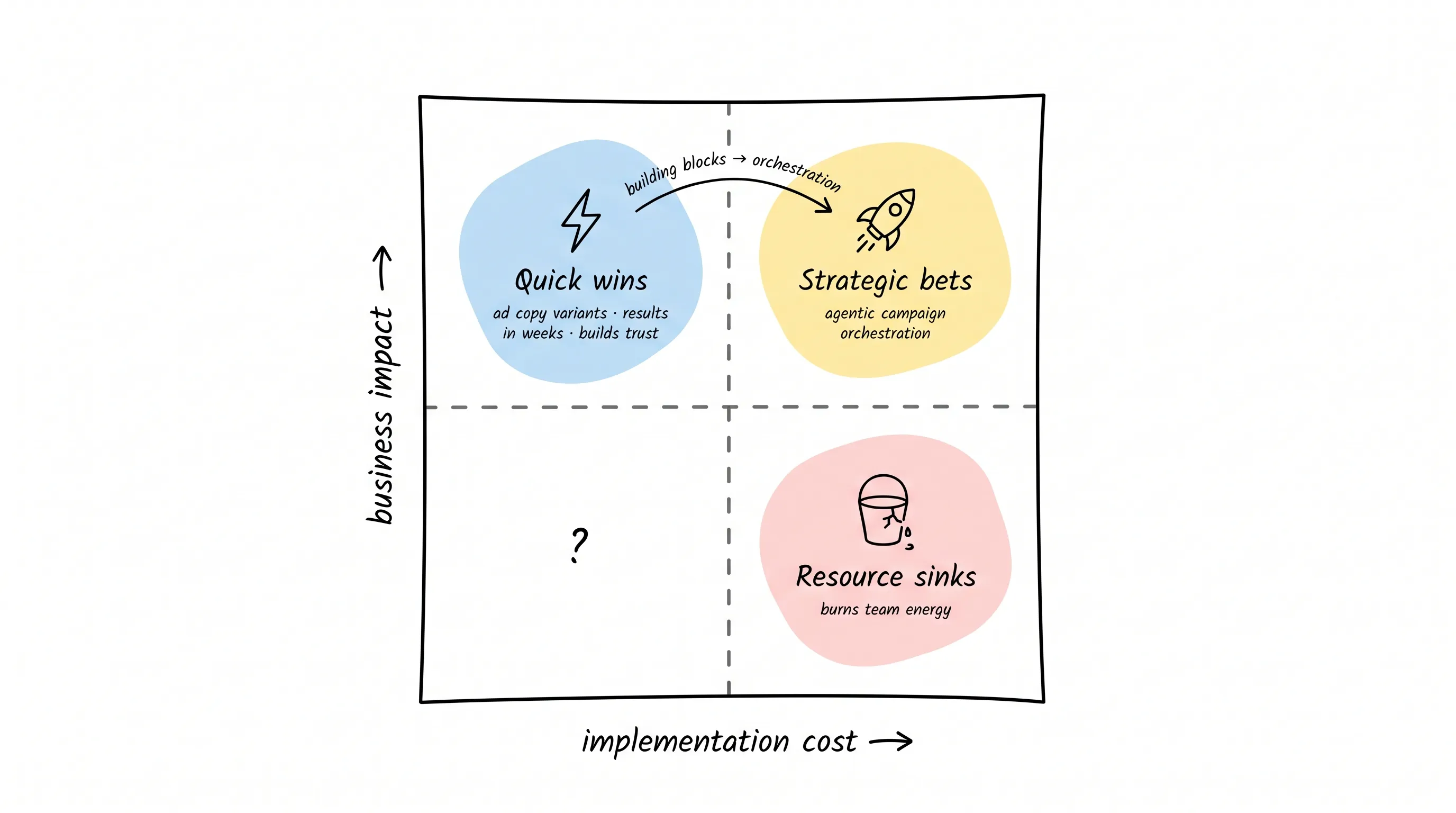
The first: quick wins. Real impact, low cost — use cases that can show results in weeks, two months at most. Ad copy variants are the classic example: AI generates a batch of versions, you test them fast, and whichever performs best on social media, display ads, or your website becomes instantly obvious. Swap it in.
The biggest value of this kind of use case isn't the money saved — it's building trust. Spread the wins through the organization, and the resistance to the next project shrinks by a degree. Without early momentum, that flywheel of yours will never get turning.
The second: strategic bets. Agentic marketing campaign orchestration belongs here. From planning, budgeting, and forecasting all the way to campaign attribution and post-mortem analysis, the entire value chain runs on AI agents. The payoff is huge, but the list of prerequisite capabilities is long: small models that can forecast, agents that understand attribution, agents that know your product catalog… every link has to be a "domain expert," and they all have to work together.
So how do you climb up there? The speaker's advice: start with building blocks. Audience agents, product agents, attribution agents — these small components each generate value on their own, and they become the foundation for orchestration later. Start from quick wins, and accumulate your way up to strategic bets.
The third: resource sinks. Use cases with huge investment and unvalidated returns. The worst part is they don't just burn their own money — they burn your scarcest resource: your team's energy. By the time a use case actually worth doing shows up, your team is already running on fumes.
Momentum, once lost, is very hard to pick back up.
4. Map the Roadmap — Pin It to Everyone's KPIs
Use cases chosen, time to assemble the whole picture.
One easily overlooked point at this step: the roadmap has to align with every stakeholder's interests. The CMO has the CMO's KPIs, the CEO answers to the whole company and the shareholders, and the CIO and CDO have their own set of priorities. If your AI roadmap contradicts what the CEO tells the board, or what the marketing lead tells the quarterly review, tear it up and start over.
Because that kind of conflict doesn't burn a few slides — it burns the organization's trust and momentum.
So How Much Money Can Actually Be Saved?
Framework done, time to run the numbers.
First, a disclaimer: all the figures below are Uniphore's own numbers from their own webinar — a vendor's examples. Take the logic and the order of magnitude, and don't treat it as independent research.
By their account: use AI agents to rework process fragments — running processes automatically, triaging questions, handling tickets, validating data — and returns for a single operations scenario can approach $10 million; the initial investment pays back within four months, with clear upside on top; and marketers go from idea to first draft 70% faster than working alone.
One part stuck with me in particular. They said if you had a senior marketer enumerate every audience combination and every attribute permutation, then calculate the optimization headroom for each, you'd have to fill in their calendar for weeks ahead. An AI agent sees what humans can't — it finds new opportunities in the same data, holding costs and gross margin steady while lifting conversion.
Honestly, even if half those numbers are pie in the sky, I'd accept it. But the "exhaustive enumeration" logic feels real to me: AI's cruelest advantage isn't replacing people — it's exhaustive enumeration. Humans do combinatorial analysis by intuitively sampling; it does the full set. That's exactly how blind spots disappear.
Finally, a Word About Uniphore Itself
By the end, of course, they had to land on their own product — no surprise there.
Uniphore's Marketing AI is a Customer Data Platform (CDP) plus a lineup of marketing AI agents, covering the end-to-end campaign lifecycle. Underneath it all sits a platform they call Business AI Cloud, which also powers their Sales AI, People AI, and HR AI. The technical foundation is a set of Small Language Models (SLMs), trained on your own business data — they know your product catalog, your brand voice, your standard procedures, so they know what "done well" looks like.
Where's the cleverness in this narrative? In how it slots its own product into the methodology above: you're supposed to start with building blocks and climb the maturity curve step by step — and building blocks are exactly what they sell.
So my advice is the same as ever: take the methodology for free, and judge whether to buy the product based on your own starting position and North Star.
Back to that splash of cold water at the start: 95% of pilots fail.
But look at those four steps, and you'll notice almost none of them died because the model wasn't smart enough. They died from never measuring the starting point, from never anchoring the destination, from picking the wrong use cases, from nobody minding the momentum.
Tools are never the answer. Maturity is.
And here's hoping you never join that 95%.
Continue reading
Related articles

Cross-Border Business: Time to Upgrade Your AI Toolbox
A learn article explaining how AI tools help cross-border e-commerce sellers clear five hurdles: language, regulation, logistics, payments, and fraud. It outlines a five-compartment toolbox, a five-step adoption path, and metrics such as conversion rate and CLV, while cautioning against over-reliance on AI.

AI Is Taking Over the Dirty Work of Social Media Marketing, One Task at a Time
This learn article outlines four social media marketing tasks AI can handle — audience analytics, content drafting and design, ad targeting and creative testing, and spam moderation — and cautions that taste, judgment, and data security remain human responsibilities.

AI Is Already This Good — Why Is Your Social Media Marketing Still Pure Manpower?
An overview of 18 AI tools for social media marketing, organized into six categories covering audience research, content creation, scheduling, comment and DM handling, ad management, and visual production, plus notes on personalization, prediction, and emerging trends.