
How Much Money Does AI Marketing Actually Save? Let Me Run a Few Numbers for You
A bilingual learn article that walks through AI marketing cost and efficiency examples across content, sales, and traditional channels, citing vendor case studies and market estimates, while flagging pitfalls like compliance and legacy systems.
A few days ago, I had dinner with a friend who has been in marketing for over a decade.
He's been miserable lately. His budget hasn't grown by a cent, but his workload has tripled: the WeChat official account needs updating, short videos need filming, the private domain (owned audience channels, like WeChat groups and follower communities) needs tending — and on top of all that, he has to report ROI to his boss every day.
His boss even asked him: AI is all the rage now — how come we haven't freed anyone up yet?
He told me he had saved dozens of "AI marketing case lists" and hadn't managed to finish a single one. And even the ones he did finish left him no idea where to start.
I said, stop collecting lists. Saving lists is nothing but a comfort blanket — a little psychological reassurance that "I'm learning."
I picked a few examples that are genuinely running on production lines right now, and ran a few numbers for you. Once the math is done, you'll know exactly which slice of cheese AI is moving in marketing.
First, the Big-Picture Numbers
What is AI marketing, anyway? Simply put: hand the repetitive, data-driven, pattern-following work in marketing over to machines.
So how big is this cake?
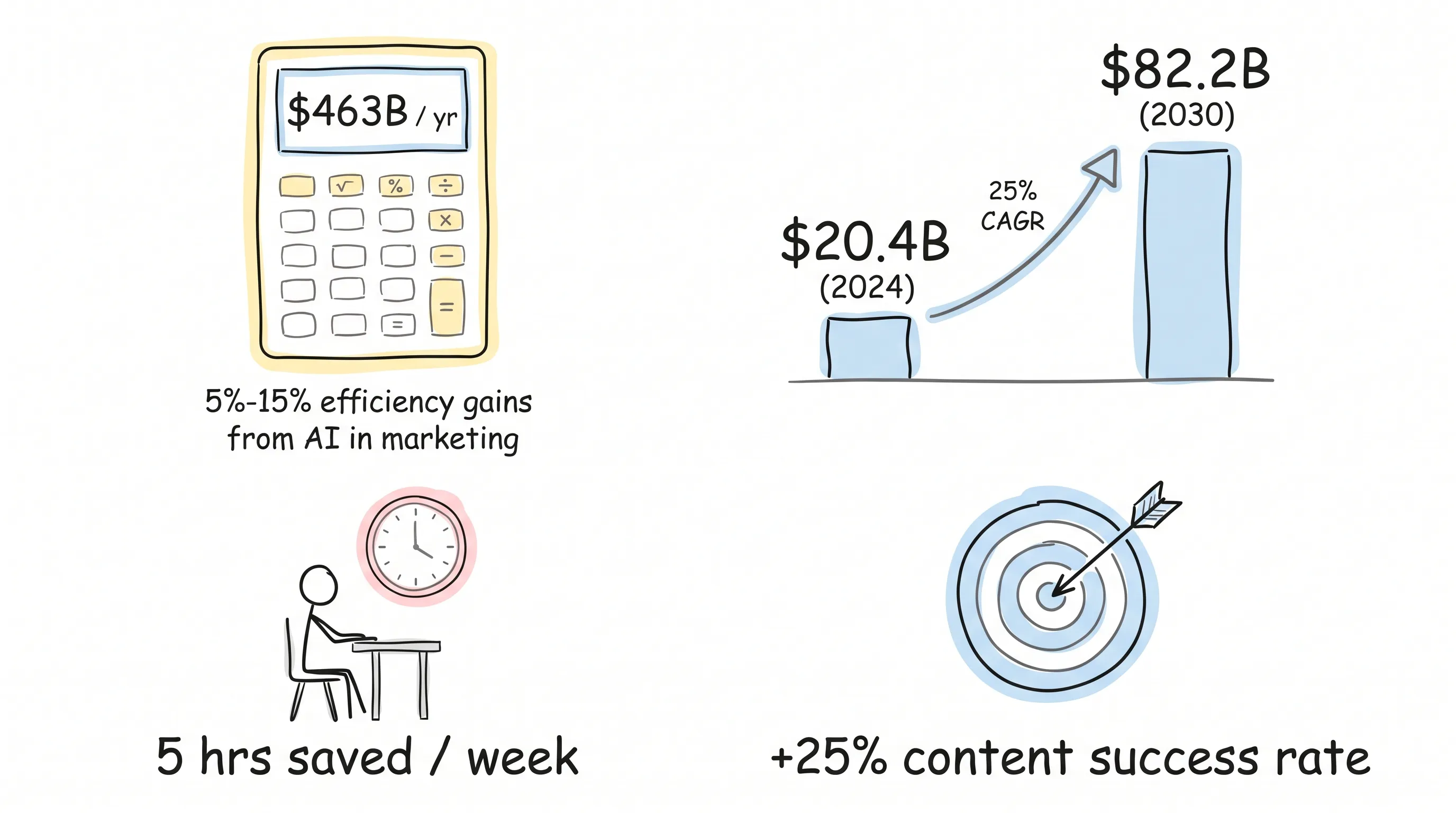
McKinsey, the consulting firm, once put a number on it: applying generative AI to marketing can bring efficiency gains of 5%-15%. Converted into money, that's roughly $463 billion a year.
What does $463 billion mean? It's about the annual GDP of a mid-sized country. In one year. From marketing alone.
This isn't guesswork — the adoption rates tell you: 51% of marketers are already using AI to optimize content and email; 50% use it to produce assets — writing blogs, making images, posting on social media; and another 43% hand it their chores.
Real money is pouring in, too. In 2024, the global AI marketing market was around $20.4 billion; by 2030, it's projected to reach $82.2 billion — a compound annual growth rate of 25%.
Two smaller numbers hurt even more: marketers using AI save an average of 5 hours a week, and content created with AI involvement has a 25% higher success rate.
Saves time, and lifts the win rate. Now this deserves a line-by-line audit.
The First Tab: Content
Start with the most cutthroat corner of marketing: content.
There's a company called Copy.ai that serves B2B marketers. Their clients' perennial headache: content has to hold the brand tone, while costs stay under control. They plugged Claude in, letting AI write long-form pieces, mimic each brand's writing style, do research, and check facts.
And the result?
Blogs went from one post a month to one post a day. Overall output quadrupled, and costs were cut by three-quarters.
Work that used to cost $100 now costs $25. And the brand voice never slipped one bit.
Some say, that's big-company stuff, it has nothing to do with me.
No — really not. A youth soccer club called NC Fusion wanted to send different messages to the parents and donors of different families. It used to be all manual, with data scattered everywhere. After turning on Copilot inside Dynamics 365 Customer Insights, writing an email dropped from an hour to a few minutes, campaign launches sped up by 75%, and engagement jumped from 10% to 30%.
A community soccer club, running enterprise-grade personalization.
What AI takes away isn't the work marketers want — it's the work marketers stopped wanting long ago.
The Second Tab: Sales
Content is about saving money. Sales is the ledger where money is made directly — a bigger one.
A sales platform called Apollo embedded Claude into the core of its product. AI handles writing emails, picking up customers' buying signals, and mirroring the other side's tone.
Now, more than 5 million AI-generated personalized messages go out through their platform every month.
Five million — what does that mean? Over 160,000 a day, on average. Typed out by salespeople one at a time? A team would have to write into the next life.
The results: 35% more meetings booked, 40% less time hunting for leads, and customer retention up another 15%.
Even more interesting is a company called Clay. They used GPT-4 to build an AI agent called Claygent, which goes out to find leads, fill in missing information, and tier customers on its own. That agent now runs 500,000 tasks a day, and 30% of customers use it daily.
Riding on it, Clay grew 10x a year, two years running; in the first 5 months of 2024, revenue climbed another 2.5x.
Good grief. What does exponential look like? This.
Later they added Claude 3 Haiku, offloading 80% of the manual work in the sales process outright. Many clients' three-to-five-person teams now run the output of an entire agency on Clay. The industry coined a name for these teams: Claygencies.
Small teams, massive output. The lever just got a new handle.
The Third Tab: Old Channels
You think AI only works its magic online? The old channels can be renovated just the same.
Epsilon, a direct-mail company. Don't underestimate direct mail — it's one of marketing's antiques. They used to manually build hundreds of thousands of predictive models every year, just to decide which household should get which letter.
After moving onto H2O.ai's platform, modeling became automated. Response rates rose 3%-5%, and a single campaign brought in roughly 15,000 additional high-value customers. One client alone earned an extra $9 million.
Even mailing letters can add up to $9 million. Just think: how much of this money is still buried in your channels?
Then look at the advertising giant Dentsu. Marketing teams used to wait several weeks for a media performance report. By the time the report arrived, the golden window for placement had long passed. They built a predictive analytics assistant on Azure AI, and insights went from weeks to minutes.
Between "weeks" and "minutes" lies the real-money window to shift your ad spend.
A Few Smaller Tabs
The rest, I'll run through quickly.
Brand compliance: a platform called Brand.ai turned the rigid brand handbook into a living AI system. One copywriter keeps watch over 600 pieces of content; the global asset launch cycle was compressed from 24 months down to days; a client's $5 million a year in compliance costs was cut to a mere fraction. Then there's Advolve, which uses Claude as its master dispatcher, managing millions of ads at once — operating workload down 90%, while ROAS (return on ad spend) actually rose 15%. Big clients like iFood and Cogna trust it with budgets in the millions of dollars.
Community: CIPIO.ai helps brands rally their own users to produce content. The result: posts published organically by users earned 6-8x more tags and mentions than official posts, and brought in 93 new customers along the way. Local Falcon produces SEO reports for 95,000 local businesses, saving over 20 hours a month, with renewal revenue up 15%.
As for those writing emails, building proposals, doing SEO, posting tweets — Dotdigital, TRY, Quillit, Unify, Searchmetrics, Tweet Hunter... all variations on the same story: hand the repetitive labor over, keep the judgment for yourself.
But Don't Celebrate Just Yet
By this point in the math, it sounds like AI flips on and you can sit back and win.
But everything always has another side. Behind these cases are buried a few pits that refuse to let you rest easy.
First, content going off the rails. When nobody guards what AI writes, it comes out drenched in "AI flavor," or even veers off-brand. You save small money and damage trust — a bad trade.
Second, compliance fines. The more AI you use, the more sensitive data flows around. Europe's GDPR, California's CCPA (data-privacy laws) — one oversight, and the fine is sky-high.
Third, legacy systems fighting back. Many companies built their marketing tech stack ten years ago; AI can't plug in, and buying it changes nothing.
Fourth, the people side can't keep up. One survey shows that two-thirds of companies are stuck at the "pilot" stage and can't push into production.
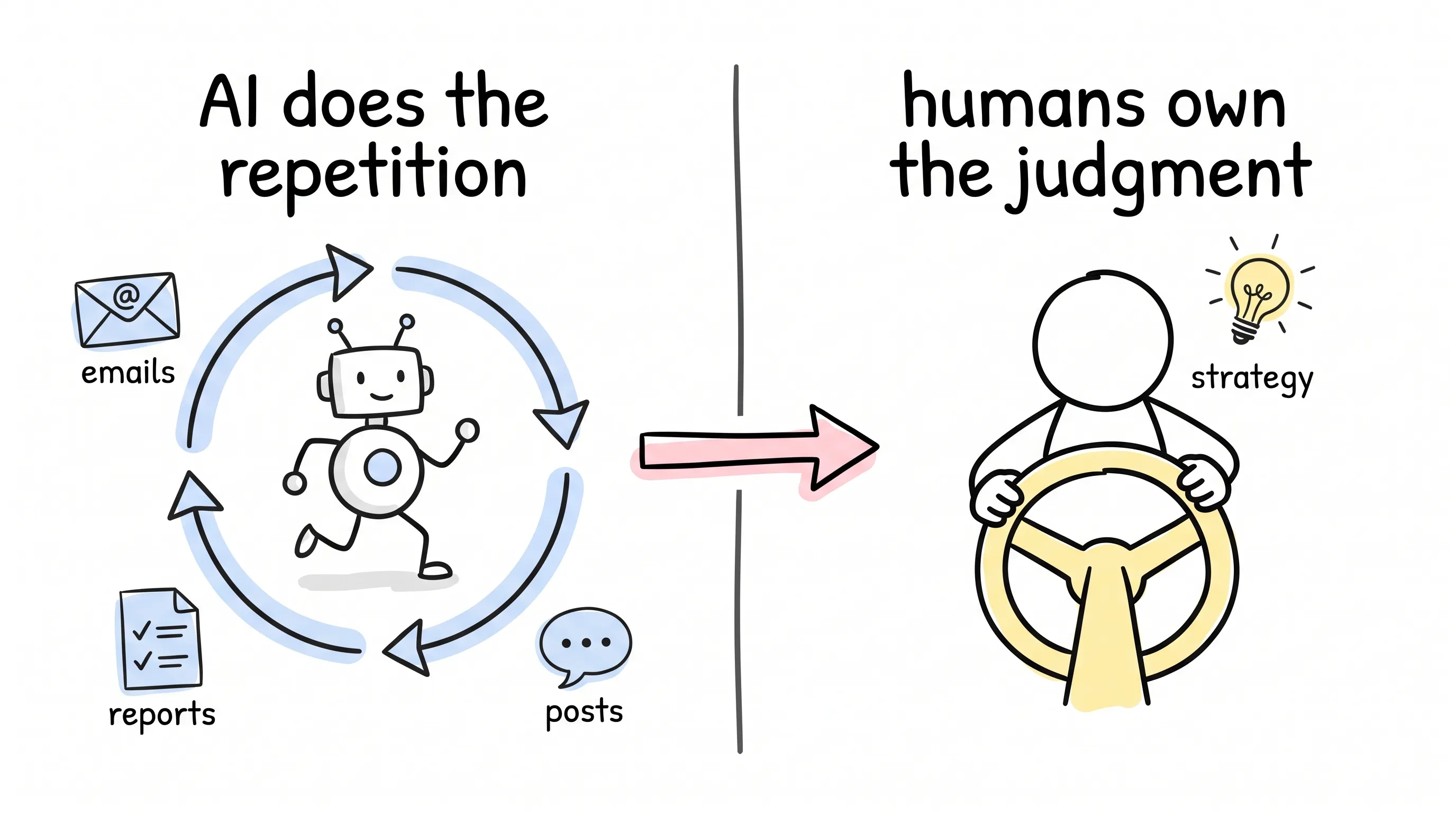
So you see, the teams that actually generate ROI are all doing the same thing: humans own the judgment; AI does the repetition. With human hands on the wheel, you can floor the accelerator.
So, Where Do You Start?
Back to my friend.
My advice to him came down to three sentences.
First sentence: stop collecting lists. Lists don't produce growth; running the numbers does.
Second sentence: pick the thing closest to the money and start there. Either content production, or outbound lead calls. Don't be greedy — get one thing working first.
Third sentence: before you act, run the numbers: how many hours and how much money does this cost today? How much would AI save by taking over? If the savings are bigger than the cost of the effort, go. If the math doesn't work, shore up your data foundation first — rushing won't help.
A Final Word
As that meal was wrapping up, my friend deleted every one of the dozens of lists in his bookmarks and picked the smallest possible task: letting AI take over their email subject lines and the weekly report.
Last week he told me that this one change alone gives his team a whole extra day every week.
That's exactly right. The biggest dividend in AI marketing doesn't belong to the person who saves the most case studies.
It belongs to the person who settles the numbers first and gets one small thing working first.
May your first tab get settled soon, too.
Continue reading
Related articles

Cross-Border Business: Time to Upgrade Your AI Toolbox
A learn article explaining how AI tools help cross-border e-commerce sellers clear five hurdles: language, regulation, logistics, payments, and fraud. It outlines a five-compartment toolbox, a five-step adoption path, and metrics such as conversion rate and CLV, while cautioning against over-reliance on AI.

AI Is Taking Over the Dirty Work of Social Media Marketing, One Task at a Time
This learn article outlines four social media marketing tasks AI can handle — audience analytics, content drafting and design, ad targeting and creative testing, and spam moderation — and cautions that taste, judgment, and data security remain human responsibilities.

AI Is Already This Good — Why Is Your Social Media Marketing Still Pure Manpower?
An overview of 18 AI tools for social media marketing, organized into six categories covering audience research, content creation, scheduling, comment and DM handling, ad management, and visual production, plus notes on personalization, prediction, and emerging trends.