
How Much Is Brand Exposure in AI Actually Worth? Let Me Run the Numbers
A learn article explains the ABMV (AI Brand Mention Valuation) model from a Similarweb team, which prices brand visibility inside AI answers using category question volume, target visibility share, an attention coefficient, and an AI CPM, and covers budget splits, timelines, and the model's limits.
At half past eleven one night, an old friend of mine who runs a SaaS business called me, his voice exhausted.
That afternoon, they'd had a budget meeting where the CMO grilled him: competitors keep showing up in ChatGPT's answers — do we have a plan? Should we put money into AI search optimization? How much? And how do we calculate the ROI?
He had no answer.
And having no answer is normal — because every old yardstick in his toolkit had stopped working. AI platforms don't give you impression counts, rankings, or per-click prices; the whole thing is a black box. Yes, a black box. He asked agencies for quotes, and every quote came back different; nobody could explain their methodology.
He asked me: has anyone ever actually run the numbers on this?
There is. A team at Similarweb worked the whole ledger out — and gave it a name. Today I'll walk you through it.
First, a Few Numbers
According to Similarweb, in Q4 2025, 7 billion visits a month worldwide were flowing to generative AI platforms of every kind — up 76% year over year.
Traffic that generative AI sends to transactional websites grew 357% year over year.
What's even more striking is conversion: visitors arriving from AI platforms convert at roughly 7% — matching many traditional channels, sometimes beating them.
Think about it: what does that mean? The river of traffic has genuinely changed course. And the water in the new channel carries plenty of gold.
So the question was never "should we invest in AI visibility." The question is: what is that visibility actually worth?
First, Swap the Yardstick
Let me ask you something first: why is Coca-Cola willing to pay big money for a Super Bowl ad?
115 million viewers. What it's buying is that guaranteed reach. No click promises, no conversion bets — just that many eyeballs seeing the brand.
Someone who has spent many years in this industry put forward an idea that, I think, cuts straight to the heart of it:
Brand mentions inside AI shouldn't be valued by the logic of Google ads. They should be valued by the logic of TV commercials and billboard ads.
Think about it: when your brand appears in the answers ChatGPT gives to a million questions, what have you actually gotten?
You show up as the answer itself, not as an ad strip wedged into the content. There's no "ad" label to trip the reader's ad-blindness reflex. The AI is vouching for you, not just displaying you. And the story is told only to people actively searching for an answer.
This is not performance advertising. This is buying guaranteed reach in a premium, credible setting.
Three sets of data back this logic up.
First, an analysis by the SEO firm Seer Interactive in 2024 found that brand search volume correlates clearly with AI mention volume — a correlation coefficient of 0.18. Ahrefs, a tools company, studied 75,000 brands and found that the correlation between brand search and visibility in AI Overviews reached 0.392. AI exposure does turn into brand search — but you can hardly ever trace which mention became which search. Remind you of anyone? TV advertising.
Second, the marketing agency Brainlabs puts it even more bluntly: AI often influences decisions without ever producing a trackable click. A user asks ChatGPT, remembers your name, and later searches for you directly — or types your URL straight in. The credit lands in the "brand search" and "direct traffic" buckets, not on AI's ledger. Ask AI first, buy later, with days or even weeks in between.
Third, conversion quality. Companies that started tracking AI-referred traffic early found conversion rates running as high as 3x traditional search, because users arrive pre-digested — already briefed on who you are. Yotpo, which serves e-commerce brands, tested more than 100 brands: a strong review system lifted conversions by up to 25%, and exposure in AI shopping scenarios could triple.
So when you price AI exposure, don't price it by the click. Price it by the reach. The way you buy ad space: set the price first, then place the buy.
What Exactly Is ABMV?
ABMV — AI Brand Mention Valuation. In one sentence: put a dollar price on your brand's visibility inside AI answers.
The formula looks like this:
Monthly value = (total category question volume × target visibility share × attention coefficient) × (AI CPM ÷ 1,000)
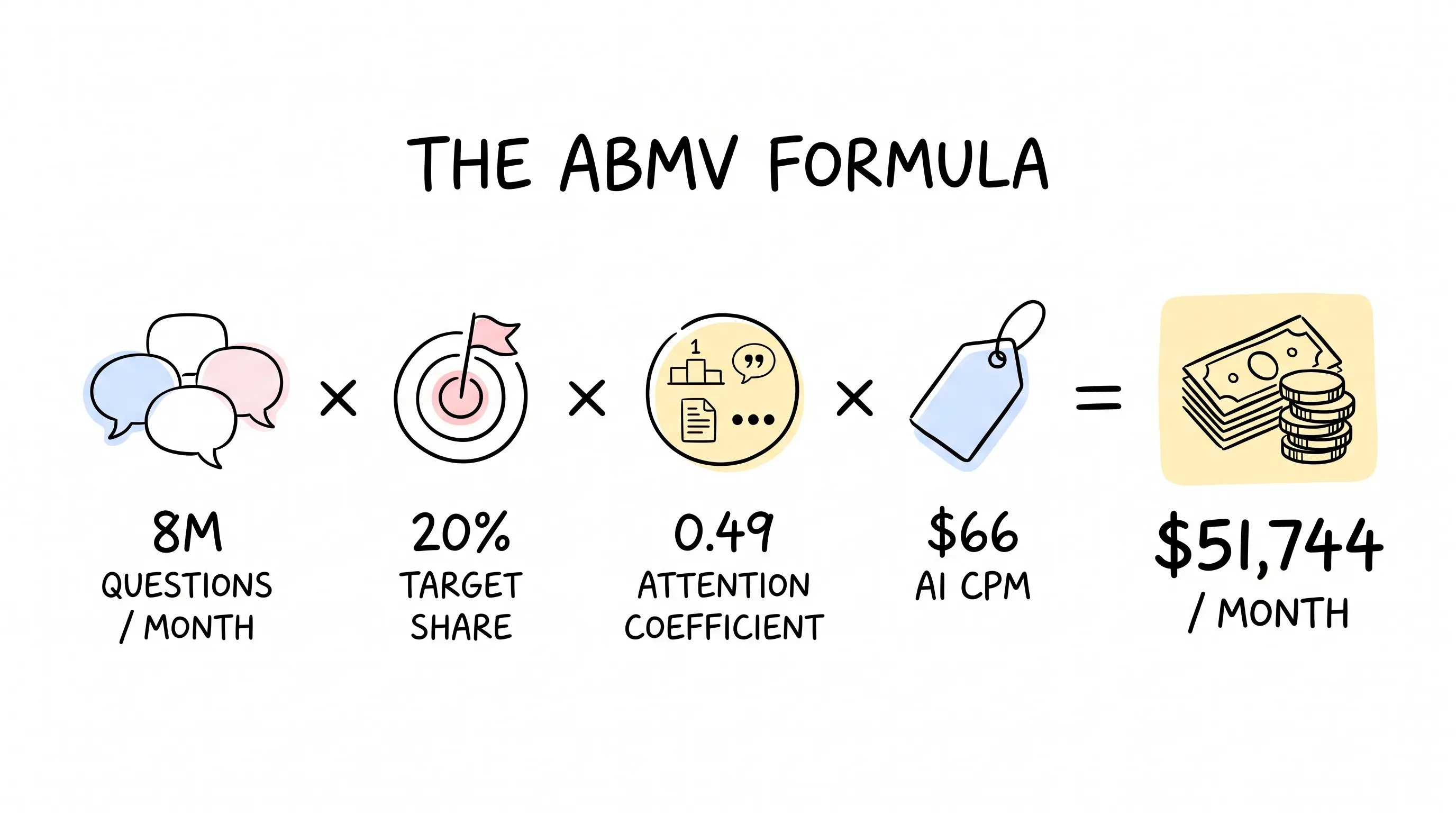
It looks intimidating, but it's really just four numbers. Let me use a fictional CRM company and work through it line by line. The company: cloud CRM for small businesses, 8% market share, 12 to 15 main competitors, primary markets the US and Europe.
The First Entry: How Big Is Your Market?
Similarweb's report, The 2025 Generative AI Landscape, took a full inventory of the space: ChatGPT handles 40 to 50 billion questions a month — roughly 80% all on its own; Gemini 6 to 7 billion; Perplexity 780 million to 1 billion; Claude 1.9 to 2.4 billion. Add it up: 40 to 70 billion questions asked globally every month.
That's the total pie. Your category is carved out of it in three cuts: category, subcategory, region. Technology accounts for 8% of all questions; CRM is only 0.4% of the technology slice; and the US and Europe together take half of that.
50 billion × 8% × 0.4% × 50% = 8 million a month.
Those 8 million questions are the "population" of your category inside AI. Every story starts here.
The Second Entry: How Much Share Do You Want?
With 15 competitors, an even split gives each 6.7%. Our company holds 8% of the actual market and sets a target of 20% AI visibility — punching with nearly 3x its share of voice. If a newcomer wants to climb, that's the kind of aggression it takes.
But don't get greedy. Looking at a large body of real campaign data from 2024 to 2025: going from 5% to 15% costs $15,000 to $30,000 a month and takes 12 months; from 15% to 35% takes 18 to 24 months at $30,000 to $50,000 a month; and want to go from 50% to 70%? Two to three years at minimum, $50,000-plus a month — and even then it might not happen.
What does the top look like? Salesforce is to CRM what Kleenex is to tissues — the brand is all but the category itself, with 80%-plus mention share. Newcomers shouldn't even dream about that yet. Set targets by your market position, not by your ambition.
The Third Entry: The Attention Coefficient — Here Comes the Best Part
What is the attention coefficient? It's an admission of one simple fact: not every AI mention is created equal.
It's the product of four factors: position, context, source, and competitive density.
Position. If the AI recommends you solo: 1.5x. First on a recommendation list: 1.0. Second or third: 0.7. Buried eighth or lower: 0.2.
Context. If the AI says "Salesforce is the enterprise first choice": 1.5x. A neutral passing mention: 1.0. "Worth considering if you have the budget": 0.7. "Powerful, but expensive and complicated": 0.5. Called an "overpriced option"? That's minus 0.5 — a deduction.
Source. If the AI cites authoritative sources like The Wall Street Journal or Wikipedia when it mentions you: 1.3x. With no citations at all: 0.7.
Competitive density. This one is the most brutal — it deserves its own paragraph.
In a typical answer, an AI only names 3 to 5 brands. With only 3 competitors, those slots are close to a monopoly — value goes up 20%. With 12 to 15 competitors? Sorry, there's a queue standing behind every slot: value cut to 70%. With 26 or more? Cut to 40% — the floor.
For our CRM company, the four numbers multiply out to: 0.7 × 1.0 × 1.0 × 0.7 = 0.49.
What does that mean? Every mention it earns is worth only 49% of the theoretical maximum.
Now the two extremes. Best case: a solo recommendation, a strong endorsement, an authoritative media citation, only 3 competitors — a coefficient of 3.51. Worst case: sixth on the list, a conditional mention, no citations, 22 competitors — a coefficient of 0.11.
Same "being mentioned by AI," a 32-fold difference in value. Good grief.
And what if you're already squeezed into a red ocean of 20 competitors? The model's advice is blunt: narrow down. Burrow into a subcategory with only 5 to 10 competitors — better to be a 25% big fish in a small pond than a 3% shrimp in the open sea.
The Fourth Entry: What's the AI CPM?
Start from premium display-ad CPMs (cost per thousand impressions) as the floor price, then layer on two premiums.
The trust premium: 2.2x. The basis is Nielsen's research: its 2021 global survey, covering more than 40,000 people, found that 88% trust recommendations from people they know and 67% trust editorial content — while only about four in ten trust online banner ads. AI's recommendations arrive wearing the face of "answers" and "expert advice." BrightEdge, a marketing technology company, also found that ChatGPT mentions brands 3.2 times more often than it cites them — and when it does cite you, that's the AI holding you in higher esteem. Research from the University of Melbourne likewise found that nearly half of people trust AI recommendations.
The intent premium: 1.5x. People who go ask AI are people with a real problem to solve. Conversion rates from AI-referred traffic run as high as 17x the average.
2.2 × 1.5 = 3.3. Multiply each industry's display-ad CPM by 3.3 and you get the AI price: B2B software, $20 becomes $66; mass-market e-commerce, $9 becomes $29; legal services, $33 becomes $109 — the highest on the whole table.
Why is legal so expensive? Customer lifetime value. A single legal client is worth tens of thousands of dollars, so pricier exposure still pays. Mass-market e-commerce competes on volume, so unit prices naturally stay low.
Tallying the Ledger
Now all four numbers are in hand:
8 million questions × 20% target share = 1.6 million target impressions × 0.49 attention coefficient = 784,000 quality-weighted impressions × $66 ÷ 1,000 = $51,744 a month
That is the "ad-equivalent reach value" our CRM company collects every month once it hits 20% AI visibility.
One more thing: if its audience skews toward particular platforms, the ledger can be refined further. Say 60% of the audience is on ChatGPT, 20% on Claude, 10% on Perplexity — the weighted unit price rises another 5.5%, and the monthly value becomes $54,589. Perplexity, the favorite of B2B audiences, has high-quality citations and carries a built-in 1.25x premium.
Is the Money Well Spent?
Value computed; now the cost. How much does it take to raise visibility by one percentage point? Converted from First Page Sage's customer-acquisition benchmarks, the B2B software industry runs $800 to $1,500 per point, times a competition factor of 1.8:
12 percentage points × $1,150 × 1.8 ≈ $24,840 a month.
$51,744 ÷ $24,840 ≈ 2.08.
Counting reach value alone, ROI is already above 2x. The value of clicks, the value of conversions, brand lift — none of that has been counted yet.
How should the budget be split? Their recommendation: content optimization takes 35% to 40%; authority building (PR, citations, expert presence) 25% to 30%; technical changes (structured data, entity management) 15% to 20%; of the remainder, 10% goes to review management — shoring up your ratings on platforms like G2 and Trustpilot — and the last 10% to monitoring tools.
Keep the timeline in mind too: the first three months are groundwork, and visibility may dip before it climbs; months 4 to 6, things start accelerating; months 7 to 9, compounding kicks in; in most cases, ROI turns positive between months 10 and 14.
What if you pour in serious money and nothing moves? Set a stop-loss line: if you've spent five figures a month for nine months and visibility is still stuck below 5%, don't keep grinding — switch niches.
There's another class of business where the books run by the quarter. Take winter apparel: a baseline value of $80,000 a month, off-season Q2 discounted to 40% — $32,000; peak-season Q4 at 3.3x — $264,000. Never spread the budget evenly: slam 60% to 70% of it into the peak season, and start content optimization 90 days ahead. Why? AI has to index your improvements first — only then does the peak season give you your turn on stage.
What This Yardstick Can't Measure
The model is genuinely capable, but let me be upfront about its limits.
It can't measure clicks and conversions — that takes a different analytics stack. It can't measure brand lift — long-term perception can't be discounted to today. It can't measure assisted conversions — the people who ask AI and then buy somewhere else are invisible to it. And negative mentions get only a simple treatment.
In one sentence: it prices exposure; it doesn't book deals. This is reach valuation, not performance attribution. It holds up when you explain budget to your CFO. It does not hold up when you compute GMV.
And the model doesn't pretend otherwise: AI is a black box, question volumes are estimates, CPMs are benchmarks, and the attention coefficient can only point in a direction.
But it beats guessing. It beats "throw $10K in and see what happens," and it beats "our competitors did it, so we have to."
A Few Even Blunter Lessons
The model comes from the team at Similarweb that owns SEO and AI search. The interesting part: they eat their own dog food, using their own tools to track their visibility across the major AI platforms. A few lessons from their retrospective — I think they're worth more than the formula itself.
First, you can't optimize what you can't measure. Without visibility tracking, every optimization is a guess.
Second, the quality of mentions matters more than the quantity. Ten conditional mentions lose to five strong endorsements.
Third, competitive density is the biggest predictor of ROI. Move to a subcategory with only 5 to 8 competitors, and the same investment makes the ledger look better immediately.
Fourth, every platform has its own temperament. If B2B audiences favor Perplexity, tune your content to its taste first.
One last macro point. Similarweb's data shows that 95% of ChatGPT users are still using Google at the same time. AI hasn't replaced search — it has stretched the boundaries of discovery.
So the winner looks like this: you're in Google, you're in ChatGPT, you're in TikTok, and you're in Siri too. GEO (Generative Engine Optimization) and AEO (Answer Engine Optimization) don't steal budget from SEO — they're a new line item added on top of it.
How much is that new budget line worth? ABMV is the one that does the math.
One Last Thing
That night, I walked my friend through the whole ledger. When I finished, he asked me one question: in our category, how many people are actually asking AI every month?
I said: that's exactly right. The moment you ask that question, you're doing math, not gambling.
They've also turned the whole model into a calculator: enter your industry, number of competitors, and target share, and it returns results in ten minutes, with industry benchmarks pre-loaded.
The model is of course imperfect. But every entry is laid on the table: how big the market is, what share you're targeting, what grade your mentions carry, what the unit price is, what the ROI turns out to be.
What is a single mention in an AI answer worth? Now you can run the numbers for anyone who asks.
And here's a wish for you: may you never again find yourself speechless in a budget meeting.
Continue reading
Related articles

Cross-Border Business: Time to Upgrade Your AI Toolbox
A learn article explaining how AI tools help cross-border e-commerce sellers clear five hurdles: language, regulation, logistics, payments, and fraud. It outlines a five-compartment toolbox, a five-step adoption path, and metrics such as conversion rate and CLV, while cautioning against over-reliance on AI.

AI Is Taking Over the Dirty Work of Social Media Marketing, One Task at a Time
This learn article outlines four social media marketing tasks AI can handle — audience analytics, content drafting and design, ad targeting and creative testing, and spam moderation — and cautions that taste, judgment, and data security remain human responsibilities.

AI Is Already This Good — Why Is Your Social Media Marketing Still Pure Manpower?
An overview of 18 AI tools for social media marketing, organized into six categories covering audience research, content creation, scheduling, comment and DM handling, ad management, and visual production, plus notes on personalization, prediction, and emerging trends.