
How Much Does AEO Really Cost? Let's Run the Numbers
An explainer on Answer Engine Optimization (AEO) costs, covering pricing models from monitoring tools to agency retainers, budget tiers, and a 90-day low-cost experiment approach.
A few days ago, a friend of mine who runs a consumer-goods business invited me out for tea.
He could barely sit down before he asked: nobody searches for things anymore — they just ask AI. Whichever brand the AI mentions, that's what people buy. I want them mentioning me too. How much does this cost?
I gave it some thought. Lately, far too many people have been asking me this exact question.
So today, let's run the numbers properly.
What Exactly Is AEO?
First, a quick definition.
What is AEO? Answer Engine Optimization.
Put simply: SEO used to be about getting your web pages to rank when users searched for keywords. AEO is about getting your brand mentioned and cited when AI generates its answers.
One puts your page in front of people's eyes. The other plants your name in the AI's mouth.
ChatGPT, Gemini, Perplexity — these answer engines handle countless questions every day. Whether those answers mention you increasingly decides whether people buy from you.
So what does it cost to do this?
The Short Answer: From About $30 a Month to $15,000 a Month
The price range is frighteningly wide.
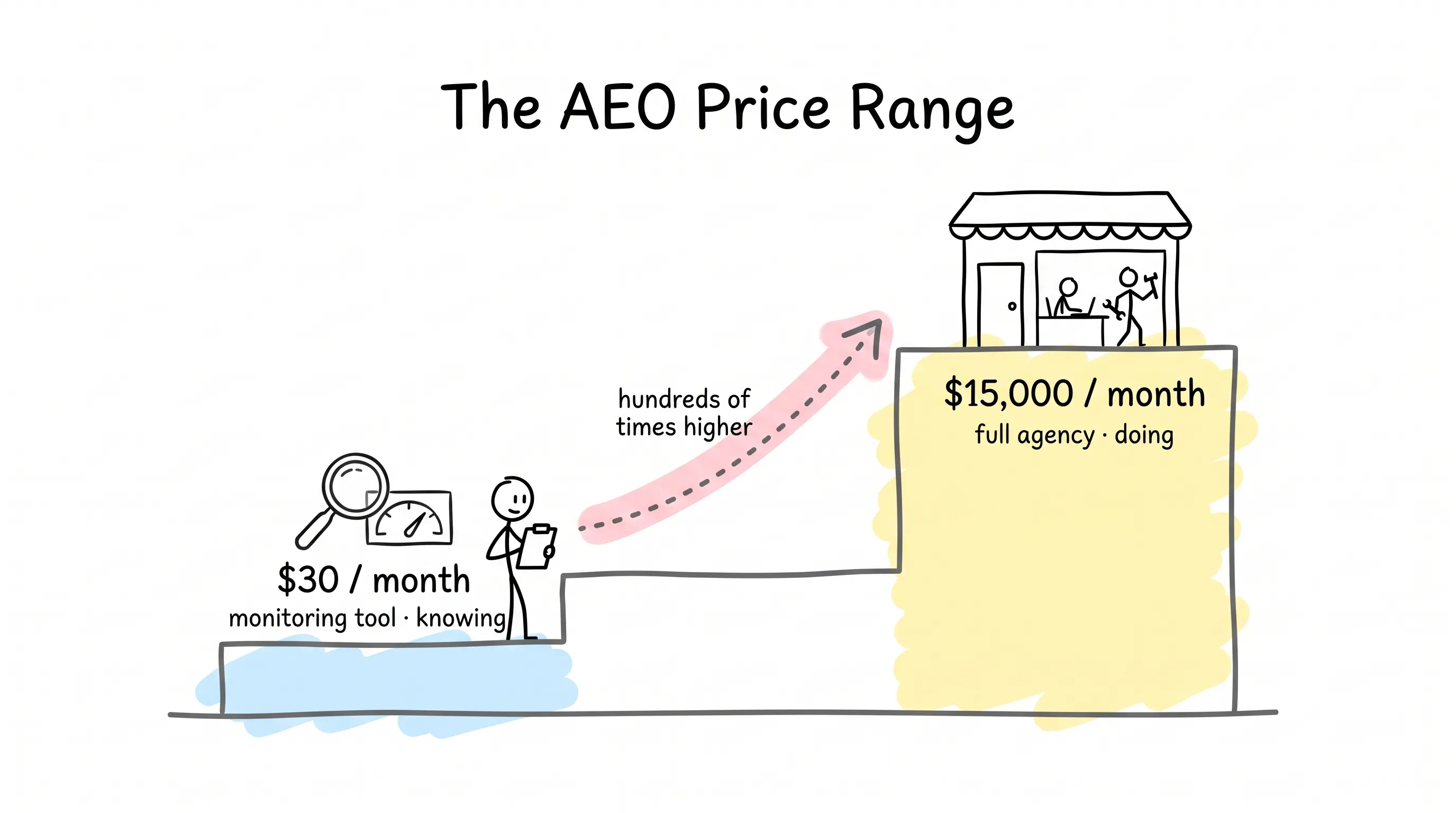
The floor: about $30 a month (a little over ¥200). That buys a monitoring tool, so you can track which AI questions mention you.
The ceiling: $15,000 a month and up (over ¥100,000). You hand the entire program to an agency — strategy, content, technical work, off-site building, all of it done for you.
That's some range. Several hundredfold from one end to the other.
Why such a gap? Is somebody charging whatever they want?
Actually, no.
The price of AEO was never about the tools. It's about the workload.
$30 buys "knowing": knowing whether AI mentions you. $15,000 buys "done": making AI mention you every day.
Knowing is cheap. Doing is expensive.
Where Does the Price Gap Come From? Five Things
Same job, same label — so why do some providers charge a few hundred a month while others charge tens of thousands? Break it apart and it comes down to five things, each one stacking cost on top.
-
Content volume. Refreshing a few old pages is cheap. Mass-producing new content around buyers' real questions is expensive. The more pages and formats, the higher the bill.
-
Technical work. Adding structured data (standardized site markup that tells machines who you are and what you sell) to your site, then straightening out your information on LinkedIn, Crunchbase, and the various review platforms, so that AI can recognize who you are. This work eats technical hours and needs long-term maintenance.
-
Off-site reputation. Whom AI cites depends on who gets mentioned repeatedly in third-party sources: review sites, industry media, Reddit. These mentions have to be earned — costly in time and people, and you can never stop. Of the entire budget, this is the piece that swings the most.
-
Monitoring coverage. Tools charge by how many prompts you track and how many engines you cover. 25 prompts is one price; 250 prompts across five engines is another.
-
Reporting depth. A simple visibility dashboard is cheap. Competitor comparisons, citation analysis, a prioritized list of recommendations — expensive.
You see, each of these five things can be done a little or done all the way. Naturally the prices are worlds apart.
The Four Ways Vendors Charge
That's how the math works. On actual quotes, though, it mostly comes in four shapes.
First, monthly agency retainers. The agency charges by the month and bundles content, technical, off-site, and monitoring. Entry level runs $249 a month for an audit plus strategy — NetWebMedia, for example. At the top end, $15,000 a month gets you 15-plus articles every month, LinkedIn content, and a dedicated data dashboard — RevenueZen's Total Market package. One heads-up: many agencies require a minimum three-month commitment.
Second, a one-time diagnostic, plus implementation. First you spend a little on a checkup: which prompts and which engines you're missing from, what traps hide in your structured data, where competitors get cited instead. A few hundred dollars, sometimes even free. The fixing is billed separately. One company, Digital Elevator, runs sprint projects from $3,000, with the biggest single engagements topping $24,000.
Third, software subscriptions. You buy the tools and do the work yourself. Monitoring tools run from $29 a month (Otterly.ai's Lite tier) to $489 (Otterly.ai's Premium tier). In between there's Profound's $99 entry plan — though it only watches ChatGPT; to cover multiple engines you need its $399-a-month Growth tier. Peec AI starts at $95. Ahrefs' Brand Radar runs $199 a month per engine. Remember: these tools handle "seeing," not "doing" — your own team still has to produce the content.
Fourth, hybrid. Audit-then-retainer, retainer with performance promises, software with managed service — every kind of combination exists.
Quotes come in all shapes and sizes, but budgets really fall into three tiers.
Three Budget Tiers — Find Where You Fit
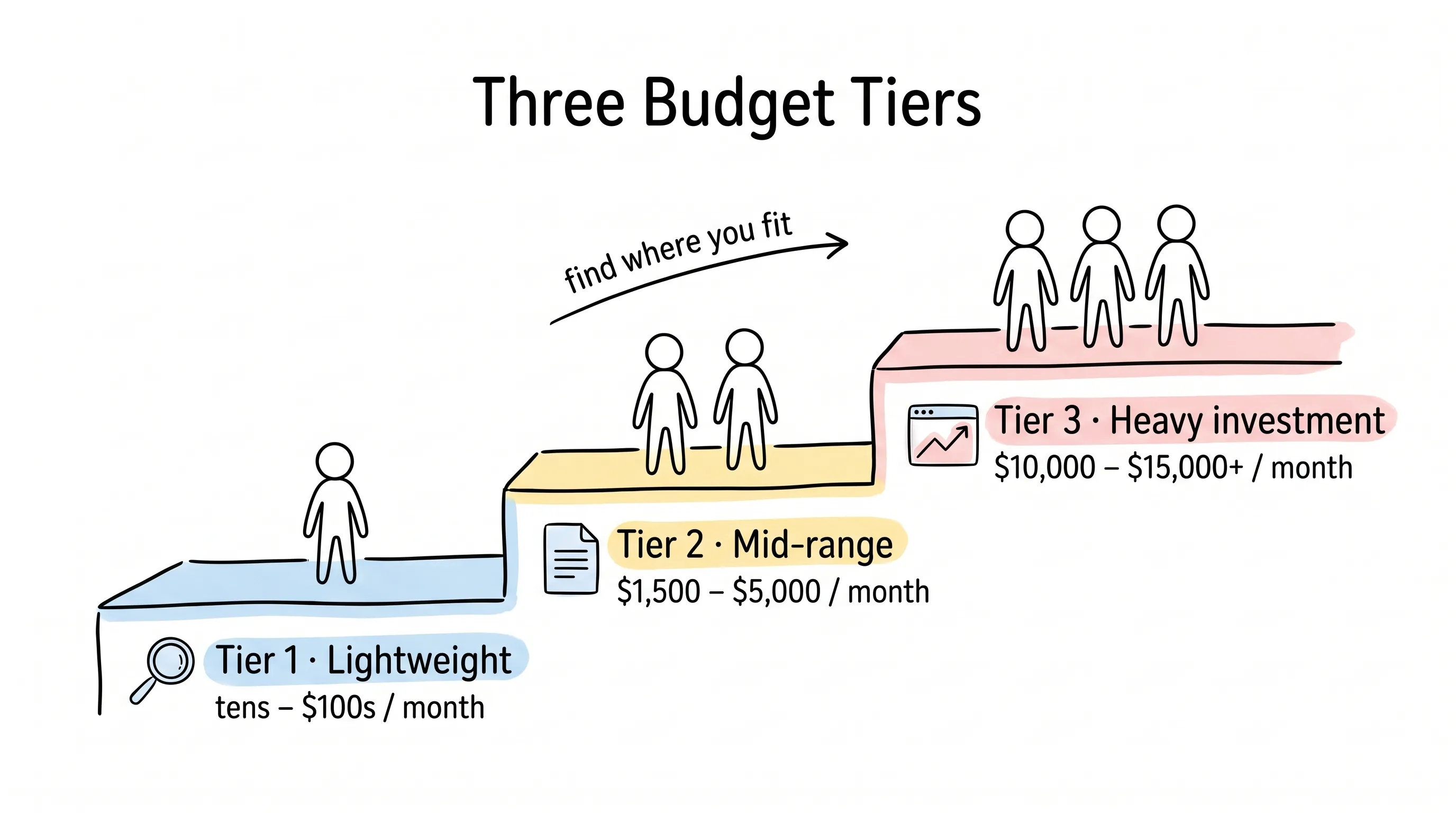
Tier one, lightweight: tens to a few hundred dollars a month. One monitoring subscription, plus at most one diagnostic. You can see how often you're mentioned, how big your share is, and where the gaps are — but all the doing is on you. Fits small teams, one-person marketing departments, and anyone who wants to test the water first.
Tier two, mid-range: $1,500 to $5,000 a month. A small-agency retainer that adds some content production, structured data, and monthly reporting on top of monitoring. Nugentive's done-for-you package, for example — $1,497 a month with structured data plus 3 to 5 content pieces — sits right at the lower edge of this tier. Fits companies with a few pairs of hands that still need outside help.
Tier three, heavy investment: $10,000 to $15,000-plus a month. Fully managed: strategy, content at scale, continuous off-site building, technical optimization, competitor benchmarking, pipeline-level reporting. Fits big teams treating AEO as a core channel, or companies with no in-house capacity at all.
Can You Cut SEO and Spend the Money on AEO?
Many business owners figure: AI is red-hot, so why not cut the SEO budget and put it all into AEO?
My advice: don't.
Because these two things share the same foundation: solid content plus a technically strong website. The fork comes in the second half. SEO competes on where your pages rank in search results and how often they get clicked — it counts rankings, click-through rates, impressions. AEO competes on whether your brand gets cited in AI answers — it counts mentions, share of voice (your brand's slice of all the AI answers in your category), citations. And with AEO you have to feed the engines before you can move people: if AI doesn't cite you, users never see you at all.
The two also feed each other. Pages that rank well on Google are more likely to be picked up by AI as citation sources. Not guaranteed, but the trend is obvious.
Cut SEO, and you cut off AEO's food supply.
Consider one widely cited industry analysis: from January to December 2025, referral traffic from AI grew about 3x. Sounds impressive. But by the end of 2025, its share of overall referral traffic was still under 2%.
Translated into plain terms: AI has started to surge, but the main battlefield is still traditional search. So you have to do both.
Five Red Flags to Check Before You Sign
This category is too new: there's no standard pricing, and promises are everywhere. Watch out for these five kinds of offers.
-
Reskinned SEO. Take the proposal, look inside, and it's still keywords, rankings, and clicks with an AEO stamp on it. But rankings and clicks cannot solve the question of whether AI mentions you. You'd be paying a premium for something you already had.
-
Guaranteed citations. Same logic as SEO: no vendor can guarantee that AI will cite you. A promise written into the contract, with a refund if it fails — that, you can accept. All chest-thumping, no contract: turn around and walk.
-
Vague scope. "Full AEO optimization" is a phrase you can neither compare quotes on nor hold anyone to. How many prompts tracked, which engines covered, how many content pieces per month — it must be in black and white.
-
Mystical scores. Some vendors invent their own "AI visibility score," one that only rises and never falls, with a secret algorithm. AI answers differ from one run to the next anyway; a score like that is worse than useless. Demand metrics that tie back to actual business results.
-
Opaque data. Reports that give only one aggregate number? Make them hand over the raw data: which prompts were tested, on which engine, which sources the answers cited. A report you can verify is a real report.
Tight Budget? Run a 90-Day Experiment First
At this point you might ask: so do I need to spend tens of thousands up front just to test the water?
Quite the opposite. Spend a little first and run a 60-to-90-day experiment to answer one question: does AEO actually work for my business? If yes, double down. If no, cut your losses.
How do you run it? Three steps.
-
Set a baseline first. Pick a batch of high-intent questions (the kind buyers ask right before they're ready to purchase) that buyers are most likely to ask an AI, run them on the engines buyers actually use, and record how often you're mentioned and how often competitors are.
-
Fix the cheap, valuable gaps. Prioritize the pages that rank well on Google but don't get cited by AI, and straighten out structured data and brand information while you're at it. This work takes the least time and pays off fastest.
-
Put the expensive things later. Mass content production and off-site reputation building are slow plays — two or three months cannot test their effect at all, so don't stuff them into the experiment.
Three metrics only: mentions, share of voice, citations. Set the baseline in week one, then check once each at day 60 and day 90. Watch the trend, not any single snapshot. The same AI answer can change between today and tomorrow.
A small team on a tight budget can even start at zero cost. HubSpot AEO, for example, has a 28-day free trial, no credit card required: it tracks 25 prompts across ChatGPT, Gemini, and Perplexity. That's the entire monitoring line item of a 90-day experiment — essentially free.
The Experiment Works — Then What?
If the experiment proves it's worth doing, the next phase is the long game. The question becomes: how do you continuously track visibility, see exactly which prompts competitors are stealing citations on, and tie all of this to the business?
This is where the software players come in. Take HubSpot AEO as an example: it watches your brand's visibility on ChatGPT, Gemini, and Perplexity, marks the spots where competitors snatch the citations, analyzes which sites and content types in your category get cited most, then hands you a prioritized action list. HubSpot itself runs exactly this playbook internally and has written the whole process up as a case study.
The price? Standalone, it's $50 a month, or $45 a month billed annually. If you're already running its Marketing Hub Professional or Enterprise, AEO is included at no extra charge — and its recommendations can plug into your CRM data and content tools.
Be clear about one thing, though: the software only does the monitoring. Fixing pages, producing content, and running off-site campaigns still fall to your own team. Want it all handled? Go back to the agency retainers above. Nothing in this market is both cheap and hands-off.
By the time I finished the math for my friend, the wince had gone out of his face — he looked settled.
Here's what I told him: don't be afraid of the price tag, and don't chase the bargain.
$30 is testing the water; $15,000 is hiring it done; neither is the standard answer. The standard answer has only one line: spend a little first, and verify that being mentioned by AI can truly bring business. If it can, double down. If it can't, cut your losses.
And here's my wish for you: in the half-second it takes an AI to answer any question, may yours always be the name that gets mentioned.
Continue reading
Related articles

Cross-Border Business: Time to Upgrade Your AI Toolbox
A learn article explaining how AI tools help cross-border e-commerce sellers clear five hurdles: language, regulation, logistics, payments, and fraud. It outlines a five-compartment toolbox, a five-step adoption path, and metrics such as conversion rate and CLV, while cautioning against over-reliance on AI.

AI Is Taking Over the Dirty Work of Social Media Marketing, One Task at a Time
This learn article outlines four social media marketing tasks AI can handle — audience analytics, content drafting and design, ad targeting and creative testing, and spam moderation — and cautions that taste, judgment, and data security remain human responsibilities.

AI Is Already This Good — Why Is Your Social Media Marketing Still Pure Manpower?
An overview of 18 AI tools for social media marketing, organized into six categories covering audience research, content creation, scheduling, comment and DM handling, ad management, and visual production, plus notes on personalization, prediction, and emerging trends.