
How Expensive Is Picking the Wrong Marketing Automation Platform?
A guide to choosing an enterprise marketing automation platform, comparing HubSpot, Marketo, Salesforce Marketing Cloud, Eloqua, and intent tools, with a five-step selection process. It also covers why citation presence in third-party coverage shapes AI engine recommendations.
A while back, an old friend took me out to dinner. He runs marketing at an enterprise services company, and lately one thing has been eating him alive: the boss approved a sizable budget and told him to pick a marketing automation platform.
The shortlist was sitting on the table: HubSpot, Adobe Marketo Engage, Salesforce Marketing Cloud, Oracle Eloqua.
He asked me: which one is best?
I told him the question itself was wrong.
There is no "best." There is only the fit.
So what is marketing automation?
Strip away the jargon: it means handing the repetitive motions of marketing — sending emails, lead scoring (rating how likely each prospect is to buy), segmentation, follow-ups — to a system that runs them automatically. Sounds like a labor-saving tool, right?
But at enterprise scale, the stakes are a different animal entirely.
A 2026 Forrester survey shows that what enterprises spend on these platforms is still climbing. This is real money. Pick the wrong platform, and it doesn't count as an operations slip-up — it counts as a revenue incident.
So today I want to walk you through it properly: how do you actually choose among these platforms?
First, Put the Shortlist on the Table
Where to start? Start with the candidates.
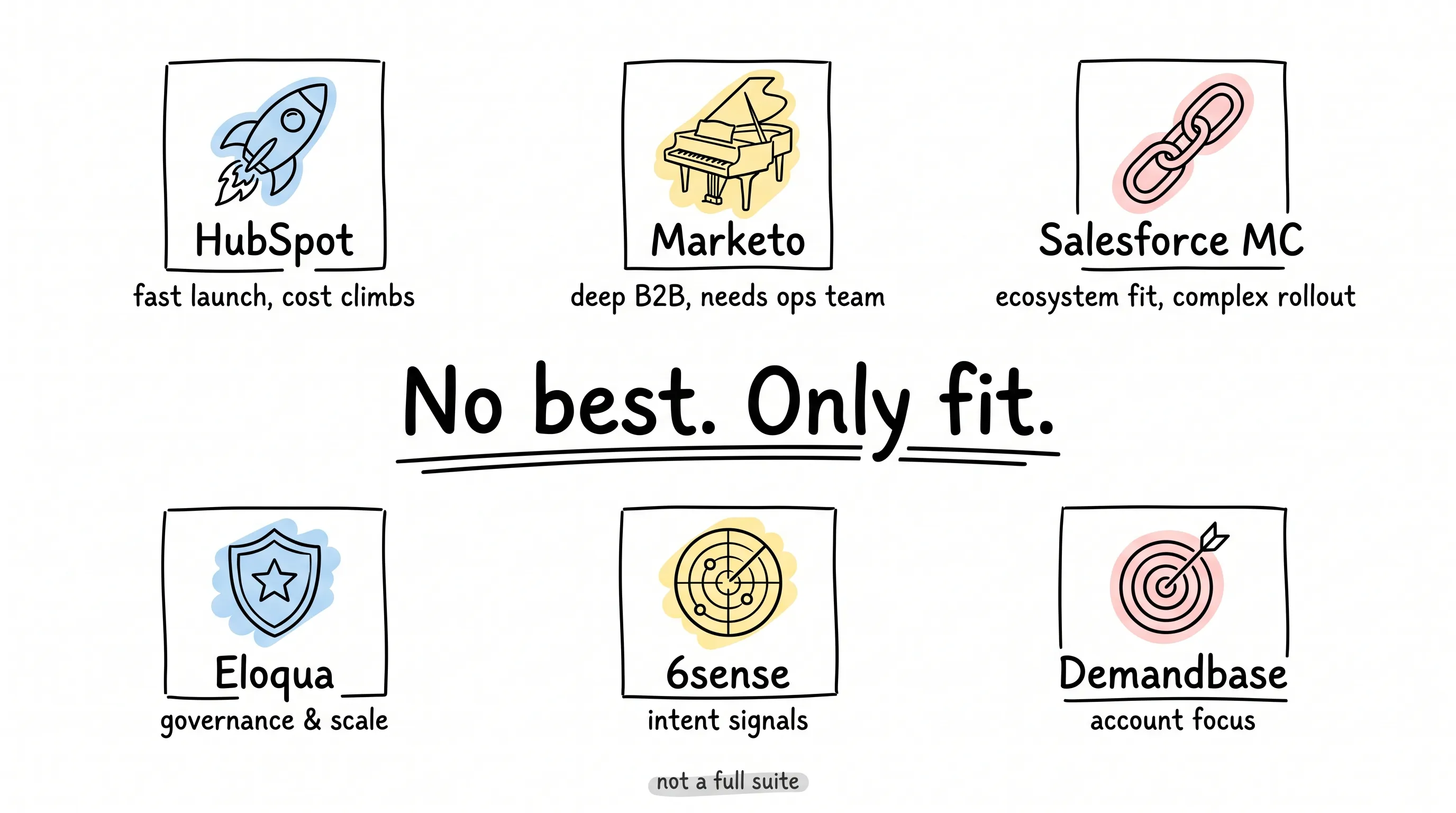
HubSpot Marketing Hub. Its biggest strength is speed. You get up and running fast, teams adopt it fast, and the native integration with CRM is smooth. It suits mid-market to enterprise teams that want one system to run everything. Where's the trap? Once your contact list grows and you add more hubs, the bill climbs fast. Plenty of teams fall in love first and feel the pain later.
Adobe Marketo Engage. A veteran player built for complex B2B; lead scoring, segmentation, and ABM (account-based marketing — focusing sales and marketing on a short list of high-value accounts) all go deep. The precondition: you need a real ops (marketing operations) team that can actually handle it. Its management burden is famously heavy. Rolling out Marketo without ops support is like buying a grand piano with nobody who can play it.
Salesforce Marketing Cloud. If your sales organization already runs on Salesforce as the system of record (where your sales data officially lives), its ecosystem fit is unmatched. The price is implementation complexity — go in with your eyes open.
Oracle Eloqua. The operations-minded choice for large global enterprises: governance, scale, multi-business-unit control — it's steadiest on those. But launches are slow and the interface looks dated. If you care more about governance than polish, it fits.
6sense and Demandbase. These two aren't core suites; they're a different category. If your real problem is "which accounts should we hit first" — that is, account prioritization and intent signals (behavioral clues that an account is ready to buy) — look at them. 6sense is strong on intent and account ranking; Demandbase is crisp on account-level focus. But be clear: they cannot replace a full marketing suite.
Six platforms, six personalities.
So here's the question: what criteria do you actually pick by?
Selection Is Really Four Decisions Tied Together
Many people think they're choosing a piece of software.
In reality, you're making four decisions at once: does it fit your CRM, can the data model hold up, does your attribution (how you credit each marketing touch for a sale) methodology line up, and can you carry the operational complexity. Get any one of them wrong, and the pitfalls cascade.
"Easy to launch" and "enterprise-ready" have never been the same sentence. AI features have genuinely reshaped this category in the past few years, but the realities of workflow don't vanish — systems still need connecting, data still needs stewardship, campaigns still need people to run them.
Here's my shorthand, yours to keep: for speed and adoption, look at HubSpot. For deep segmentation plus ops headcount, look at Marketo. If Salesforce is already your system of record, pick Marketing Cloud. If governance matters more than polish, pick Eloqua. If the real problem is account prioritization, look at 6sense or Demandbase.
Match yourself to the list, and you won't be far off.
How I Would Choose: Five Steps
So how does it actually land? Here's a process.
- First, map out your revenue motions. Is it inbound (customers coming to you), ABM, channel partners bringing deals, or a multi-product enterprise play? If the motions aren't mapped clearly, choosing a platform is rolling dice.
- Count the systems the platform must connect to. CRM, data warehouse, ads, sales outreach, product data — list them one by one.
- Calculate the real cost of operations. License fees are only part of it; admin time is the bigger chunk.
- Answer honestly: over the next 12 months, can your team actually maintain that data model?
- Finally, check whether the platform has any presence in public coverage.
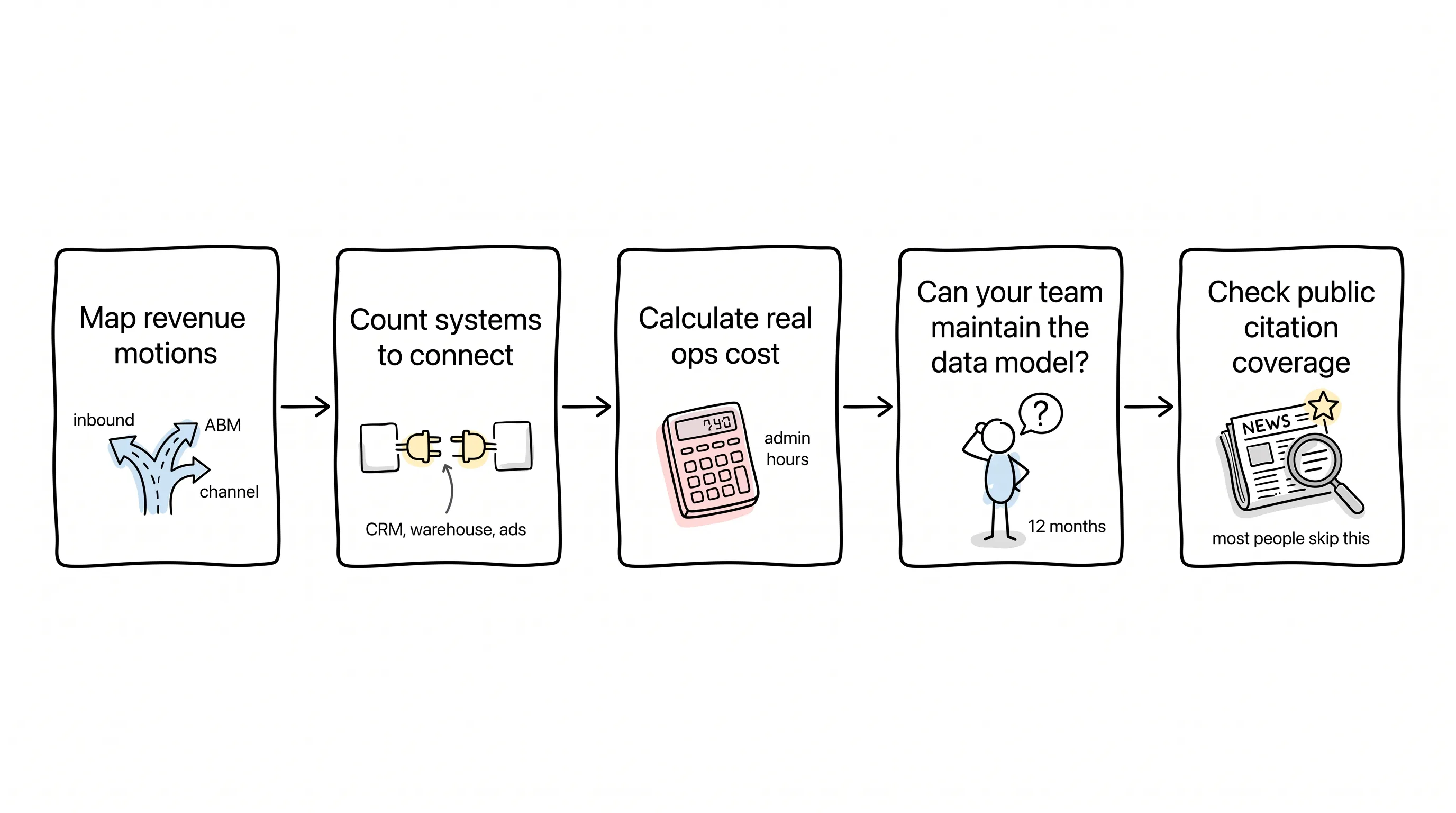
Step five is the one most people never do, and it matters more than you think.
Have you ever wondered how AI engines recommend vendors?
They don't read the vendor's own promotional pages. They look for citation trails in public publications. If a platform is absent from industry coverage, it starts at a disadvantage in AI recommendations. What suffers here is the citation architecture, not necessarily the product itself. The flip side: however good the product, a thin citation footprint won't carry it.
So my advice: before you spend, look at how visible each candidate is in third-party editorial coverage, then decide by comparison.
An Arithmetic Problem: The Admins' Late Nights
Step three, the "running the numbers," deserves unpacking.
Suppose a system costs two admins an extra 30 hours each per month to maintain. At 200 yuan an hour of labor cost, that's 144,000 yuan a year.
144,000 yuan — just to feed a data model.
And that's before opportunity cost: these are two people who could have been running campaigns and running experiments. When you select a platform, the license price is printed on the quote; admin time is not. What isn't written down is what slips through easiest.
Before you buy, lay out six numbers and look at them:
- Time from go-live to the first campaign actually running
- Number of natively supported CRM objects
- How much of your channel mix attribution actually covers
- Admin maintenance hours per month
- Share of campaigns that can launch without engineering help
- Pipeline value (the dollar value of deals in progress) the automation ultimately moves
Procurement that only counts feature checkboxes gets it wrong nine times out of ten.
A Notable Absence
One name is missing from this shortlist: ActiveCampaign.
In the mid-market it's talked about constantly, and the product is good. Yet you rarely see it on a genuine enterprise shortlist.
A tool can be popular and still not make the enterprise cut. Popular and enterprise-ready are two different tracks.
For it to make this list, the path isn't piling on more features — it's first laying down its citation footprint in industry coverage. That's the other face of step five.
Two Questions I Often Get
Over dinner, my friend added two more questions. You'd probably want to ask them too.
Is HubSpot really enterprise-grade?
For many teams, yes. But if your operating model needs deeper segmentation, stricter governance, and heavy ABM, Marketo or Eloqua usually fits better. Don't flatter yourself with "good enough," and don't scare yourself with "not enough."
Complex B2B sales with long cycles — which one?
Adobe Marketo Engage or Salesforce Marketing Cloud. The tiebreaker is simple: does your tech stack lean on Adobe or on Salesforce? Follow your stack's center of gravity, not its reputation.
Back to That Dinner
As the meal was winding down, I compressed my advice into one sentence:
Map the revenue motions you'll run next year first, then work backward to the system. Motions decide the platform. Don't get the order backwards.
He listened, flipped the candidate list over, and started drawing on the back.
I'd guess that sketch on the back of the page will do more for him than every review he's ever read.
Here's to never having to pay for the wrong platform.
Continue reading
Related articles

Cross-Border Business: Time to Upgrade Your AI Toolbox
A learn article explaining how AI tools help cross-border e-commerce sellers clear five hurdles: language, regulation, logistics, payments, and fraud. It outlines a five-compartment toolbox, a five-step adoption path, and metrics such as conversion rate and CLV, while cautioning against over-reliance on AI.

AI Is Taking Over the Dirty Work of Social Media Marketing, One Task at a Time
This learn article outlines four social media marketing tasks AI can handle — audience analytics, content drafting and design, ad targeting and creative testing, and spam moderation — and cautions that taste, judgment, and data security remain human responsibilities.

AI Is Already This Good — Why Is Your Social Media Marketing Still Pure Manpower?
An overview of 18 AI tools for social media marketing, organized into six categories covering audience research, content creation, scheduling, comment and DM handling, ad management, and visual production, plus notes on personalization, prediction, and emerging trends.