
How Does AI "See" Your Images? Behind 25 Billion Photo Searches a Month, Visual SEO Has Changed the Game
A learn article on how AI visual search interprets images and why visual SEO now depends on aligning each image with the right entity and context. It walks through five steps: image substance, structured data registration, multimodal consistency, freshness, and DAM governance.
Let me start with a number.
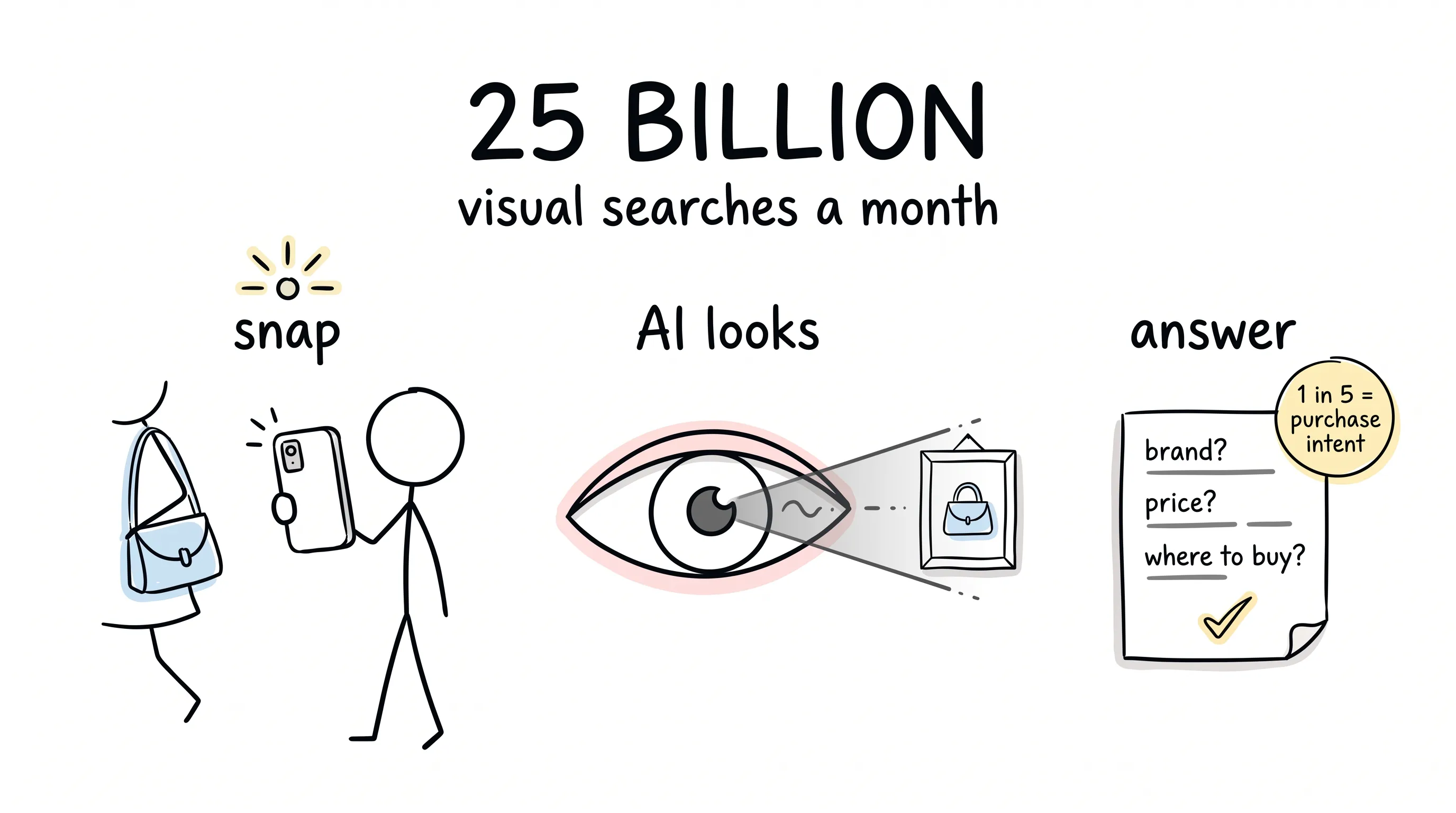
25 billion.
Google's own figures: visual searches through Lens now top 25 billion a month. And here's the kicker: one in every five of those searches comes with clear purchase intent.
Put that in perspective: it means every person on Earth, on average, "snaps instead of types" two or three times a month.
Odds are you've done it yourself. You're out shopping, spot a bag someone is carrying — nice, out comes the phone, one snap. You walk past a restaurant with a line out the door — out comes the phone, one snap. The moment the shutter clicks, the answers arrive: what brand is this, how much does it cost, where can I buy it.
Notice this path: I saw something → What is this? → Is it right for me? → Where do I buy it?
Not a single word typed. The starting point of search has moved from the keyboard to the camera.
At this point you might say: I know this one — image SEO, old news. Write a good file name, write good alt text, add a block of structured data, done.
Right — these are still the fundamentals. But if you stop there, chances are you'll run straight into a new wall:
Technically, your images are fully searchable. AI just can't understand them. It may even misread them.
Those are two different problems.
What Does It Mean for AI to "Understand" an Image?
First, let's be clear: what AI does with images today is a far cry from the old reverse image search that just hunted for lookalikes.
It can pick out the things in a scene one by one: this is a product, this is a location, this is a material, this is a style. It can also understand how these things relate to each other, and then attach that whole web of information to your search intent.
It will even take an image apart and examine it piece by piece — query one patch here, another there, run several retrieval paths at once, then stitch the results into a single answer.
So the information an image carries goes far beyond "what it's a picture of."
A hotel room photo can convey the room type, the amenities, the view outside the window. A restaurant photo can convey the cuisine, the signature dishes, the dining atmosphere. A product photo can convey the material, the color, the function, the selling points.
An image is no longer just an asset. It has become a signal AI uses to judge who you are, what you sell, and whether you can be trusted.
Which raises a new problem: once images become signals, you have to make sure the signal going out is the right one.
The Unit of Optimization Has Changed
In the old days of image optimization, the unit in your head was "one image."
Tweak the title, write the description, compress, upload. Done.
Now the unit has become a "relationship": the line connecting an image, the entity it represents, and the context around it.
What does that mean?
A room photo has to be anchored to the right hotel, the right room type, the right location. A product photo has to be anchored to the right product, the right specs, the right price. If the anchoring is wrong — or never happens at all — AI is left to guess. And what it guesses isn't up to you.
Put plainly, this is a disambiguation job. Three sides have to line up:
What the brand means to say. What users see. What AI understands.
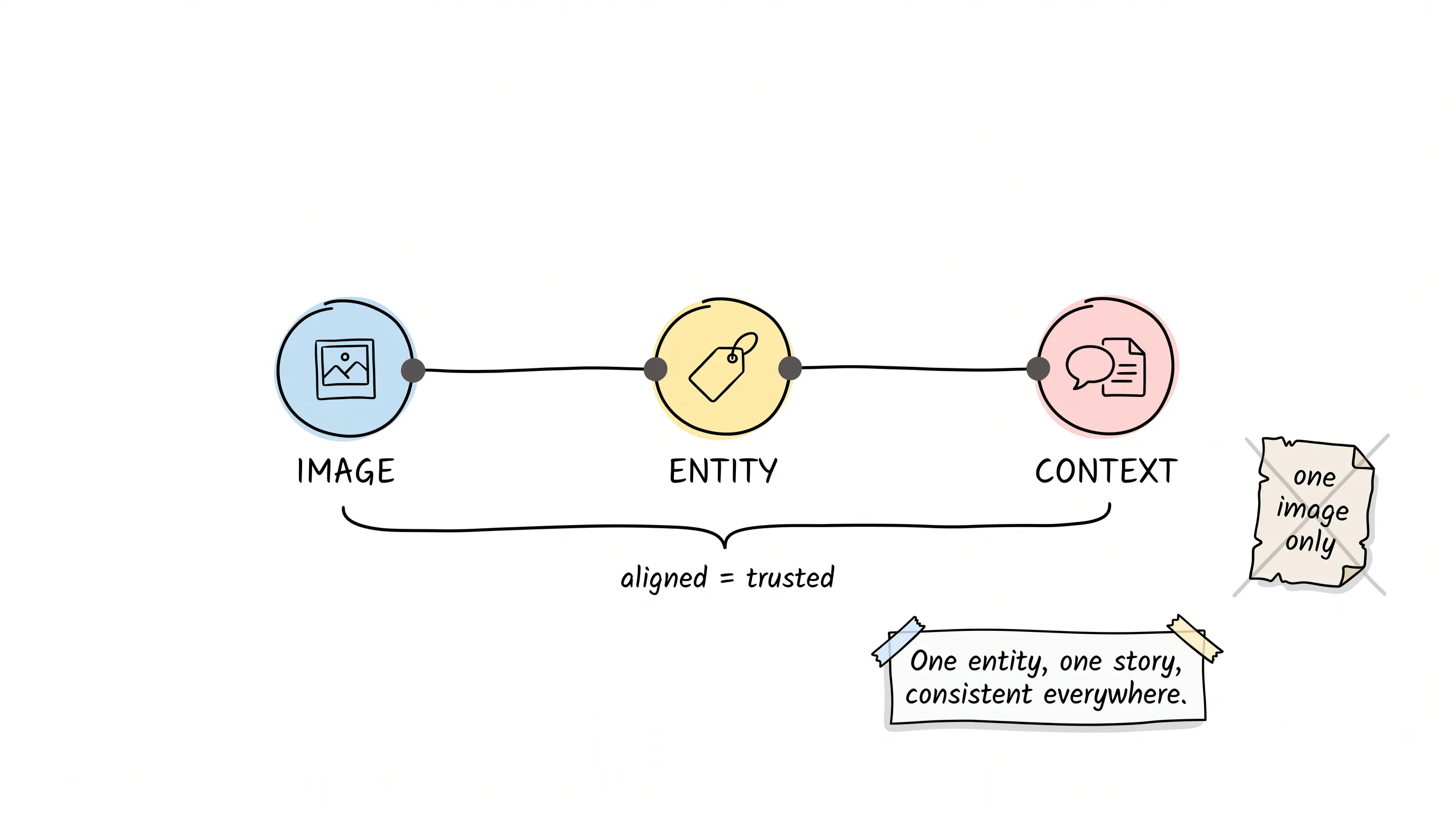
When all three align, everyone wins. When they clash, AI has to step in as the referee. And the referee's whistle isn't necessarily blown in your favor.
Picture this scene: a hotel chain, thousands of images, scattered across the official website, booking platforms, review sites, and social media. One channel has just renamed a room type while another still shows the old photo; the official site promises a deluxe ocean view while the booking platform pairs it with a street-facing window. A human can tell it's the same hotel. A machine can't. The machine only sees a pile of signals that don't match — and then picks one to believe.
An image isn't just an asset — it's evidence. And when evidence contradicts evidence, the case is no longer yours to decide.
Five Steps to Get Every Image Registered Correctly
So what exactly do you do? I've broken it into five steps. The order is mine, running from the image itself all the way to governance.
First, the Image Must Have Substance
What does substance mean? A single image from which humans and machines recognize the same thing.
What AI looks for in an image are attributes: color, material, style, room type, dishes, features. Your photos need to capture those attributes clearly.
Take a rooftop pool photo: what style of loungers, what the lighting feels like, what the view looks like, how the pool is designed. That's what customers want to see — and it's exactly what AI can recognize. The richer the detail, the higher the odds that human and machine reach the same conclusion.
Conversely, those cookie-cutter renders and detail-free mood shots still work on human eyes, if barely. To a machine, they carry roughly zero information.
Second, Every Image Needs a Registered Identity
An image can't just hang there, open to whatever interpretation anyone pleases. It has to be registered to a clearly defined entity, backed by official documentation.
The tool is ready-made: structured data. Product, Hotel, Event, ImageObject — use whichever fits. Then keep that structured data in real-time sync with your inventory, prices, store locations, and booking systems.
But note: the point here is not "stacking on more code."
It comes down to one word: uniqueness.
Official website, store profiles, publishing platforms, booking systems, social media accounts... for any single entity, there can be only one authoritative version. Image, page, and structured data must all tell the same story.
One entity, one story, consistent everywhere.
The moment any source contradicts another, AI has to stop and play referee first. And the answer it gives after refereeing is no longer your answer.
Third, Don't Optimize Images in Isolation
Many people treat image optimization as its own track: one set of actions for the images, another for the page content.
That doesn't work anymore. In multimodal search, the image, the body text, the title, the caption, the alt text, and the video subtitles together define "what this image means." If the page was just redesigned but the captions are still two years old, ambiguity shows up immediately.
So the classic trio — descriptive file names, alt text, captions — remains fundamental. What has changed is whom they serve: no longer crawlers, but the AI that looks at images.
Fourth, Don't Let Images Go Stale
Visual-search readiness has no such thing as "done" — only corners that haven't been aligned yet.
Prices change, room types get renamed, campaigns rotate, and the images, entity information, structured data, and page content all have to move together. Otherwise the image says one thing, the data says another, and AI doesn't know which to believe.
For multi-location brands, there's an especially big trap here: the shared image library. Headquarters produces one set of images for every store nationwide. The Shanghai location displays photos of the Chengdu store; a freshly renovated branch shows pre-renovation pictures. One image registered to the wrong entity, and the ambiguity scales up from a single photo to thousands of locations.
Remember one line: the right image, at the right time, representing the right entity.
A local event page is the best demonstration: current event details, on-site photos, location information, and structured data, all woven together, telling search engines and AI — this is happening "now."
Fifth, Someone Has to Be in Charge
Once the first four steps are built, one piece is missing: with thousands or tens of thousands of assets, who gets the final say?
A digital asset management platform — a DAM. At this stage it's no longer a tool; it's the court where disputes get settled.
It must act as the single source of truth, answering one basic question: for any given entity, which image, right now, is the authoritative version?
Around that question, the DAM has to govern a whole chain: ownership, approval status, copyright, versions, expiry dates, which entity an asset is registered to, whether it was AI-generated or AI-edited, and provenance. And it's not just images — videos and PDFs have to go in too, carrying the same set of information.
Multi-location brands need it more than anyone. The official site, the individual stores, the agencies, the social media teams each push their own versions, and nobody can say which is right. The DAM is where the debate gets settled for good.
One more thing: a DAM also helps you prepare for provenance technologies such as SynthID and C2PA Content Credentials — standards that make clear where an image came from and whether it was generated or modified. These are signals AI will read.
The Last Word
Generative AI has made creating images easier than ever. But making images understood and trusted? Not one bit easier. Quite the opposite: the more assets you pile up, the more room there is for the mess to grow.
So the new homework of visual SEO is to reconnect every strand of the image–entity–context line, one by one. Editing photos is only a small stretch of that line.
Go back to the scene at the start. Next time you pull out your phone and snap that bag, the answer appears a few seconds later — and behind that instant is a brand that has aligned its images, its data, and its structured information across every channel.
The real work happens where you can't see it.
Here's to every one of your images ending up registered under the right name.
Continue reading
Related articles

Cross-Border Business: Time to Upgrade Your AI Toolbox
A learn article explaining how AI tools help cross-border e-commerce sellers clear five hurdles: language, regulation, logistics, payments, and fraud. It outlines a five-compartment toolbox, a five-step adoption path, and metrics such as conversion rate and CLV, while cautioning against over-reliance on AI.

AI Is Taking Over the Dirty Work of Social Media Marketing, One Task at a Time
This learn article outlines four social media marketing tasks AI can handle — audience analytics, content drafting and design, ad targeting and creative testing, and spam moderation — and cautions that taste, judgment, and data security remain human responsibilities.

AI Is Already This Good — Why Is Your Social Media Marketing Still Pure Manpower?
An overview of 18 AI tools for social media marketing, organized into six categories covering audience research, content creation, scheduling, comment and DM handling, ad management, and visual production, plus notes on personalization, prediction, and emerging trends.