
How Does AI Help Cross-Border E-commerce Move Three Mountains Out of the Way?
A learn article explaining how AI is applied in cross-border e-commerce across customer service, personalization, translation, demand forecasting, logistics and customs compliance, and fraud detection, ending with a three-step adoption guide.
A few days ago, I had dinner with a friend who does cross-border e-commerce.
He's been at it seven or eight years, with business reaching Europe, America, and Southeast Asia. In previous years, meeting him meant listening to his complaints: goods stuck in overseas warehouses; one wrong code on a customs form and the whole batch sat at port for half a month; a customer service team needing five languages; taxes from different countries calculated until he doubted his sanity.
But this time, the man was completely relaxed.
I asked, how did you solve it?
He said, I handed most of the work to AI.
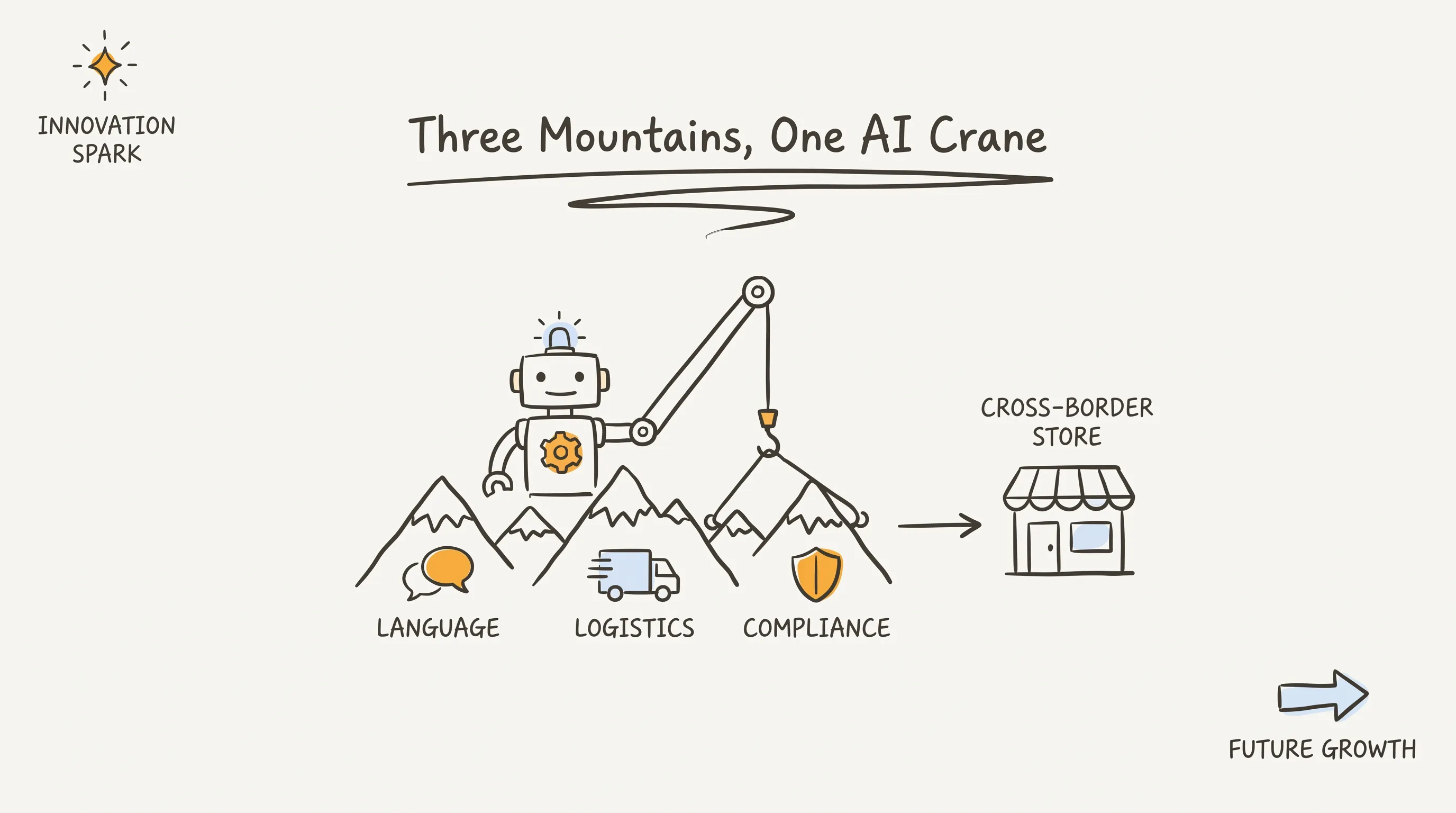
Today, I want to talk with you about this: how exactly does AI help cross-border e-commerce move the three mountains — language, logistics, compliance — out of the way, one at a time?
A Premise First
You may have heard a number: one survey shows over 74% of e-commerce executives believe AI is genuinely driving their business.
At first I was skeptical too. Then I ran the numbers and found the logic remarkably plain.
Cross-border business is hard — hard where? Hard in that every link is separated by borders: customers separated by language, goods separated by customs, money separated by exchange rates and regulation. Solving these used to mean stacking people. Stacking translators, customs specialists, multilingual support.
What AI does is, essentially, one thing: flatten everything that's "separated."
Once flattened, costs come down and speed goes up. How aggressively? Read on.
Mountain One: A Cost Account That Keeps Its Word
What does efficiency improvement mean? It means work that used to be done by humans is now done by machines — more reliably, too.
A few numbers. On the customer service side, after AI support goes live, support tickets generally drop 30% to 60%, and first-contact resolution rates rise noticeably. On the compliance side, HS codes used to be handled manually (that's the "ID number" for classifying goods at customs); now AI can cut manual workload by half to 80%.
What happens when it goes wrong? One wrong code — light, your goods get held; heavy, you eat a fine. AI does this fast and without errors. That's what real saving looks like.
Pricing also falls to AI. It watches competitors' prices and local market demand in real time, dynamically adjusting your pricing to protect your margin. You sleep once; it has already repriced three rounds.
Powerful!
Mountain Two: Making Every Market's Users Feel You "Get Them"
What is personalization? One example and you'll understand.
A German user opens your website and sees products, recommendation order, and homepage content that are an entirely different set from what a Japanese user sees. That's personalization.
How dramatic can conversion get when it's done well? Three real cases:
A footwear company called Clarks optimized social proof elements: new-visitor conversion rose 4.5%, overall conversion rose 12%. Office Depot optimized product pages by user behavior and earned nearly $6.9 million more. Fingerhut merely customized its homepage content by segment: product page views rose 4%, total conversion rose 1.1%.
Not finished. Look at pricing localization: one comparison dataset shows that after localized pricing, conversion went from 3% to 41% in 14 days.
3% to 41%. You read that right.
Why? Because a user buying on an unfamiliar site faces one great psychological barrier: distrust. Speak his language, price in his familiar conventions, and only then does he think: this store is seriously here to do business with me.
Trust is the foundation of cross-border conversion.
Mountain Three: Language, and the Money Behind It
Translation used to be a fixed cost for cross-border sellers. Hire a translation firm, pay by word count — expensive and slow.
Now? AI translation cuts costs by 30% to 80%. If you dare skip human review, you can save over 95%.
But my advice: don't cut that human review entirely.
Why? Machine translation guarantees "correct," but not "flavor." A brand speaks with a certain tone. Some markets' slang, memes, and taboos — one careless slip and AI crashes. Keep one human gate to guard the brand voice. This money cannot be saved.
Mountain Four: Guessing What Sells Tomorrow
The most painful loss in cross-border e-commerce isn't failing to sell — it's selling out with no stock, or stocking up and letting it pile in the warehouse.
What is demand forecasting? Letting AI watch real-time data from 200-plus data sources and tell you in advance: which market, which SKU, roughly how much sells next month.
How well does it work? Forecast accuracy improves 10% to 20% over traditional methods, forecast error can drop by as much as half, stockouts drop up to 65%. With inventory optimized, overall inventory levels fall 35%, excess stock cut up to 40%, supply chain costs down 10% to 15%.
Stock goods closest to the user, and the business has backbone.
Mountain Five: Logistics, and That Paper Through Customs
On logistics, I've already seen too many specific victories.
Customs document automation: a platform called Nuvocargo raised clearance speed 34%. FlavorCloud's AI tool classifies products into HS codes with 98% accuracy. UPS uses AI to optimize delivery routes, saving 10 million gallons of fuel a year. In warehouses, manual picking used to manage 60 to 80 items an hour; with AI guidance it reaches 300-plus, with accuracy over 99.9%.
Then tariffs and compliance automation. Tools like Zonos and Avalara use machine learning to automatically assign tariff codes, calculating duties and taxes in real time at checkout — users know what they'll pay before ordering, and cart abandonment falls accordingly.
Overall: manual operations reduced by up to 75%, document error rates below 0.1%, clearance time cut up to 60%, trade costs down 5% to 12%. Most companies earn back the investment in 12 to 18 months.
One customs form used to be a cross-border nightmare. Now it's a line of code.
One Invisible Mountain: Fraudsters
Global business means global scams too. Data says global e-commerce fraud losses in 2024 were about $44 billion, projected to rise to $107 billion by 2029.
AI works both ends. One end blocks the bad guys: analyzing purchase behavior, identifying suspicious devices, verifying shipping addresses, running transaction frequency checks. PayPal, using AI, intercepts roughly $500 million in fraud every quarter. Merchants with AI risk controls typically see fraud losses drop 30% to 50% within six months.
The other end spares the good guys: AI reduced false declines (normal customers wrongly rejected as fraudsters) by 25%. Know this — a wrongly accused high-value customer may never come back.
The highest state of risk control is not scaring away all the good people.
If You Mean It: A Three-Step Landing
Having talked this far, you may already be tempted. But don't rush to buy every tool once through.
My advice is three lines.
First, start from business value. Find the most painful link in your business first: customer service? Customs? Inventory? Treat wherever hurts first. Don't do AI for AI's sake.
Second, small steps, fast runs. Launch one small project, run it through, do the accounts, then expand. For tool selection, prioritize ones that span multiple platforms: the likes of Shopify Plus and Amazon Global Selling, paired with Avalara for tax compliance and Phrase for translation localization, basically covers most scenarios.
Third, bring the team along. What AI replaces is repetitive labor. The time people free up should go to work that needs more brains. Your team must learn how to direct it and how to inspect its output.
Finally, don't forget to measure. Conversion rate, cost, fulfillment speed, inventory turns — look at each market separately. Watch cultural adaptation closely too: research says localized marketing emails can lift conversion by 56%. Conversely, one ill-timed automated email can also wreck a market.
Finally
At the end of that dinner, my friend said something that stuck with me.
He said, going global used to be a contest of who dared to stock more goods and hire more people. Now it's a contest of who first turns AI into their own muscle.
The mountain of language — AI translates it for you. The mountain of logistics — AI carries it for you. The mountain of compliance — AI calculates it for you.
The three mountains are still there. But the person moving them has changed.
May you soon turn AI into muscle, not decoration.
Continue reading
Related articles

Cross-Border Business: Time to Upgrade Your AI Toolbox
A learn article explaining how AI tools help cross-border e-commerce sellers clear five hurdles: language, regulation, logistics, payments, and fraud. It outlines a five-compartment toolbox, a five-step adoption path, and metrics such as conversion rate and CLV, while cautioning against over-reliance on AI.

AI Is Taking Over the Dirty Work of Social Media Marketing, One Task at a Time
This learn article outlines four social media marketing tasks AI can handle — audience analytics, content drafting and design, ad targeting and creative testing, and spam moderation — and cautions that taste, judgment, and data security remain human responsibilities.

AI Is Already This Good — Why Is Your Social Media Marketing Still Pure Manpower?
An overview of 18 AI tools for social media marketing, organized into six categories covering audience research, content creation, scheduling, comment and DM handling, ad management, and visual production, plus notes on personalization, prediction, and emerging trends.