
How Can Someone Who Doesn't Exist Outshine Real Influencers?
An explainer on why brands adopt virtual influencers, covering human-endorsement risks, storytelling-driven fan attachment, and the limits of digital personas for certain audiences.
A while back, a friend of mine who works in branding came to me with a question.
His team wanted to sign a new spokesperson. Someone suggested: sign a virtual influencer. He burst out laughing: a person who doesn't exist — on what grounds?
I didn't answer right away. I said, first let me tell you two stories.
First, Look at the Other Side of Being a Human Influencer
The first story: a slap.
At the 2022 Oscars, broadcast live around the world, Will Smith walked onto the stage and slapped Chris Rock. The very next day, Sony, Netflix, Apple — the companies holding his projects — canceled or shelved them, one after another. A single slap shattered a screen image built over decades.
The second story: terminations.
Kanye West, rap superstar, after a string of outrageous remarks, saw Gap, Adidas, Balenciaga, Vogue, and JPMorgan all cut ties with him by the end of 2022.
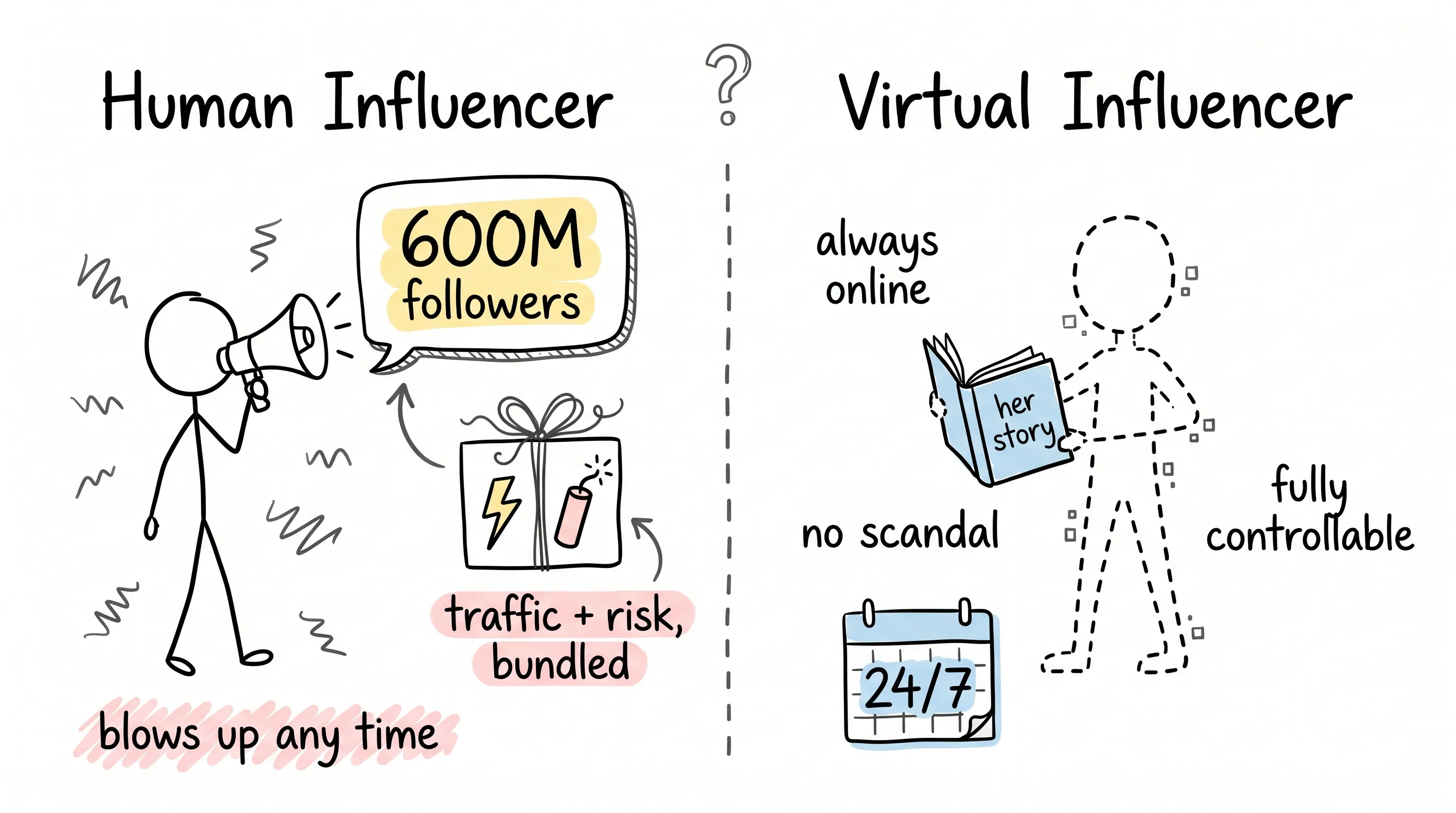
Think about it: why do brands hire influencers? For traffic, for image. And at bottom, to sell product. But the human-influencer lever has one end hooked to massive traffic — and the other end tied to a living person.
Living people blow up.
And when they do, they never give you a heads-up.
This is the Achilles' heel of human endorsement: traffic and risk come bundled and sold as one.
How powerful are top human influencers? In late 2023, MrBeast, YouTube's biggest creator, passed 220 million subscribers; Cristiano Ronaldo has more than 600 million Instagram followers, endorsing Louis Vuitton and Nike. The bigger the lever, the more brands love it — and the harder the fall.
So some big brands worked one thing out: fine — find someone who doesn't exist.
So What Is a Virtual Influencer?
What exactly is a virtual influencer?
A digital persona built with 3D modeling, animation, and artificial intelligence. She has a face, a personality, friends, hobbies, moods — like the lead of a drama series, living her life one season at a time, for you to watch.
Sounds fake, right? Yet the big brands poured real money in.
Noonoouri became Dior's virtual muse. Prada built its own, named Candy, and even brought in the director of the film Drive to shoot her short films. LVMH's virtual avatar Livi is dedicated to promoting the group's innovation projects; she appeared at VivaTech 2022 (VivaTech: Europe's biggest tech and startup show) to present, and even interacted on stage with the virtual avatar of the group's chairman, Arnault — quite the picture. Samsung has Sam in Latin America, and Renault gave the Kadjar its own virtual ambassador.
Luxury, beauty, fashion, retail — the industries most obsessed with image control are now the ones most welcoming to virtual influencers. Markets like Brazil and South Korea are especially receptive.
You might find this odd: these brands fight counterfeits every day — and now they're using "fake people" themselves?
Because the Story Feels More Real Than the Face
Here lies a counterintuitive finding.
In 2024, a team of researchers ran a study: they examined the virtual influencers of Brazil's three largest retail groups — Lu of Magazine Luiza, CB of Casas Bahia, and Nat of Natura — and interviewed 16 digital marketing experts.
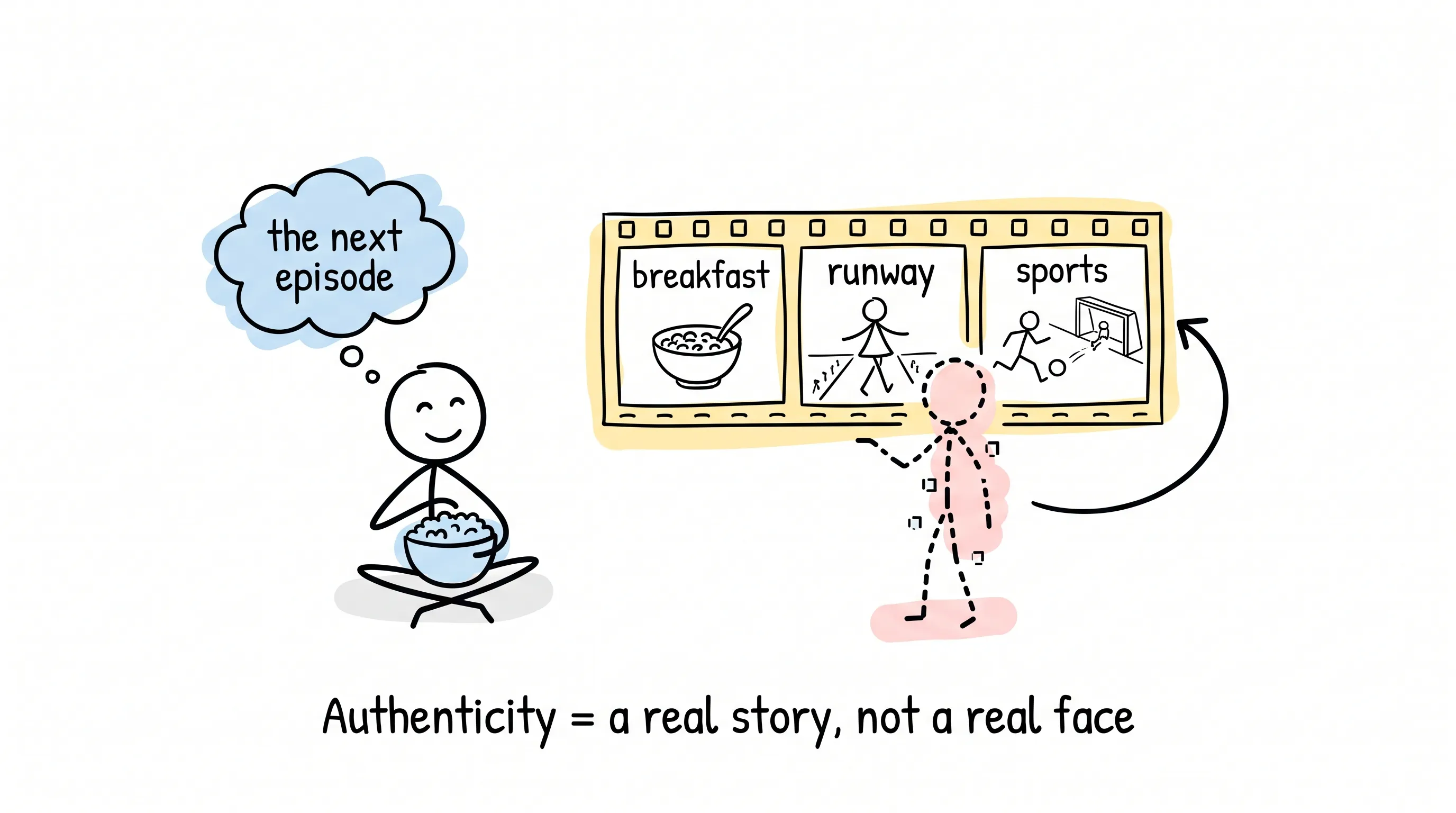
The conclusion was a little surprising: what gets fans hooked is never the face. It's her story.
How she wakes up, what she eats for breakfast, where she walks the runway, which extreme sports she plays. Fans follow her the way they follow a TV series, a comic-book hero — what they're chasing is "the next episode."
Authenticity doesn't come from "you are real." It comes from "your story is real."
And here's the even more counterintuitive part: virtual influencers can actually feel more "real" than human ones.
Why?
Think about it: when you scroll past a human influencer with a flawless body, how do you feel? Envy — then anxiety. A 2023 study found that human influencers lead users to compare themselves involuntarily, breeding appearance anxiety. A virtual influencer? She's obviously fake, so you don't compete with a bundle of rendered pixels. The anxiety disappears, and you can actually relax and like her.
Honest fakeness is more comfortable than effortful realness.
Now let's run the numbers for brands. A virtual influencer doesn't age, doesn't get tired, doesn't take time off, doesn't self-destruct in a scandal, won't clash with brand values, is online 24 hours a day, delivers fully controllable content — and costs less.
For a brand, this is nearly the perfect employee.
But Everything Has a Flip Side
Tempted? Hold on a second. Virtual influencers have a fatal flaw: a portion of the audience simply won't buy it.
Some people just feel that interacting with a fake person is unsettling. Especially when the persona looks too human and doesn't admit to being fake — it's like wandering a wax museum at midnight, skin crawling. Researchers have argued about this for years: some call virtual influencers "fake idols," saying they're off-putting; others have found that when the story is told well, fans form bonds with her deeper than you'd imagine.
So the study's "limitations" list states it plainly: virtual influencers cannot reach certain demographics.
What to do? Look at the industry. In luxury, beauty, and retail — where image control is paramount — virtual influencers are in their element. In settings that depend on genuine human charisma, real people remain irreplaceable.
A Few Final Words
Let's go back to my friend's question from the start: a person who doesn't exist — on what grounds?
Not on the grounds of that face. She never self-destructs. Her story can keep being written. She lets fans drop the comparisons and like her in peace. And she lets brands, for the first time, strike "blow-up risk" off the budget sheet.
The researchers behind that study judged at the time: as virtual worlds spread, virtual influencers would go increasingly mainstream. Looking back now, that call hasn't gone off course.
I pass that judgment on to you. The influencers you scroll past in the future may be less and less "real," and you'll like them more and more.
Because what moves you has always been the story.
Continue reading
Related articles

Cross-Border Business: Time to Upgrade Your AI Toolbox
A learn article explaining how AI tools help cross-border e-commerce sellers clear five hurdles: language, regulation, logistics, payments, and fraud. It outlines a five-compartment toolbox, a five-step adoption path, and metrics such as conversion rate and CLV, while cautioning against over-reliance on AI.

AI Is Taking Over the Dirty Work of Social Media Marketing, One Task at a Time
This learn article outlines four social media marketing tasks AI can handle — audience analytics, content drafting and design, ad targeting and creative testing, and spam moderation — and cautions that taste, judgment, and data security remain human responsibilities.

AI Is Already This Good — Why Is Your Social Media Marketing Still Pure Manpower?
An overview of 18 AI tools for social media marketing, organized into six categories covering audience research, content creation, scheduling, comment and DM handling, ad management, and visual production, plus notes on personalization, prediction, and emerging trends.