
He Built Marketing Automation. Now He Wants to Replace It With His Own Hands
Marketo co-founder Jon Miller launches Phave, an AI-native marketing automation platform that replaces rule-based lead flows with per-person AI playlists — and why the incumbents' agent updates may not be enough.
A few days ago, a photo showed up in my LinkedIn feed.
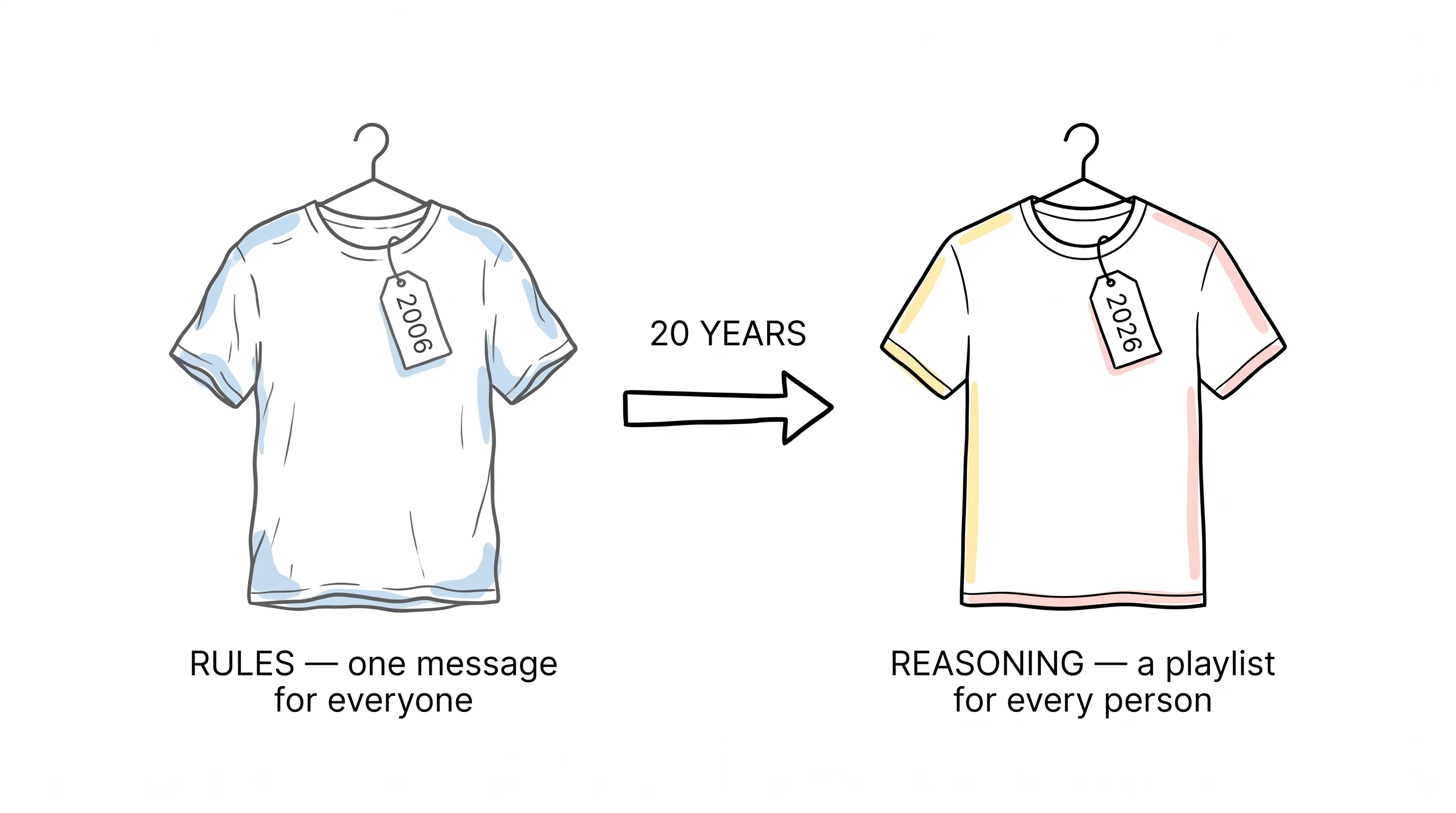
Two T-shirts, side by side. The one on the left reads Marketo, from 2006. The one on the right reads Phave, the new 2026 edition.
The man who posted it is Jon Miller, co-founder of Marketo. The caption, in essence: between these two T-shirts lie twenty years. The year the Marketo shirt was still new, the concept of "marketing automation" was still new too.
God, what a brilliant detail.
Because just this week, Miller announced that his new company, Phave, is officially stepping out from behind the curtain. The positioning leaves no room for ambiguity: an AI-native marketing automation platform, built to replace Marketo, Pardot, Eloqua, and HubSpot.
Yes, you read that right. He built Marketo. Now he's back to replace Marketo.
What is marketing automation?
The 2006 playbook went like this: you write content, put it on a landing page, a form collects leads, you score the leads, and when the score is high enough you push them to sales. The most famous word in that playbook: MQL — the marketing-qualified lead (a lead that marketing has vetted as ready for sales).
That playbook ruled B2B marketing for twenty years.
But B2B buyers have changed
B2B buying today is decided by a group. A buying committee of seven or eight people, each researching anonymously — the one who actually fills out your form might be an intern. Forms plus lead scoring see only the hand that's raised, never the whole committee.
Marketing's goals, too, stopped being about acquisition long ago. Accelerating deals, expanding accounts, driving customer success — all of it lands on marketing's books.
And the tools? The tools have barely changed.
Over the past two years, Miller has talked with more than two hundred marketers and heard almost the same complaint every time: it's not AI features they lack — it's a platform built from scratch around AI. Nobody wants to paste AI wallpaper onto the walls of an old building.
The market doesn't have one. So he built it himself.
This is Phave.
What is Playlist?
At the heart of Phave is an intelligence engine called Maestro.
What it does, to put it plainly: it computes a separate playlist for every single person.
The marketer first describes a goal, then loads their vetted campaigns in as raw material. Maestro takes the full context of the person — their company, the buying group they belong to — and computes which touch is most likely to advance the goal, where it ranks, and when to send it.
Note: computed for each person, individually. Not one set of rules written for one segment.
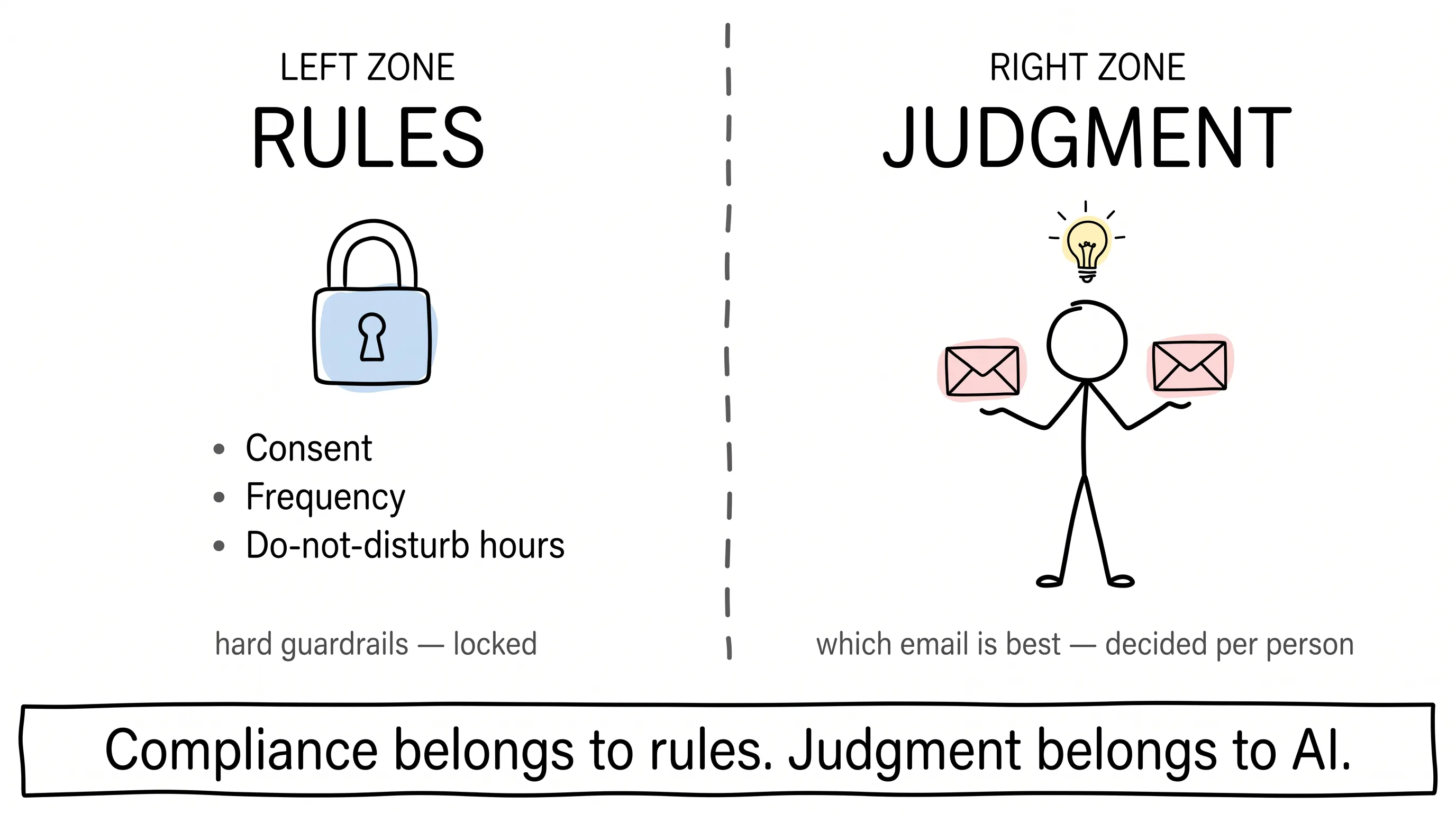
Miller put it precisely: "Rules are good at governing what is allowed, but not good at deciding what is best."
Consent, frequency, do-not-disturb hours — those should be rules, hard guardrails, locked down and untouchable. But when a person has two equally compliant, equally good emails in front of them, which one do you send? That was never the job of rules. That's the job of judgment.
Compliance belongs to rules. Judgment belongs to AI. This is the dividing line between the old and new generations of tools.
In Phave's data model, company accounts and buying groups are records in their own right, with their own scores and their own lifecycle stages — no longer appendages of the person record.
There are three ways in: the built-in interface, the AI client your team already has, or no interface at all — via the MCP protocol plus a versioned REST API, using it as a tool for your agents.
Let's do the math
Phave's pricing starts at $36,000 per year.
Thirty-six thousand divided by twelve: $3,000 a month. Doesn't sound cheap, right?
But the key is the billing basis: you are charged by the number of people actually reached each month, not by how many people sit in your database.
Marketing automation sells databases. Phave sells reach.
The old platform logic is that the bigger the database, the more you pay — so everyone frantically hoards contacts, hoards a pile of contacts they will never contact again, and still pays storage fees for zombie data. Phave's logic: only the people you reach generate cost.
So under this model, you can finally delete data without worry. A marketing automation vendor encouraging you to shrink your database. Counterintuitive, right?
Bruce Eidsvik of Servion said in the official announcement that Playlist solved for them the forever-unguessable question of "when, and by what means, to reach every person" — and their marketing execution more than doubled.
He prepared for this fight for twenty years
If you think this is a whim, you are underestimating Miller.
He has been making his case in public for more than ten years.
In 2014, as VP of marketing content and strategy at Marketo, he said publicly that the industry needed to move from "campaigns" to "continuous conversations." Think about it: in 2014, most marketers were still agonizing over how to schedule this week's emails.
In 2015, he left Marketo and founded the ABM platform Engagio, with a $10 million Series A led by FirstMark. At the $22 million Series B in 2016, he let loose a bold claim: I've seen this game before, I know exactly how Marketo played it, and our speed to 50 customers is far ahead of Marketo's back then.
Impressive.
In 2017, he did something with real character. Marketo was holding its annual conference in San Francisco, so he staged his own event directly across the street — and declared: I want every person attending the Marketo conference to know that Engagio is the leader in ABM.
Ruthless, isn't it?
In 2020, Demandbase acquired Engagio.
In April 2025, in a public interview, he laid out the whole thesis at its most complete: AI can "automate the automation itself," and the ideal system is like Spotify's DJ, taking songs created by humans and arranging them into a playlist that belongs to each listener alone. He also left behind a line that has been quoted again and again since: leads are too narrow, accounts are too broad — the buying group is just right.
You see: an argument planted more than ten years ago has become a product today. So judge Phave not by the demo alone — go read his public positions over the past decade. When someone has fought the debate ten years in advance, the product almost certainly isn't a whim.
Oh, and the co-founder, Nick Bonfiglio, ran product and engineering at Marketo from 2009 to 2016, and later founded Aptrinsic and Syncari. How the last-generation platforms were built, and where they fall short — these two men hold a complete map of it in their heads.
Phave itself has long been officially available: two years built in stealth, GA (general availability) in August, more than ten enterprise customers including SambaNova, SPS Commerce, mabl, Servion, and Hypha. Its investors are FirstMark, Ridge Ventures, and Costanoa Ventures.
The giants aren't sitting still
The timing is interesting.
The week before Phave's official announcement, Salesforce's Dreamforce (September 15–17) and HubSpot's UNBOUND (September 16–18) wrapped up one after the other, and both companies released agentic campaign tools.
Salesforce brought out the Campaign Agent in Marketing Cloud: given the goals, guardrails, and brand guidelines a marketer supplies, it builds audiences, lines up content, and runs campaigns on its own. For the older Account Engagement — once known as Pardot — Salesforce's strategy is not to force migration, but to hand out agentic features for free through Account Engagement+.
On September 16, HubSpot released what it calls its most substantial update ever: a rebuilt Breeze Assistant that understands natural language and decides for itself which specialized agents to call and how they should collaborate; Smart CRM now automatically logs calls, emails, and meetings. Marketing Studio, launched in October 2025, gains campaign and content agents in this release — early customers, HubSpot says, produced 81% more campaigns with it.
And Adobe? In this May's Marketo Engage release, it launched a suite of Marketo AI agents, plus an MCP server that connects AI assistants into Marketo — able to operate more than 100 features, forms, smart campaigns, emails, and lists all included, all currently in public beta. But the "buying-group engagement" Phave leads with? Adobe parks that in a different product: Journey Optimizer B2B Edition.
Oracle's Eloqua is the quietest. Version 26C, launched in August, spotlighted the Redwood interface and data quality; the list of new agents is empty. Oracle's marketing agents are discussed one level up, in its Fusion applications — role-based agents for audience analysis, copy drafting, and image selection were announced this February.
By the way: in Gartner's 2025 Magic Quadrant for B2B marketing automation, the Leaders are HubSpot, Adobe, Creatio, Oracle, and Salesforce.
The very table Phave intends to flip, head-on.
The real barrier is not the product
So is Phave a guaranteed win? Not necessarily.
Its biggest enemy may be neither Salesforce nor Adobe, but something inside marketers' own heads.
Miller even has a name for it: the marketing-automation version of "Stockholm syndrome."
What is marketing-automation Stockholm syndrome? It's this: the platform has tormented you for years, you hate it, you curse it — but ask you to switch, and you don't dare. Switch platforms, and your lead flow could break, your scoring models would need rebuilding, your compliance audits redoing. Fear does that to you: eventually you find yourself defending it — switch to what? It still works, doesn't it?
Held hostage long enough, hostages start defending their captors. That is roughly how marketers feel about their old platforms.
Miller's own prescription is plain: don't switch everything at once. Pick one segment, run a parallel pilot first, and expand once it has proven out.
Back to those two T-shirts
That 2006 Marketo shirt — he wore it for twenty years. And he watched a category rise from nothing, get swallowed one company at a time by the giants, and then slowly grow quiet.
This 2026 Phave shirt is what he has to say to the next twenty years.
The age of rules was the age of "everyone the same." The age of reasoning is the age of "a playlist for every person."
The man who built it is here to replace it. This is not betrayal — it's him putting a new price tag on his own work.
Here's hoping you, too, have a T-shirt, worn halfway, that you dare to replace with your own hands.
Continue reading
Related articles

Cross-Border Business: Time to Upgrade Your AI Toolbox
A learn article explaining how AI tools help cross-border e-commerce sellers clear five hurdles: language, regulation, logistics, payments, and fraud. It outlines a five-compartment toolbox, a five-step adoption path, and metrics such as conversion rate and CLV, while cautioning against over-reliance on AI.

AI Is Taking Over the Dirty Work of Social Media Marketing, One Task at a Time
This learn article outlines four social media marketing tasks AI can handle — audience analytics, content drafting and design, ad targeting and creative testing, and spam moderation — and cautions that taste, judgment, and data security remain human responsibilities.

AI Is Already This Good — Why Is Your Social Media Marketing Still Pure Manpower?
An overview of 18 AI tools for social media marketing, organized into six categories covering audience research, content creation, scheduling, comment and DM handling, ad management, and visual production, plus notes on personalization, prediction, and emerging trends.