
Has Your AI Paid for Itself?
An essay on measuring AI's ROI in marketing, arguing that adoption without proficiency and untracked spending hides real costs. Includes a five-step ledger method, a worked cost example, and notes on an NJDMC session with Larridin CMO Denis Scott.
A few days ago, a friend of mine who leads marketing invited me to dinner. Halfway through the meal, he sighed: our team now uses AI for everything. First drafts, research, image edits, reports — can't do without any of it.
I asked him: so is the money worth it?
He froze. He thought for a while and said: well... the tool bills are real, and they're not small. But how much exactly did we save, how much did we earn?
He couldn't say.
He's not alone. On October 15, NJDMC will be held at Bell Works in Holmdel, New Jersey, and one of the sessions is a conversation titled "Measuring AI's ROI, Turning Adoption into Business Results." The guest is Denis Scott, CMO of Larridin. Larridin is an AI measurement platform, backed by Andreessen Horowitz and Bloomberg Beta.
A person who specializes in "AI measurement" is going to talk specifically about whether AI is worth it. You see, this problem has grown so big it now needs a profession.
Why Is This So Hard to Calculate?
First, let me show you a set of data.
Larridin published a "2026 State of Enterprise AI" report, surveying 365 executives from companies with over a thousand employees. The results are striking:
92% of executives said they are highly confident about the impact AI brings.
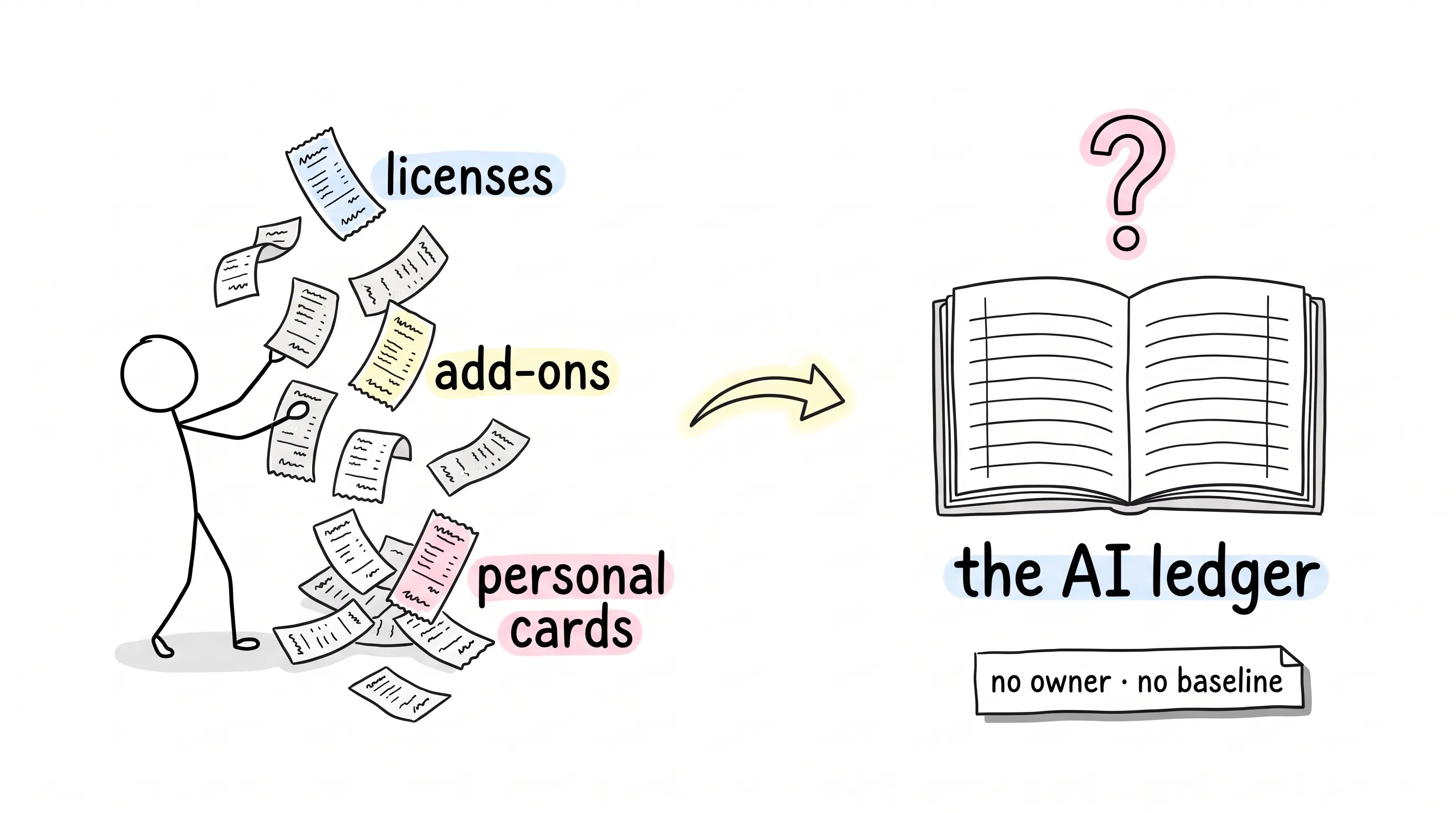
But at the same time, 58.2% admitted they can't say who should own AI performance; 62% of companies can't even produce a complete list of which AI apps their employees are using.
Confidence is running far ahead of evidence.
And marketing is often the most awkward one here. AI purchases are usually booked under IT, but the heaviest user is often marketing: writing content, doing research, personalization, creative work, running campaigns — it's everywhere.
Worse, the money leaks out in dribs and drabs. There are team-wide licenses, there are add-on modules hidden inside existing software and charged per seat, and there are colleagues who swipe their personal credit card first and deal with it later.
The heaviest user has the murkiest ledger. When the CFO asks, all you can do is stare back empty-handed.
The invisible bill is the most expensive.
Using AI and Using AI Well Are Two Different Things
Two words need untangling here: adoption, and proficiency.
What is adoption? It's how many people in your company can access and are using AI tools.
What is proficiency? It's whether these people can turn AI into results.
A VP can report to management: our adoption rate is 90%. Everyone applauds.
But look closer — what are most people actually doing with AI? Fixing grammar, smoothing email wording. Those who can build a process and not tear it down and redo it every time are rare. Those who can say how much compute and how much labor cost that process burns each month are practically nonexistent.
Adoption is the starting line. Only when you run into repeatable processes and produce measurable results are you truly on the road.
Let Me Run the Numbers for You
So how do you actually calculate it? Here is a five-step method. One spreadsheet, one serious afternoon, and you can start.
- List all AI expenses. Include the add-ons hidden in software, and the credit cards colleagues swiped personally.
- Pick the three most important workflows, and match the expenses to them.
- For each workflow, set a "before AI" baseline.
- Calculate the real cost. Note: the real cost, rework included.
- Tie each workflow to one business metric (how much time saved, how much money saved, which delay was cut), then designate a named owner.
Method alone is too abstract. So let me run a real number for you.
Suppose a 5-person marketing team publishes 8 blog posts per month.
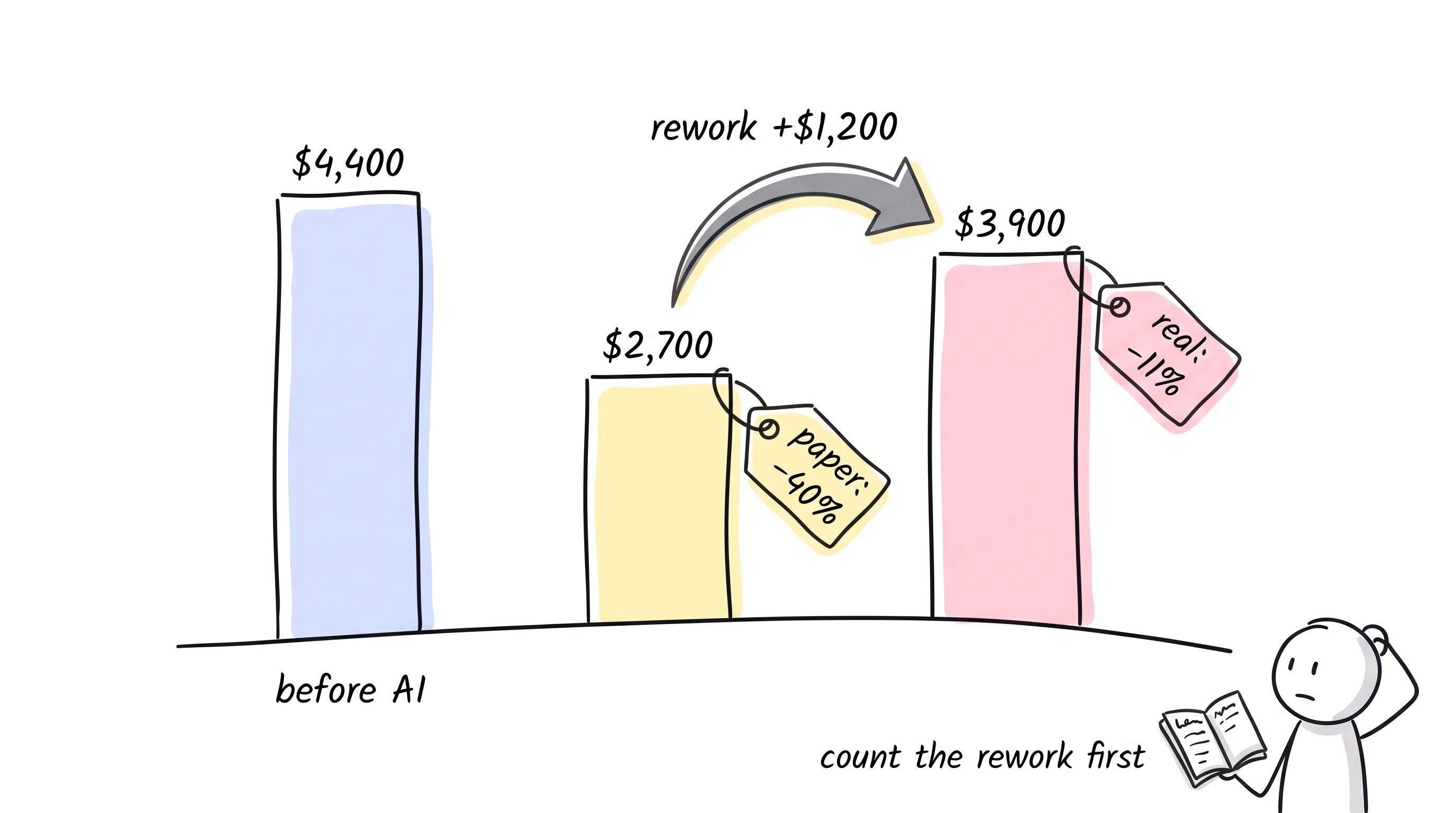
Before AI: outsourced writers at $400 per article, internal editor review worth $150 — $4,400 a month.
After AI (the paper version): fire the writers, tool fee $300, internal staff writing and editing worth $2,400 — $2,700 total. On paper that saves $1,700, nearly 40%. Report that, and who wouldn't be tempted?
But that's the paper version.
The real ledger: fact-checking AI's first drafts and doing heavy rewrites eats up another $1,200 of labor. Actual monthly cost, $3,900.
You actually saved $500, about 11%.
From "AI helped us cut nearly 40% of content costs" to "AI helped us save 11%, and the money mainly leaks in rework." These two sentences are worlds apart in numbers, but the latter is the valuable one. Because it gives you a handle you can act on: polish the brand prompts, update the requirements doc, plug up the rework.
On paper you save 40%. In reality, 11%. The missing stretch all leaks out in rework.
What About the Ones Secretly Using AI at Work?
When you list the bills, you will most likely run into some unreported AI tools. On the expense report, a subscription you've never heard of suddenly shows up.
Many people's first reaction: this is "shadow AI" — block it.
My suggestion is, don't rush to block.
A blanket ban kills the real productivity you can neither see nor amplify. Instead of plugging the hole, sit down and ask him: which tool are you using? What pain point did it solve? Not only will you complete the ledger, you may very well walk away with a few of the best workflow ideas in the company, free of charge.
The people who secretly use tools are often the ones who first found the way in.
So How Should You Hire?
After AI takes over the middle layer of execution work, there's a longer-term question: where do junior marketers develop judgment?
Researchers have a name for the phenomenon: cognitive surrender — taking AI's output and trusting it without a careful look. That's how errors slip into shipped work.
So going forward, being good at typing prompts isn't enough. Teams that can really compete hire for editorial judgment, strategic thinking, and domain expertise. These are exactly the things AI cannot replace, and things that keep getting more valuable.
Back to That Conversation
Back to Denis Scott. His résumé deserves a closer look.
His career started in FP&A (financial planning and analysis), which probably explains why he's famously fond of tying marketing dollars to pipeline rather than watching vanity metrics. He was Gap Inc.'s first online marketing person ever; early on he drove e-commerce for Gap, Old Navy, Banana Republic; later he ran the consumer business at OpenTable, served as CMO of SurveyMonkey (the team won an ANA Reggie Gold), built Fanatics' betting-and-gaming brand from scratch, and took CharterUP to No. 2 on the Inc. 5000. He has given keynotes at Google Marketing Next and Salesforce Dreamforce. He played four years of varsity soccer at Georgetown, and one college summer he worked at the Nordstrom department store in Short Hills.
A man who spent twenty-plus years "spending the marketing budget" has recently crossed to the other side of the table: helping executives figure out whether their AI investment is actually paying off.
He has also said something refreshingly practical: rather than selling anything, he'd rather talk about the problem itself. So that session is a conversation, not a product demo.
October 15. Next Thursday. NJDMC. Bell Works, Holmdel. If AI's ledger is what's keeping you up at night, this conversation on "Measuring AI's ROI" is worth your seat.
Finally, back to my friend.
That day I walked him through the five-step method. He was quiet for a while, then said: honestly, the tools haven't changed. What changed is — I never managed it as a ledger.
Right. Every dollar you spend on AI does not automatically turn into returns. It only turns into a ledger. Either a ledger someone owns, with a baseline, that adds up — or a muddle of unclaimed expenses.
You're not missing a more expensive AI tool. You're missing a ledger for your AI.
That's my read. I could be wrong.
Continue reading
Related articles

Cross-Border Business: Time to Upgrade Your AI Toolbox
A learn article explaining how AI tools help cross-border e-commerce sellers clear five hurdles: language, regulation, logistics, payments, and fraud. It outlines a five-compartment toolbox, a five-step adoption path, and metrics such as conversion rate and CLV, while cautioning against over-reliance on AI.

AI Is Taking Over the Dirty Work of Social Media Marketing, One Task at a Time
This learn article outlines four social media marketing tasks AI can handle — audience analytics, content drafting and design, ad targeting and creative testing, and spam moderation — and cautions that taste, judgment, and data security remain human responsibilities.

AI Is Already This Good — Why Is Your Social Media Marketing Still Pure Manpower?
An overview of 18 AI tools for social media marketing, organized into six categories covering audience research, content creation, scheduling, comment and DM handling, ad management, and visual production, plus notes on personalization, prediction, and emerging trends.