
Half the People Scrolling Their Phones Are Looking for Something to Buy: The Ad Money Is Moving
An explainer on how ad budgets are shifting from paid search to paid social as consumers increasingly discover products in social feeds, with notes on AI's emerging but not yet dominant role in shopping research.
A while back, I had dinner with an old friend who runs an e-commerce business. He told me something that caught me off guard: half of his company's ad budget had just moved from search engines to social platforms.
I asked: why?
He said: consumers have changed.
Hmm. Consumers have changed. I turned that sentence over in my head for a long time after. The more I thought about it, the bigger it seemed. With AI in the picture, the entire logic of buying things is being reshuffled. Today, let me walk you through it.
First, Let's Look at the Big Numbers
What is digital advertising, exactly?
Put simply, it means moving ads off the streets and out of TV and newspapers, and into the internet. Behind every feed post you scroll past, every splash screen, every page of search results, someone is paying.
None of this is news. The market research firm Statista projects that by 2030, 82.4% of global ad spending will go to digital channels.
82.4%. The advertising industry has all but moved into the internet.
But moving in is only step one. What really sets winners apart is which exact slot your money lands in.
People Find Products, Products Find People
Digital advertising falls into two main buckets.
One is paid search. You type "running shoes" into a search engine, and the top few results are seats that advertisers paid for.
The other is paid social. The ad wedged between posts while you scroll short videos or social networks is also a seat someone paid for.
So what's the difference?
Paid search is "people looking for products." The demand already exists in the consumer's mind, and they go searching on their own. A search engine is like a giant information desk — everyone who walks up arrives with a question.
Paid social is "products looking for people." The consumer never means to buy anything — then, somewhere in the scroll, a single piece of content quietly plants the urge.
For many years, the information desk belonged to Google. Before buying something, people ran a search first; some went straight to Amazon. You could place an order on Facebook too, but that was pocket change.
This arrangement held steady for years.
Until recently, when it started to wobble.
The Scales Are Shifting
Why do I say that?
A recent report asked social media users a very direct question: when you're on these platforms, do you look for things you might want to buy?
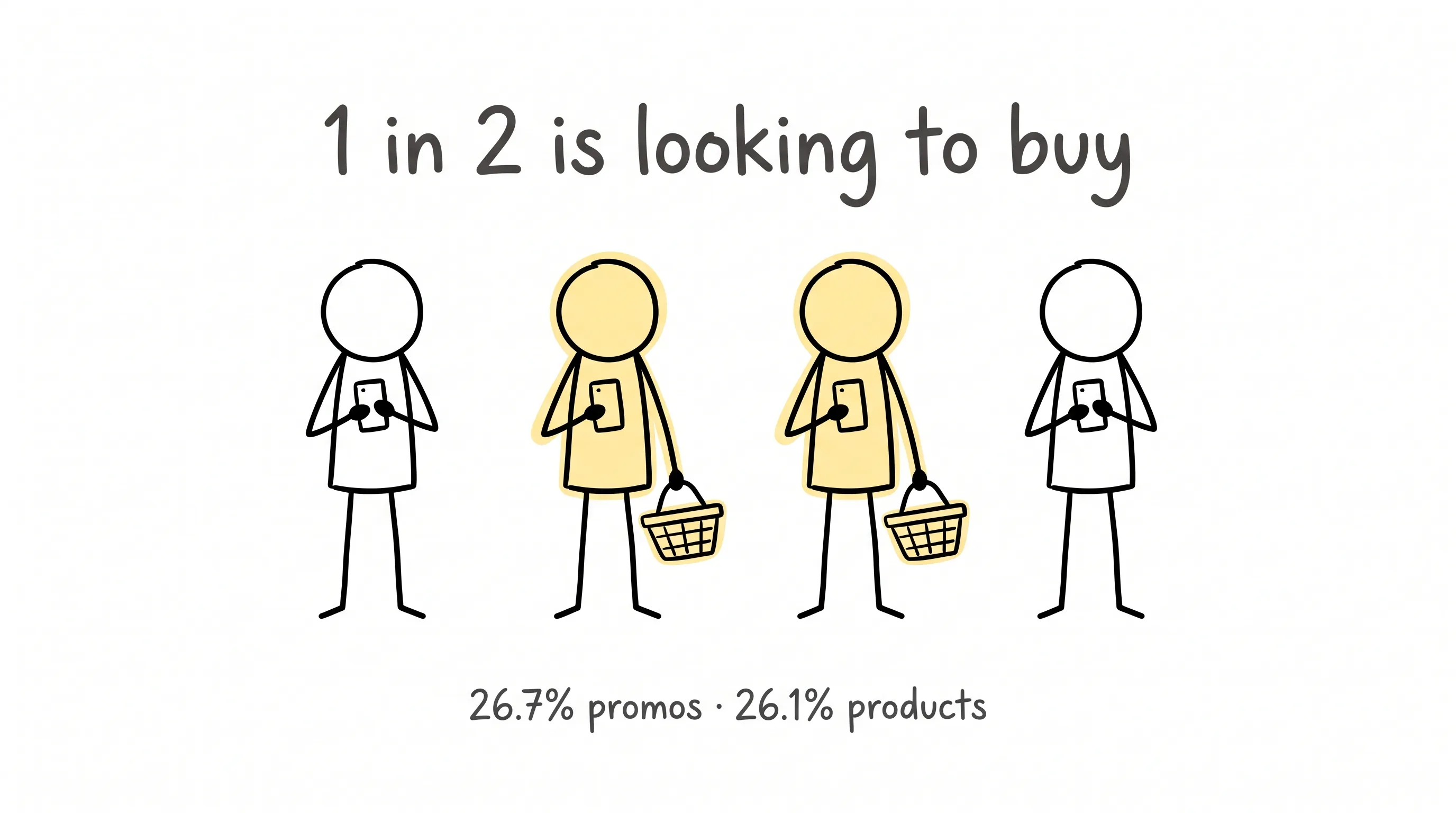
26.7% of users keep an eye out for new promotions and new products on social platforms. 26.1% actively seek out products there.
Add those two numbers together and you're past half.
What does that mean? Out of every two people scrolling social media, one is there to "find something to buy."
Another marketing agency, Sixty Gelu, estimates it even more aggressively: 60%.
It's staggering. Social platforms stopped being mere time-killers long ago. They are quietly growing a new identity: a store shelf.
Meanwhile, Google's search traffic is under mounting pressure.
What About AI?
You might ask: aren't AI tools like ChatGPT and Claude already changing how consumers research products? Won't people just ask an AI when they want to buy something?
True — AI has arrived, and it arrived fast. More and more people ask it a question before they buy: Which one is good? How do I choose?
But — notice that "but."
AI search adoption in e-commerce hasn't taken off yet. It's a new guest at the banquet, still not seated at the head table.
Today, the ones standing in the front row of product discovery are still the social platforms.
Where Will the Money Flow?
Put all of this together: more than half of consumers are already on social platforms "looking for something to buy"; AI is changing how people research, but it hasn't taken over product discovery.
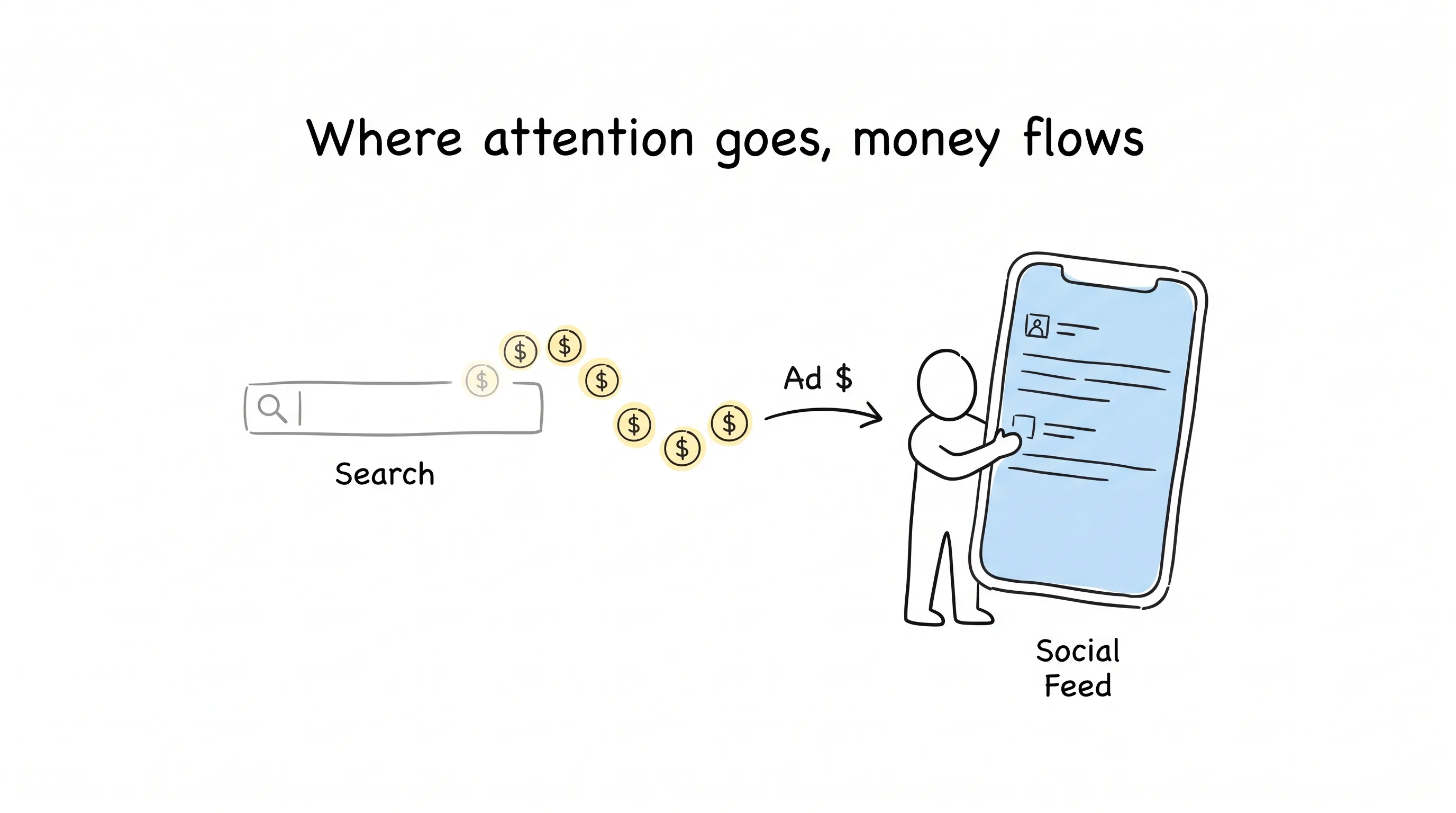
Wherever consumer attention goes, ad money will move.
When attention lived in the search box, money flowed to search ads. Now attention lives in the feed, so money has to flow to paid social.
My advice to friends in marketing: stop agonizing over "should we run social ads or not," and get clear on one question first: in which feed, and in what form, will my product show up in someone's scroll?
One of these days, you too might run into an old friend who tells you: his budget just moved again.
Here's hoping you're the one who moves first.
Continue reading
Related articles

Cross-Border Business: Time to Upgrade Your AI Toolbox
A learn article explaining how AI tools help cross-border e-commerce sellers clear five hurdles: language, regulation, logistics, payments, and fraud. It outlines a five-compartment toolbox, a five-step adoption path, and metrics such as conversion rate and CLV, while cautioning against over-reliance on AI.

AI Is Taking Over the Dirty Work of Social Media Marketing, One Task at a Time
This learn article outlines four social media marketing tasks AI can handle — audience analytics, content drafting and design, ad targeting and creative testing, and spam moderation — and cautions that taste, judgment, and data security remain human responsibilities.

AI Is Already This Good — Why Is Your Social Media Marketing Still Pure Manpower?
An overview of 18 AI tools for social media marketing, organized into six categories covering audience research, content creation, scheduling, comment and DM handling, ad management, and visual production, plus notes on personalization, prediction, and emerging trends.