
Grow a Left Brain, Protect the Right One: Marketing's Two Must-Answer Questions in the Age of AI
An AI-marketing learn piece on how generative AI is transforming the marketing function. It cites a BCG–Harvard study on productivity gains and divergence loss, warns of content inflation and homogenization, and urges companies to build predictive AI teams while protecting human creative talent.
More than thirty years ago, when word processors and spreadsheets first hit the market, the entire business world was waiting for a productivity revolution.
The promise sounded beautiful: writing documents would take far less time, no more drawing slides one by one, no more punching numbers into a calculator — maybe even less overtime. And what would you do with all that saved time? Rest, of course.
Thirty-plus years later, was the promise kept?
It was kept. The documents we write are far longer than before. Decks went from six pages to fifty.
I say this with some authority. I came up through consulting myself.
Have you noticed that once the productivity revolution actually arrived, nobody took a single extra day off? The time saved turned into longer documents, more slides, and vastly more complicated decisions. Why did decisions get more complicated? Because the amount of data to handle exploded.
Time saved by productivity never becomes your vacation. It only becomes new workload.
These past few years, it's generative AI's turn. It is embedding itself into the core of organizations, into the way we work. This is the next productivity revolution, and there's no dodging it.
So here's the question: how do you plan to collect the dividends of this revolution?
In my consulting years, I spent more than a decade working alongside marketing teams. A saying circulates in the marketing world: marketing is the most disrupted function of all, with room for productivity gains as high as 50%.
Whether that number is exact is another matter. But "what should marketing do about this" is a question worth every person in business thinking hard about. Yes, you too — even if you're just a consumer.
Marketing Takes the First Hit
Marketing is a right-brain function.
What does that mean? It means marketers live off the right brain: sensing the emotions consumers never say out loud, building products that catch exactly that emotion, then finding the words that land in people's hearts.
Over the past fifteen years, digital marketing and data analytics took off, and marketing slowly grew new skills: digital media buying, marketing technology. But all of that was still "specialization" — the backbone remained the right brain.
The last two years are different. What generative AI is shaking up is marketing's core moves themselves.
A few years ago, Boston Consulting Group (BCG) partnered with Harvard on a study. Back then ChatGPT was still rudimentary, and it already lifted marketers' right-brain output by 40%.
Forty percent. On a five-day week, that's two full extra days.
I hardly need to tell you how far the tools have evolved in the two years since.
So let me ask: what will marketers do with those two extra days?
Where Does the Saved Time Go
Two extra days off? Yoga? More time with family?
Your boss will be the first to say no.
Then how about cutting a big chunk of the marketing function — layoffs?
My judgment: most likely not that either. As long as no one takes the helm on purpose, that time will be poured into what marketers are already best at: making more content, dreaming up more ideas.
Start with the good side. For consumers, more content means personalization taken to the extreme.
Think of that brand email you receive every week. What if it were written entirely for you alone? The person in the picture is your age, your gender, wearing a T-shirt from your favorite band; every recommended product has something to do with you; and at the end, a human-like service agent chats with you.
Now that is productivity.
But what about the other side?
Content overload. Don't you already feel chased around the internet by the same batch of content? The same pair of shoes ambushing you on every page you open. Now multiply the content chasing you by ten.
And on top of that, it all sounds the same.
Why does it all sound the same? That's the deadly question underneath.
Generative AI is trained on existing content and data. It naturally pushes results toward sameness.
Think about it: everyone is simmering their soup in the same pot. How could the flavors not end up tasting more and more alike?
Content inflation: volume rises, attention falls. In the end, nobody's voice gets through to anybody's ears.
This is no scare tactic. The homogenization of marketing has already begun.
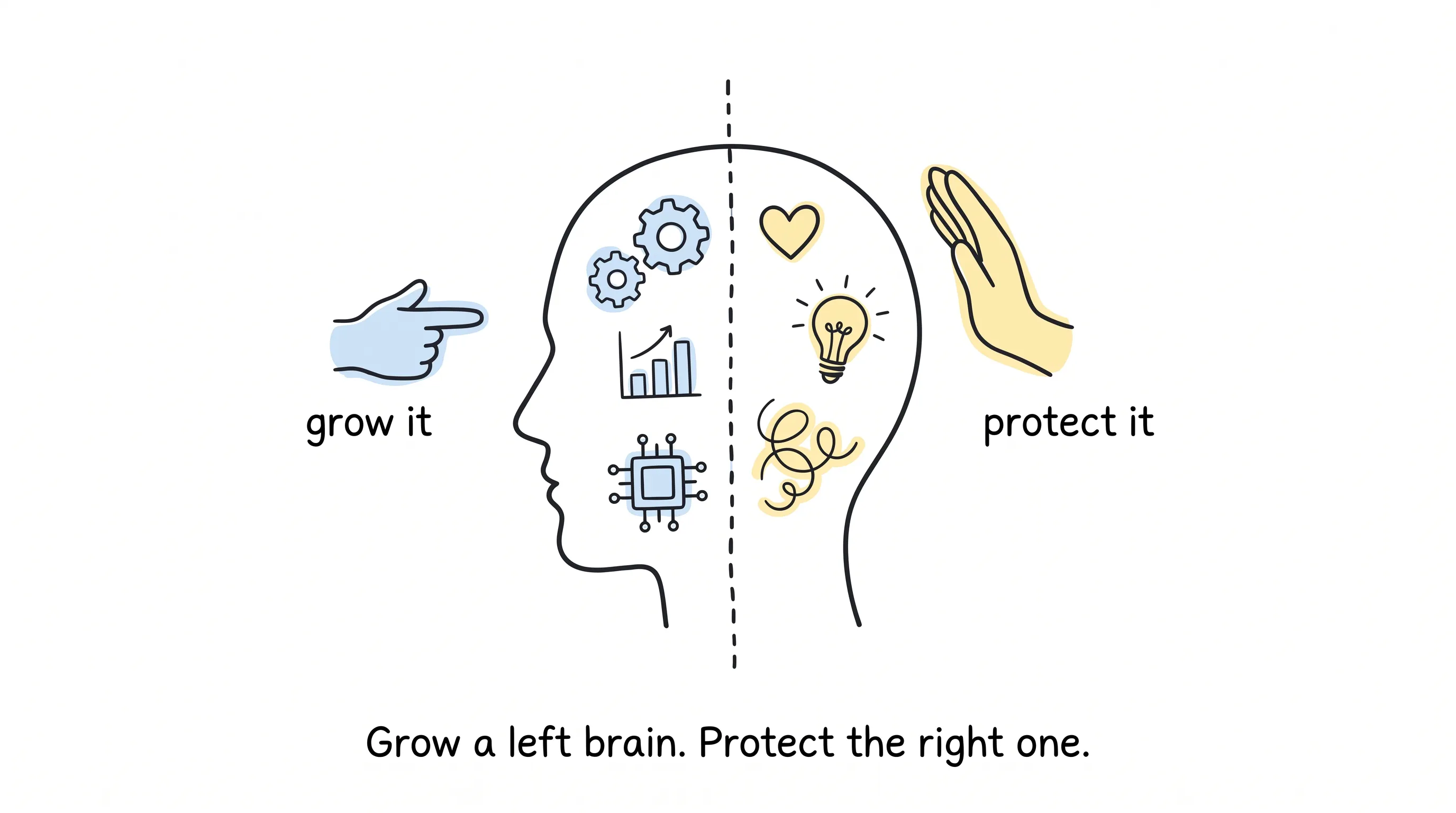
The First Thing: Grow a Left Brain
So what do you do?
My view: marketing, along with every other function this revolution hits, must urgently do two things. First, grow a "left AI brain" — and fast. Second, find the person with the strongest right brain and protect them.
First things first.
What is a "left AI brain"?
Plainly put: strategically redeploy your troops — put a group of people who can build, use, and spread predictive AI tools at the core of decision-making.
Concretely: build a team of marketing data scientists and marketing data engineers. They build the tools, then distribute them to marketers across the whole company, helping everyone dissect ad performance and forecast campaign outcomes.
For instance: which combination of "creative plus audience" actually wins in the market? Which product moved which type of consumer, and why? How is the funnel evolving? These questions used to be answered by gut feel; from now on, by models.
I've seen a consumer goods company do exactly this. Tools spread across the entire organization; before any marketer launches a campaign, they can already predict roughly what sales it will generate and how consumer behavior will shift at every channel and touchpoint. Dig deeper, and they can see which piece of creative is actually working, and why.
The whole company spins into a virtuous cycle.
The price? A team of thirty-plus people. Those thirty-odd people build the tools, refine the tools, and are also responsible for teaching the entire company to use them.
But a team alone doesn't get the job done.
I've watched too many companies charge in full of excitement, then train their models only on the tiny patch of data and content sitting right in front of them.
There's a particularly sneaky trap here: you get trapped on your current turf.
Today, you're a brand, king among millennials. But your data and your content contain nothing about Gen Z. So no matter how well the models are trained, they can't help you go after Gen Z. And if you never break into Gen Z, you'll miss the new trends that could have made you even stronger among millennials.
An infinite loop.
So my advice to every company: step outside your own ecosystem and go find partners for data and content.
Another example. A construction company wanted, for the first time, to market to architects. Its data on architects: zero.
Ask industry peers? Peers are all competitors — who's going to hand you their data?
So look outside the ecosystem. Financial institutions, insurance companies — they may be sitting on mountains of architect-related data. Set up a "federated model" with them: nobody's data ever has to leave home, and together you train one model. Once it's trained, you have what it takes to break into a brand-new customer segment.
Data in hand, skills in place. Surely that's everything now?
The Second Thing: Protect the Right Brain
No. There's a more dangerous trap ahead.
The stronger your left brain gets, the easier it becomes to hand the entire right brain over to AI as well, without even noticing. That's when homogenization comes for you personally: you lose divergence, you lose brand distinctiveness.
That same Harvard and BCG study held one more finding: when people over-rely on generative AI, the divergence of collective thinking drops by 40%.
Forty percent. Set against the earlier 40% gain — one up, one down, matching perfectly. I find that symmetry fascinating.
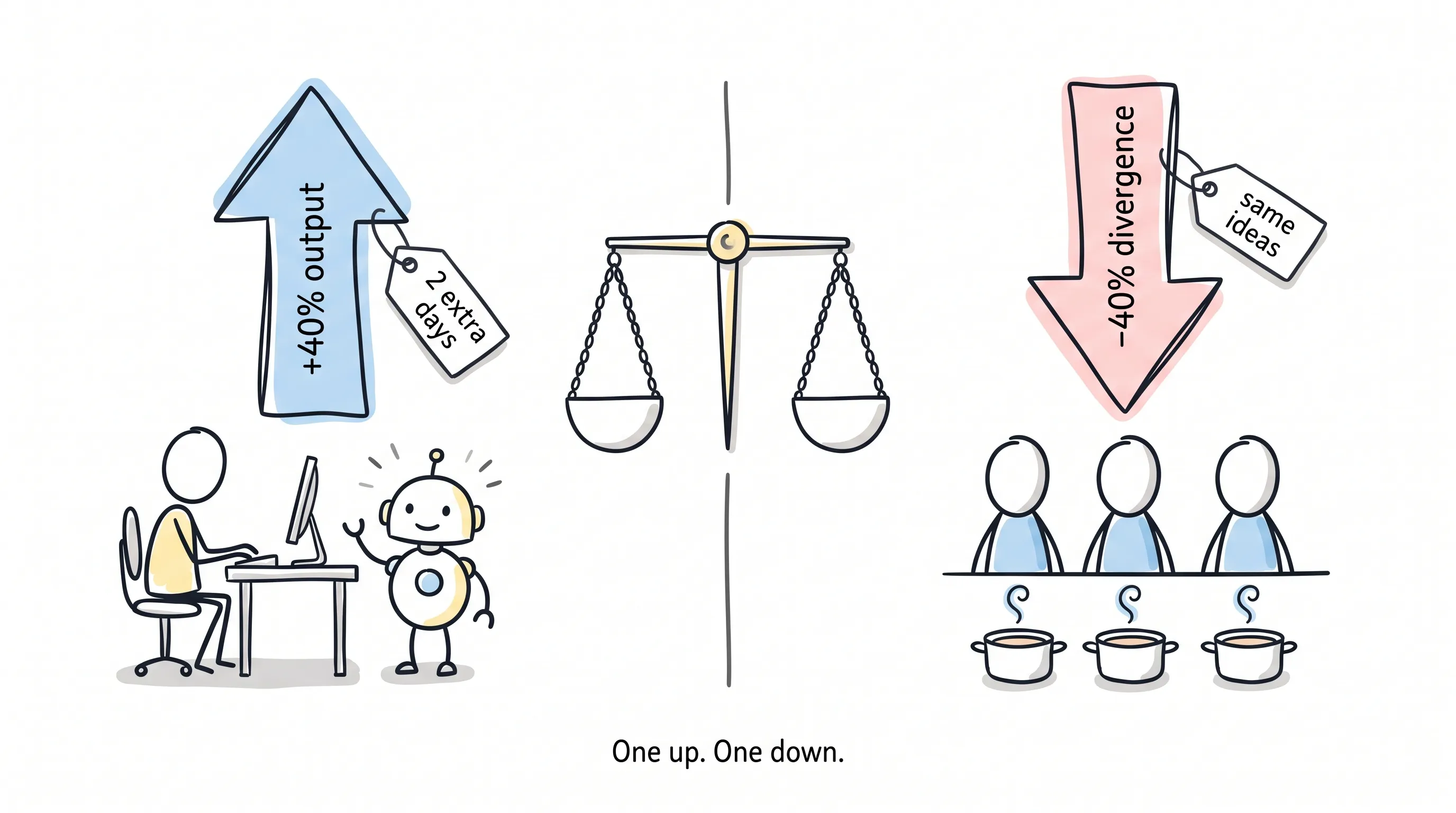
What does a 40% drop in divergence mean? New ideas never make it to the surface. Real innovation gets strangled in the cradle.
So the second thing: find the genuine artists on your team, the people who can truly create differentiation.
Anyone who has worked in marketing knows exactly who they are.
It's the person who never agrees with you.
Find those people, retrain them, teach them to use AI as a whetstone: borrow AI for inspiration, scan new trends, knock out a prototype in a few hours — take a good idea that's already been validated and amplify it tenfold.
But there is one line that must be held: never let AI create from zero in their place.
That's right: the source of creativity must be the human brain. Only when human brains keep producing — a steady, unbroken stream — can a brand's identity and differentiation hold.
What About You?
Enough about companies. Let's talk about you.
Ask yourself one question: what are you good at?
If you're the genuine innovator, the person in the room with the most ideas, then go all in on creativity and forge it into your superpower. Don't get distracted.
If you love data, are fiercely rational, and want evidence for everything, then go deeper: build technical skills and put real work into studying predictive AI.
This era has no shortage of tools — what it lacks is choice. Either grow the left brain, or protect the right one. The real danger is wanting both and going shallow on each.
That productivity revolution of thirty-plus years ago never turned into anyone's vacation.
This time is no different. The time saved will not become vacation.
It will become your moat. Or someone else's.
Here's hoping you're the former.
Continue reading
Related articles

Cross-Border Business: Time to Upgrade Your AI Toolbox
A learn article explaining how AI tools help cross-border e-commerce sellers clear five hurdles: language, regulation, logistics, payments, and fraud. It outlines a five-compartment toolbox, a five-step adoption path, and metrics such as conversion rate and CLV, while cautioning against over-reliance on AI.

AI Is Taking Over the Dirty Work of Social Media Marketing, One Task at a Time
This learn article outlines four social media marketing tasks AI can handle — audience analytics, content drafting and design, ad targeting and creative testing, and spam moderation — and cautions that taste, judgment, and data security remain human responsibilities.

AI Is Already This Good — Why Is Your Social Media Marketing Still Pure Manpower?
An overview of 18 AI tools for social media marketing, organized into six categories covering audience research, content creation, scheduling, comment and DM handling, ad management, and visual production, plus notes on personalization, prediction, and emerging trends.