
Google Search Traffic to Media Fell 40 Percent in a Year. Who's Catching It?
An analysis of a Chartbeat report indicating a steep year-over-year decline in Google Search traffic to news publishers, while AI referral traffic remains a tiny share. The article notes rising direct, dark social, and internal traffic and the stabilizing role of loyal readers.
Last night, I read a report three times, cover to cover.
The more I read, the colder I felt.
The report comes from a company called Chartbeat. They do media analytics — a huge number of the world's news sites rely on them to keep an eye on their traffic. Every year they publish a handbook for the industry, the Publisher Playbook, which is basically taking the temperature of the entire news business.
This time, the thermometer blew past the top of the scale.
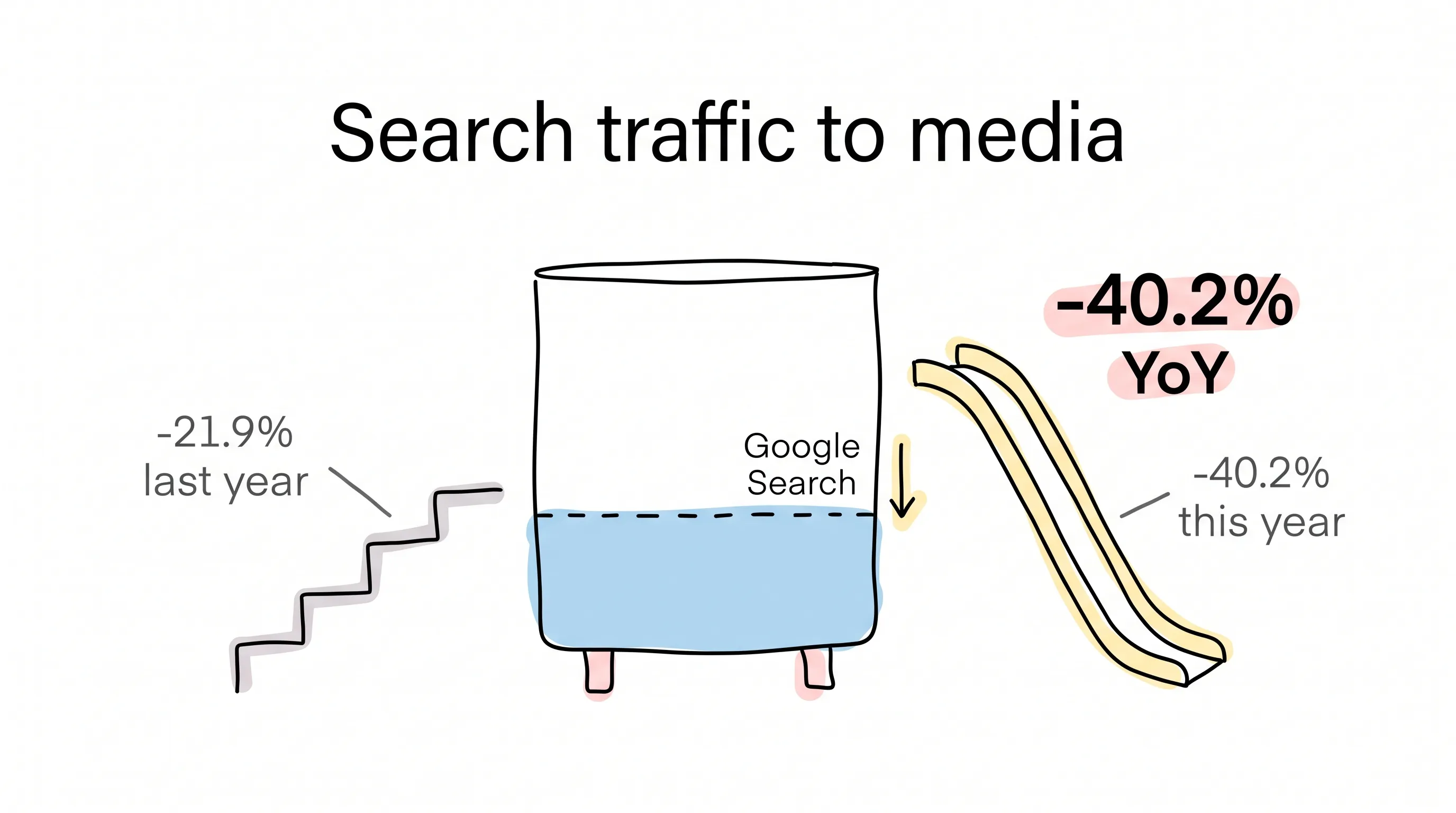
From July 2025 to July 2026, across Chartbeat's entire client network, traffic from Google Search fell 40.2% in one year.
40.2%. What does that mean?
The year before, the drop was 21.9%.
In other words, this downhill road is not moving at a constant speed. It is accelerating. Walking down a staircase is one thing; stepping onto a slide is another.
Google Discover is even harsher. That's the feed Google pushes to you proactively, the kind you scroll on your phone. The year before it fell only 6.6%; this year it took a straight 34.3% dive.
There's a line in the report I'll copy for you: AI-generated search results, combined with the shifting recommendation landscape, are putting real, tangible pressure on audience acquisition.
Real, tangible pressure. The report chose its words with restraint; the data showed no mercy.
The Water Level, from 9% to 5%
Some of you may say: a 40% drop sounds scary, but is the base perhaps small?
I thought so too at first. So I kept reading.
In July 2024, Google Search contributed about 9% of total pageviews across the network.
By July 2026, just 5%.
Two years, nearly cut in half. The report's own math puts the relative decline at close to 46%. Over the same period, Discover's share also shrank by 28.4%.
This is not a small-base problem. This is a water-level problem. And the water level is falling before your eyes.
So, Can AI Catch It?
Reading this far, you must be asking: can the ChatGPTs of the world catch the traffic search is leaking?
The report has a set of numbers that is especially interesting.
Over two years, referral traffic from AI grew eightfold.
Eightfold — pretty wild, right?
Hold your excitement. Its share of total traffic is 0.01%.
One ten-thousandth.
The water level in a pool is dropping, and beside it a new faucet has been installed, dripping at eight times the speed. You hold a measuring cup under it for two years and come away with one ten-thousandth of a cup.
The part that stings even more comes afterward. The report says that in 2026, traffic from AI like ChatGPT, Claude, Perplexity, Microsoft Copilot, and Gemini did not rise — it fell. The whole category retreated together.
The biggest traffic driver among them is still ChatGPT.
So what should content publishers do? The report's judgment is clear: generic content that a single AI sentence can summarize away is the most exposed; original reporting, on the other hand, is hard for AI to replace.
Beautifully said.
Where Did the Traffic Go?
By now, the question arises: search is leaking, AI is shrinking — the traffic must have gone somewhere, right?
It actually has. Three places are quietly rising.
First, dark social. What is dark social? You toss an article into a WeChat chat window, send it to your mom, or drop it into the group chat with your close friends. That path is invisible to analytics tools, so it can only be filed under "the dark" — hence dark social. Over two years, its share rose from 7.1% to 11.3%.
Second, direct traffic. Readers skip search and type the URL directly, or click a bookmark. From 13.5% up to 15.9%.
Third, internal traffic. From 37.9% up to 40.4%.
The report grouped these channels together, and the gist is this: they are more like "your own courtyard." Search and social are other people's front gates — whether they open is up to the platform. But dark social, direct traffic, and internal traffic are your own family's yard, and the key to coming and going is in your hand.
The Most Moving Set of Numbers
Of the entire report, what moved me most was actually a set of unremarkable numbers.
Chartbeat has a definition of "loyal readers": people who came to your site on at least 8 of the past 16 days.
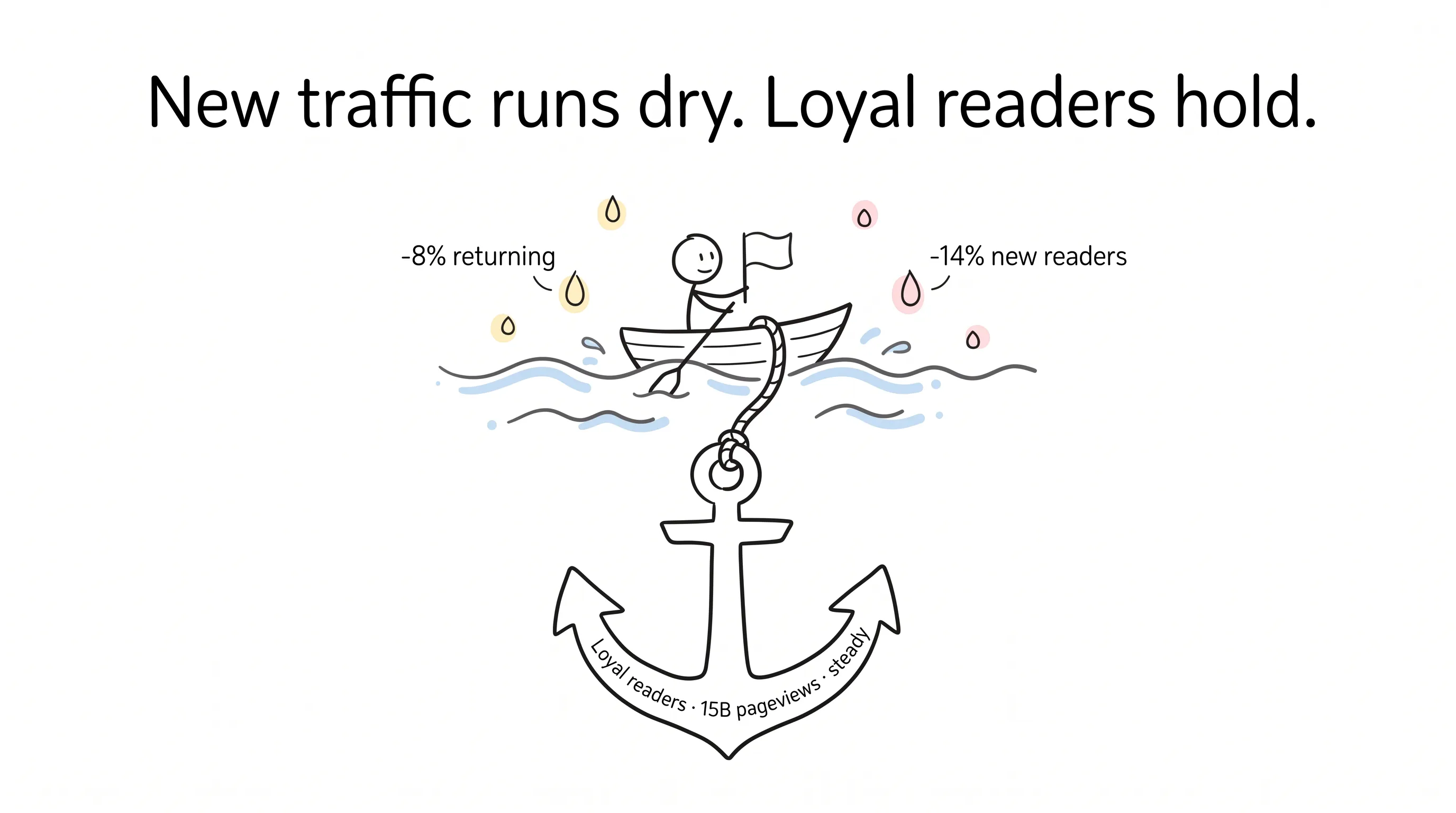
Two years on, this group's monthly pageviews barely moved at all: 14.98 billion in 2024, 15.02 billion in 2026.
But over the same period, returning visitors fell 8%, and new readers fell 14%.
What does that mean?
New visitors aren't coming. Casual visitors aren't returning. The old regulars are still here.
The whole network's monthly pageviews slipped slightly, from about 32 billion in 2025 to 31.1 billion in January through July 2026. The reason the pool didn't spring a major leak is precisely this group of old regulars who show up rain or shine.
The report's own words: loyal readers are an important reason overall pageviews haven't fallen off a cliff.
In one sentence: new traffic runs dry; loyal readers are the anchor.
Three Question Marks for the Report
Of course, I should hold this report up to the light for you too. A few spots in it deserve a question mark.
One, it doesn't make clear whether that 40.2% annual decline refers to the absolute number of traffic or the channel's share. The two-year data is on a share basis; how the annual figures line up with the share figures isn't spelled out.
Two, that 0.01% is two orders of magnitude away from another set of numbers Axios reported this March — chatbots accounting for less than 1% of media referral traffic — and there's no explanation of how they align.
Three, the report doesn't publish how many websites were in its two-year sample. Bear in mind, Chartbeat itself sells media analytics tools; flip the playbook to the last page and there's the button for booking a demo.
Data published by the man selling shovels. Trust the direction. Don't take the digits after the decimal point on faith.
This is not nitpicking. Any industry report you read deserves these three question marks.
So What Now?
Back to the original question: what should media do?
The report's advice really comes down to one line: treat SEO as one channel among many, and move your resources toward the audiences you yourself can influence.
In plain language: stop betting your entire fortune on other people's front gates.
The gates of search and social are held in the platforms' hands. They open them when they say, close them when they say, without even a heads-up. But the old regulars, the direct visits, the private forwards — the things clutched in your own hand — in two years, not one of them has dropped.
Oh, and the report left one loose end: it says this year's overall traffic decline is modest, but the US midterm elections in November haven't arrived yet — the big months for news traffic are still ahead.
At the start of this article I said that reading this report left me cold inside.
Now I want to put it differently.
The ones who should feel the chill are the people who have staked their lives on search. Someone who built an audience one reader at a time will finish reading, fold the page over, and write it into next year's plan.
So, if you are making content too, I want to translate this report into a blessing and send it to you:
May you, too, have a whole crowd of readers who never search — who come straight to you.
Continue reading
Related articles

Cross-Border Business: Time to Upgrade Your AI Toolbox
A learn article explaining how AI tools help cross-border e-commerce sellers clear five hurdles: language, regulation, logistics, payments, and fraud. It outlines a five-compartment toolbox, a five-step adoption path, and metrics such as conversion rate and CLV, while cautioning against over-reliance on AI.

AI Is Taking Over the Dirty Work of Social Media Marketing, One Task at a Time
This learn article outlines four social media marketing tasks AI can handle — audience analytics, content drafting and design, ad targeting and creative testing, and spam moderation — and cautions that taste, judgment, and data security remain human responsibilities.

AI Is Already This Good — Why Is Your Social Media Marketing Still Pure Manpower?
An overview of 18 AI tools for social media marketing, organized into six categories covering audience research, content creation, scheduling, comment and DM handling, ad management, and visual production, plus notes on personalization, prediction, and emerging trends.