
Google Isn't Sending Customers to Your Store Anymore — So Where Do They Come From?
A learn article arguing that Google AI Overviews and AI browsers are rerouting organic search traffic away from independent stores, and suggesting rewriting content as direct answers (AEO) and distributing it on social media to stay visible.
A while back, a friend of mine who sells to overseas markets invited me out for tea.
He had been running an independent online store for six years, and organic traffic from Google had always been his lifeline.
That day he told me about something strange: his rankings hadn't dropped, and he was putting more care into his content than ever, yet the numbers in his dashboard kept sliding. Same keywords, same positions — just nobody clicking through anymore.
He asked me: "Man, did I do something wrong somewhere?"
I told him, you probably didn't do a single thing wrong. The problem is the road — it got rerouted.
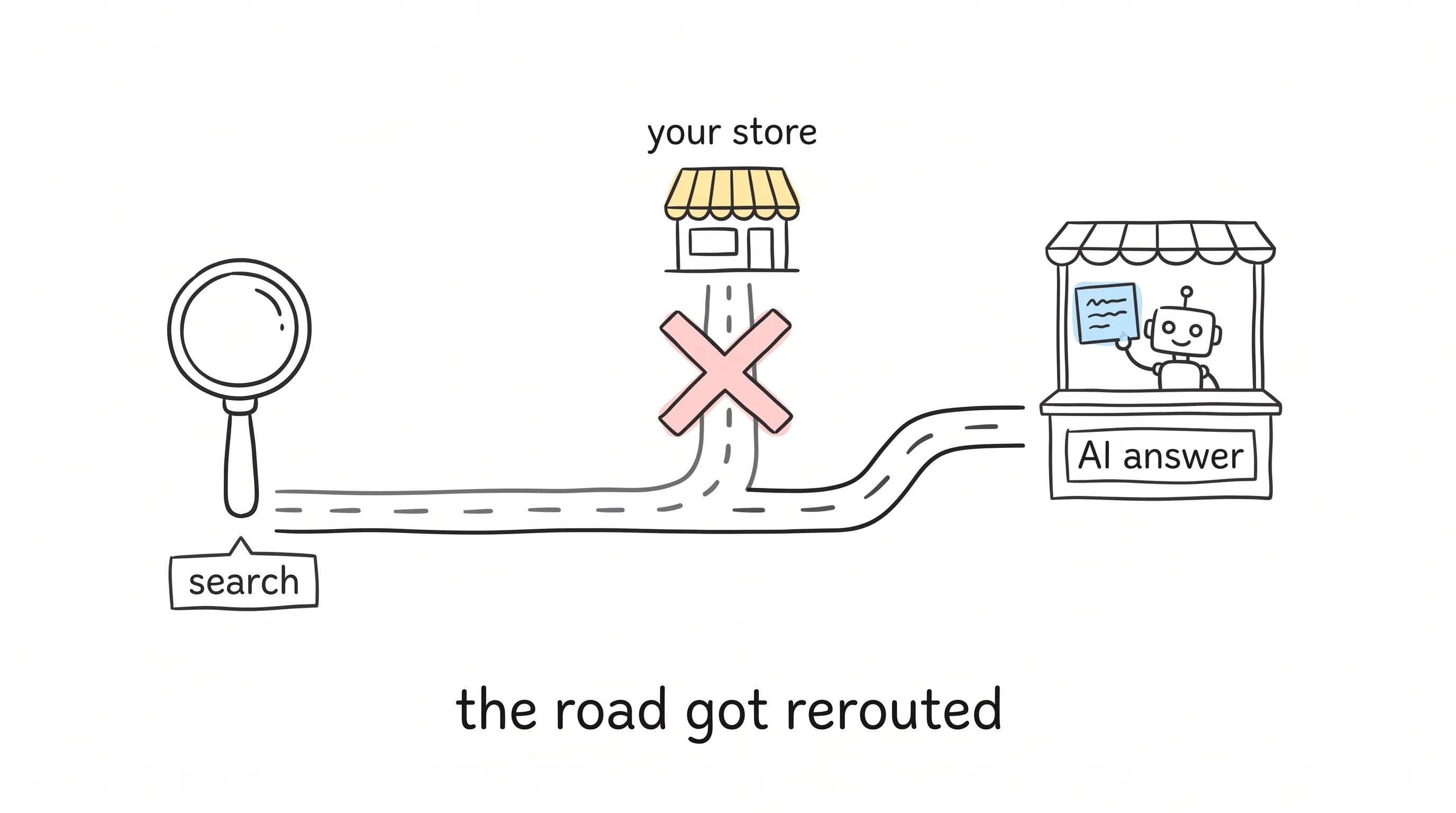
How the Old Rules Got Made
This story starts in 1998.
That was the year Google was founded. From then on, how the whole world found things on the internet was essentially Google's call. You can think of Google as a map — how visible your website's spot on that map decided whether anyone came knocking at all.
What is SEO (search engine optimization)?
Put simply, it's the craft of studying how that map gets drawn, then placing your website on the prime spots. A user types in a query, you rank high, they click in, and you've got business.
That system ran for nearly thirty years.
Now the people who drew the map are redrawing it with their own hands.
The Change Starts at Google's Own Front Door
Have you noticed? Search a question on Google these days, and the top result is often an answer already written by AI.
The feature is called AI Overviews. Google chews up content from every corner of the web, condenses it into one paragraph, and serves it up to you on the spot.
For you, that's convenience.
But what about the row of blue links underneath?
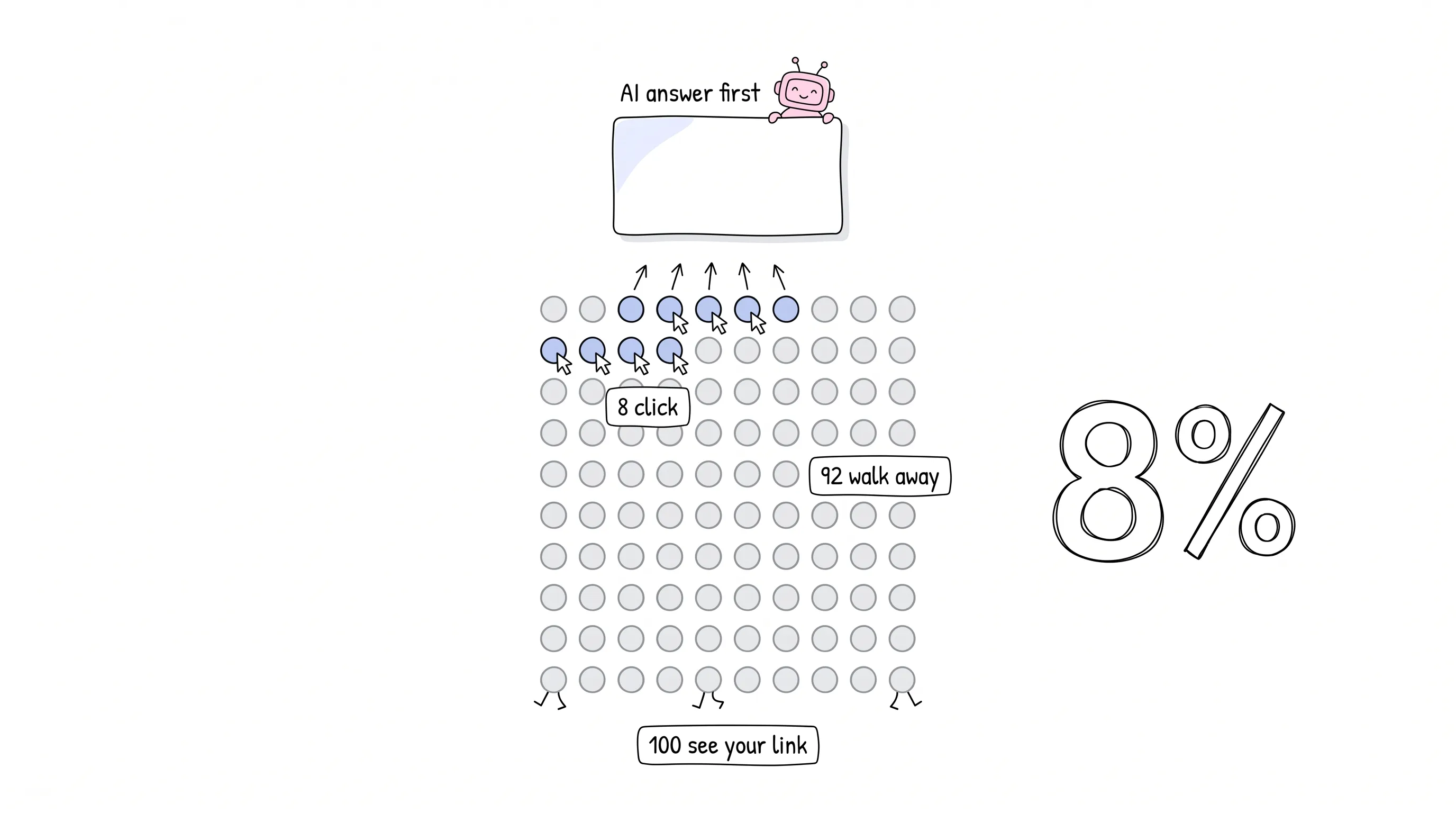
Pew Research Center ran a survey in 2025, and the conclusion makes for grim reading: among users who saw an AI summary, only 8% went on to click the traditional search results.
8%.
Out of 100 people who see your link, only 8 click it. The other 92 finish reading that summary and walk away. Even if you are the most relevant answer out there, you still sit obediently beneath the summary.
And these things are showing up more and more often. Estimates of how often AI summaries appear in search results vary wildly: the low end says 18%, the high end says more than half. Pew's own number is one in every five searches; in a June 2025 study, the marketing agency Xponent21 put it above 50%.
Which number you believe is up to you. But every estimate points the same way — and this is only going to get more common.
What's Google After?
You might ask: why would Google do this? Pinning users down on its own pages, not letting anyone leave — isn't that a bit greedy?
Flip it around and it makes perfect sense.
If a user stays on the results page and doesn't click out, what does that mean? It means that user never left Google's turf from start to finish. And the most visible spots on that turf can be sold as ad space.
The content you slaved over does the cooking; Google plates it, serves it, and keeps the cash register on its side of the table.
Push this logic one step further and you might break into a cold sweat. The phone number and address listed in your Google Business Profile — you handed those over for nothing. If one day they hide your listing unless you're running ads, or just start charging for it outright, who are you going to complain to?
It hasn't happened yet. But the direction is already glaringly obvious.
And there's a layer that deserves even more thought: Google now weighs your social media content more heavily than your own website, treating it as an important ranking signal.
In other words, they aren't even planning to "drop by" your place anymore — they plan to requisition your goods outright.
Meanwhile, Someone Else Just Tore the Whole Stage Down
Just as Google busies itself pinning users to its own pages, someone else has gone and stuffed search straight into the browser.
OpenAI launched its own desktop browser, called Atlas. What is this thing?
Half search engine, half butler. You ask it a question, it gives you an answer; you want to buy something, it compares prices and places the order while it's at it. Shopify is being wired into ChatGPT too — soon the shopping cart may live right inside the chat window.
Here's the kicker: Atlas's slogan is "Unlock the Web."
Unlock. And who locked the web in the first place? Everybody knows.
You have to hand it to them.
For a generation that grew up living in chat apps, this one's even easier: a search box that answers back will always feel warmer than a row of blue links. The older generation still "searches." The young just "ask."
So Where Do the Customers Come From?
The map has changed. If your business lives off search, what now?
The word you hear most in this space these days is probably AEO.
What is AEO? Answer Engine Optimisation — optimizing for answer engines.
The name sounds intimidating, but the work is something you do every day already: writing your content so it directly answers questions.
Writing articles used to mean figuring out how to bury keywords to catch Google's eye. Now you have to figure out: what are users actually asking? How do I hand them the answer in the very first sentence?
Add one more item: your answers need to travel — straight onto social media. As we covered earlier, Google now treats even social media content as an important ranking signal. If your content just sits on your website, it's feeding the search engine and never reaching your customers.
And notice — this isn't just about "being found." Once people's habit of getting answers changes, even what a website is for will change with it.
On the surface, this looks like several rounds of technical upgrades. Underneath, the power of distribution is moving house.
What users have always wanted is the answer. Whoever delivers it faster and better is who they'll follow.
Back to That Cup of Tea
By the time we reached the last steep of the pot that day, I told my friend: don't rush to tear your independent store down and start over — take the knife to the content first. Take every "look how great we are" article on your site and turn it, piece by piece, into answers to the questions your customers actually ask. Then carry the same content over to your social accounts.
He had his doubts.
Two weeks later, he sent me a WeChat message: several of the Q&A-style pieces had started getting cited in AI Overviews, and they brought a few inquiries back with them.
I wouldn't call this the textbook answer. Nobody can say for sure where search goes from here.
But one thing I'm quite sure of: the map is still the map — but the people giving directions have started opening shops of their own.
If you make your living off search too, open your website tonight and ask yourself one question:
Is my content written for rankings, or written for people?
Here's to switching roads early.
Continue reading
Related articles

Cross-Border Business: Time to Upgrade Your AI Toolbox
A learn article explaining how AI tools help cross-border e-commerce sellers clear five hurdles: language, regulation, logistics, payments, and fraud. It outlines a five-compartment toolbox, a five-step adoption path, and metrics such as conversion rate and CLV, while cautioning against over-reliance on AI.

AI Is Taking Over the Dirty Work of Social Media Marketing, One Task at a Time
This learn article outlines four social media marketing tasks AI can handle — audience analytics, content drafting and design, ad targeting and creative testing, and spam moderation — and cautions that taste, judgment, and data security remain human responsibilities.

AI Is Already This Good — Why Is Your Social Media Marketing Still Pure Manpower?
An overview of 18 AI tools for social media marketing, organized into six categories covering audience research, content creation, scheduling, comment and DM handling, ad management, and visual production, plus notes on personalization, prediction, and emerging trends.