
Google Held a Two-Hour Event on Winning Customers. I Only Remembered One Line: Traffic Is Getting Cheap, Signals Are Getting Expensive
A recap of Google's Rethink ROI event on AI-era customer acquisition, covering how AI changes buyer research, why first-party data signals matter more than budget, intent-based matching in AI Max, and combined search and YouTube strategies for lead-driven businesses.
I recently sat through all two hours of a Google event. It was called Rethink ROI — this September — and the room was packed with people in the "lead business": insurance sellers, lenders, B2B software companies, schools.
These businesses share one trait: customers don't pay the moment they see an ad. They compare, they ask around, they agonize for half a month.
Events like this one usually turn into product launches — two hours of chanting "our AI is amazing." But the more I watched, the more I felt this one was actually making a remarkably plain point:
In the AI era, the deciding factor in winning customers is no longer budget. It's signals.
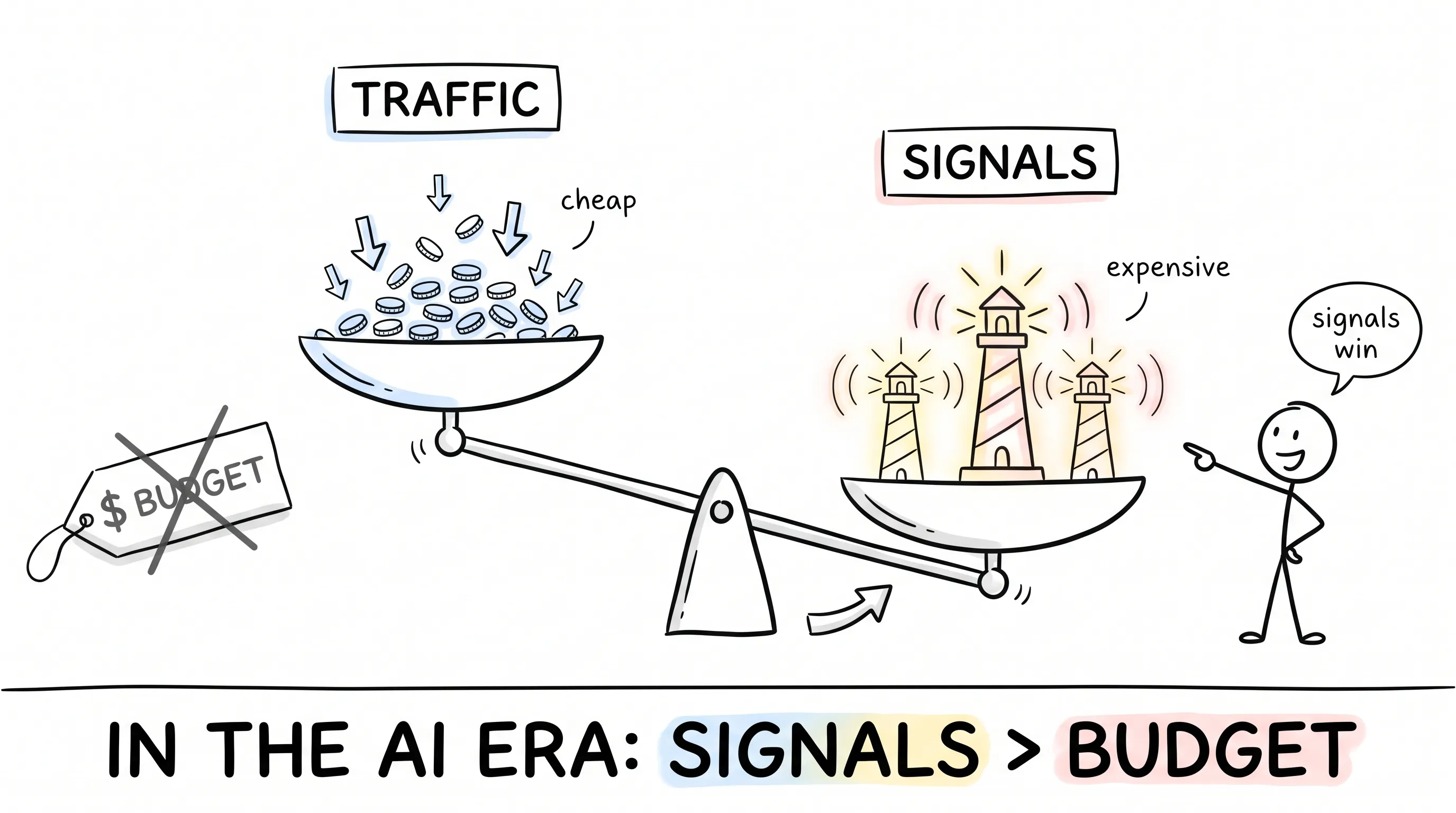
What are signals? Patience — I'll take them one at a time.
First, People Have Changed
A consumer facing a big decision — choosing software, a loan, an insurance policy — used to be tied to a knot they couldn't untie: if they wanted peace of mind, they had to play detective, juggling dozens of browser tabs until their head spun; if they wanted ease, they could only gamble on luck.
Peace of mind or ease. Pick one.
Now AI has untied that knot. Google gave these new buyers a name that says exactly what it means: super-empowered consumers.
What's a super-empowered consumer? An ordinary person who makes AI do the heavy lifting. The research, the comparisons, the price math — AI does all the dirty work, and the human keeps only the final call.
A few numbers, so you can feel it.
Among users preparing to buy a service, four out of five say AI features in Google Search made their decisions faster and left them more confident.
People who use AI make a decision across an average of 12 touchpoints — roughly 3x as many as people who don't.
If you pause here, confused — isn't AI supposed to save us effort? How did the journey get longer?
Right. And that's the most interesting part. AI didn't make decisions shallower. It made them deeper.
Before, comparing three vendors was already exhausting. Now AI will compare thirty with you, and you'll toss in three follow-up questions while you're at it. In Google's U.S. AI Mode, open-ended searches like "help me think this through" are growing 30% faster than AI search overall, and the average query length in AI Mode is 3x that of traditional search. People have stopped typing keywords. They've started asking questions the way they talk.
Behavioral psychology has an old frame for this (Kahneman's two-system model): System 1 is fast and intuitive — see a discount, buy; System 2 is slow and effortful — forty tabs, fifteen vendors, running out of steam halfway through. Plenty of purchase journeys simply died of exhaustion.
AI has gone and built a third system: the grunt work goes to AI, the human only chooses. Fast, and researched.
Discovery Can Happen Anywhere. The Decision Happens on Search.
Many people worry AI will become a gatekeeper, fencing users inside its own walls.
The data says the opposite.
Of people who research purchases with ChatGPT, 99% still come back to Google for the final confirmation; 71% won't buy without checking Google first.
See something you like on social media? 84% of people will go verify it on Google. And after verifying? Two-thirds end up buying a completely different brand.
So it doesn't actually matter where desire gets planted. Discovery can happen anywhere. The decision happens on search.
Then how does a brand get chosen? The Google folks put it bluntly: in this era, your brand is no longer yours alone to define. The answer AI gives is simmered together from reviews, news, videos, forums, and your own website.
The part you can control, you should control all the harder: make your first-party content solid — key information laid out clearly on your own site, creator partnerships that produce genuine third-party validation. As for all the loudly debated new acronyms, AEO (Answer Engine Optimization) and GEO (Generative Engine Optimization), his answer genuinely surprised me: do SEO well, and that is the best GEO.
Why haven't the guiding principles changed? Because behind every AI summary, the same old engine of crawling, indexing, and ranking is still doing the work. Don't fabricate data to please robots. Don't spray fake brand mentions across forums. Google is smarter than that.
Writing real content for real people — that road just got wider.
Keywords Are Retiring
Let me share a detail that stuck with me.
One major advertiser had built a keyword list of extraordinary refinement: exact match, negatives, layered structure — ten years of craft. The Google folks joked that this list's word count ran longer than the seven Harry Potter books combined.
And then? They switched on AI Max's search-term matching, and the system surfaced another 30% of potential traffic.
Ten years of craftsmanship, beaten by the machine's 30%.
Before you grieve those years — they weren't wasted. Everything they learned about their customers is still there. What changed is the rules of the game: users no longer type keywords; they ask questions. AI Max matches intent, not strings, and the team is freed from maintaining keyword lists to think about what actually matters — like what kind of customers you actually want.
Two numbers. Infinity Sales Group, which does telecom customer acquisition, wrapped AI copy in text guardrails — compliance requirements and geographic limits locked down tight — and revenue rose 40%. Advertisers who turned on AI Max's features across the board saw 15% more conversions on the same budget.
And Google previewed what's on the way: an agent embedded right in search ads that can answer customer questions and pre-qualify leads inside the ad itself; plus lead intent scoring that tags every new lead high, medium, or low — officially, the model already predicts whether a lead will convert with 90% accuracy. Sales teams no longer need to cast wide nets. Put your people on the leads worth betting on.
YouTube Isn't Where You Plant the Seed — It's Where You Draw the Bow
Plenty of bosses running B2B or lead businesses look down on YouTube. They figure it's a playground for consumer brands.
I'd suggest a look at these numbers.
89% of buyers in lead-driven businesses, after watching a relevant YouTube video, clicked a link, visited a site, or searched for the brand.
Businesses running the full create-capture-convert chain with the Google-plus-YouTube combo post a ROAS (return on ad spend) 37% higher than peers using other media. Measured against paid social over the long run, YouTube comes out 86% ahead.
Cases too. Columbia Southern University — a school, so admissions is a textbook long-cycle lead business — added Demand Gen on top of search ads: branded search volume up 111%, conversions up 5x. Canva reused its social creative and turned Demand Gen into its primary growth engine. And one B2B lead aggregator, Suited Connector, used generative tools — Veo, Nano Banana — to mass-produce creative variants, cutting customer acquisition cost by 90%.
Pay attention to that last one. No Hollywood budget, no professional crew — and it still works. What generative tools are best at is precisely this: saying "who we are and why choose us," cheaply and clearly.
Google Turns the Mic Around: Your Move
What I admired most about this event was its honesty. Halfway through, the people on stage said it outright: we can give you reach and intent, but there's one thing only you can provide.
Your own first-party data.
Google calls this data strength. Plainly put: can you tell the ad system, accurately and on time, who your real customers are? The truer the signals the system receives, the sharper its bidding, the less of your money it burns.
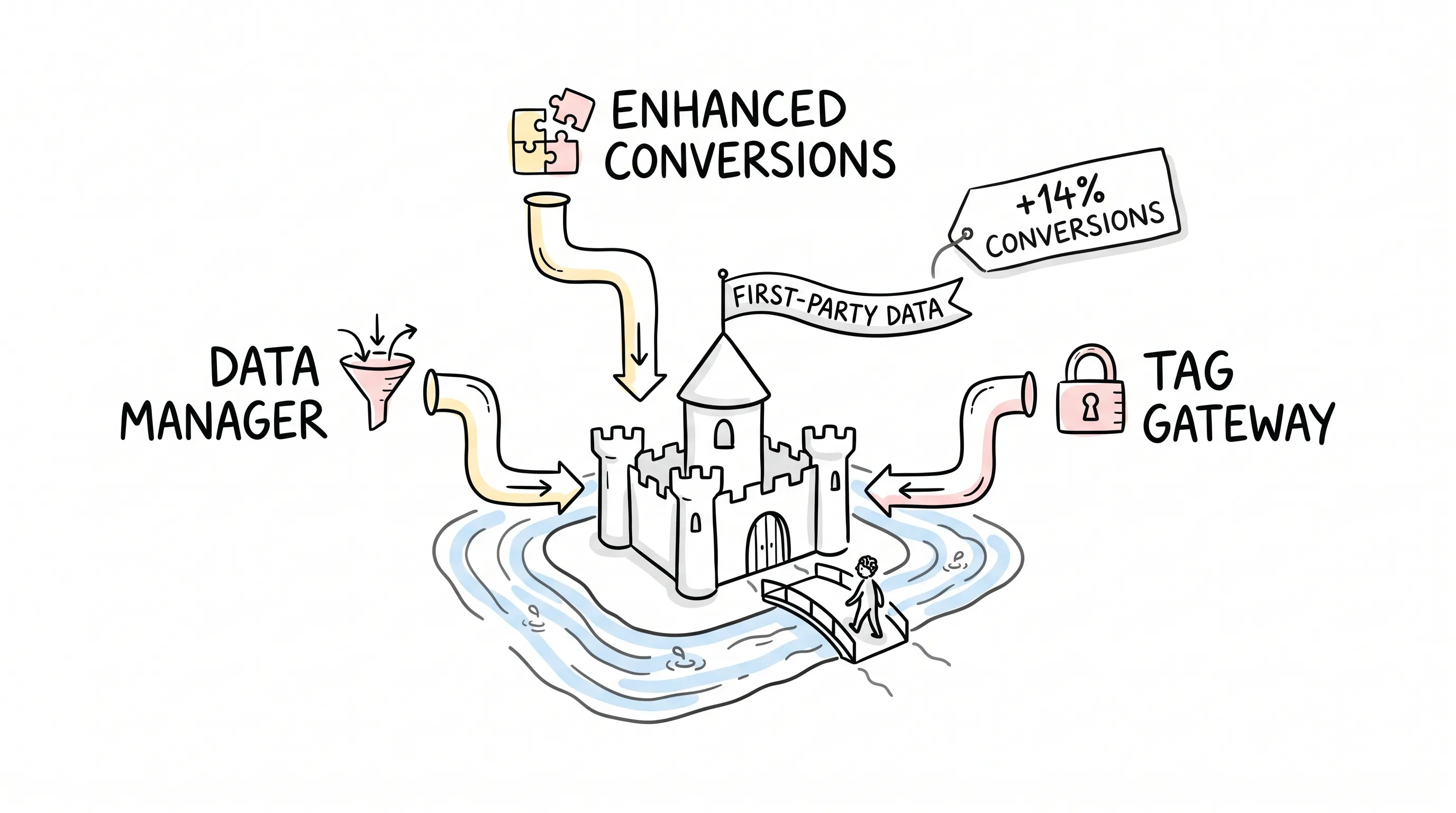
Three tools, each covering one stretch.
Data Manager handles intake. Google used to have too many doors for data — several APIs running in parallel, which marketers hated (Google admits it too). Now it's one door: data from partners like Salesforce and Shopify plugs in once and works everywhere.
Enhanced Conversions handles alignment. A customer searches on their phone today, fills out a form on a laptop tomorrow, closes the deal by phone the day after. This technology stitches the scattered traces of the same person together, so the system knows whose account this deal actually belongs to.
Google Tag Gateway handles trust. Tracking code used to live on Google's domain, and browsers trust third-party domains less and less — so data leaked out along the way. Now the code sits under your own domain, and measurement gets fuller. The official number: 14% more conversions captured.
Fourteen percent. Change nothing, move one thing, and suddenly you understand 14% more of your customers. BambooHR, which makes HR software, got its data foundation solid and cut customer acquisition cost by 20%.
The system isn't short on brains. It's short on the truth you feed it.
A Dollar You Cut Today Costs $1.92 to Win Back
There was one segment I assumed was aimed at brand managers. It turned out to be aimed at everyone who has ever slashed a budget.
A study that scanned several hundred public companies landed on this number: cut $1 of short-term brand advertising today, and on average you'll spend another $1.92 later to buy back the market share you lost.
One dollar ninety-two. Does that trade pencil out?
Kantar's research twists the knife: companies with top-tier brand strength saw their stock rise 2x the market, and when the market recovered, they rebounded 4.5x faster than the weakest brands.
Why? Think about businesses with high decision costs. The moment you actually need a loan, an insurance policy, or a consultant on the phone, you don't start comparing from zero. You check the name already sitting in your head. Brand's job isn't the present moment — it quietly puts you on the shortlist before you've even started choosing.
So how do you prove brand money was well spent? The measurement executive on stage offered a refreshingly practical method: run incrementality experiments first — use causal testing to learn which dollars actually drove growth — then talk attribution and models. The order is not negotiable. Then pick one proxy metric you can trust and watch it relentlessly. His pick: incremental branded search. He calls it the world's largest focus group.
Honestly, brand and performance were always supposed to be one line, not two.
The People in the Audience Had Already Done Their Homework
Anyone can preach concepts. What I cared about were the bosses up there who had turned these ideas into real money.
Zebra, one of America's largest insurance-comparison platforms. Its chief growth officer shared a detail: when they sell a policy, the partner insurer doesn't send back the sales data until 60 days later. With signals that delayed, how do you fight a war? Their answer: pull finance, data science, and insurance partners to one table and grind the data together. Once the signals were untangled: lead volume up 16–18%, revenue up 20%. The CFO was pleased enough to approve an in-house data science team of their own. He left one line behind: don't treat data as an IT project. This is CEO-level business strategy.
Chime's story is even more brutal. This fintech pushed AI Max to 96–97% adoption, rode that system past 10 million members, and drove new customers' LTV-to-CAC ratio (lifetime value vs. acquisition cost) to 9x what it was. But he flagged two things. First, none of this works out of the box — ten people spending 20% of their time each buys you less than one person going all-in. Second, customers arriving from AI channels convert at 2x traditional organic traffic. Why? Because they'd already finished their homework with AI before walking in.
Rippling's story hurts the most. This HR-software company used to attribute on last touch, so YouTube looked like it never did any work, and its budget got pulled on a whim. Then they understood: YouTube manufactures demand; search harvests it. Manufacture without harvesting, and you're gifting your competitors. Once that clicked, they rebalanced: branded search volume up 160%, qualified leads up 26%, even the sales team's win rate climbed. They now call YouTube "enhanced performance ads."
The agency side had strong words too. Level Agency says if a client won't share CRM data, they won't take the account. Sounds arrogant. It's actually the responsible position: without real signals, even the smartest team can't win.
And one line for the CFO conversation. In your world, cost per lead and cost per click are KPIs. In the CFO's world, those are vanity metrics. He cares about exactly one thing: how much incremental growth you brought. Get that straight and you've won half the battle in the meeting room.
To Close
If you could only take three things from those two hours, here they are.
First, stop treating search and YouTube as two separate lines. One scatters the bait, one hauls the net. Throw them as one combination.
Second, stop guessing what customers want — hand intent to AI. The precondition: you can feed it real data.
Third, data is the new moat. Creative can be copied. Media buying can be copied. A clean, truthful, timely pipeline of first-party signals cannot.
Traffic keeps getting more expensive; signals keep getting more valuable. AI has flattened the information gap — but it cannot flatten your understanding of your own customers. That understanding, you have to feed the system one honest sentence at a time.
Here's to feeding that ledger straight — one day sooner.
Continue reading
Related articles

Cross-Border Business: Time to Upgrade Your AI Toolbox
A learn article explaining how AI tools help cross-border e-commerce sellers clear five hurdles: language, regulation, logistics, payments, and fraud. It outlines a five-compartment toolbox, a five-step adoption path, and metrics such as conversion rate and CLV, while cautioning against over-reliance on AI.

AI Is Taking Over the Dirty Work of Social Media Marketing, One Task at a Time
This learn article outlines four social media marketing tasks AI can handle — audience analytics, content drafting and design, ad targeting and creative testing, and spam moderation — and cautions that taste, judgment, and data security remain human responsibilities.

AI Is Already This Good — Why Is Your Social Media Marketing Still Pure Manpower?
An overview of 18 AI tools for social media marketing, organized into six categories covering audience research, content creation, scheduling, comment and DM handling, ad management, and visual production, plus notes on personalization, prediction, and emerging trends.