
Google Has Decided: Legacy Search Ad Features Are Being Forced Into AI Max Starting September
Google Ads is phasing legacy search ad features into AI Max: new-creation entrances for Campaign-level Broad Match and ACA closed in August, with automatic migrations starting in September and DSA following later. The article walks through the timeline and practical steps for advertisers and API developers.
Monday morning, a friend who runs Google Ads campaigns sent me a WeChat message:
"Man, Google is going to 'confiscate' my campaigns."
I asked what happened. He said there was an official notice sitting in his account: the Dynamic Search Ads he was running would be automatically upgraded to AI Max starting February next year, and the notice suggested he get it done himself, sooner rather than later. He had never clicked "agree," and he didn't dare touch anything.
That's right — no consent clicked, no action taken.
This time, Google isn't asking for opinions. What it sent wasn't an invitation. It was a notice.
What Exactly Happened?
The story starts in early August.
On August 3, Google shut down the "create new" entrances for two legacy features: Campaign-level Broad Match (Google's loosest keyword-matching setting, applied across an entire campaign) and Automatically Created Assets — known in the industry as ACA. From that day on, you can't create either of them anywhere — not in the Google Ads console, not in Ads Editor, and not through the API.
Once the entrance closes, the message is unmistakable: the door to the old structure has been welded shut.
Then comes the moving. From September 1 to 30, Google will automatically migrate Search campaigns still using these two legacy configurations over to AI Max, batch by batch.
So what is AI Max?
Think of it as the "next-generation default experience" for Google Search ads: automatic matching, auto-generated assets — things you used to have to switch on separately and manage on their own are now all packed into this one box.
Picture the scene: some morning in September, you wake up, and the campaign is still the same campaign — but the logic running inside it already belongs to AI Max.
Will Anything Get Lost in the Move?
Most people's first reaction: will the settings in my account disappear during the move?
Google's answer is: migration in place.
What does migration in place mean? Your campaign structure stays untouched — it gets renovated right where it stands into the corresponding AI Max settings, with every effort made to keep the way it runs consistent before and after. The brand inclusions and brand exclusions you originally set up get carried over automatically. No need to copy them all down again.
Put simply, this is a fully renovated home, delivered move-in ready — you just show up with your suitcase.
The Timeline, Straightened Out for You
This migration involves three legacy pieces in total: Campaign-level Broad Match, ACA, and Dynamic Search Ads — better known as DSA.
The first two move out this month. For DSA, Google is giving you a few extra months.
Here are the key dates; check them against your own calendar:
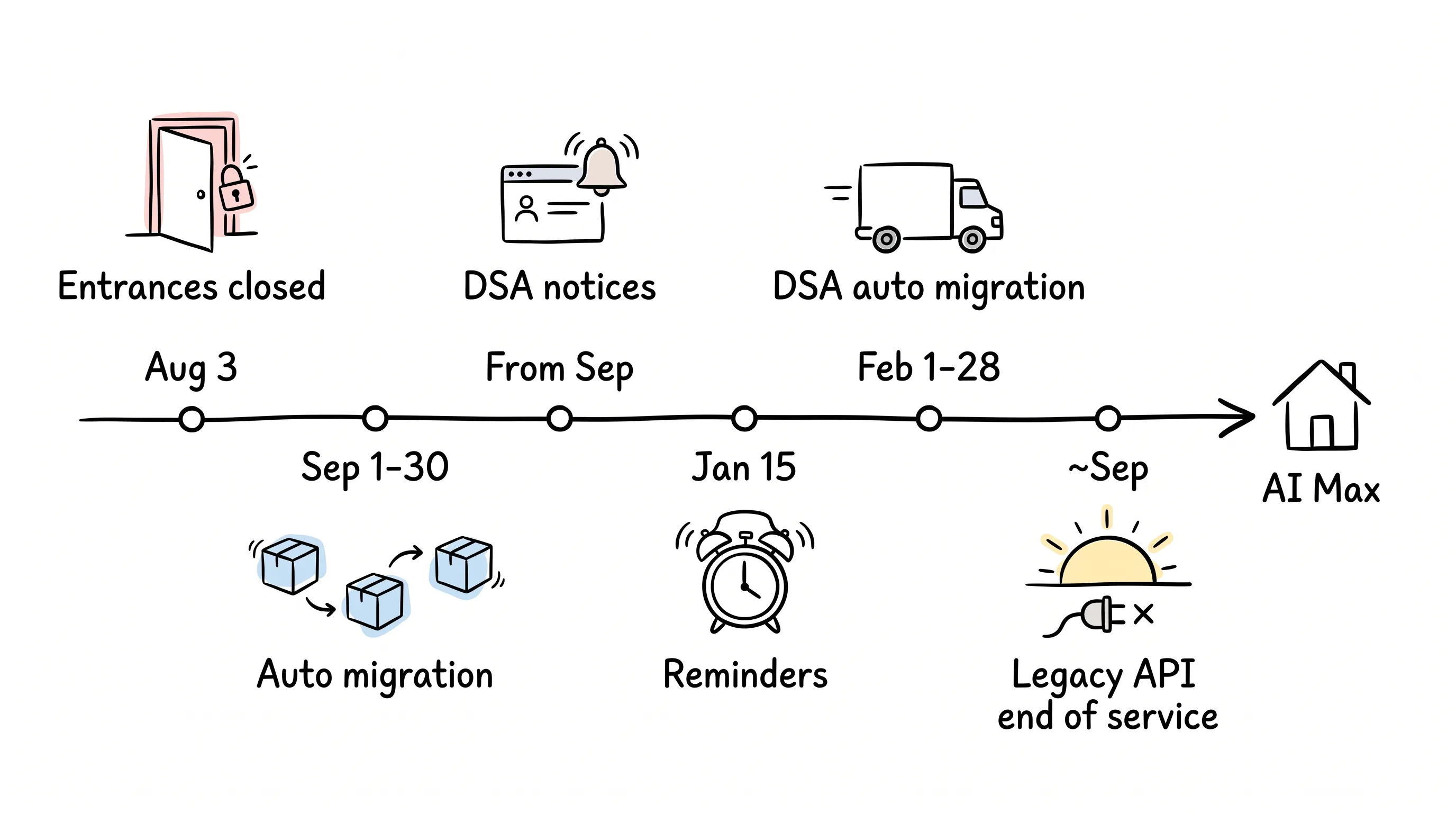
- August 3: The new-creation entrances close. Campaign-level Broad Match and the legacy version of ACA can no longer be created — not in the console, not in Ads Editor, not via the API.
- September 1–30: Automatic migration. Broad Match and ACA campaigns move into AI Max batch by batch.
- From September: Notices start popping up in your account, nudging you to upgrade DSA to AI Max on your own initiative.
- January 15 next year: Reminders go out to those who still haven't acted.
- February 1–28 next year: DSA automatic migration begins. At the same time, the ability to create new DSA ad groups is permanently shut off.
- Around September next year: The legacy versions of the Google Ads API that support these legacy entities reach their end of service.
Do you see the rhythm here?
First they close the door, then they move you out, and in the end they demolish the elevator.
Why does DSA get to stay half a year longer? My guess is that Google knows perfectly well that DSA runs deep and the account structures it touches are complicated. So first they persuade, then they push, and finally they move you. The runway is generous; the direction never changed.
Developers, This Part Is for You
If you make your living off the Google Ads API, this migration brings you one piece of bad news and one piece of good news.
Bad news: new API versions released after September 1 will completely remove support for the legacy Broad Match and ACA entities.
Good news: the legacy API won't shut off right away. It will keep running until its normal sunset, expected around September next year.
That means you have about a year to go through your scripts, tools, and integrations one by one and switch them over to AI Max settings. Google's advice is blunt: audit now. With this kind of thing, the biggest mistake is dragging your feet until deadline night.
So, What Should You Do Now?
For those of you running ads, three things.
First, open your account today and read the notices. The September migration is already underway — don't pretend you didn't see it.
Second, if you're still running DSA, settle one question for yourself: wait to be auto-upgraded in February, or take the initiative and upgrade now?
Third, if you manage scripts or tools, get the audit on your calendar. Automatic migration is a rules-based mapping performed by the system — what it guarantees is that nothing breaks, not that everything is optimal. Optimal is on you. Before and after the migration, walk through every detail of the account with your own hands.
My view is direct: if you can do the moving yourself, move yourself.
Back to My Friend
He came back to me later with one question: does this really matter?
I said it matters, but it's not that scary. Google is after efficiency — it isn't out to get anyone. There is only one real risk: you never look at your account, and one day you open it to find the world has switched to a new set of rules, while your peers moved long ago and are already running the new version.
AI Max isn't an option. It's the default.
The only thing you get to choose is how you move: move yourself, or be moved.
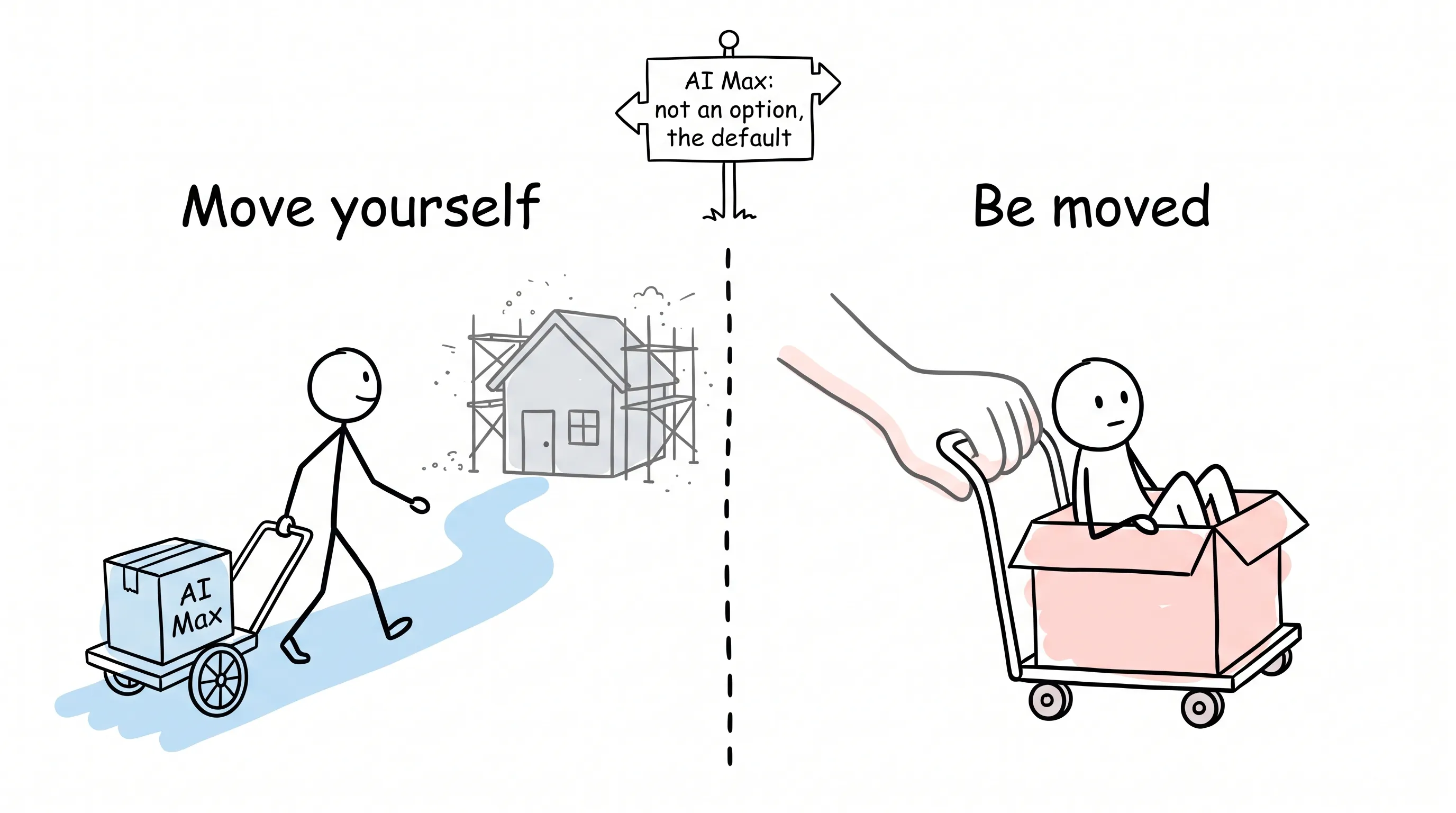
May you always be the one who does the moving yourself.
Continue reading
Related articles

Cross-Border Business: Time to Upgrade Your AI Toolbox
A learn article explaining how AI tools help cross-border e-commerce sellers clear five hurdles: language, regulation, logistics, payments, and fraud. It outlines a five-compartment toolbox, a five-step adoption path, and metrics such as conversion rate and CLV, while cautioning against over-reliance on AI.

AI Is Taking Over the Dirty Work of Social Media Marketing, One Task at a Time
This learn article outlines four social media marketing tasks AI can handle — audience analytics, content drafting and design, ad targeting and creative testing, and spam moderation — and cautions that taste, judgment, and data security remain human responsibilities.

AI Is Already This Good — Why Is Your Social Media Marketing Still Pure Manpower?
An overview of 18 AI tools for social media marketing, organized into six categories covering audience research, content creation, scheduling, comment and DM handling, ad management, and visual production, plus notes on personalization, prediction, and emerging trends.