
Google Ads' Latest Measurement Updates Are Really About One Thing: Feed the Data First
An explainer of Google Ads' September 10 measurement updates, covering Data Manager integration with GA and DV360, enhanced conversions, the open-source Meridian marketing mix model, and the GeoX geo-experiment library, framed around strengthening first-party data and proving the causal impact of ad spend.
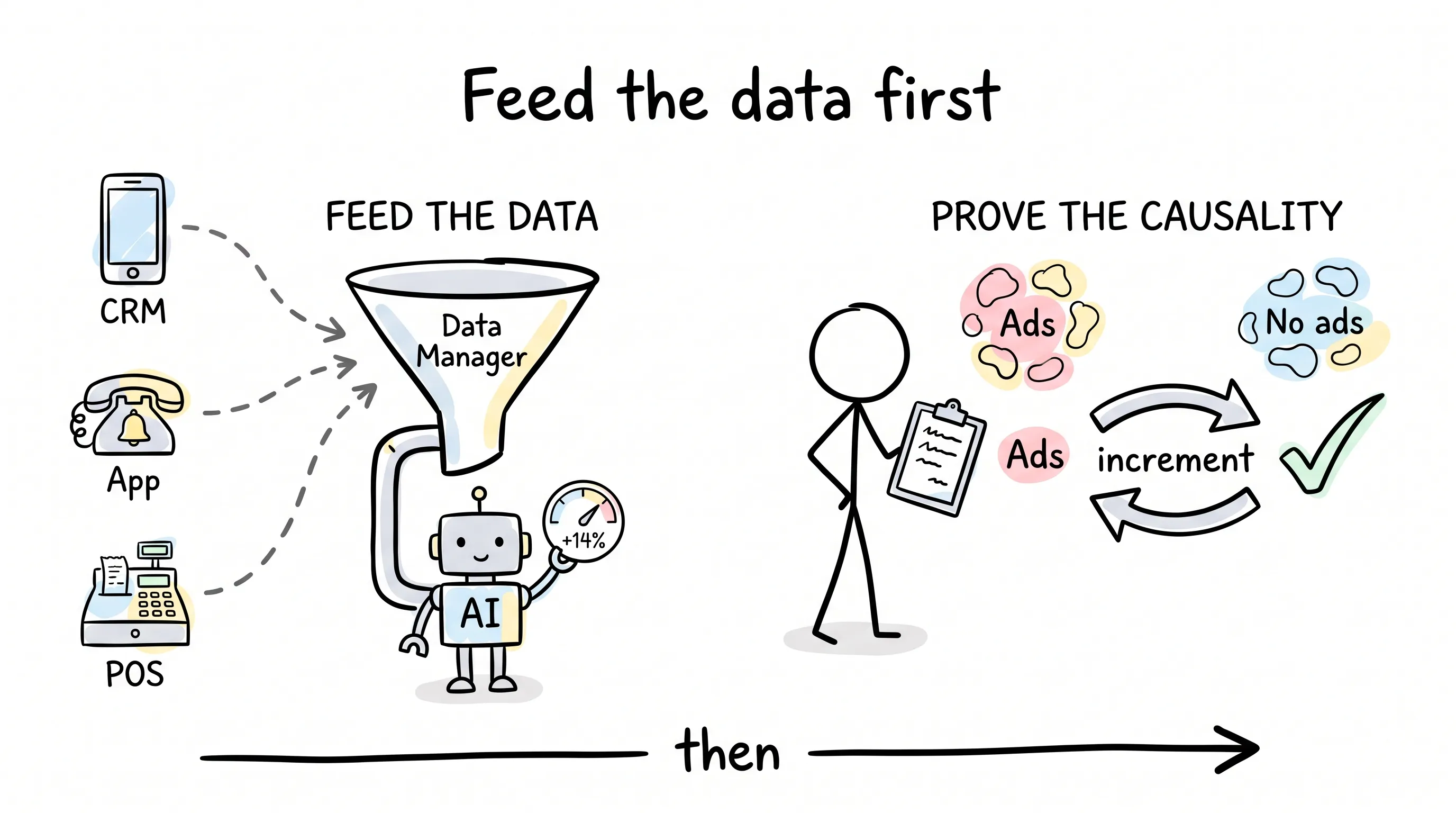
A few days ago — September 10 — Google Ads rolled out a full suite of measurement updates.
There's plenty that's new: tighter Data Manager integration, enhanced conversions, an open-source model called Meridian, and an experimental tool called GeoX.
But I'm not going to open with a feature list. You wouldn't remember it anyway.
Instead, I want to ask you a question first.
Do you know what your ad spend is actually buying?
Do You Know What Your Ad Spend Is Actually Buying?
Picture this scenario.
You're the boss. At the month-end review, your marketing team reports: 8 million impressions, 120,000 clicks, cost per click down 15%. Sounds good. You ask the obvious follow-up: how much business did those clicks actually bring in?
The room goes quiet.
Everyone can explain that "the ads ran." Nobody can explain what the ads produced. Impressions, clicks, conversions — these are all scoreboard numbers.
A scoreboard can only tell you the score after the game is over.
It can't help you win.
Earlier this year, Google's ads team shared a vision that stuck with me: turn measurement from a "post-game scoreboard" into a "pre-game performance engine." How do you get there? They said three things have to come together: a solid data foundation, multiple signals to see the full picture, and causal evidence on top of it all.
This update is a big step in exactly that direction. Concretely, it does two things: feed the data, and nail the causality.
Let's take them one at a time.
What Is a Data Foundation, Exactly?
First, let's locate the problem.
Your customer data is scattered into every corner. Your members' phone numbers are gathering dust in the CRM, your app logs browsing behavior, and your stores' POS systems hold a record of every card swipe.
To AI, all of this is fuel. AI bids for you, finds your audiences, splits your budget — all of it runs on data. Feed it scraps and it flies blind.
It's like asking someone who has only skimmed your social feed to draw up your life plan. They could do it. They'd most likely do it badly.
What Google set out to do this time was get the fuel supply under control. Four moves.
First, connect. Data Manager, Google's tool for managing first-party data, is now directly integrated into Google Analytics (GA) and DV360. You no longer have to shuttle data back and forth between tools — manage it in one place, activate it everywhere.
The effect shows up in numbers: advertisers who fed their offline and app data into Data Manager saw incremental ROAS improve by 26% on average. That's Google's data, tracked over a full year through April 2026.
What is incremental ROAS? It's the return your ads genuinely added, after stripping out the sales that would have happened anyway without running ads. 26% is nothing to sneeze at.
Second, match. Enhanced conversions have also landed in GA and DV360: you use encryption to match the customer data in your hands against the ad platform, so the system recognizes your customers better. After rollout, Search conversions came in 11% higher on average than with standard conversion imports. Based on Google's internal data from January this year.
Third, lay the pipes. Data Manager's API has been upgraded to a universal version, built on the ECAPI standard set by the IAB Tech Lab. In plain English: connecting to five ad platforms used to mean writing five sets of integrations; now one standard interface can hook into every major platform. On top of that, Data Manager now includes automatic diagnostics — if something goes wrong with your data, it flags it before your campaigns feel the impact.
Don't underestimate that last one. How many advertisers only discover their conversion feed has been broken for two weeks — after the budget has already burned?
Fourth, it hands you a ruler. Google Ads shipped a new metric called Data Strength Uplift, which computes exactly one thing: how many extra conversions the data you added actually brought in. It's visible right in the product interface — something like "5% extra conversions over the past 14 days."
Feed the data better — how much more do you get back? Google offered two numbers: advertisers who built up their data strength using Google tag gateway lifted conversions by 14% on average (second half of 2024 versus first half of 2025); Demand Gen campaigns did even better, at over 20% (June 2026 data).
The better you feed the data, the sharper your AI performs. This is not mysticism — it's math you can actually work out.
The Data Is Fed. Then What?
Then comes a harder question.
With the data foundation solid, the next thing to answer is: of all the dollars you put out, which ones actually drove business?
Here's the catch: no report answers this. Impressions and sales rising at the same time doesn't mean the impressions brought the sales. It might just be peak season — a rising tide lifting all boats.
Which brings us to Meridian.
What's an MMM? A Marketing Mix Model. In plain terms: you put your spend in every channel side by side with your final business results, and work backwards to figure out how much each channel contributed. It amounts to a full audit of the books across all your ad channels.
Meridian is Google's open-source MMM. This upgrade brings mainly three things.
The most practical one first: the model now does some of the work for you. Newly added agentic capabilities can check data quality, track down errors, and walk you step by step through building the model. The backend was also rebuilt — the same analyses now run faster.
Next, brand advertising can finally prove its worth in numbers. You can now put brand signals — for example, Branded Google Query Volume — directly into the Meridian model. This means the age-old puzzle of "does brand building actually pay off" is starting to get a quantitative answer: whether the seeds planted by upper-funnel video ads and TV ads can grow into future sales.
The third thing, and the one that excites me most: GeoX is now officially available worldwide.
GeoX is Google's open-source library for geo-level causal experiments. In plain English: pick one group of regions to run ads in, and another similar group to hold out, wait a while, then compare how far apart the two sides' business is. That difference is the increment of your ads — it's your causal evidence.
Think about it — isn't this exactly the control group in a new drug trial? To judge whether a drug works, you can't just look at whether the people who took it got better. You have to look at how much better they got than the people who didn't.
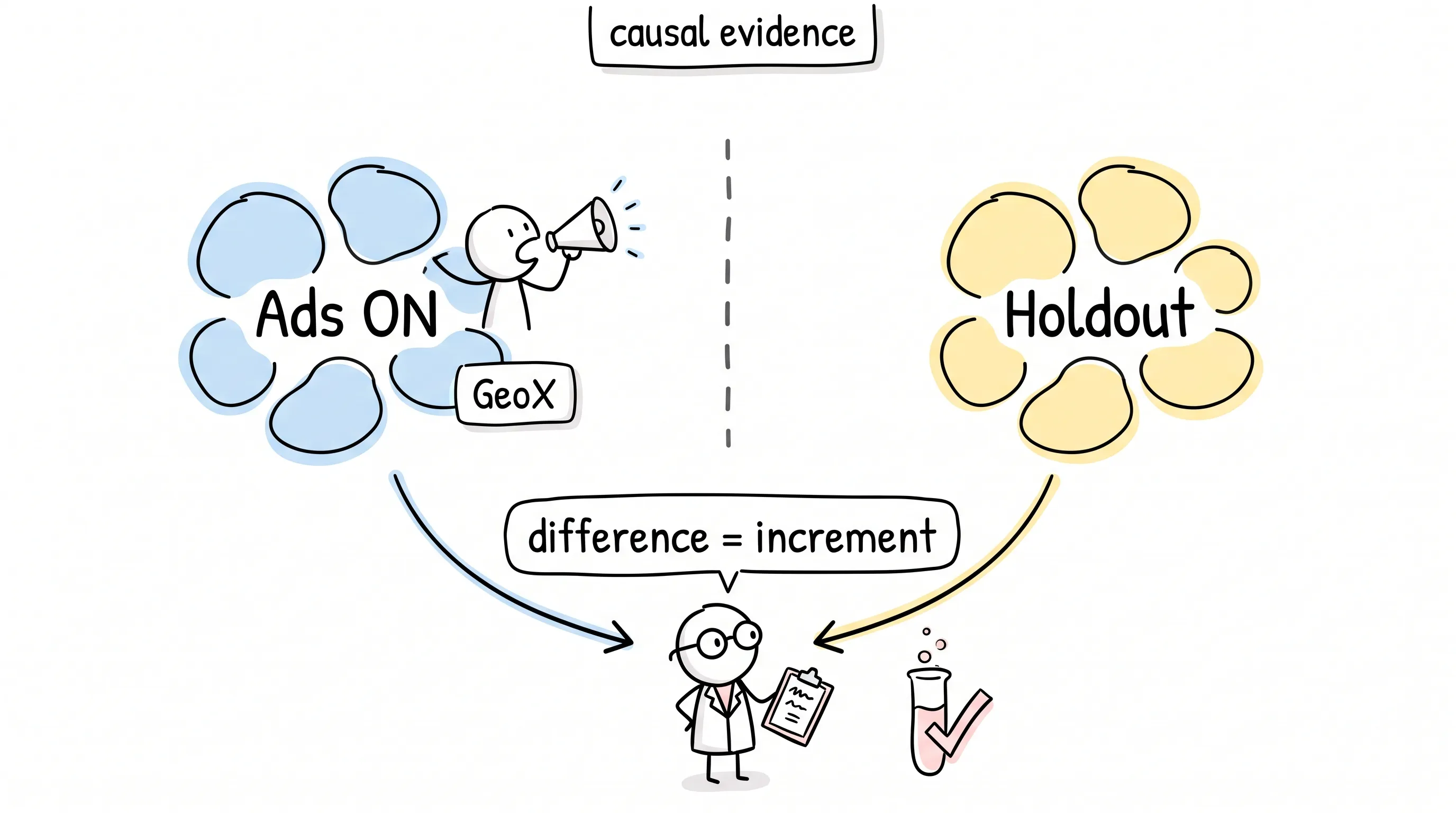
Earlier this year, GeoX was still in testing; now it's officially available worldwide. And it isn't picky about platforms — whichever ad platform you advertise on, it runs. The increment results it produces can also be fed back into Meridian, lifting the precision of the whole measurement stack another notch.
Correlation can only tell you that the places where you advertised sold better.
Causality is what gives you the right to claim: those extra sales came from your ads.
The latter is what advertisers should truly be paying for.
Finally, a Few Closing Words
Looking back, this wave of updates really tells one story:
Feed the data first, then prove the causality.
Feeding the data gives your AI the strength to do its job. Proving causality gives you the confidence to spend more. Get those two connected, and you finally know what your ad money buys.
Next up, Google will unpack this playbook at the Rethink 2026 conference — worth keeping an eye on if you run media.
Finally, back to the opening question: do you know what your ad spend is actually buying?
If the answer is still "can't really say," start with the simplest step: tidy up the customer data you're already holding, and plug it in.
Here's to your next ad budget — may every last dollar of it be spent knowing exactly what it bought.
Continue reading
Related articles

Cross-Border Business: Time to Upgrade Your AI Toolbox
A learn article explaining how AI tools help cross-border e-commerce sellers clear five hurdles: language, regulation, logistics, payments, and fraud. It outlines a five-compartment toolbox, a five-step adoption path, and metrics such as conversion rate and CLV, while cautioning against over-reliance on AI.

AI Is Taking Over the Dirty Work of Social Media Marketing, One Task at a Time
This learn article outlines four social media marketing tasks AI can handle — audience analytics, content drafting and design, ad targeting and creative testing, and spam moderation — and cautions that taste, judgment, and data security remain human responsibilities.

AI Is Already This Good — Why Is Your Social Media Marketing Still Pure Manpower?
An overview of 18 AI tools for social media marketing, organized into six categories covering audience research, content creation, scheduling, comment and DM handling, ad management, and visual production, plus notes on personalization, prediction, and emerging trends.