
Going Global: Why Do Ads Die the Moment They Get Translated?
Explains why word-for-word translated ads often underperform in new markets and introduces transcreation: AI drafts refined by native experts, with centralized workflow management for multilingual ad localization and A/B testing.
A while back, a friend of mine who makes hardware for overseas markets invited me to dinner. Before the dishes had all arrived, he was already venting.
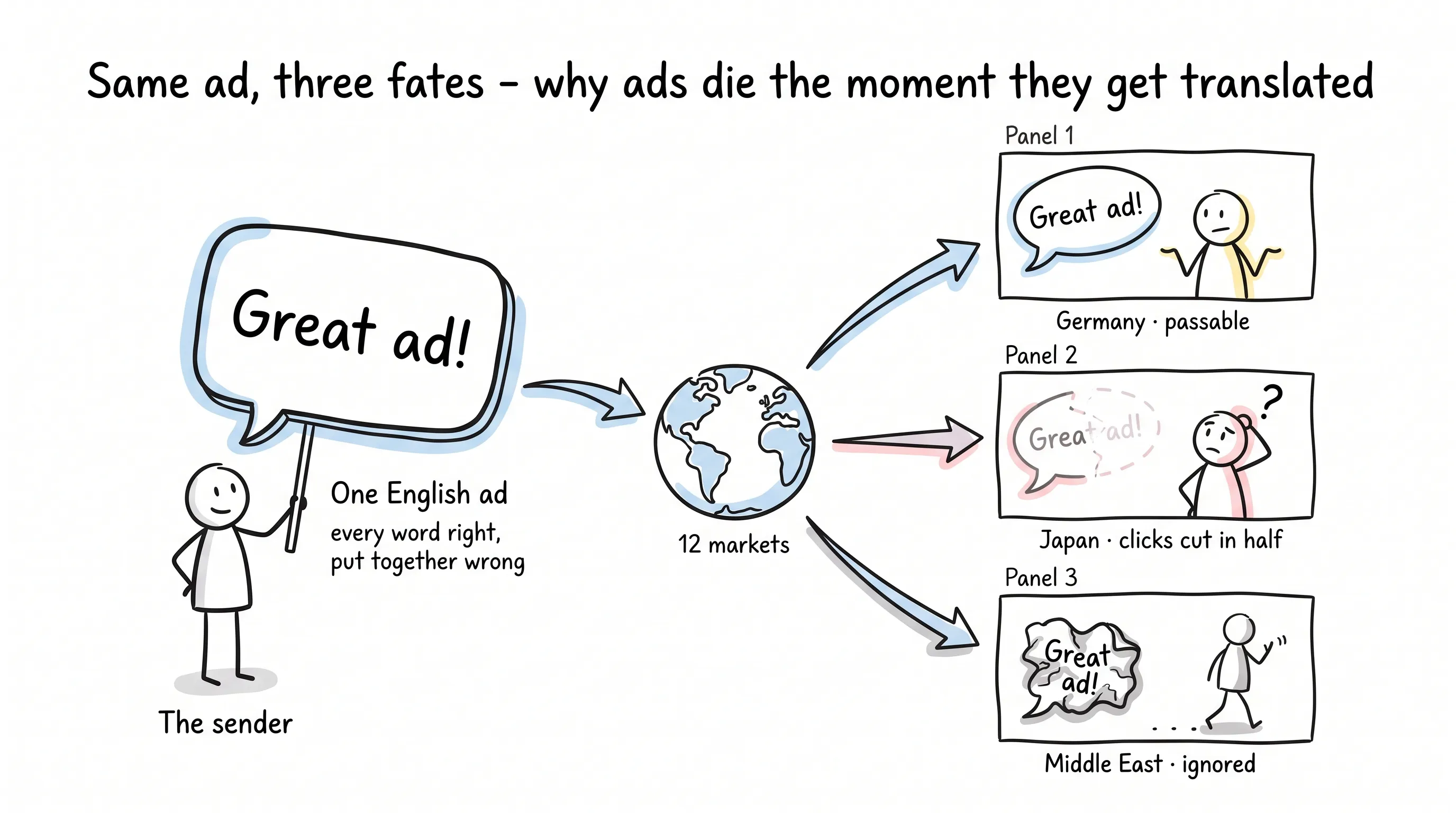
His ads, running in English across Europe, performed so well that he'd smile just thinking about the numbers at midnight. So he waved his hand and made the call: translate them into Japanese, German, and Arabic, and blanket 12 markets.
The result: the German region was passable. Japan: click-through rate cut in half. One Middle Eastern country: almost nobody paid attention.
He wouldn't accept it: "Every word was triple-checked against the dictionary. The translation was flawless."
I said, that's exactly where the flaw is. Every word is right; put together, it's wrong.
The Language Was Right. The Culture Wasn't.
What is global marketing?
A lot of people understand it as: translate your English ads into twenty languages, run them in twenty countries. Machine translation is dirt cheap — just do it.
Not even close.
Translation only moves the words across. But when users open their wallets, what they're buying is the meaning and the feeling behind the words.
Think about it: humor, symbols, tone, imagery — in different cultures, these are entirely different operating systems. The same joke sounds funny to American ears, falls flat to German ears, and in another market may come across as flat-out offensive.
One set of ads for the whole world: what you save is effort, what you lose is people. The money gets into every country; the attention never moves in an inch.
Low engagement, burned budget, and local users who only feel this brand has nothing to do with them.
The Invisible Bill
And that's not the end of it. Later I looked at their workflow and couldn't help but gasp.
Spreadsheets, emails, four or five translation vendors each handling a few markets, none talking to each other. A brand glossary? Each keeps their own version. This market calls it "Smart Butler," that market calls it "AI Butler."
Let's do the math.
One market's process runs two weeks slow, and all 12 markets slow down together. The golden window for running ads is only so long, and spreadsheets and emails gnaw it away cell by cell.
Four vendors, four voices. The "you" users meet today and the "you" they meet tomorrow don't sound like the same person.
Progress is invisible. Which market is stuck where — the boss can only ask one by one. ROI? Can't be calculated.
None of these costs show up on the books, yet every one of them scrapes real money right off you.
Machines Draft, Humans Add the Finishing Touch
So what to do?
That brings us to a word: transcreation.
What is transcreation?
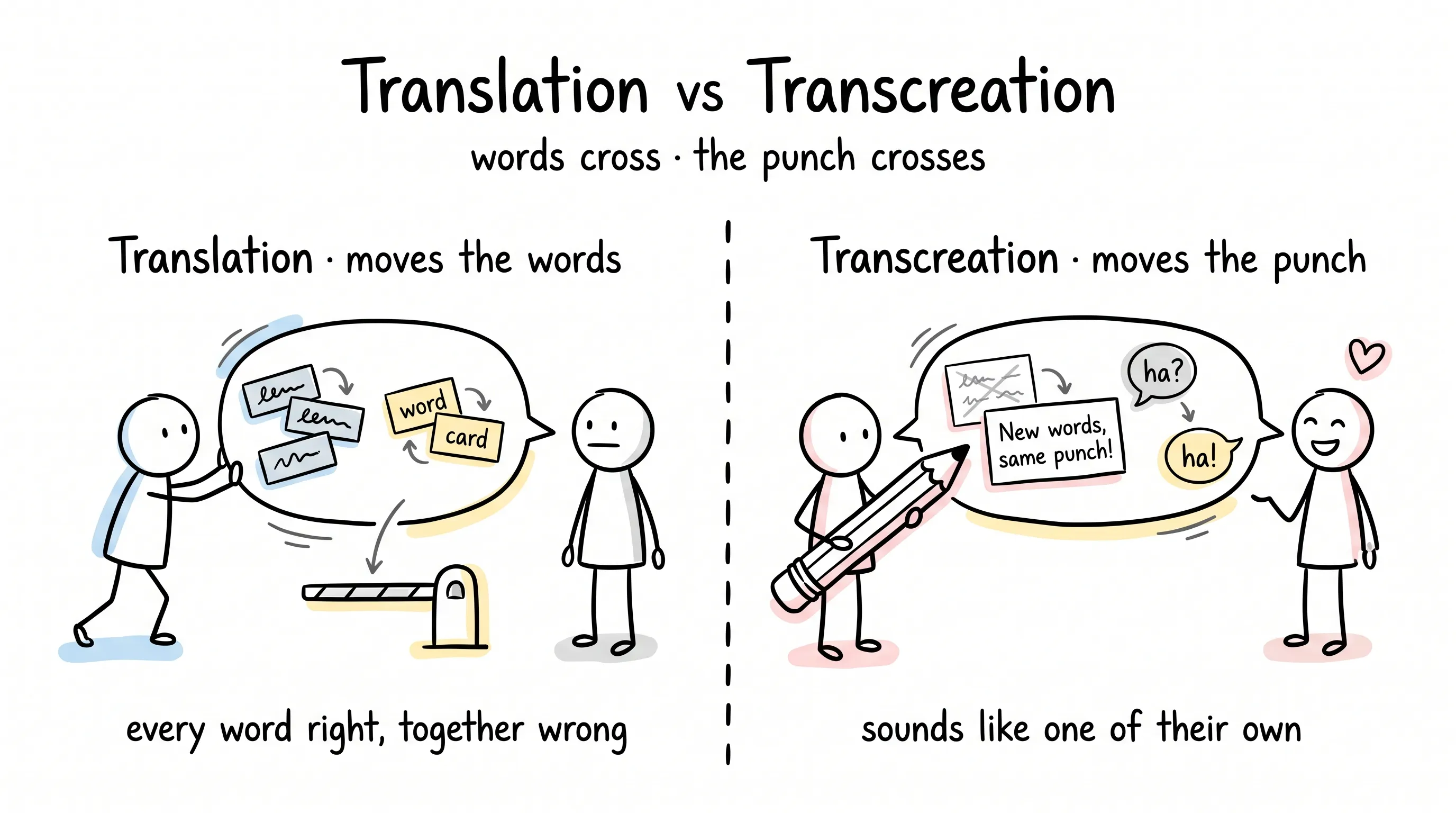
Translation moves the words across. Transcreation moves the punch across. When the same ad arrives in a new market, the sentences get rewritten, the visuals get redone, even the joke may need to be swapped. There is only one test: a local reads it and feels this is how one of their own would talk.
Who does this work? When I saw how Translated does it, I practically slammed the table. They call it Human-AI symbiosis. In plain terms, the machine drafts, the human adds the finishing touch.
On the AI side, language models like ModernMT and Lara produce first drafts with context in view. Fast, high-volume, and never wildly off course.
Then more than 500,000 vetted native-language experts take over, focusing on the part machines are worst at: emotion, tact, and the unspoken subtleties inside a culture.
Machines handle speed, humans handle precision. That's the division of labor.
What pulls it all together is their enterprise platform, TranslationOS. You can think of it as the control tower of global marketing.
Planes don't take off and land by shouting over the phone. Every flight has to pass through a control tower.
That's exactly what TranslationOS does. Workflows run on the platform — goodbye to spreadsheets and emails; glossaries and translation memories are managed centrally, so 12 markets speak the same "brand language"; you can see where every market stands, in real time; and whether the money is well spent — that you can calculate.
Even dozens of markets launching at once — it holds.
Execution Comes Down to Three Things
Framework in hand, execution comes down to three things.
First, content production. Marketing today is a bottomless pit: web copy, display ads, video, voice, an endless stream. AI produces the first draft, experts tune it until it's right, and tools like MateSub and MateDub localize subtitles, dubbing, and voice all together — quality and creativity don't have to yield to speed. Google Ads and social ads, down to keywords and targeting, are redone around how locals actually search.
Second, make the ads feel local. Copy, visuals, media strategy, all tuned to local taste. What users feel should be "this was made for me," not "this was imported."
Third, once you're live, the fight has just begun. What works in this market may not work next door. TranslationOS supports multilingual A/B testing — keep testing, keep tuning. Which version works on which turf? Let the data speak.
The Final Tally
Finally, the tally.
A lot of people book localization as a cost line. I don't see it that way.
Localization is a growth engine.
Why do conversion rates rise? When you speak to people the way a local would, they naturally hear you.
Why do new markets open fast? Once the transcreation pipeline is laid, each additional market costs less and less at the margin.
Why is customer lifetime value high? Until they truly get you, loyalty never even enters the picture.
Airbnb, Google, and Asana all use localization as a growth lever, and it pays back in real engagement and revenue. Translated has been in this business for 25 years, and NordVPN is also on the client list.
And my friend? He later redid the ads for all 12 markets, the transcreation way: machine first drafts as the base, native experts tuning sentence by sentence — for the Japan version, even the joke got swapped out.
Last month he invited me to dinner again. No venting this time — he was too busy showing me his dashboard numbers.
He picked up the tab, and that meal tasted especially good.
A product can go around the world in one version. The words need a new version for every place.
And here's to you: wherever your business goes, may you always sound like a local.
Continue reading
Related articles

Cross-Border Business: Time to Upgrade Your AI Toolbox
A learn article explaining how AI tools help cross-border e-commerce sellers clear five hurdles: language, regulation, logistics, payments, and fraud. It outlines a five-compartment toolbox, a five-step adoption path, and metrics such as conversion rate and CLV, while cautioning against over-reliance on AI.

AI Is Taking Over the Dirty Work of Social Media Marketing, One Task at a Time
This learn article outlines four social media marketing tasks AI can handle — audience analytics, content drafting and design, ad targeting and creative testing, and spam moderation — and cautions that taste, judgment, and data security remain human responsibilities.

AI Is Already This Good — Why Is Your Social Media Marketing Still Pure Manpower?
An overview of 18 AI tools for social media marketing, organized into six categories covering audience research, content creation, scheduling, comment and DM handling, ad management, and visual production, plus notes on personalization, prediction, and emerging trends.