
Global E-Commerce Is Quietly Swapping Out Its Toolbox
A July roundup of e-commerce tool launches covering AI product data agents, cross-border payment localization, multi-store setups, and new platform openings for sellers.
A few days ago, I had dinner with an old friend who runs a cross-border e-commerce business.
He exports home goods — factory in Ningbo, customers in Europe and the US. I asked how business was going, and he sighed: business is fine; it's the tools that are wearing him out.
What did he mean?
Product listings had to be filled in, one entry at a time, on every platform. Finish the English site, then start on the German one. Images, descriptions, specs, compliance info... Just getting the data for a few thousand SKUs (stock-keeping units) in order kept two of his employees fully occupied.
Sourcing suppliers was worse. Send an inquiry, wait for a quote, compare terms, haggle back and forth — one full loop, and a week has gone by.
I told him: the way you're playing this game may genuinely need an upgrade.
This past July, the global e-commerce tooling world lit up with a dense burst of launches. I went through them carefully, and the more I read, the clearer one thing became:
The e-commerce toolbox is being swapped out wholesale.
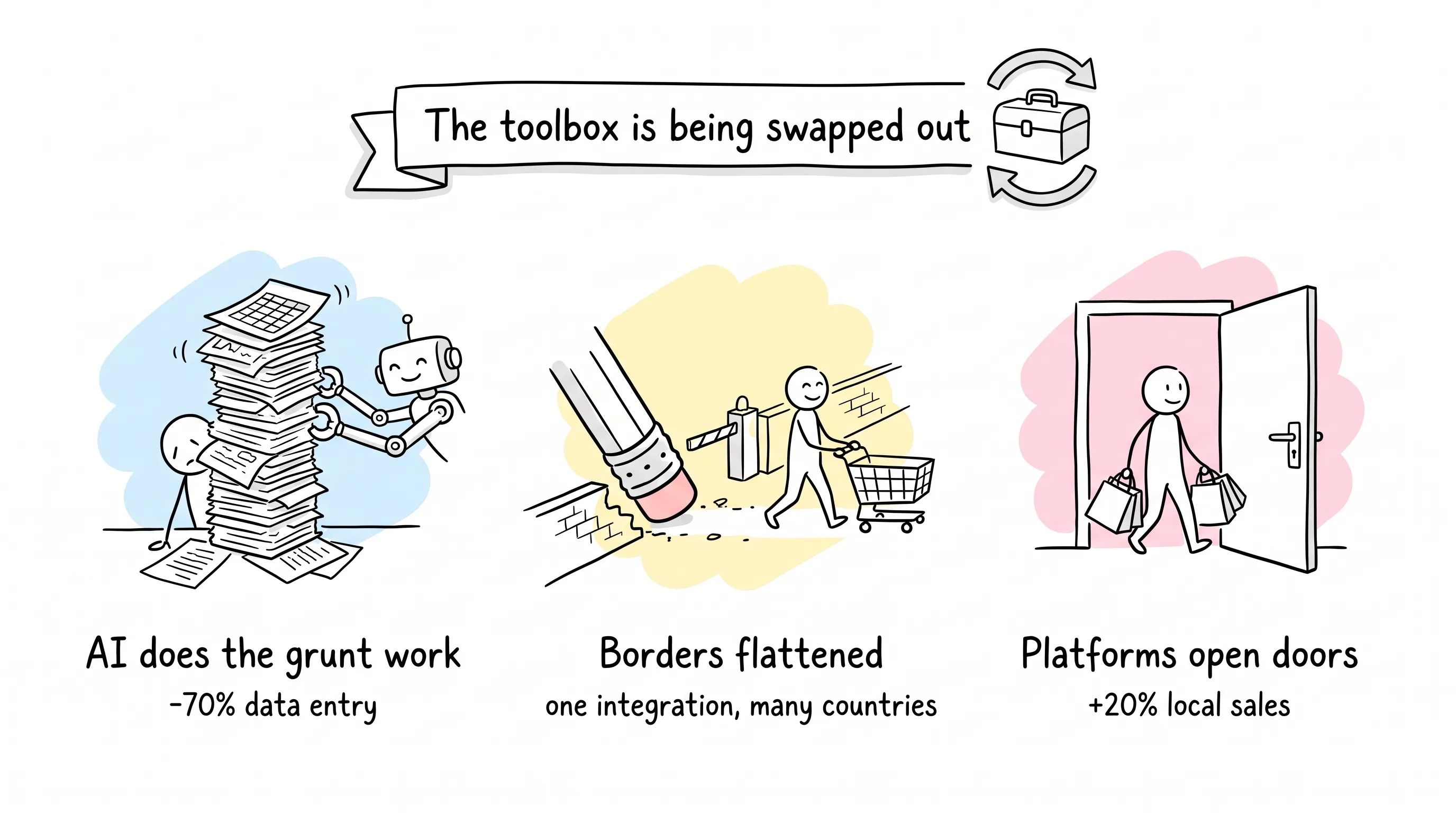
Swapped for what? Let me walk you through it. Three things, mainly: AI has started doing the grunt work; the hurdles of going global are being flattened, piece by piece; and the big platforms are racing to open new doors for your store.
1. AI Starts Doing the Grunt Work
Start with the one that surprised me most.
Product data management sounds unglamorous, but it is one of the heaviest forms of manual labor in e-commerce. What is product data management? Keeping the names, specs, descriptions, and compliance info for your thousands of products neat and correct — and making sure that in every country, on every platform, it's the right version.
Akeneo, a company that does product information management (PIM), released an AI agent called Ziggy. What can it do? Auto-fill product attributes, clean up messy catalog data into a unified format, even generate product descriptions in the local language.
The official claim: it can cut manual data entry by roughly 70%.
Seventy percent. Think about what that means. My friend keeps two employees doing nothing but filling in spreadsheets — the better part of both jobs has just been taken over by a single AI.
But this is only the opening skirmish.
Over at Alibaba, there's Accio, a sourcing toolbox flying the "agentic AI" banner that takes on the entire foreign-trade sourcing process, end to end: finding suppliers, sending inquiries, comparing terms — even negotiating on your behalf. And it learns as you use it: it remembers your purchasing preferences and proactively recommends better sourcing options.
Think about it: a small buyer looking to source from China used to have to figure it all out by trial and error — whose goods are good? how do you talk the price down? Now all that hard-won experience has been compressed into an AI.
The barrier to entry just got flattened.
2. The Hurdles of Going Global Are Being Flattened
The second thing is happening in cross-border payments.
Two launches, one right after the other, pointing in remarkably the same direction.
One is Shift4, which launched a platform called "One": integrate once, and you can collect and pay out across multiple countries under a single setup. Before, you had to plug into a payment channel in each country separately, negotiating with one provider after another. Now: one integration, done.
The other is Payfuture, which connected to Shopify and brought India's local payment methods — UPI (Unified Payments Interface, India's instant payment system), Paytm, bank transfers — right onto the checkout page.
Put these two side by side, and they are really saying the same thing:
Payment localization has gone from a nice-to-have to the price of admission.
What is payment localization? It's when a shopper in India opens your store and sees a familiar Paytm button — Paytm being India's leading digital wallet — not a form demanding an international credit card number. Every familiar button you're missing buys the customer another second of hesitation. One extra second of hesitation, and the order is gone.
Going one level deeper, there are two plays for setting up shop across borders.
Shopify has a product called Markets, built on the idea of "one store, sell globally": one back office, configured with multiple countries' currencies, taxes, and domains, with shipping carriers built in. BigCommerce's Multi-Storefront takes the other road: one back office spinning up several independent storefronts, each with a completely different brand face.
Which is better? Depends on who you are. A DTC (direct-to-consumer) brand selling into Europe, the UK, and Australia mostly wants things easy — Shopify Markets' "one store, many countries" fits better. A big corporate group with standalone brands in each region? It needs every territory to have its own storefront — BigCommerce's "one back office, many stores" is the right call.
By the way, neither side has been sitting still. Shopify's Q1 report this year showed cross-border GMV (gross merchandise value) up 30%. BigCommerce also added native multi-currency support to Multi-Storefront.
This fight is just getting started.
3. The Big Platforms Are Racing to Open New Doors
The third thing: the incumbent players have suddenly turned generous.
First, the DoorDash–Shopify partnership. Brick-and-mortar retailers in the US on Shopify can now list their products on DoorDash straight from the dashboard and offer on-demand delivery — no separate inventory to manage. Your storefront doubles as the local warehouse.
DoorDash says early-adopting merchants saw local sales rise about 20% in the first month.
Don't swallow that number whole — but note the direction: the little shop down your street is no longer doing business only within a one-kilometer radius.
Then there's Facebook. It has rolled out a standalone seller app for Marketplace sellers: manage products, check analytics, reply to messages, all in one place. Before? Sellers had to shuttle back and forth between the main app and the web dashboard.
Why the sudden attentiveness? Take a guess. TikTok Shop's volume has caught up with eBay's. Wait much longer without a proper seller tool, and sellers start getting poached.
And one more, very concrete: Amazon has opened up Seller University. Courses that used to be visible only to its own sellers — product optimization, advertising, global selling, compliance — are now free for everyone.
That used to be water in the moat. Now someone has built a bridge straight across it.
Oh, and if you want to keep your finger on the pulse of tools like these, here's a low-tech way: Practical Ecommerce has long run a weekly roundup of new e-commerce tools — the July 22 edition mentioned things like Shopify's social proof plugin and a carbon-neutral shipping calculator. A lot of good tools surface in corners like that first, and only later grow into the mainstream.
So How Do You Choose?
By now you may be feeling a little dizzy: with this many tools, whose advice do I take?
My suggestion: don't rush to chase tools. Ask yourself one question first: what shape is my business, really?
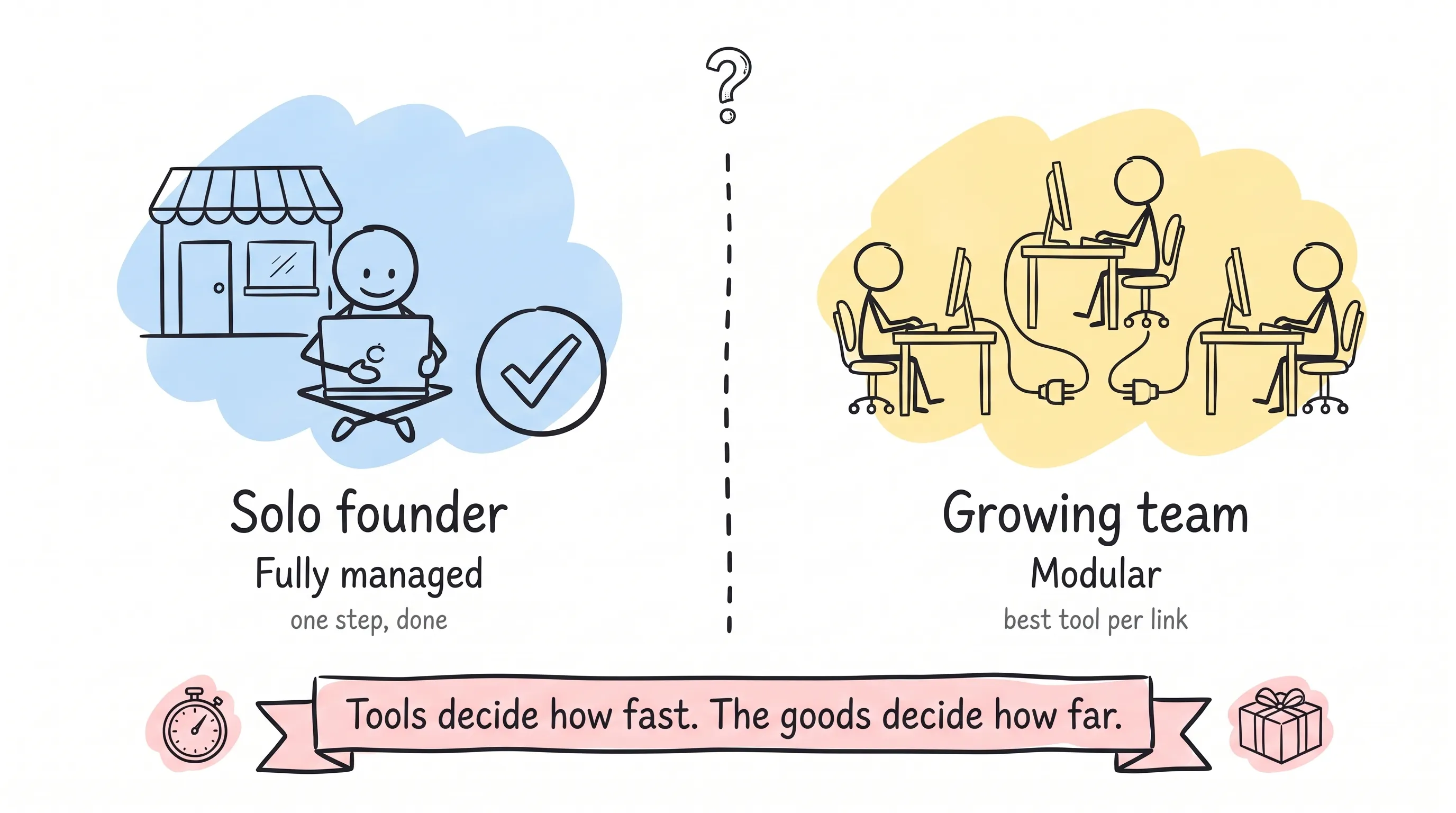
If you're a solo founder doing DTC, pick the "fully managed" kind — one step, done. Once your team grows and splits by region or brand, go modular instead: pick the strongest tool for each link and wire them together yourself.
AI does the grunt work for you. Payments flatten the borders for you. Platforms open the doors for you. But once the door is open, whether the goods are good, the price honest, and the service up to par — that's still on you.
Tools decide how fast you can run. The goods decide how far.
Back to my friend from the opening. Midway through dinner, he took out his phone, pulled up the page on Akeneo's AI, and stared at it for a long while. Then he said: "Looks like those two colleagues who fill in spreadsheets will need to switch roles."
I couldn't tell whether to congratulate him or break a sweat on behalf of those two colleagues.
But this is what's happening. The tools have rotated once; some people save their strength, and some have to find new places to spend it.
May you land on the side that saves it.
Continue reading
Related articles

Cross-Border Business: Time to Upgrade Your AI Toolbox
A learn article explaining how AI tools help cross-border e-commerce sellers clear five hurdles: language, regulation, logistics, payments, and fraud. It outlines a five-compartment toolbox, a five-step adoption path, and metrics such as conversion rate and CLV, while cautioning against over-reliance on AI.

AI Is Taking Over the Dirty Work of Social Media Marketing, One Task at a Time
This learn article outlines four social media marketing tasks AI can handle — audience analytics, content drafting and design, ad targeting and creative testing, and spam moderation — and cautions that taste, judgment, and data security remain human responsibilities.

AI Is Already This Good — Why Is Your Social Media Marketing Still Pure Manpower?
An overview of 18 AI tools for social media marketing, organized into six categories covering audience research, content creation, scheduling, comment and DM handling, ad management, and visual production, plus notes on personalization, prediction, and emerging trends.