
Give the Grunt Work to AI, Keep the Soul for Yourself
Based on an Airtable guide to AI content marketing, this learn article explains how AI handles repetitive work across topic selection, drafting, editing, distribution, and review, while people keep judgment and final checks. It also covers adoption steps, quality and data-ethics risks, and brand examples.
A while back, I had dinner with an old friend who works in content.
Halfway through the meal, he set down his chopsticks and asked me a question: AI can write now — are people like us about to run out of work?
I didn't answer right away. I asked him one back: on your team, who's the most exhausted?
He thought for a moment and said, the ones doing the grunt work. Writing a dozen headlines nobody clicks, grinding a two-hour interview recording down into minutes, turning one article into eight versions for different platforms.
I said, exactly.
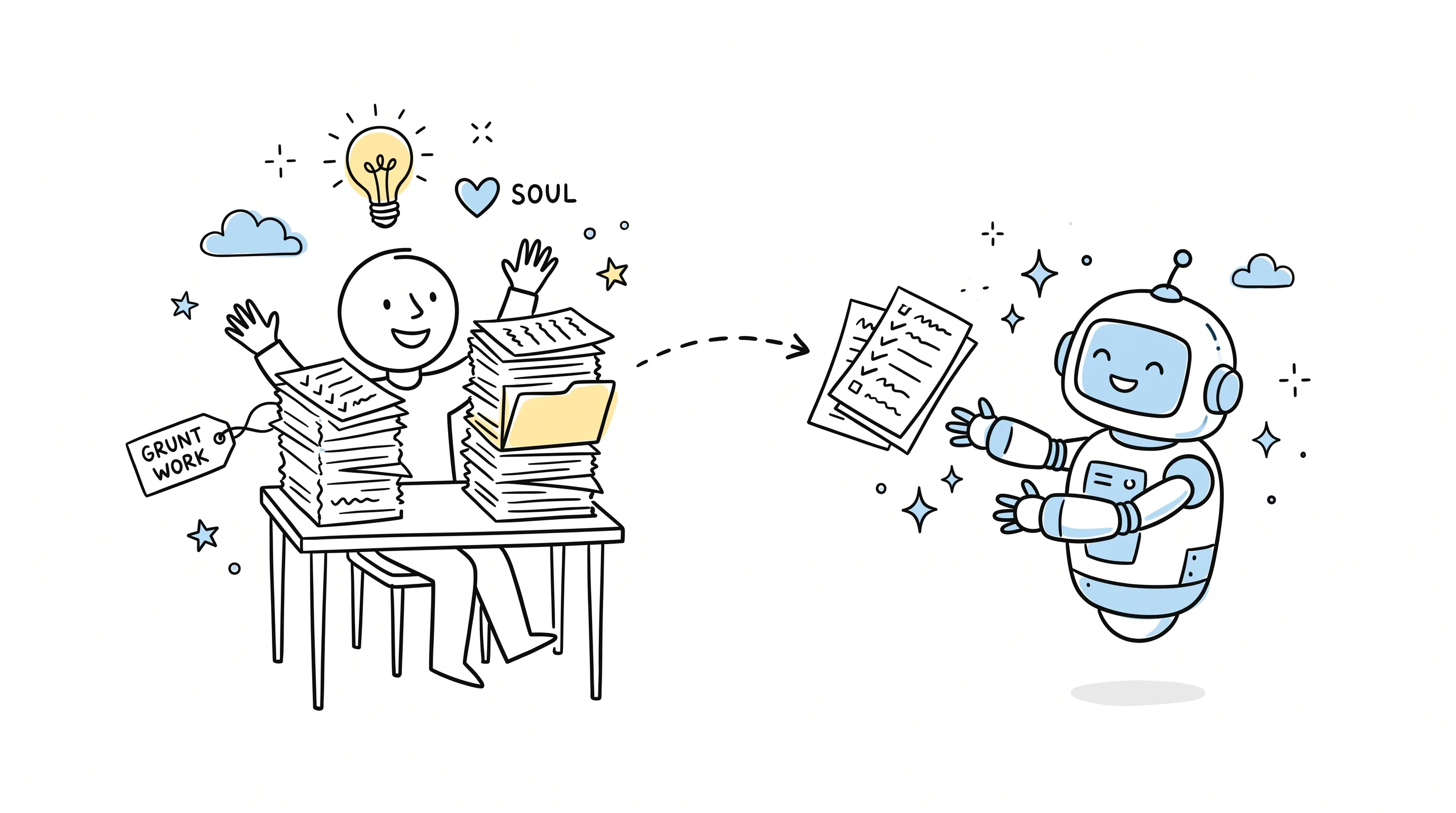
What AI takes away was never your livelihood. It's the grunt work.
A few days ago, I read a guide on AI content marketing that Airtable put out, and went through it inside and out. Today I'm going to break it apart piece by piece and walk you through it.
First, a Look at How Far Everyone Has Already Gotten
Start with a set of numbers, to feel how fast this is moving.
A 2024 Statista survey found that about 42% of marketers use AI several times a week to write copy and generate content, and another 40% use it for social media content.
SurveyMonkey's survey slices the numbers finer. Optimizing content, 51%. Creating content, 50%. Brainstorming topics, 45%. Automating repetitive busywork, 43%. Analyzing data, 41%.
Half of all content teams have already brought AI into the office.
When people in content hear numbers like these, their stomachs drop. After all, most of us got into this line of work because we genuinely love to write.
Not so fast. Look at it from another angle: AI can raise the overall floor, carry off the most soul-crushing drudgery, and push you to think about how to dig deeper into your craft and root your brand more firmly.
So what exactly can it do for you?
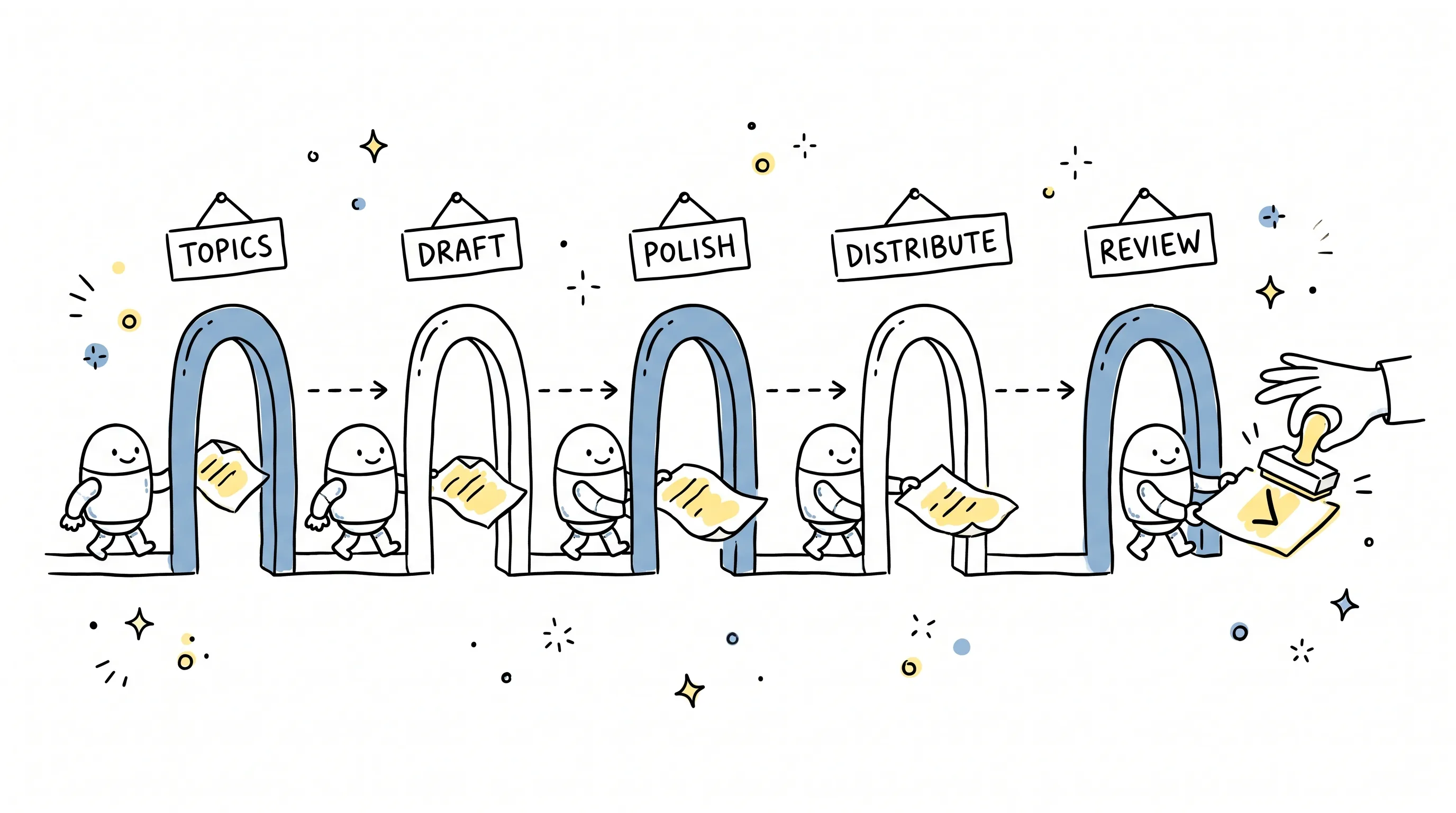
Five Gates in the Life of a Piece of Content — It Can Lend a Hand at Every One
Think about it: how many gates does a piece of content have to clear between the first idea and the final result?
Gate one: topic selection. AI watches trends, digs through competitors, reads customer complaints, and hands you a data-backed list of topics — then writes a dozen headlines for you to pick from while it's at it.
Gate two: the first draft. Blog posts, social copy, emails, podcast scripts — it can lay the foundation for all of them. Those drafts usually can't run as-is, but they pull you out of "staring at a blank screen."
Gate three: polishing. Optimization tools read as they go and flag the flaws: where it's clunky, where keywords are spread too thin, where it rambles and needs a cut, where it's thin and needs expanding.
Gate four: distribution. Post where, in what format, at what hour? It combs through your historical performance data and tells you who this piece is for, where to run it, and when to publish — and it keeps learning as it goes, getting sharper with every use.
Gate five: the review. Ordinary tools only tell you the view count. AI can trace conversions across complex user journeys, tell you exactly which paragraph, which sentence kept people reading, even predict how results will shift if you change one thing. It can also read the comments for you, sorting the comment section's vague moods into "genuinely loved it" and "just being polite."
From topic selection to review, it can handle the grunt work along the entire assembly line.
So What's In It for You? Three Ledgers
A ledger gets tallied one entry at a time.
The first entry: time. Writing briefs, building templates, laying out landing pages, drafting long reports — things that used to eat up days now take shape in hours. Even the requests every department stuffs into the content calendar can be triaged by AI first. Where does the saved time go? Toward thinking about what matters more.
The second entry: personalization. Want to write a custom version for ten thousand individual users? Used to be unthinkable — nowhere near enough hands. Now AI can read call records and user behavior, sort audiences into clusters automatically, and push content by cluster. Some systems even factor in whether it's early morning or the middle of the night, or what the user just clicked, adjusting in real time what they put in front of you. What only giant teams could once pull off, small teams can reach now.
The third entry: consistency. AI has studied your brand guidelines, and your breakout hits too. No matter who wrote the draft — or how rushed it was — it holds the tone in place and stands guard on quality before anything goes out.
But every coin has a flip side.
Three Pitfalls, Flagged for You in Advance
Pitfall one: people panic first.
Writers feel it most keenly: if machines can write, what am I for? Others simply can't see how to fit this thing into their existing workflow.
The fix? Put it all on the table: AI is here to upgrade your tools, not to take your seat. Bring the team in early, decide together which tasks get handed off, and back it up with hands-on training. Only when people have laid their own hands on it does the fear go away.
Pitfall two: quality goes off the rails.
AI writes fast, but it doesn't know your brand's temperament — and it will make things up with a perfectly straight face. Facts need checking, bias needs guarding against, tone needs to hold.
The fix? Keep a human in the loop. Every AI first draft gets a pass from an editor or a strategist. Don't begrudge that step its slowness — it has saved countless brands. And by the way: learning to train and edit AI is becoming a new craft for content people. Get good at it, and it's a lasting advantage.
Pitfall three: data and ethics.
When you feed customer data to AI, do your customers know? Is it compliant? No company gets to dodge this one.
The fix? When picking a platform, hold the line on three things: enterprise-grade security, data-use terms in black and white, and clearly drawn ethical boundaries. Especially when AI generates public-facing content, transparency is itself part of trust.
In one sentence: machines can do the work for you, but they can't take the responsibility for you.
Where to Start? Four Steps — Don't Go All In at Once
Step one: draw the map. Lay out the entire process — topic selection through distribution through review — and find the most time-consuming, most bottlenecked spots. Wherever it hurts most is where AI should land first. Pick the use cases with quick wins and low difficulty and run those first, so everyone gets a taste of the upside.
Step two: pick tools that fit your hand. Plenty of companies start with general-purpose tools like ChatGPT or Claude, but content teams have platforms built specifically for them — some of which plug straight into your own data and workflows. When choosing, don't reach for the biggest thing; solve the most painful point first, and ask one extra question: what does it do with my data? Can a human take over at any moment? For what it's worth, Airtable practices this itself: Airtable AI brings topic selection, production, distribution, and analysis under one roof, and even illustrations can be generated on the spot with OpenAI's image generation — so teams without design resources can get things out the door faster.
Step three: write the rules down. Which tasks AI does, which humans do, who reviews, how quality is controlled, where the red lines run. Don't lean on verbal understandings — get it on paper. This is usually a cross-department effort, and it needs training to go with it.
Step four: win one small battle first. Find a pilot project, set metrics tied to business goals, get it running, listen to the team's feedback, and iterate. Don't expect to nail it in one pass.
Three Stories
That's the methodology. Now let me tell you three stories, so you can feel how far this has already gone.
First, a tennis match across time. Nike ran a campaign called "Never done evolving," using AI to pit tennis legend Serena Williams across the net from her past self — and play out a match. Good heavens, the idea is that strong. Notice this: a human dreamed up the concept, but actually making "two Serenas play on the same court" happen — that took AI.
Second, letting users do the magic themselves. Coca-Cola ran an activation called "Create Real Magic," built a sandbox with ChatGPT and DALL-E inside, and invited users to take Coca-Cola's historical brand assets and create brand-new brand works of their own.
Third, giving reporters back to in-depth journalism. The Washington Post let AI write the short, fast breaking-news items — high school sports recaps, election results, finance digests — hundreds of pieces at a stretch, and after the news went out, had AI look after the comments underneath as well. So what did the reporters do? They went off to dig into the more complex, weightier investigative stories.
Plenty of other plays are just as clever. Netflix uses AI to tailor trailers and emails to every single user, even picking thumbnails to match your taste. The meditation app Calm will guess which sleep story you haven't heard yet and feel like hearing. Luxury e-commerce player Farfetch uses AI to test email subject lines and copy styles over and over, with open rates and click-through rates genuinely climbing. Creative agency Code and Theory is even more direct: AI lays out first drafts of event calendars, resource schedules, and channel assets all at once, handing the team a starting point they can build on.
Notice a pattern? In not one of these cases did "AI do all the work by itself."
The direction never changes: humans set the direction, machines pave the road.
Back to That Dinner
A few months later, I ran into that friend again.
He hadn't lost his job. His team now splits the work like this: AI turns out first drafts, runs the numbers, watches distribution; people handle judgment on topic selection, gatekeeping the facts, and that final mouthful of "the right flavor."
At the table, he said something I still think about today: I used to spend all my time writing; now I finally have room to think about what to write.
There's a number in SurveyMonkey's survey I've never forgotten: 69% of marketers are excited about the changes AI brings.
I understand that excitement completely. Honestly, this article itself carries traces of AI, from research to first draft. But which words to say and which judgments hold up — that's on me. However good AI's output is, in the end it comes down to what the person feeding it put in.
If you haven't started yet, stop waiting. The best way to catch up is to start trying now, and learn from the results.
Give the grunt work to AI. Keep the soul for yourself.
And may you be one of the first to roll up your sleeves and try.
Continue reading
Related articles

Cross-Border Business: Time to Upgrade Your AI Toolbox
A learn article explaining how AI tools help cross-border e-commerce sellers clear five hurdles: language, regulation, logistics, payments, and fraud. It outlines a five-compartment toolbox, a five-step adoption path, and metrics such as conversion rate and CLV, while cautioning against over-reliance on AI.

AI Is Taking Over the Dirty Work of Social Media Marketing, One Task at a Time
This learn article outlines four social media marketing tasks AI can handle — audience analytics, content drafting and design, ad targeting and creative testing, and spam moderation — and cautions that taste, judgment, and data security remain human responsibilities.

AI Is Already This Good — Why Is Your Social Media Marketing Still Pure Manpower?
An overview of 18 AI tools for social media marketing, organized into six categories covering audience research, content creation, scheduling, comment and DM handling, ad management, and visual production, plus notes on personalization, prediction, and emerging trends.