
GEO: The New SEO for the AI Era — Is Your Content Still Working for Search Engines for Free?
A learn article introducing GEO (Generative Engine Optimization), explaining zero-click search, AI citations, and five practices for getting content cited in AI-generated answers.
A while back, an old friend of mine who runs a B2B business invited me to dinner. Halfway through the meal, he suddenly pushed his phone across the table, looking utterly deflated.
"Look," he said. "I searched the most important keyword in our industry, and the AI had already written the whole answer. Three sources, cited clear as day. Are we in there? No."
He'd been doing content for five years, kept a team of seven or eight, and ranked top three for his keywords year-round.
I asked him one question: after users see that AI answer, do they still click through to your website?
He froze.
They don't. The answer is so complete that users read it and leave without clicking a single link.
That's the real state of search today. Google's AI Overviews and Bing's AI-enhanced results are turning "search" into "Q&A." The user asks one sentence, the AI answers with a paragraph, and the errand is done.
Search engines keep getting smarter. Your SEO strategy needs to get smarter with them.
That new thing has a name: GEO.
What Exactly Is GEO?
GEO stands for Generative Engine Optimization.
Simply put: it's about getting your content into AI-generated answers.
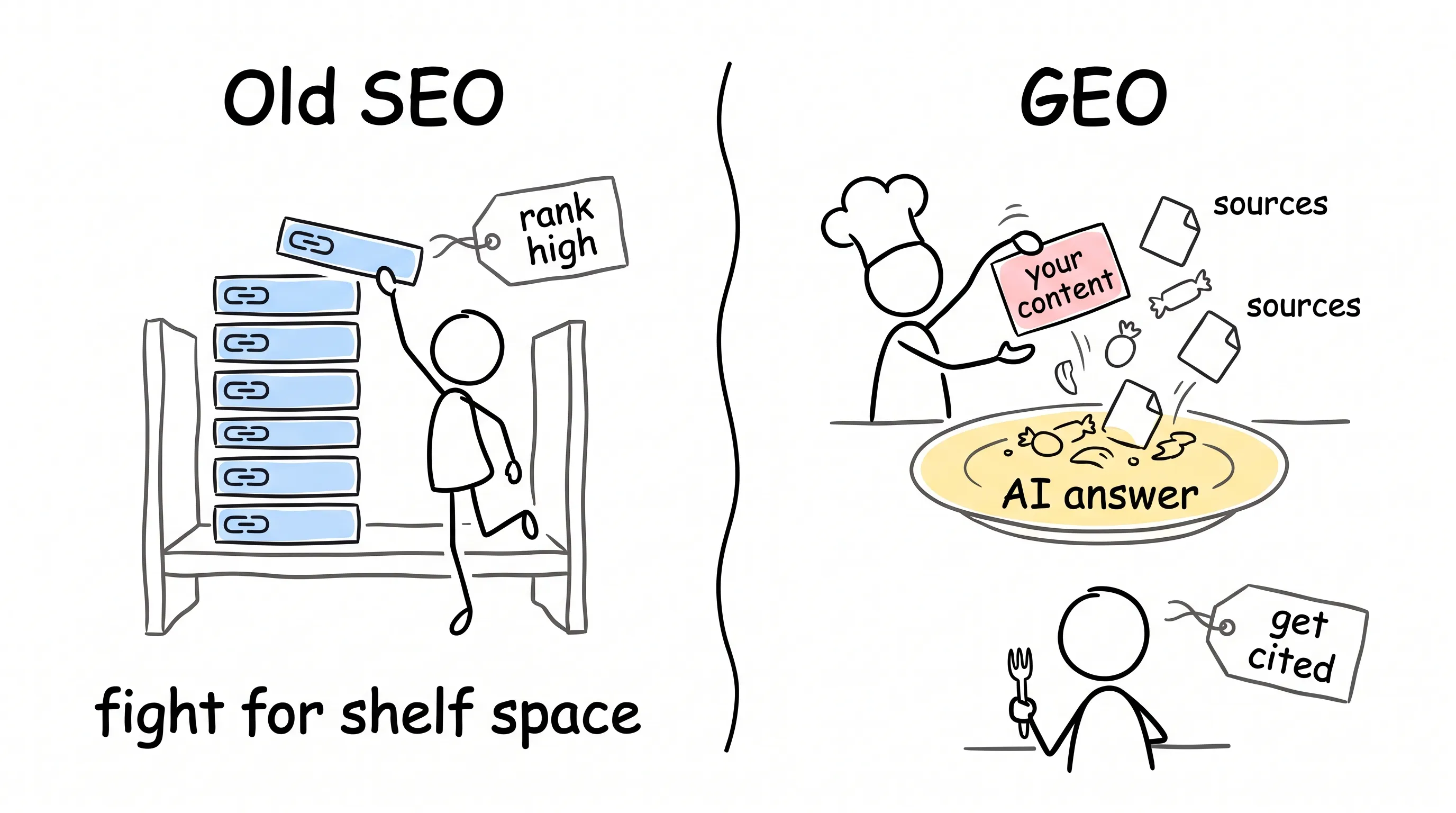
Think about it. The old results page was a list of links, like a store shelf. Your goal was the most eye-catching spot on that shelf, so users would reach out and grab you.
Not anymore. Now the AI pulls information from a pile of sources, assembles it into a complete answer, and serves it up to the user like a plated dish. The shelf is gone — it has become a dish.
So what must your content do? Three things:
First, be discoverable by AI crawlers.
Second, be worth citing in the answer.
Third, be structured clearly enough that the AI trusts you and treats you as a reliable source.
The old goal was ranking high. The new goal is getting cited.
From fighting for shelf space to earning a place in the recipe. That's GEO.
Why the Urgency? Three Shifts
Shift 1: Zero-Click Is the New Normal
Remember ZMOT, the "Zero Moment of Truth" Google introduced back in 2011? The idea: consumers do their research — and make their decision — online before they ever set foot in a store.
That was scary enough back then.
Zero-click search has now pushed it a step further. Users get the key information right on the results page and decide on the spot — without so much as knocking on your website's door.
Your content may well be the raw material of that answer. But there are no visits, no conversions — and quite possibly not even credit as the source.
In these scenarios especially, you come away with nothing at all:
You didn't squeeze into the three to five sources the AI cites; the answer has already fed users everything they need, leaving no reason to click through; or your lane is brutally crowded, with dozens of sites writing nearly identical keyword content.
What do users want? Speed and convenience — ask once on the phone or through voice search, get the answer.
Let's run the numbers. Say you get 100,000 search impressions a month at a historical click-through rate of 3% — that's 3,000 visitors. Now AI summaries cover 60% of those queries; users read the answer and go, clicks slide to 1.2%, and you're left with 1,200 visitors.
1,800 visitors, gone. And you don't even know where they went.
And that's just the traffic. The harsher part: for those read-and-leave users, the decision is actually being made inside the AI's answer. Whoever gets cited is part of the decision. Whoever doesn't is out of the game — without ever getting an elimination notice.
That's the reality. Complaining about it won't help.
Shift 2: Authority and Topical Depth Are the New Hard Currency
What do generative engines favor? Trustworthy sources with genuine depth on a topic.
Skim-the-surface content — a superficial pass with keywords piled on top — is a road that no longer leads anywhere.
Think about how an AI picks whom to cite: it behaves like a rigorous academic choosing references. Who makes the cut? The person who has written the most on the topic, dug the deepest, and gets cited by others all the time.
Publish high-quality content on a topic consistently, and as more people cite you, search engines and AI models take you more and more seriously — and grow more willing to write you into their answers.
Here's an analogy.
A single shallow post is like scattering a hundred flyers over the same topic: one gust of wind and they're gone. Building a content library around a topic is like sinking a well on that spot. The deeper you dig, the more water comes up — and when others drill their own wells, they take their bearings from where your "old well" stands.
So swap the "one viral post" mindset for the "whole library" mindset.
Shift 3: It's Time to Redo the KPI Math
Should you still watch click-through rate and rankings? Yes. But if those two are all you watch, the numbers will fool you.
The GEO-era ledger looks roughly like this:
How many times your brand appears in AI citations; how often it's mentioned in zero-click scenarios; how it's doing for exposure across the various generative tools; and whether AI is flagging your content as a source.
Here's an example. Suppose AI summaries cut your clicks by 20% — do you panic? Hold that thought. If impressions are climbing at the same time, your content is still being shown at scale; it has simply moved from "being clicked" to "being cited."
It's still your work — just done a different way now. And that's how the books need to be kept.
What Now? Five Actionable Plays
1. Feed the Bots: E-E-A-T Isn't an Elective
Google's E-E-A-T: Experience, Expertise, Authoritativeness, Trust.
Plenty of teams treat it as a nice-to-have. Wrong. In the GEO era, it's the price of admission.
Want to show up in answers from AI Overviews, Gemini, or ChatGPT? Then you need earned authority, not self-declared authority.
What does "earned" mean? Saying "we're experts" yourself does nothing. It takes authors who have genuinely worked in this industry. It takes people willing to cite you. It takes sources that can be checked and credentials that can be verified. When an AI picks its sources, it's picking third-party endorsements.
How do you earn it? Real experts behind the content. Author bios and credentials out in the open. Citations to reputable sources.
And here's a hands-on tactic: use structured data — schema markup — to spell out your authority for machines in plain view. On a WordPress site, Yoast SEO or Rank Math will add it automatically; anywhere else, you can use Google's Structured Data Markup Helper.
2. Write for Intent, Stop Obsessing Over Keywords
Generative engines understand natural language. They understand intent.
So stop asking, "Is the keyword density high enough?" Start asking, "What problem is the user actually trying to solve?"
Answer the questions users genuinely ask; write in clear, plain human language; supply plenty of context — and no keyword stuffing.
Here's an example. Take "WeCom CRM" (WeCom is Tencent's enterprise messaging app). Ten years ago you'd cram those keywords into the title, the opening paragraph, and the close — the denser the better. Today you'd put the sentence users actually ask into the title — "How do I automatically sync customer data from WeCom into my CRM?" — and then answer that question thoroughly and clearly.
Which one gets cited by the AI? The latter, no question. When the AI assembles an answer, it goes looking for the passage that directly answers a real question.
On the tooling side, try Frase.io. It uses AI and natural language processing to analyze search intent and generate question-based headlines, aligning your content with the way users and AI actually ask.
3. Earn High-Quality "Votes of Confidence"
AI trusts what everyone else already trusts.
High-quality backlinks are votes of confidence presented to search engines and AI systems. The more votes you hold, and the weightier they are, the more credible you look.
But remember one thing: backlinks are fundamentally about relationships, not volume.
One citation from an authoritative source beats a hundred spam links. And the flip side: a pile of sketchy spam backlinks will only drag your credibility down.
So how do you make people want to cite you? Build the things they can't help citing: original research reports, case studies, proprietary data, one-of-a-kind insights. That kind of content is a link magnet — the citations come on their own.
4. Structure Your Content So Humans and Machines "Get It at a Glance"
AI engines and human readers, it turns out, share the same taste: they both love clean structure you can scan in one pass.
Use bullet lists and tables wherever they fit; organize your H1, H2, H3 heading hierarchy around common questions and subtopics; add schema markup.
Looking for a shortcut? SurferSEO studies top-performing pages and helps you plan headings, questions, and layout, so your content looks just like the AI-friendly pages that are already ranking.
5. Track "Mentions," Not Just Clicks
Clicks from AI answers very often can't be tracked. So what do you do?
Use tools like Google Alerts and Semrush to monitor when your content gets cited, by whom, and in which AI summaries.
Here's the concrete playbook:
Set up Google Alerts for your brand terms; log "AI attribution," "post-zero-click engagement," and "brand share of voice" as formal KPIs in your reports; and watch how brand awareness shifts over the long run.
To be fair, "brand visibility" is a metric worth recording even when it isn't bringing traffic yet — because repeated mentions inside AI answers are compound interest in their own right.
Think about it: a user sees you once in an AI answer today and barely registers it. Again next week, again next month. When they're finally ready to buy, whose name shows up in the vendor shortlist and the comparison docs? More likely than not, it's the name that "kept showing up in the answers."
Traditional advertising calls this mind share. In the GEO era, the gateway to mind share has moved out of elevator ads and TV screens and into AI answers.
Both Semrush and Brand24 can help you keep tabs on your content's reach in generative search.
A Few Parting Words
GEO isn't here to overthrow SEO.
It's the next layer of SEO.
Search left the "stuff keywords, grab rankings" stage long ago. What's the contest now? Relevance, trust — and, when the AI sits down to write its answer, whether it believes you.
That friend from dinner? He went back and did three things: added author credentials to every article his team had published, restructured the hierarchy of his content library, and started logging weekly how often his brand appears in AI answers.
Last month he messaged me: "An AI tool just listed us as a source."
You see — the deflated guy from the dinner table already has the ledger tipping back his way.
Three lines to close. Just follow them:
Think like a search engine.
Write like a human.
Structure like a machine.
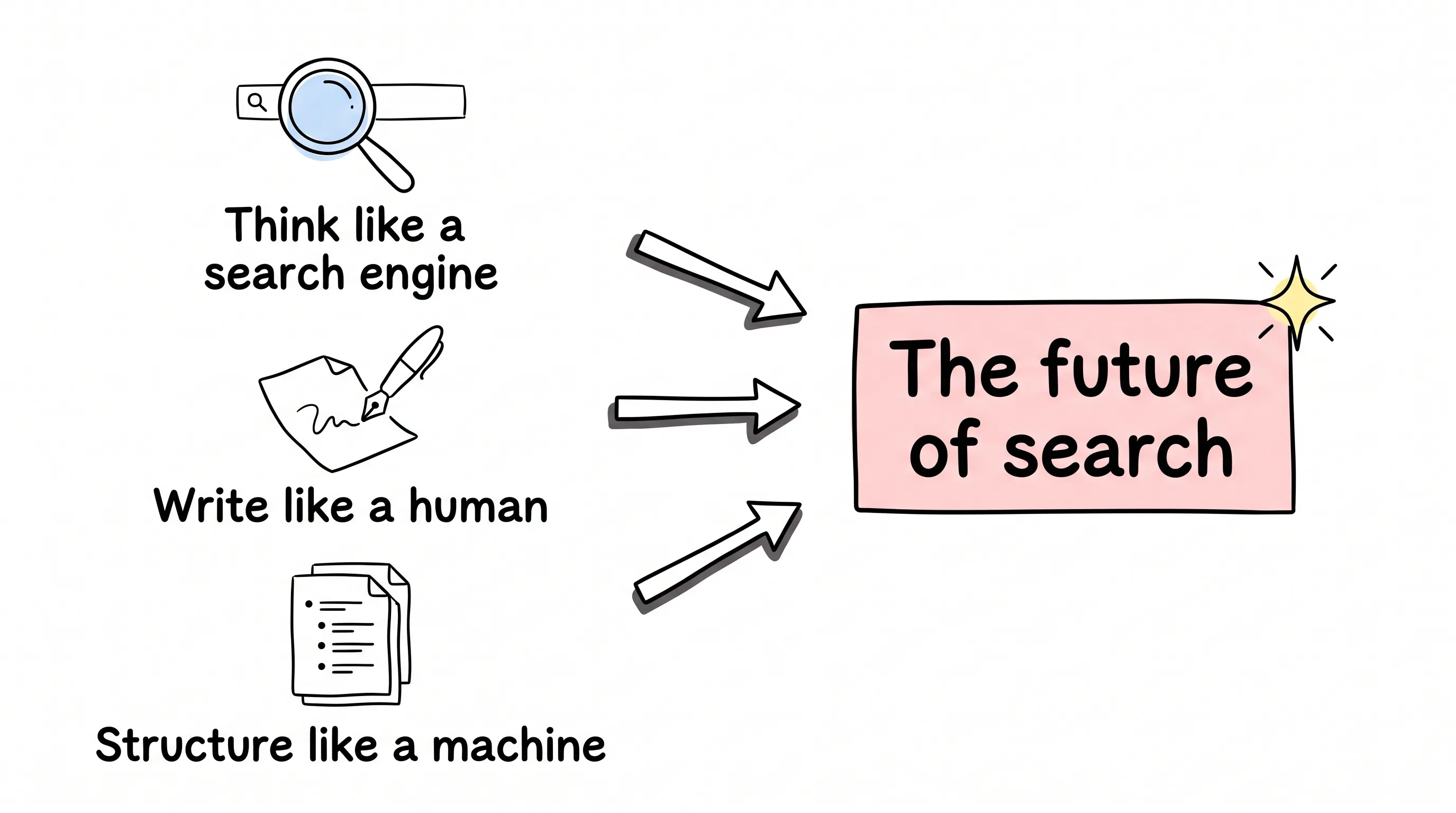
The future of search — and your visibility — is hiding inside those three lines. Start now, and you're still in time.
Continue reading
Related articles

Cross-Border Business: Time to Upgrade Your AI Toolbox
A learn article explaining how AI tools help cross-border e-commerce sellers clear five hurdles: language, regulation, logistics, payments, and fraud. It outlines a five-compartment toolbox, a five-step adoption path, and metrics such as conversion rate and CLV, while cautioning against over-reliance on AI.

AI Is Taking Over the Dirty Work of Social Media Marketing, One Task at a Time
This learn article outlines four social media marketing tasks AI can handle — audience analytics, content drafting and design, ad targeting and creative testing, and spam moderation — and cautions that taste, judgment, and data security remain human responsibilities.

AI Is Already This Good — Why Is Your Social Media Marketing Still Pure Manpower?
An overview of 18 AI tools for social media marketing, organized into six categories covering audience research, content creation, scheduling, comment and DM handling, ad management, and visual production, plus notes on personalization, prediction, and emerging trends.