
Generative AI Meets Marketing: 7 Million Bottles, No Two Alike
A learn article introducing generative AI for marketing, covering how it differs from traditional AI, brand campaign examples, common tool categories, and risks like hallucination and data privacy.
A while back, I met an old friend who works in marketing for tea. He sat down looking exhausted, and the first thing out of his mouth was — "I can't keep up. The work never stops."
I asked, what's going on?
He said, you have no idea — the content demands just keep piling up. Our WeChat official account needs to post daily, our WeChat Channels videos weekly, our community groups need a daily presence, and every single email has to be personalized one by one. Same team, three times the workload.
I laughed when I heard this. I told him, your predicament is playing out in marketing teams all over the world. Several surveys I've read point to the same thing: 60% of marketers admit that simply producing content consistently is a struggle in itself. And at 94% of companies, employees spend their days on repetitive, time-consuming busywork.
What's the traditional fix? Hire more people, or roll out a project management system.
Hiring is expensive. Systems manage process, not creativity.
So is there a third path?
There is. Over the past couple of years, it's gotten a name: generative AI.
What Exactly Is Generative AI?
First, let's be clear — this is not the same thing as traditional AI.
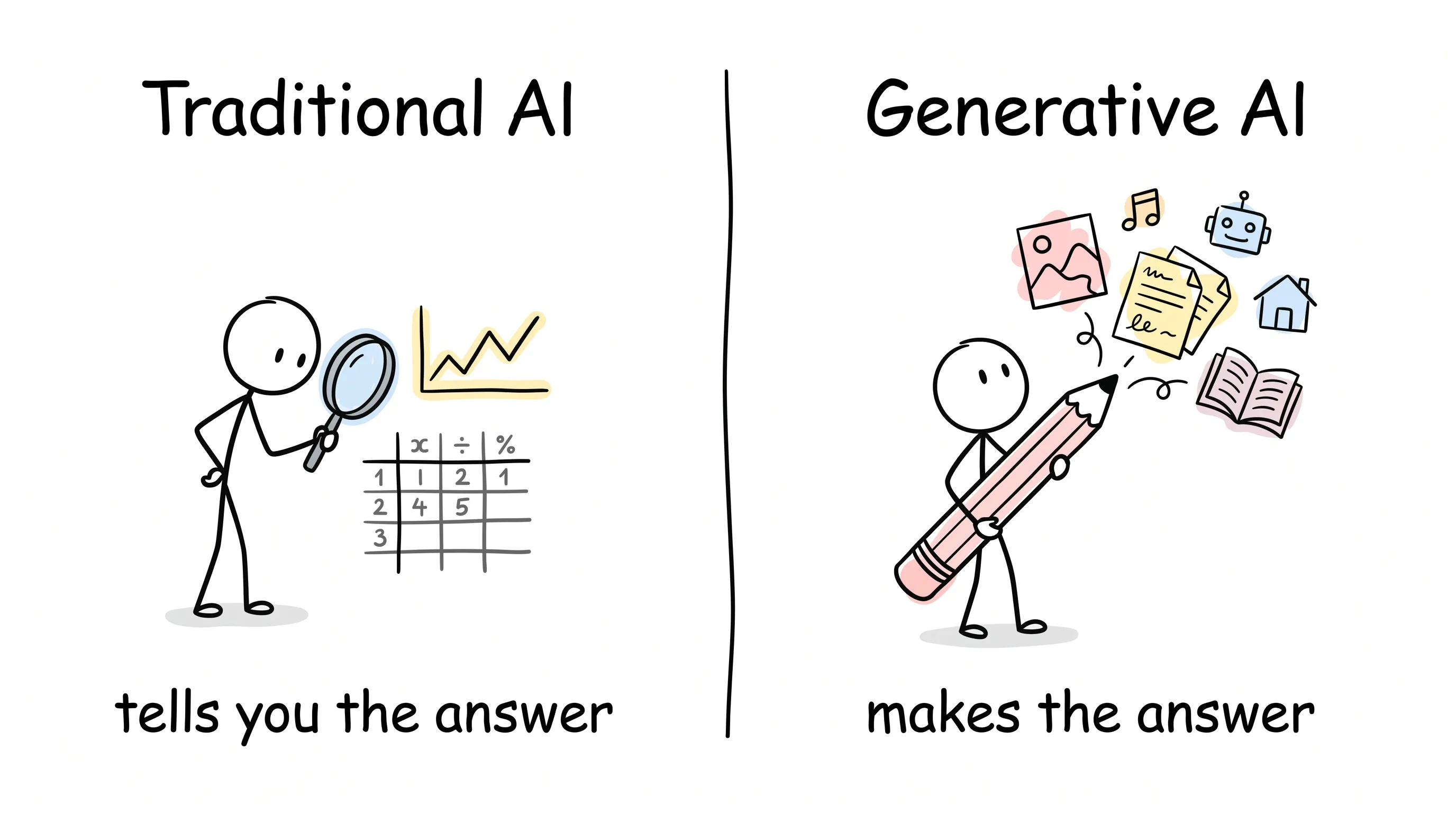
Traditional AI is like an analyst. You hand it data, and it helps you understand it, find patterns, make predictions. Like forecasting which channel's conversion rate will drop next quarter.
Generative AI is different. It's like an apprentice that has read through centuries of human text, images, and video — and then started writing, drawing, and editing on its own.
Traditional AI tells you what the answer is. Generative AI goes ahead and makes the answer.
You may have heard the word prompt. Sounds mystical. Really, it just comes down to this: are you good at delegating work to an assistant?
Give the same assistant "write an article," and you get one thing. Brief it properly — background, audience, tone, key points — and you get something else entirely.
So in the AI era, a new skill has emerged: delegating work. This skill has a name, prompt engineering. Don't be intimidated by the word "engineering" — at its core, it's simply the ability to communicate clearly.
Let Me Tell You 3 Stories
What can this stuff actually do? Talk is cheap — here are 3 stories.
First, Coca-Cola.
They built a platform called Create Real Magic, plugged in GPT-4 and DALL-E, then opened up their own brand assets — bottle designs, logo, use them however you like — inviting users worldwide to generate their own artwork.
This move was sheer genius. Brand content was no longer produced exclusively by the marketing department; thousands of consumers were creating it alongside them. The best pieces went straight onto billboards in New York and London.
Second, Nutella.
This one is even bolder. In a campaign called Unica, they used generative AI to create a one-of-a-kind package design for every single jar. Not a hundred. Not ten thousand. Seven million jars, no two alike.
The result? Consumers rushed to buy, then proudly posted photos — and it spread across social media on its own.
Think about it: in the age of handcraft, writing a personalized note for each of 7 million customers would have been impossible — let alone a unique package for each one. Personalization used to be a luxury. Now it's a commodity.
Third, Michaels.
An American arts-and-crafts retail chain. No earth-shattering technology here — just the steady, unglamorous work of applying AI to the most everyday touchpoints: 95% of their email marketing is now personalized, and SMS click-through rates rose 41%.
Forty-one percent isn't huge. But for a mature brand, that's growth you essentially get for free.
Three stories told. Notice that not one of them is merely "use AI to write an article." Each did one thing: open up brand assets, amplify personalization, or optimize everyday touchpoints.
Running the Numbers
Stories are emotional; numbers are cold. Let's do the math.
Data from Master of Code Global: by 2030, the global generative AI market is projected to reach $350 billion, growing 46.47% annually; 92% of Fortune 500 companies are already using it. Meanwhile, 71% of experts expect to save 5 hours a week, and 51% are already using it or experimenting with it.
On the marketing side, IDC estimates that by 2029, generative AI could lift marketing productivity by more than 40%. McKinsey goes further: it calculated that the value created here is equivalent to 5% to 15% of total marketing spend — roughly $460 billion a year.
$350 billion. $460 billion. Sounds far away. So which number actually lands on you?
11.4 hours. That's how much time many marketing teams, on average, save per week after adopting generative AI.
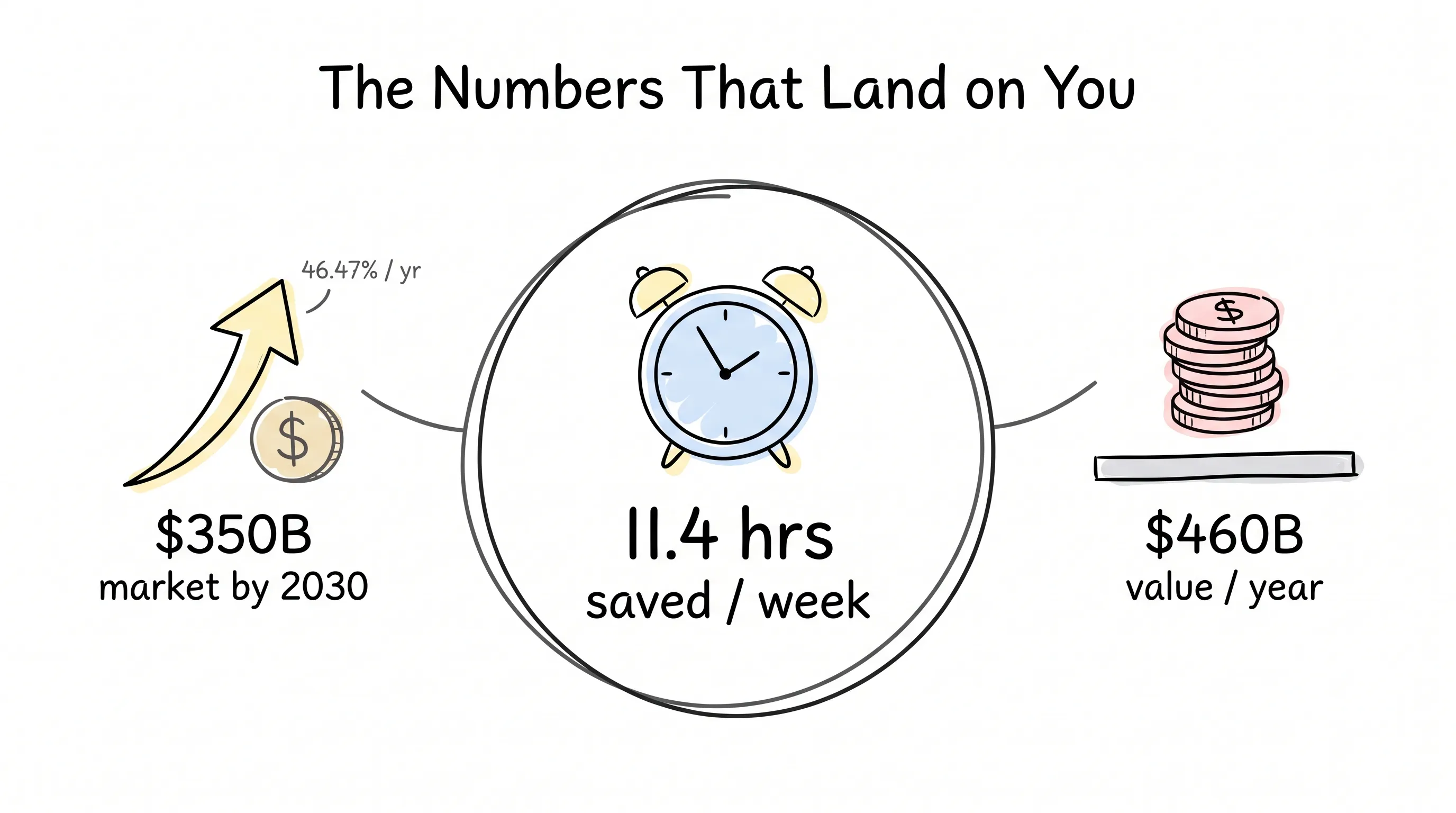
That's about an hour and a half a day. Enough for a few extra client calls, a proper review of your latest campaign — or simply getting home for dinner earlier.
That's leverage. Leverage isn't glamorous. But it's real.
What's in the Toolbox
The market is full of tools. Don't panic — there are really just four categories.
For writing: ChatGPT, Claude, Jasper — article drafts, ad copy, social media captions, they handle it all. For images: DALL-E, Midjourney, Adobe Firefly — one sentence, one image. For video: Synthesia, Runway, Pictory — from AI-generated avatars to automated editing. For polishing: tools like Grammarly, checking grammar and smoothing tone.
My advice: don't try to do everything at once. Pick one tool, get your most painful workflow running smoothly, then expand.
But There's Always Another Side
After all that praise, it's time to pour some cold water.
First, it makes things up with a completely straight face.
The technical term is hallucination (AI confidently generating false information). It invents numbers, quotes, and facts — and it delivers them with total confidence. So a human must review everything before it ships. That's the bottom line, not an option. AI handles speed; humans handle truth.
Second, brand voice drifts.
More tools, more channels, and your tone starts to fray — yesterday's WeChat official account post sounded like an expert, today's Weibo post sounds like customer service. The fix is equally plain: write a brand voice guide for your AI, pair it with fixed prompt templates, and spot-check its homework regularly.
Third, data privacy.
Once you feed customer data to an AI, it's out the door. Regulations like GDPR (Europe's strict data-privacy law) keep tightening, and these models come with a nasty quirk: you can't make a model precisely "forget" one particular piece of data it was fed. So anonymize first, then feed. Don't rush.
Fourth, money.
Subscription tools cost a modest monthly fee — cheap enough to ignore. But if you build your own, a basic marketing application starts at $20,000 to $50,000; deep customization can run $100,000, even into the millions.
So start small, get the ROI clear, then double down. Don't reinvent the wheel on day one.
Back to My Friend
I saw him again recently and asked whether he'd tried it.
He had. Weekly report drafts, social media captions — AI takes the first pass, he does the final gatekeeping. He said the time he saved finally gave him room to think about strategy — about which market to push for over the next three months.
See, this is the dividing line.
AI takes over the repetition. What's left for humans is judgment.
Machines scale output. They can't carry judgment. Judgment is — and always will be — a human job.
Here's to you: may your saved 11.4 hours go to the things machines can't do.
Continue reading
Related articles

Cross-Border Business: Time to Upgrade Your AI Toolbox
A learn article explaining how AI tools help cross-border e-commerce sellers clear five hurdles: language, regulation, logistics, payments, and fraud. It outlines a five-compartment toolbox, a five-step adoption path, and metrics such as conversion rate and CLV, while cautioning against over-reliance on AI.

AI Is Taking Over the Dirty Work of Social Media Marketing, One Task at a Time
This learn article outlines four social media marketing tasks AI can handle — audience analytics, content drafting and design, ad targeting and creative testing, and spam moderation — and cautions that taste, judgment, and data security remain human responsibilities.

AI Is Already This Good — Why Is Your Social Media Marketing Still Pure Manpower?
An overview of 18 AI tools for social media marketing, organized into six categories covering audience research, content creation, scheduling, comment and DM handling, ad management, and visual production, plus notes on personalization, prediction, and emerging trends.