
Generative AI Marketing Might Be the Most Expensive Way to Save Money
A learn article examines the risks of generative AI marketing, including homogenized content, Google's scaled content abuse policies, and unverified AI claims, arguing that human experience and original stories remain the durable advantage.
A few days ago, a friend of mine who runs a business showed me his backend dashboard.
He said: I can now publish 8 articles a day, all written by AI. The cost is almost zero.
I asked: so over these three months, how many more inquiries did you get?
He froze.
Traffic hadn't really moved. No new customers. Worse: a long-time client told him, "The articles on your website read exactly like everyone else's."
Oh my. That one sentence cuts deeper than any drop in traffic.
My friend's story isn't an outlier. Today I want to walk you through one thing, thoroughly: generative AI marketing — is it a shortcut, or a trap?
First, the conclusion: fast — that part is real. Losing money — that may be real too.
What is generative AI marketing?
You write a prompt, an article comes out, you fit a headline, click publish. The whole pipeline, done in a few minutes.
Sounds great, doesn't it?
But think about it: what is marketing actually for?
Is it "publishing more content"?
No. It's being remembered.
Trap one: every company starts wearing the same AI face
Ask AI to write an article on an industry topic, and the opening, the list, the recommendations it gives you are nearly identical to those on hundreds of other websites.
Because AI learned from the entire web. When the whole web looks like this, that's all it can look like.
So what is AI-written content missing?
It's missing the real case from your workshop floor. The pitfalls you stumbled into yourself. The edge in your point of view that dares to be different from everyone else's. The kind of story that makes clients nod when they hear it.
It looks polished. Ten seconds after reading it, you can't recall a single word.
When everyone can generate the same article in 10 seconds, that article is worth nothing.
Trap two: Google hasn't banned AI — it bans "no value"
People keep coming to ask me: if I use AI to write content, will Google penalize me?
Good question. The answer is more interesting than you'd think.
Google has said it plainly, long ago: content won't be judged as spam just because AI generated it. What it looks at is something else: is this content useful to readers?
The real red line is called "scaled content abuse." When Google updated its spam policies in 2024, it called this behavior out by name: using automation to mass-generate pages without delivering any real value to users.
What counts as no value?
Hundreds of pages, all saying the same thing. Restating, over and over, information that's already everywhere online. Tossing in a few claims with no basis.
The end result: the site loses its originality, and the team has to turn around and spend huge amounts of time cleaning up the low-quality content.
The time you saved comes back — with interest.
You can't win by out-publishing. You win by being more useful.
Trap three: AI states nonsense with total confidence
AI has a quirk: when its information is incomplete, it still speaks with absolute certainty.
In casual chat, no harm done.
Marketing is different. Marketing is full of statements you can't take back once they're out: product specs, customer results, statistics, prices, industry research, your company's capabilities.
Getting these wrong isn't embarrassing. It's an incident.
Regulators have already stepped in. The U.S. Federal Trade Commission (FTC) has penalized a batch of companies in recent years over AI claims they couldn't back up. That 2024 enforcement sweep targeted exactly the marketing talk that "inflates AI to the skies."
So my advice is one sentence, and a plain one:
AI can help you write content. But it can never serve as the final fact-checker.
Every marketing claim passes through a human before it goes out the door.
The root problem: AI can generate content, but it can't replace your experience
By now you can see that the three traps are actually one trap.
AI doesn't have your experience.
And what readers want from you is precisely that: experience.
What do clients ask you most often? What mistakes do they keep making? After all these years in this industry, what have you seen clearly that others haven't? What's special about how you do things? What real results can you show?
AI can't give these answers. Because these questions only exist between you and your clients.
Let me run the numbers for you.
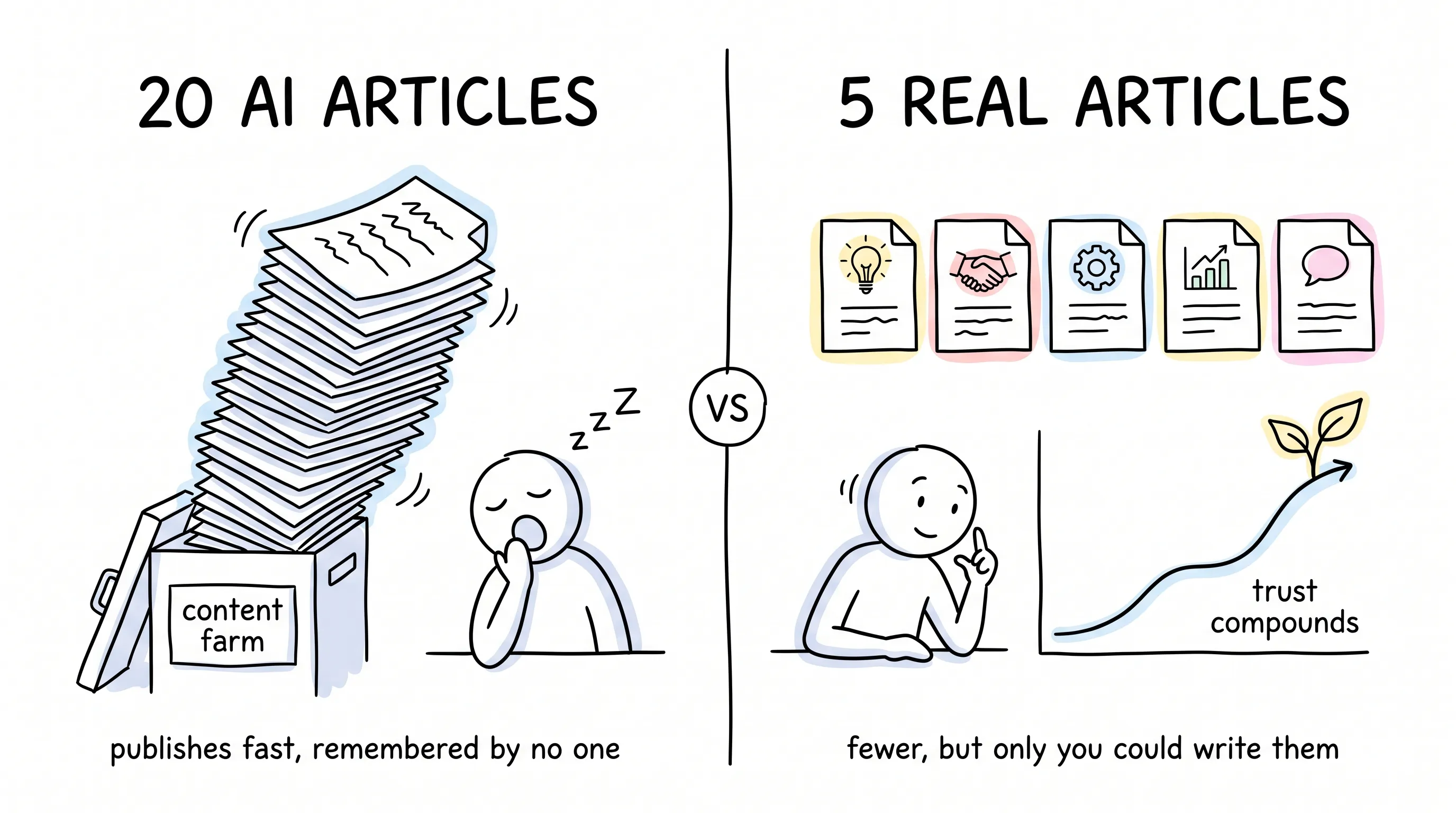
Publishing 20 mediocre AI articles, or publishing 5 articles with real substance — which is worth it?
The former: slowly, Google and readers both file you under "content farm." The latter: every single article is quietly building your trust, your rankings, your reputation as "someone who knows the trade."
The effort behind the 20 articles went out and deposited nothing. The effort behind the 5 — every article compounds.
That math isn't hard.
The tool isn't wrong. Wrong is handing over the steering wheel too
So can you still use AI?
Yes. For ideas, research, first drafts — it's excellent.
But somewhere along the way, many people hand over the steering wheel along with it.
Those who only let AI grind out content get mediocre scale. Those who make AI the assistant while humans set the direction get efficient scale.
The former amplifies mediocrity. The latter amplifies you.
Search itself is changing too — AI search, all kinds of new entry points, the playbook keeps shifting. But no matter how the entrance changes, one phrase never changes: "content that's useful to people."
Your story is the one thing AI can't steal
Writing this, I look back at my friend again.
My advice to him was simple: demote AI from "author" to "intern." Making outlines, organizing materials — hand all those chores over. But the most valuable part of every article must be your own: the client's real problem, your unique judgment, the case you closed with your own hands.
When we met again three months later, he said something that stayed with me: fewer articles go out now, but finally a client said, one look and you know it's us.
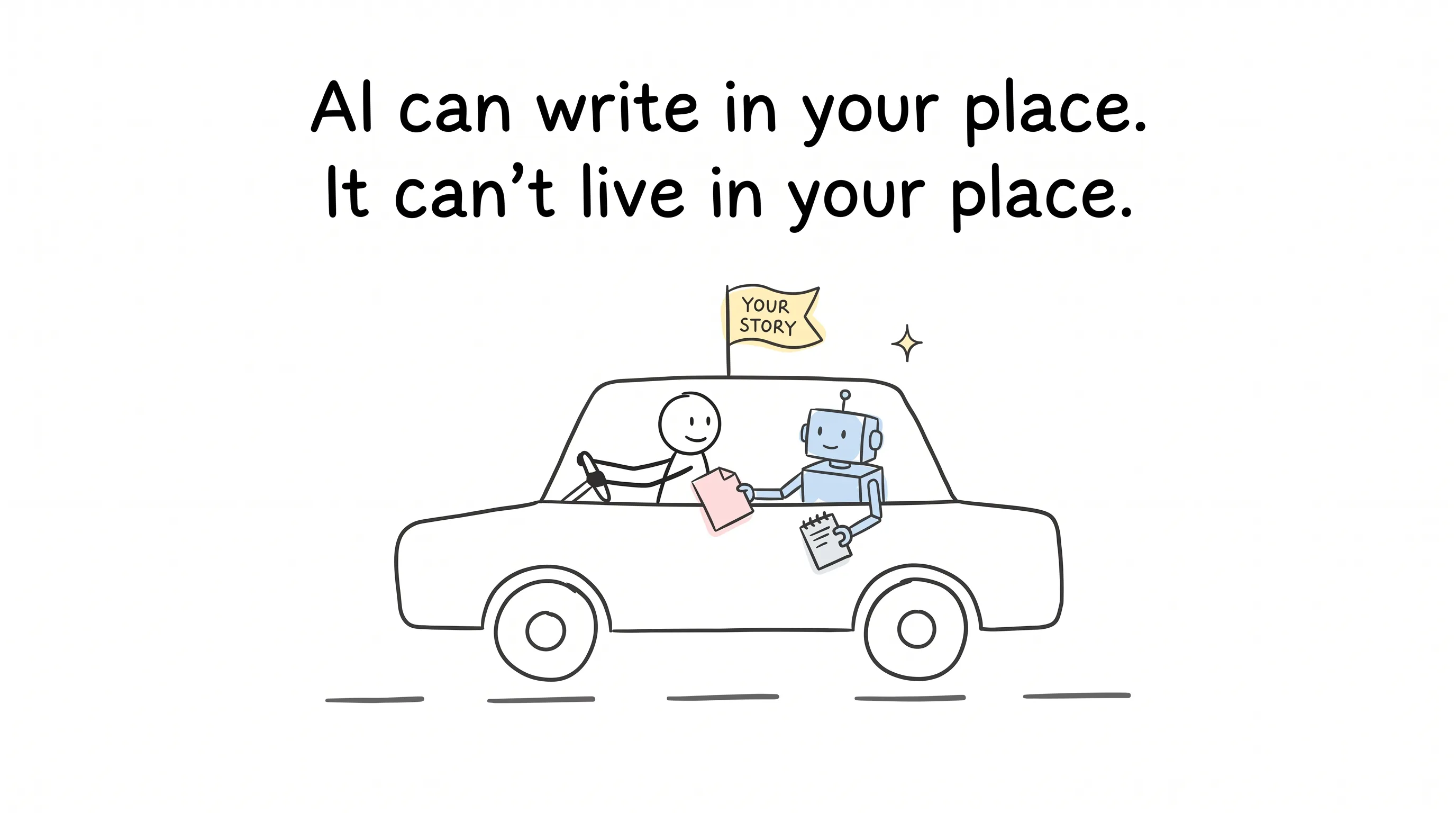
AI can write in your place. But it can't live in your place.
The temptation of generative AI marketing lies in the speed it promises.
But speed can't buy strategy. If every one of your competitors can generate the same article, the same post, within seconds, none of it forms a moat.
The real moat is what AI cannot take away.
Your story.
Put it dead center in your marketing.
And my wish for you: may every word you publish be one only you could have written.
Continue reading
Related articles

Cross-Border Business: Time to Upgrade Your AI Toolbox
A learn article explaining how AI tools help cross-border e-commerce sellers clear five hurdles: language, regulation, logistics, payments, and fraud. It outlines a five-compartment toolbox, a five-step adoption path, and metrics such as conversion rate and CLV, while cautioning against over-reliance on AI.

AI Is Taking Over the Dirty Work of Social Media Marketing, One Task at a Time
This learn article outlines four social media marketing tasks AI can handle — audience analytics, content drafting and design, ad targeting and creative testing, and spam moderation — and cautions that taste, judgment, and data security remain human responsibilities.

AI Is Already This Good — Why Is Your Social Media Marketing Still Pure Manpower?
An overview of 18 AI tools for social media marketing, organized into six categories covering audience research, content creation, scheduling, comment and DM handling, ad management, and visual production, plus notes on personalization, prediction, and emerging trends.