
Generative AI Just Joined the Marketing Department: What It Can Do, and Where the Pitfalls Are
A while back, a friend of mine who runs an e-commerce business took me out to dinner.
A while back, a friend of mine who runs an e-commerce business took me out to dinner.
Over the table he was clearly pleased with himself. These days, he said, the first drafts of everything at his company — WeChat official-account posts, product detail pages, social media posts — are all written by generative AI. Humans just handle the editing. "Work that used to take three people a month, half a person now handles."
I asked him: "So do you still dare to publish the long articles AI writes, just as they are?"
He paused for a beat: "I wouldn't dare. Anything long, we write ourselves."
One dinner, two contradictory answers. That's interesting. Today I'm going to walk you through it.
Why Is It Marketing, of All Departments, That's Cashing In on This Wave?
There's a McKinsey study that combed through every department of the company, and its conclusion: marketing and sales are among the departments benefiting most from this wave of AI.
Why? Think about a marketer's daily routine: writing copy, making images, planning campaigns, chasing trends. All these tasks have one thing in common: they involve "making something out of nothing."
And making something out of nothing is exactly what generative AI is best at.
How much can it actually help? Let me break it down into four things.
First: speed.
Anyone who's done marketing knows what it's like to sit all afternoon staring at a blank page. Now you toss AI your brief, and a few seconds later a presentable first draft pops out. It can lend a hand with brainstorming and structuring, too.
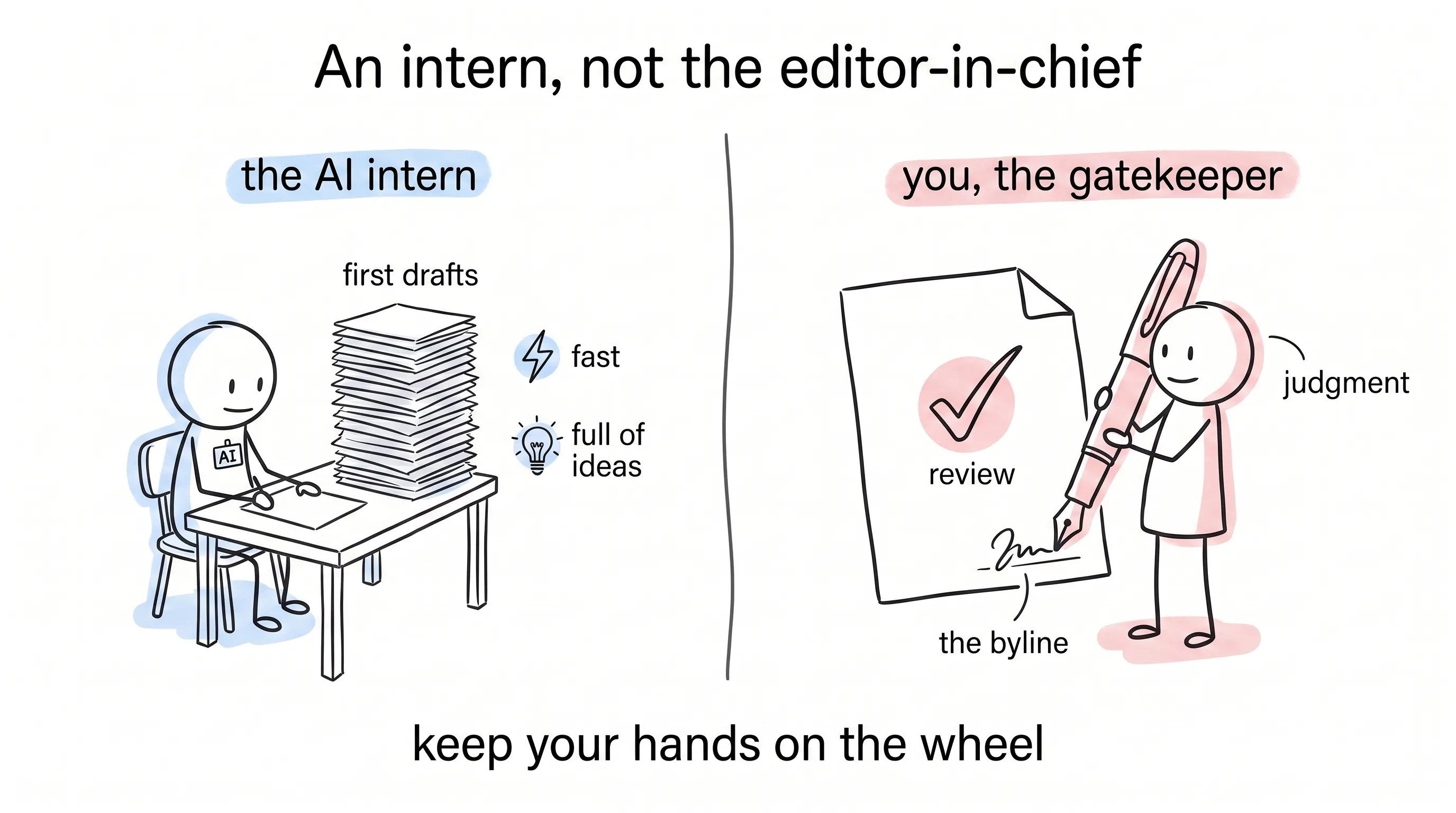
It's like being assigned an intern who never tires and is always on call.
Second: savings.
In the past, if you wanted to double your content output, your team basically had to double too. Not anymore. You can produce twice the content and run twice the campaigns without headcount growing along with it.
Scale goes up; costs don't double.
Third: precision.
There's exactly one thing that works on today's consumers: "you get me." What does "personalization at scale" mean? A thousand people open your page and see a thousand different versions of the content — each of them feels you're talking to them alone. AI can turn your user data inside out and make this happen. It used to be a game only the super-platforms could afford; now small teams can get in on it too.
Fourth: the spark.
People keep saying AI has no creativity. I don't see it that way. Ask it for ten ideas and nine may be forgettable — but the tenth might be one you'd never have come up with in your life. Sometimes inspiration is just waiting for someone to toss one more log on the fire.
In Practice, AI Holds Three Jobs in the Marketing Department
That's the upside. Now, something practical. I've seen three typical ways it gets used.
One: the content factory.
Articles, images, voiceovers, video — it can do them all. And it's especially good at getting several dishes out of one fish: feed it a long article, and within minutes it breaks down into ten short social media posts. That kind of efficiency is honestly a little scary. You can even feed it the way your brand talks, so what comes out sounds like you.
Two: the personalization engine.
Put first-party data and market trends side by side, and it can send a different message to each person — and conversion rates will most likely rise along with it.
There's also a hidden use case: translation. Rolling a campaign out into another language market used to mean hiring translators and localization teams; now AI just steps in, costs get slashed, and markets that used to be out of reach get picked up almost in passing.
If you're in retail, take note: it can also write a different product description, and pair it with different images, for every single person looking at a product. To every one of them, it reads like it was "written just for me."
Three: the outbound sales rep.
Large language models have learned to talk like people. Feed them information on your target customers plus market conditions, and they'll send emails and chat with clients automatically. Your sales colleagues never have to open every single conversation by hand again.
But don't get excited just yet. Of the three jobs, this is precisely the one that needs a human watching most closely: once a message goes out, there's no pulling it back.
Remember My Friend's "I Wouldn't Dare"?
Now I can answer the question from the opening.
His team tested it hands-on and found a pattern: the longer the content, the more AI's quality drifts. Short posts are passable; long articles tend to contradict themselves and invent details out of thin air.
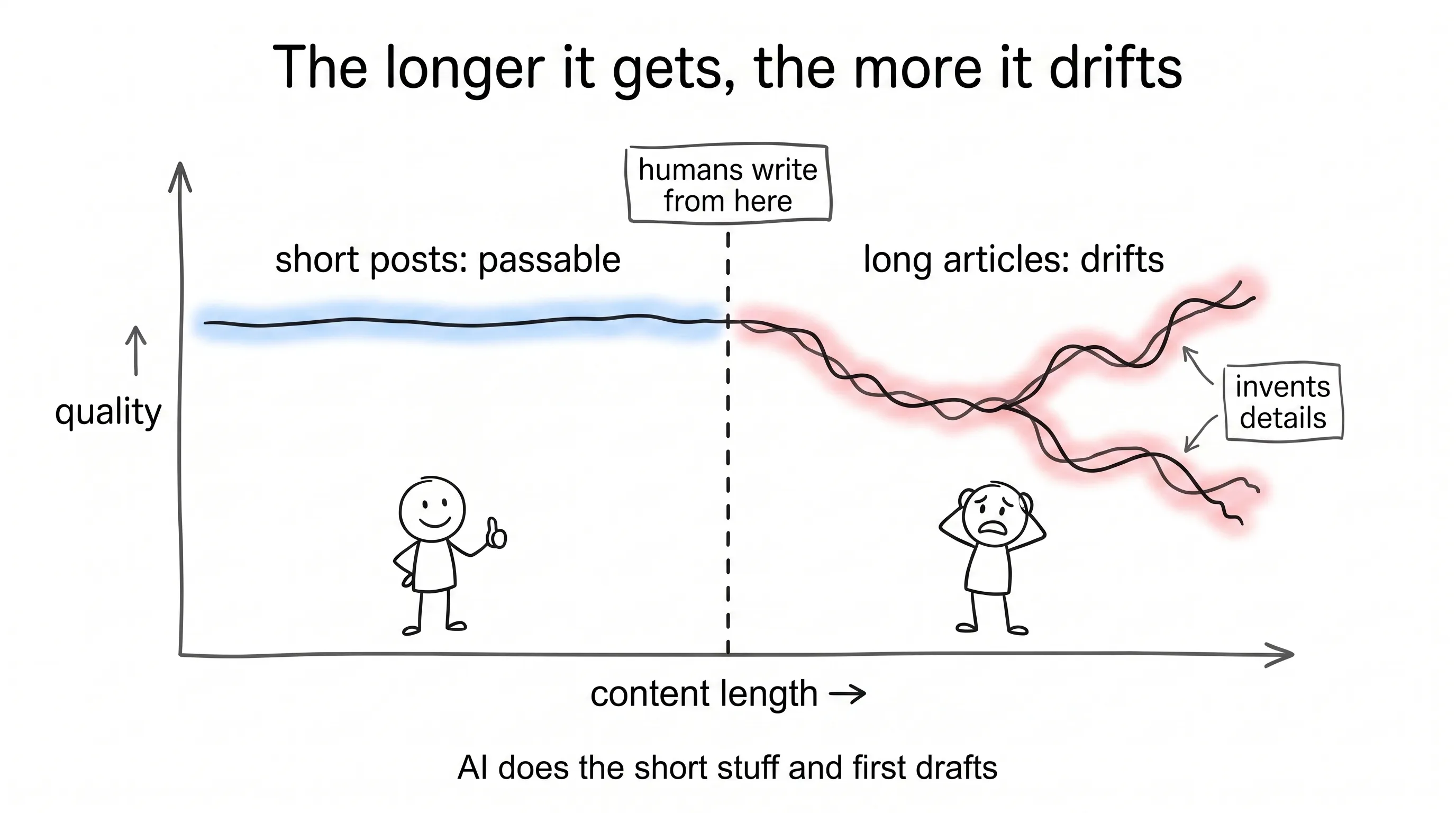
So their rule is: AI only does the short stuff and first drafts; anything long, humans write it, no exceptions.
This finding is worth a lot. It tells you that AI, right now, is an intern — not an editor-in-chief. You have to keep it in the quick-turnaround and first-draft roles, and hold on to the byline for now.
Three Pits You Need to Know About in Advance
However capable an intern is, it will still cause trouble. Three pits — and people have already fallen into every one of them.
The first pit: talking nonsense with a perfectly straight face.
AI "hallucinates": it invents things that don't exist, and states them with total conviction. Ask it for a recipe and it makes one up — worst case, you waste a meal. But what if it ends up written on your brand's materials, on something a customer paid money for? Then it's an incident.
So a team using AI must have a review process in place. AI content without review is food leaving the factory with no quality check.
The second pit: dirty data invites lawsuits.
Generative AI grew up "drinking" data from the internet. Whatever it drank, it may spit right back out.
Stable Diffusion had an incident: the images it generated came out bearing the watermark of the stock-photo company Getty. That's as good as admitting out loud that other people's copyrighted works were in the training data. And some people have used cleverly worded prompts, step by step, to coax the AI into spitting out users' personal information and companies' confidential data.
Two bottom lines, drawn for you in advance: when using data, obey privacy laws; when dealing with customers, be transparent — spell out clearly how their data is being used. This isn't a moral bonus question — it's a survival requirement.
The third pit, and the easiest one to forget: people.
No matter how strong AI gets, humans set the direction, humans review the output, humans make the final call on strategy. As of 2026, this much should be beyond dispute: AI is here to amplify human capability. Replace humans? It's still a long, long way off.
Whoever forgets this can look forward to cleaning up the mess hallucinations leave behind.
A Closing Thought
At the end of that dinner, my friend said something I've kept with me ever since:
"AI turned me from a writer back into a gatekeeper. The work got lighter — yet I'm more careful now, not less."
I like that line.
Once tools drive the cost of creation down to nearly zero, what's scarce is no longer output — it's judgment.
Only when you dare to sign your own name on the tenth draft AI hands you does your name become worth something.
Here's to getting that intern on your team soon. Teach it, use it — but keep your hands on the wheel.
Continue reading
Related articles

Cross-Border Business: Time to Upgrade Your AI Toolbox
A learn article explaining how AI tools help cross-border e-commerce sellers clear five hurdles: language, regulation, logistics, payments, and fraud. It outlines a five-compartment toolbox, a five-step adoption path, and metrics such as conversion rate and CLV, while cautioning against over-reliance on AI.

AI Is Taking Over the Dirty Work of Social Media Marketing, One Task at a Time
This learn article outlines four social media marketing tasks AI can handle — audience analytics, content drafting and design, ad targeting and creative testing, and spam moderation — and cautions that taste, judgment, and data security remain human responsibilities.

AI Is Already This Good — Why Is Your Social Media Marketing Still Pure Manpower?
An overview of 18 AI tools for social media marketing, organized into six categories covering audience research, content creation, scheduling, comment and DM handling, ad management, and visual production, plus notes on personalization, prediction, and emerging trends.