
Generative AI: Is It a Story, or a Business?
A learn article reviewing how 25 companies, including Coca-Cola, L'Oréal, Netflix, and IKEA, have put generative AI into production, covering ad co-creation, multilingual content, personalization, and workflow integration, and closing with four takeaways on time savings and taste as the new barrier.
Lately, entrepreneur friends keep asking me the same question:
"Liu, generative AI — is it a story, or an actual business?"
My answer: don't ask me.
Let me show you a few ledgers instead.
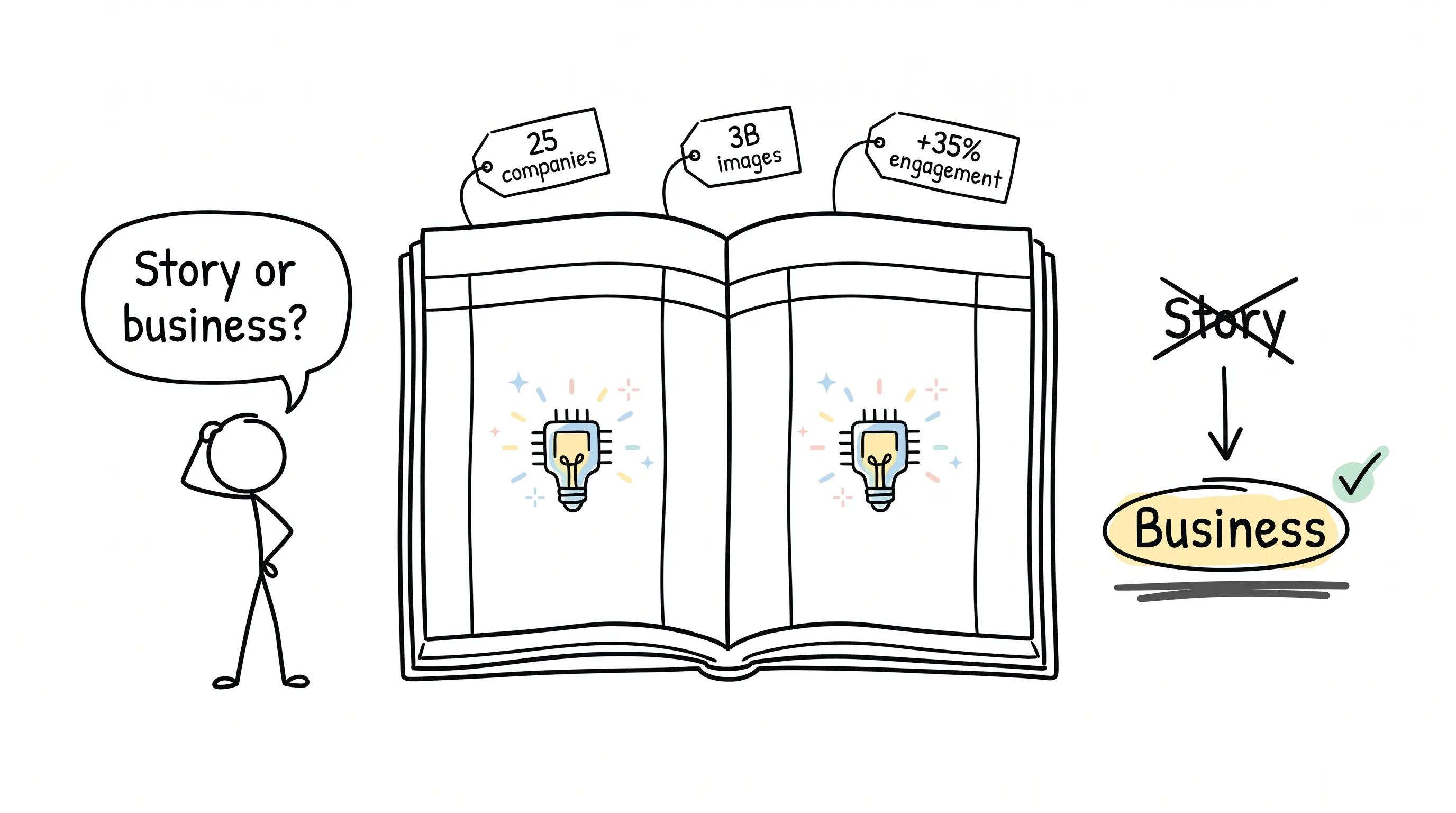
A while back, I went through how 25 companies are using AI — from Coca-Cola and L'Oréal, to Netflix and Expedia, and on to Shopify and IKEA. Not one of them was "running experiments." Every one of them has put generative AI into production with real money behind it, and every one of them can show you the numbers.
After reading through those ledgers, I was left with a single feeling:
My God — this is no longer a story.
First, What Exactly Is Generative AI?
What is generative AI?
Put plainly: it's as if the company hired a creative intern who never gets tired, never asks for a salary, and knows a little bit about everything.
Tell it in plain language what you want, and it will write copy, draw images, produce videos, write code. These jobs used to be done by people, one task at a time. Now the intern delivers in seconds.
And the key part: this intern never sleeps, and never asks for a raise.
So what exactly is recorded in those 25 ledgers?
Let me pick a few and walk you through them.
Ledger One: Coca-Cola Turned Advertising into a Game
Coca-Cola did something very clever.
Together with OpenAI, it built a platform called Create Real Magic, where artists and everyday people anywhere in the world could use ChatGPT and DALL·E 2 to create their own work around Coca-Cola's classic brand elements — the contour bottle, the red-and-white palette, Santa Claus.
Brilliant!
In the end, creators from more than a hundred countries took part, and thousands of original works came pouring in. The best of them went up on the big screens of Times Square in New York and Piccadilly Circus in London.
Think about it: co-creation used to mean running a contest, sending emails, collecting entries, hiring judges — half a year of scrambling, start to finish.
Now it's one platform, synchronized globally, and creators show up on their own.
What users put in wasn't just their work — it was their feelings.
Ledger Two: L'Oréal Squeezed Every Drop Out of the Translation Math
L'Oréal's numbers are even more ruthless.
It is the world's largest beauty company, with more than 35 brands sold in over 150 countries. When a product launches, the copy, the sales scripts, the descriptions all need to become dozens of languages. That used to rely on human translators and local teams — slow and expensive.
So it plugged models like GPT straight into its content production line.
The result: product content development cycles shortened by 60%. Copy and visuals rolled out to 25-plus languages in a single pass. After its AI beauty assistant went live, user engagement time rose 35% and conversion rates climbed 22%.
Let me run the numbers for you.
Say a product line's content used to take 100 days to develop; now it hits the shelves in 40. Launch ten collections a year, and you've freed up 600 days.
Six hundred days, in the beauty industry, is two full peak seasons.
What you save isn't just money — it's the first-mover edge.
Ledger Three: Stitch Fix Taught AI to Speak Like Its Stylists
Stitch Fix is an online styling company. You place an order, and it sends back a box of styled outfits, with a handwritten-style note explaining why each piece was chosen.
That note is its most expensive dose of human warmth.
Eventually, they taught AI to write it. The model was trained on a large body of notes written by stylists, on user feedback, on purchase behavior. AI writes the first draft; the stylist then polishes it.
Time spent writing notes was cut by more than half. And how did users respond?
Barely any difference from the fully human-written ones.
See what happened? In the very place that prides itself most on "human touch," AI squeezed its way in. And the way it got in was clever: AI does the draft, and the human makes that final gesture of "nodding it through."
Ledger Four: The Barrier Came Tumbling Down
Reading this one, I felt a slight chill run down my spine.
When Canva launched its Magic Studio suite, AI actions on the platform passed one billion within the first few months. Surveys show that more than 70% of paying users got noticeably faster at getting things done.
Adobe's Firefly generated more than 3 billion assets in its first year online.
What does 3 billion mean? I did the math: on average, more than 8 million a day.
In other words, every single day, the images the world draws with Firefly outnumber the entire inventories of many stock-photo sites.
Microsoft Designer, meanwhile, is generating several million designs a week.
What is a barrier to entry? It's this: you used to have to spend three years learning design software; now, if you can type, you can design.
Once the barrier collapsed, everyone could "make something."
But pay attention — once everyone can make things, the scarce skill becomes "judging which one is good."
Ledger Five: The Winners All Stuffed AI into Their Workflow
Reading further, I noticed a pattern.
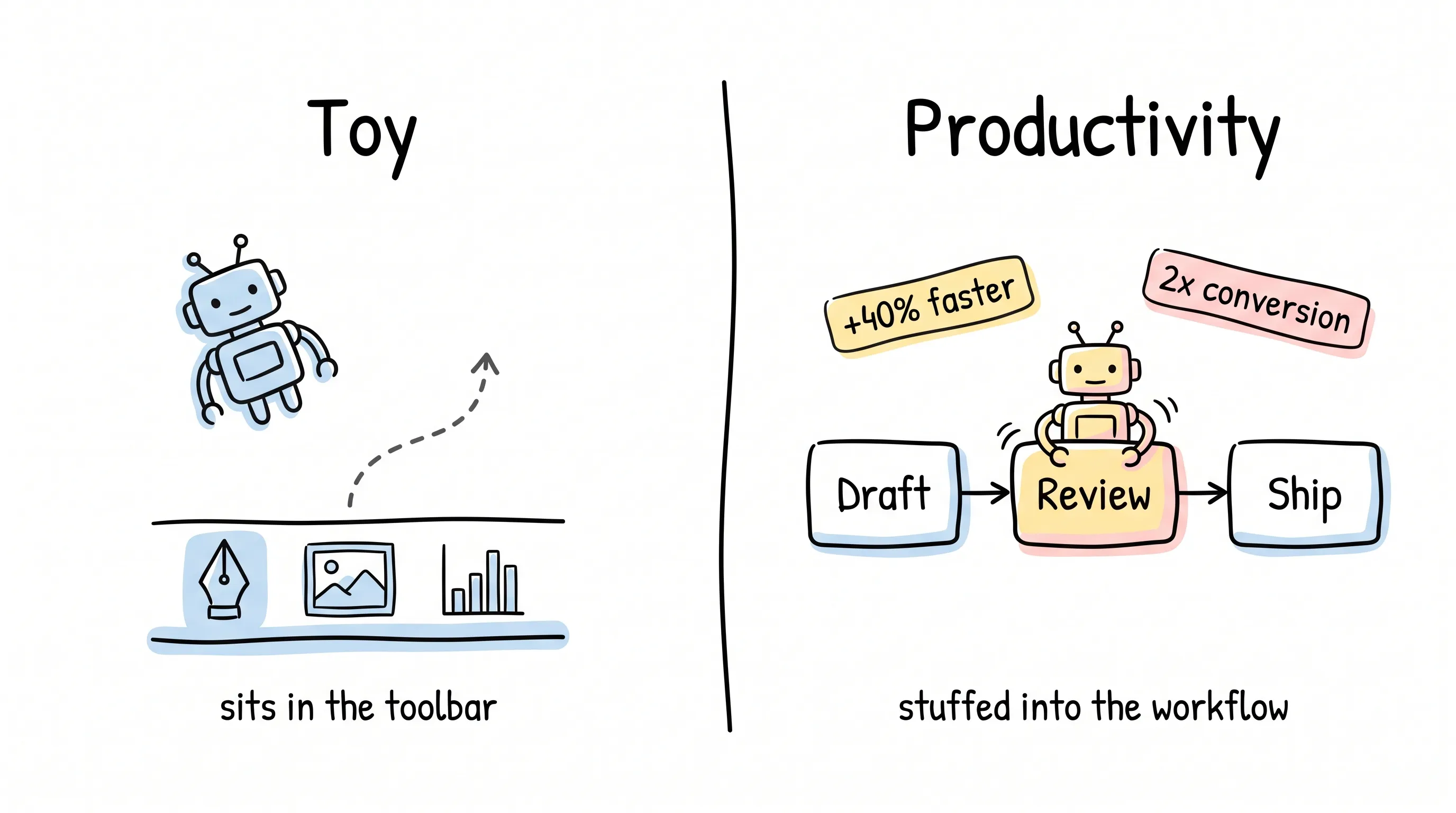
The companies that built AI as a standalone app — a toy — made lots of noise but showed ugly numbers. The companies that stuffed AI straight into their workflow all posted beautiful numbers.
IBM's Watsonx "read" millions of documents, tickets, and manuals for its clients. Employees' time spent hunting for information dropped by as much as 70%. Customer-service tickets now get resolved 30–40% faster.
Salesforce embedded Einstein GPT into its CRM. Sales follow-up emails, support replies, marketing campaign copy — all of them get an AI first draft. Work gets done 40% faster, and marketing email click-through rates are up 28%.
LinkedIn added an AI writer in-app. Users became 55% more likely to update their profiles; AI-assisted posts draw 40% more engagement than hand-written ones; and recruiters writing a job description save 60% of the time.
Klarna built a shopping assistant on ChatGPT. Ask it "what waterproof hiking shoes can I get under a hundred dollars," and it recommends them on the spot. People who use it convert at twice the rate of ordinary search users.
Replit embedded Ghostwriter right inside the coding interface — developers write and debug code 60% faster. Google tucked Duet AI into Docs, Sheets, and Gmail; in internal pilots, writing documents got 40% faster. Notion AI is even more direct: a few months after launch, 60% of users on the teams that had enabled it were using it every week.
See it?
AI sitting in the toolbar is a toy. AI stuffed into the workflow is productivity.
Ledger Six: A Different Face for Everyone — Painted on the Spot
Netflix did something small but ruthless.
The same show, with a different cover for different people. Romance lovers see a warm character close-up; action fans see a blazing fight scene. AI automatically picks frames from the video, generates the artwork, and tests it.
The result: streaming rates up 20–30%.
One show, a thousand faces.
Meta's Emu model carried the idea into the chat box. Type one line — "a cat surfing in space" — and within seconds, a sticker pops out. In its first few months, users made billions of stickers.
Duolingo used GPT-4 to build a Roleplay feature, where you can chat in Spanish with an AI barista until closing time. Users of these features spend 30% more time per learning session.
BuzzFeed went even more direct: enter your name and your mood, and a personalized quiz result is generated on the spot. Personalized content gets shared 45% more than static content.
It used to be people hunting for content.
Now it's content being made for you, on the spot.
Ledger Seven: The Physical World Isn't Spared Either
You might think: isn't all of this just online stuff?
It isn't.
Autodesk built generative design into Fusion 360. Engineers enter goals, materials, and manufacturing constraints, and the AI generates thousands of structural options. What it added up to in practice: up to 40% savings on materials, and iteration time cut in half.
Pixar and NVIDIA together put generative models into early concept design. A set of scene concept art used to take days; now it takes hours. In art reviews, everyone gathers around the screen, revising and viewing live.
IKEA's Kreativ platform: you take a photo of your own living room, the AI "erases" your old furniture, generates a new arrangement from your description, and you can order it directly. You see it before you buy, so you buy with confidence — and return rates drop along with it.
Industries built of stone and wood — AI has walked into those too.
Four Takeaways from 25 Ledgers
First: what you save is time; what you seize is the head start.
L'Oréal's 600 freed-up days, Shopify merchants' 80% time savings on product copy, Expedia users planning trips 30–40% faster — at heart they're all the same thing: while others are still preparing, you're already on the shelf.
Second: AI isn't taking anyone's job — it's taking over the repetitive work.
The New York Times has AI draft dozens of headline versions, then hands them to A/B testing to run — but the final call always belongs to an editor. Stitch Fix's stylists take the time they saved and put it into maintaining client relationships. The people didn't leave; they moved to more valuable positions.
Third: once the cost of creation drops to zero, taste becomes the new barrier.
When everyone can generate 3 billion images, "making something" isn't worth money anymore. "Judging which one makes it onto Times Square" is what's worth money.
Fourth: don't ask whether AI can replace you.
Ask yourself first: in your daily work, how much of it could that "intern who works for free" also do?
Hand those tasks over.
Back to Where We Started
Later, I ran into that entrepreneur friend again — the one who asked whether it was "a story or a business."
She didn't ask the question again.
She said her company had started using it last month — a customer-service assistant tool, piloted first on the after-sales line.
I said, good.
May you soon have that tireless, unpaid intern of your own.
And may you spend the time you save on the one thing that only you can do.
Continue reading
Related articles

Cross-Border Business: Time to Upgrade Your AI Toolbox
A learn article explaining how AI tools help cross-border e-commerce sellers clear five hurdles: language, regulation, logistics, payments, and fraud. It outlines a five-compartment toolbox, a five-step adoption path, and metrics such as conversion rate and CLV, while cautioning against over-reliance on AI.

AI Is Taking Over the Dirty Work of Social Media Marketing, One Task at a Time
This learn article outlines four social media marketing tasks AI can handle — audience analytics, content drafting and design, ad targeting and creative testing, and spam moderation — and cautions that taste, judgment, and data security remain human responsibilities.

AI Is Already This Good — Why Is Your Social Media Marketing Still Pure Manpower?
An overview of 18 AI tools for social media marketing, organized into six categories covering audience research, content creation, scheduling, comment and DM handling, ad management, and visual production, plus notes on personalization, prediction, and emerging trends.