
Generative AI Has Moved into Marketing: The Efficiency Is Real, and So Are the Pitfalls
A learn article on generative AI in marketing: adoption is high but formal policies lag. It covers value areas like time savings, cheaper testing, and personalization, plus pitfalls including hallucination, bias, privacy, copyright, and brand dilution, ending with advice to start small and set usage rules.
A few days ago, I was having coffee with a friend who runs marketing at his company.
He told me his team can barely work without AI anymore. Copy gets drafted by AI, images get generated by AI, ad creative for Google, Meta, and LinkedIn comes out by the dozens in a single day — even the weekly report starts with an AI first pass.
I said, fine. Then let me ask you one question: have you set any rules?
He froze. About five seconds of silence, then he shot back: rules? Does a prompt template count?
And there it is — the state of things I keep seeing everywhere lately. Everyone's hands are already inside AI. Everyone's brains haven't caught up.
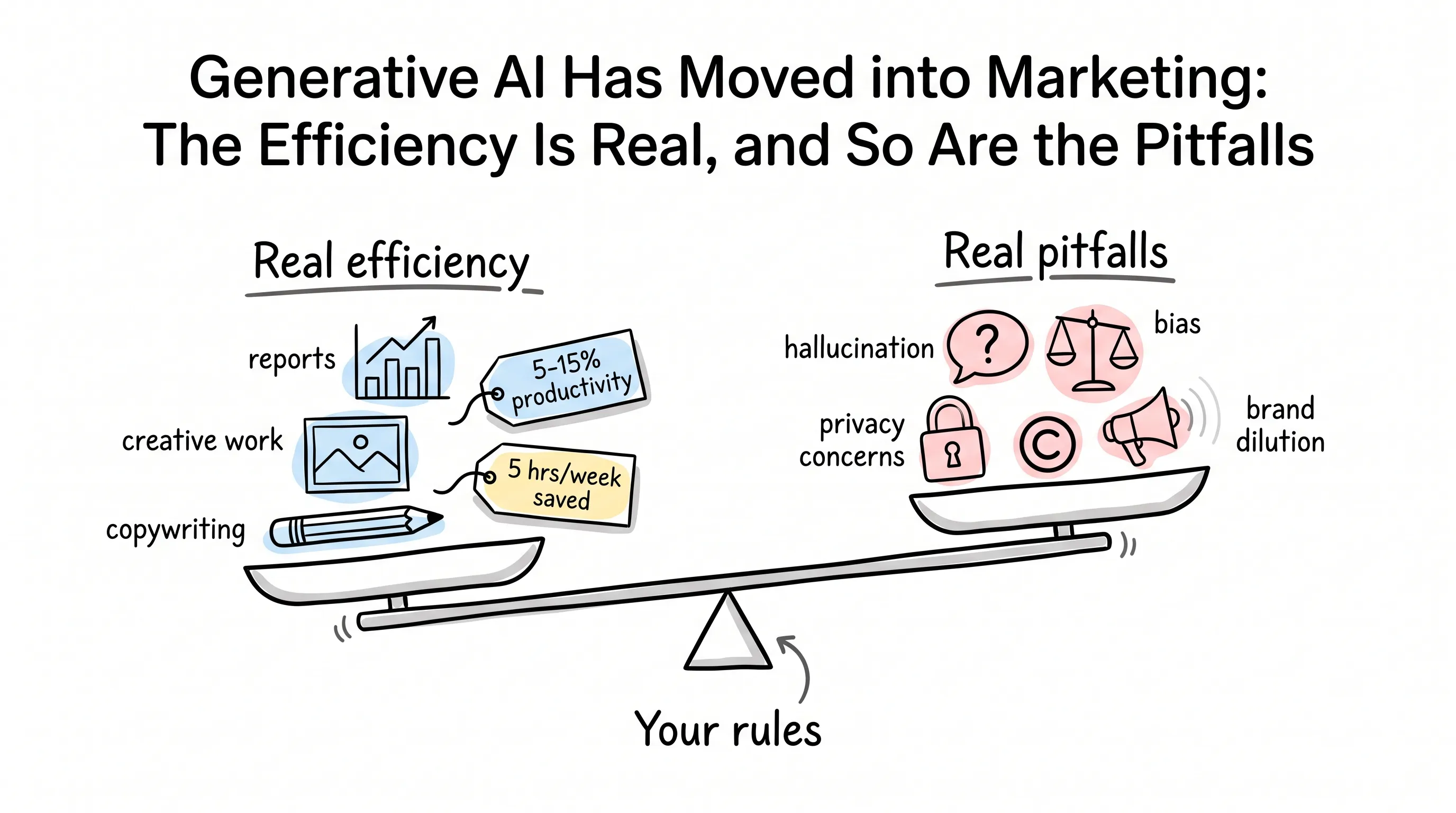
What does generative AI in marketing actually mean? It means letting models write your copy, produce your creative, summarize your research, design your ad tests, and answer your customer-service tickets. Two years ago these were novelty toys. Today they're everyday infrastructure in the marketing department.
The problem is, infrastructure is supposed to come with safety standards. Most teams haven't installed them yet.
How Far Along Are People, Really?
Start with the money. In 2024, the market for generative AI in marketing use cases was roughly $1.56 billion. Some forecasts put it around $22 billion by 2033, which works out to annual growth of about 35%. The broader generative AI market has been projected to exceed $350 billion globally by 2030.
Treat these numbers as direction, not gospel. Analysts' definitions vary wildly — don't paste them into a business plan.
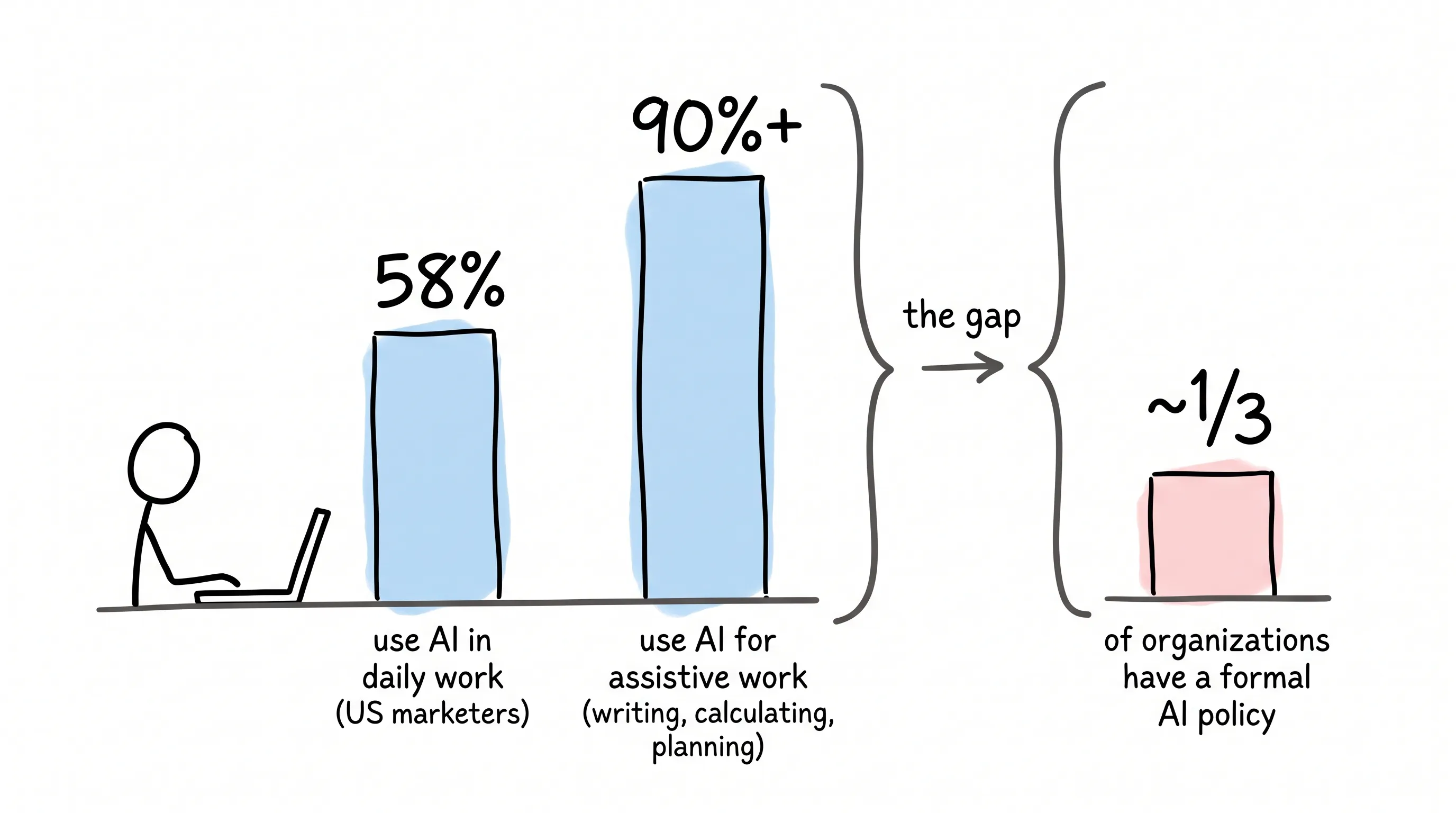
Now the people. Multiple industry surveys point to the same finding: more than half of marketers are already using, or actively testing, generative AI. In the US, roughly 58% have woven it into their daily work. Count all the assistive work — writing, calculating, planning — and one report puts penetration above 90%.
That is wild.
But the very next data point brings you right back down to earth.
Only about a third of organizations have a formal generative AI policy.
That gap is what I most want to talk about today. Marketing is a peculiar department: it speaks to the outside world, it touches customer data, and every sentence it publishes can turn into an advertising claim. An AI output no one has reviewed can become a product claim, a mass email, a customer-service reply, even a targeting strategy — within minutes.
Outward-facing, data-touching, claim-making. Stack those three together, and having no rules means you're running naked.
Where the Money Is — I Counted Four Places
First, saved time.
McKinsey has estimated that the marketing productivity lift from generative AI is equivalent to 5% to 15% of total marketing spend. And marketers themselves expect to save about five hours a week.
Five hours, every week. Over a year, that's two hundred-plus hours.
What can you do with two hundred hours? Run dozens more user interviews, take a serious pass at your positioning, finally make real sense of the data in front of you. The most valuable use of saved time is making judgments — not sitting in three more meetings.
Second, experimentation got cheap.
Generating ten headlines costs close to zero. So you can test more headlines, more message structures, more landing-page versions.
But there's a trap here, and I call it testing noise. What is testing noise? It's when the variations are churned out by AI in one go, with no hypothesis behind any of them. Before you test anything, you have to answer one question: for first-time customers, does "here's how to avoid the pitfalls" copy beat straight discounting? That's a test. Ten randomly generated headlines aren't a test — they're busywork.
Third, personalization can finally scale.
AI can use behavioral data, transaction data, and context data to generate copy, offers, and content blocks segment by segment. Hand-writing a thousand versions for a thousand people used to be impossible. Now it's possible.
There's one case I've never forgotten. Michaels — the US crafts-and-hobby retail chain — used AI-powered personalization to push personalized email from 20% of sends to 95%. Email click-through rose 25%; SMS rose 41%.
25%, 41%. Bring those numbers to your boss's report and watch their eyes light up.
There's always a flip side, though. Personalization is tethered, on the other end, to one word: creepy. When you seem to know too much, customers get scared. The moment your messages feel "smart" enough to have read their chat logs, the click-rate bump you gained turns into trust they delete.
Fourth, analysis is no longer the analysts' monopoly.
Marketers who can't write SQL can now have AI sort open-ended survey responses into themes and translate traffic trends into plain language. Data literacy requirements haven't dropped one bit — they've simply raised the whole team's floor. Every company used to keep one or two "data translators" on staff; now everyone can muddle through a question or two.
Now the Pitfalls. Five of Them.
First, hallucination.
Models will say false things with total confidence. In other departments, that's a joke. In marketing, it's an incident. Something the model invented goes straight out as a product claim, a price promise, a compliance problem — a public disaster on the record.
Analysts have estimated that AI hallucinations cost global business on the order of tens of billions of dollars. Methodologies differ wildly, so treat the number as a reference. But the lesson is solid: unchecked output is the most expensive output.
So here's an iron rule. Anything involving statistics, promises, comparisons, or regulation must be verified against approved source material before it goes out. No exceptions.
Second, bias.
Generated images carry narrow default aesthetics and narrow default demographics; generated copy can quietly drift off-key on topics touching race, gender, income, or age. That hurts customers — and invites lawsuits. Periodically pull your outputs back out and review them across different demographics, channels, and customer segments. Don't wait for someone outside to audit you.
Third, privacy.
Don't paste raw customer records, health information, or confidential quotes into public AI tools. It's that simple. Which data may enter a prompt, which tools are approved, how data is stored — settle all of that with your privacy team before you connect AI to your CRM and automation systems. Don't get the order backwards.
Fourth, copyright.
Don't let AI imitate the style of living artists, and don't touch competitors' or otherwise protected brand assets. For major campaigns, keep records of prompts, sources, and approvals. If trouble comes later, those records are your defense.
Fifth, brand dilution — the most invisible pitfall of the five.
AI's default tone is a cheap kind of enthusiasm: everything is great, everything is exciting, and the structure is always the same. A prompt library can save part of that, but prompts are not governance.
Let me tell you about a real test. One team had AI mass-produce ad variations, and output volume genuinely went up. When the results came in, every single ad was betting on the same benefit point. The budget quietly burned down, and incremental gains were thin. More creative does not mean more effective. With weak hypotheses, the more creative you generate, the faster you burn money.
So How Do You Start?
My advice: don't try to do everything at once, and don't sit on the sidelines either.
Pick one high-value, low-risk workflow. Email subject-line testing, summarizing customer reviews — both good starting points; an internal post-campaign retrospective report counts too. Pick one, record a baseline first, run a fixed cycle, then compare with real metrics: conversion rate, customer-acquisition cost, ROAS (return on ad spend), LTV (customer lifetime value), retention. When you run the numbers, reconcile against real data in GA4, HubSpot, Salesforce, or your own warehouse. Vanity metrics don't count.
When the run is over, write the rules down, then scale up. The rules don't need to be long — a few will do:
- Which use cases AI is approved for, and which it isn't. Keep low-risk drafting and high-risk customer decisions separate.
- What data may go into AI, and what may not.
- Numbers, legal language, targeting, sensitive content — all require human review.
- Audit outputs regularly for bias.
- Train the team while you're at it: how to write prompts, how to read outputs critically.
These rules aren't worth much. What's worth a lot is actually enforcing them.
As for tools, don't sweat it. Over the next few years, generative AI will root itself deeper into CRM, marketing automation, analytics, and creative platforms; multimodal will be table stakes, and regulation will catch up on transparency, fairness, and content authenticity. The platforms will serve these capabilities up to you. You can't jump the line — and you don't need to.
One Last Thing
What didn't get finished at that coffee table, I've written here instead.
The question was never "should we use generative AI." That part is no secret — everyone can see the cards. The question is whether you plan to write the rules first — or have your first incident first.
Tool subscriptions are cheap. Incidents are expensive.
Here's hoping you never have to learn the former by way of the latter.
Continue reading
Related articles

Cross-Border Business: Time to Upgrade Your AI Toolbox
A learn article explaining how AI tools help cross-border e-commerce sellers clear five hurdles: language, regulation, logistics, payments, and fraud. It outlines a five-compartment toolbox, a five-step adoption path, and metrics such as conversion rate and CLV, while cautioning against over-reliance on AI.

AI Is Taking Over the Dirty Work of Social Media Marketing, One Task at a Time
This learn article outlines four social media marketing tasks AI can handle — audience analytics, content drafting and design, ad targeting and creative testing, and spam moderation — and cautions that taste, judgment, and data security remain human responsibilities.

AI Is Already This Good — Why Is Your Social Media Marketing Still Pure Manpower?
An overview of 18 AI tools for social media marketing, organized into six categories covering audience research, content creation, scheduling, comment and DM handling, ad management, and visual production, plus notes on personalization, prediction, and emerging trends.