
Generative AI Has Entered Marketing: The Opportunities Are Real, and So Are the Pitfalls
A marketer's overview of generative AI in marketing, contrasting traditional algorithmic ad targeting with content generation, and covering output quality, hallucinations, and data privacy risks alongside emerging opportunities.
The other day, I had dinner with a friend who does creative work at an ad agency.
He had barely sat down before he sighed: his team was pushing AI for efficiency. The work was indeed moving faster, but morale was shaky. If efficiency is up, why keep this many people around?
Here's the interesting part: after a couple of drinks, he changed his tune. Deep down, he said, he actually wanted AI to come. Marketing is full of repetitive work that grinds people down until they go numb. If those tasks could truly be handed to machines, he'd jump at the chance.
The same AI left him both afraid and hopeful.
He's not the only one torn this way. Over the past two years, tech giants, advertising groups, and marketing consultancies have one-upped each other with new releases, wave after wave. The whole industry keeps swinging between "afraid of being replaced" and "longing for relief."
In this article, let's take the thing apart: what generative AI actually brings marketers, and what it buries.
First, Get the Concept Straight
What is generative AI?
Start with a counterexample. Many people think AI is a new species. It isn't. Advertising has been using machine learning and deep learning for over a decade. That ad you scrolled past—who picked it? How was the budget split? Where was it placed? How did you react once you saw it? Behind all of it: algorithms.
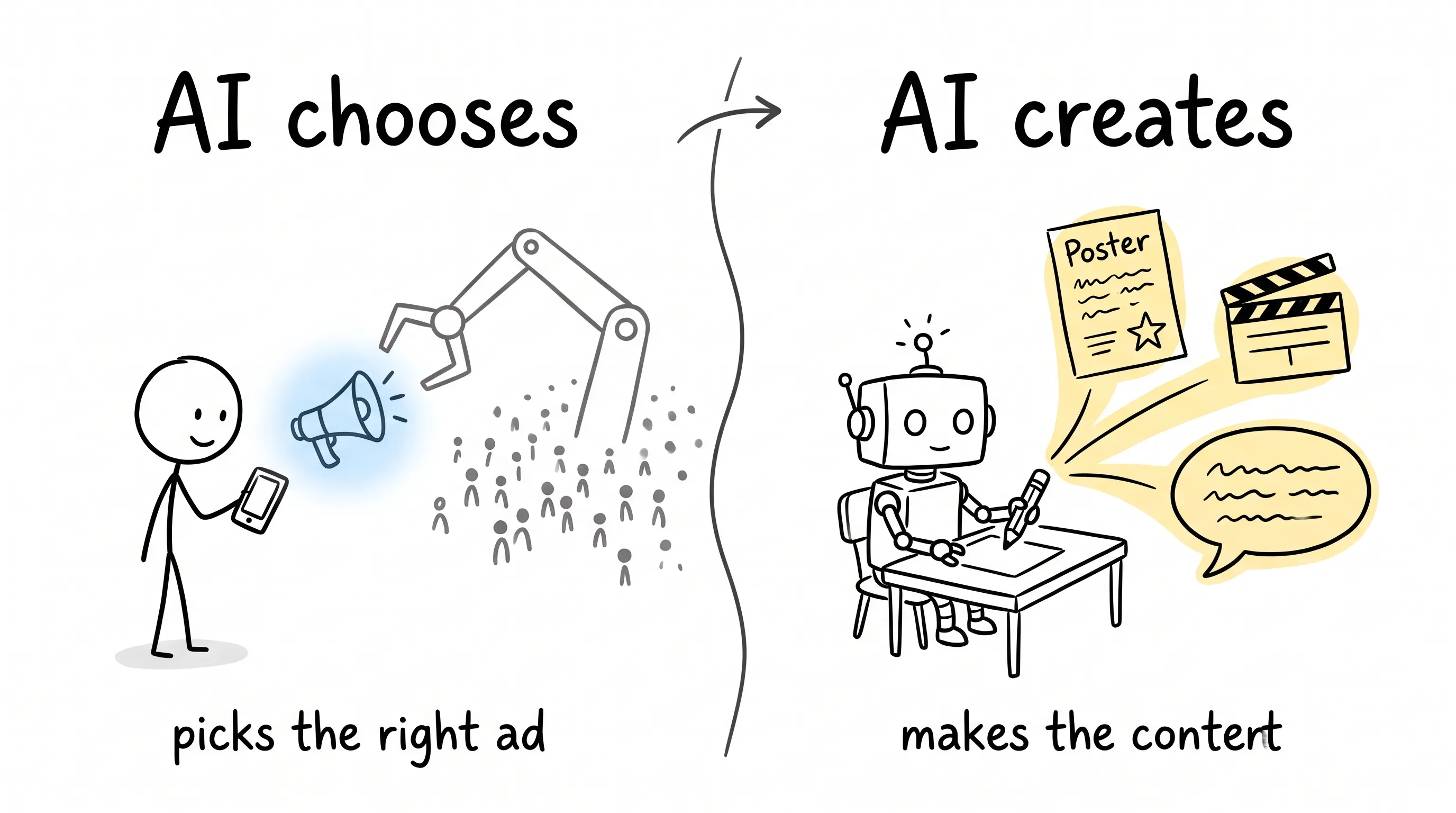
But those algorithms do one thing: choose. Out of hundreds of millions of people, they put the most suitable ad in front of you.
Generative AI is different. It doesn't choose — it creates. Give it a sentence, and it writes copy, designs posters, edits video, scripts scenes.
This is the watershed. AI used to help you put content in front of the right people; now AI helps you make the content.
With the concept clear, the industry's chaos suddenly makes sense. Every feature gets an AI label slapped on, then repackaged and resold. Old wine in new bottles outnumbers the genuinely substantive.
So next time someone talks AI marketing at you, don't rush to nod. Ask one question: which AI do you mean?
A Pot
What is generative AI like?
My own take: it's like a pot.
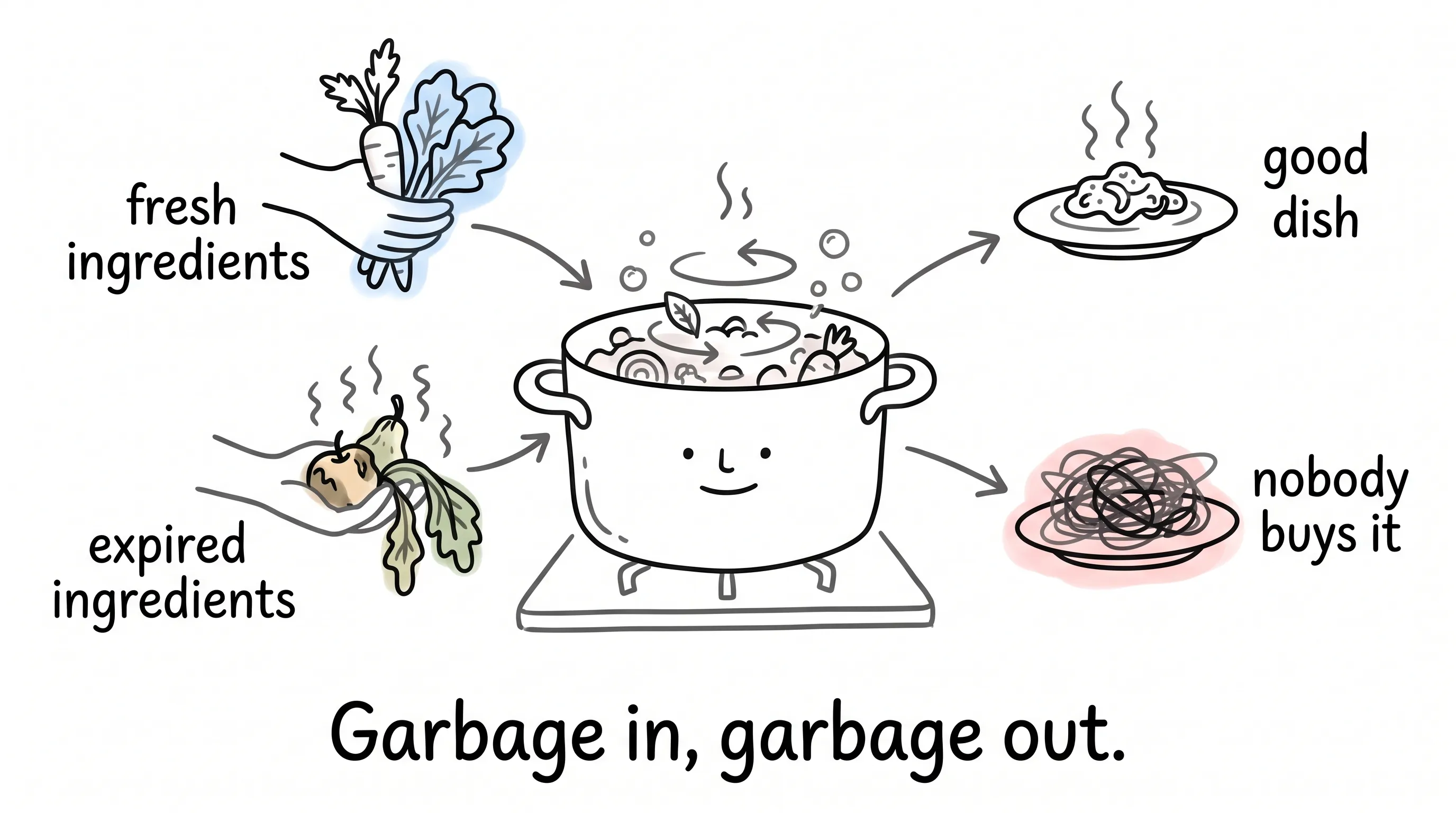
The same chef—give him fresh ingredients and he serves up good dishes; give him expired ones and he'll stir-fry them all the same, producing a potful of food nobody will buy. The pot doesn't pick ingredients; the pot only turns ingredients into dishes.
Generative AI works the same way. What you feed it is what it serves back. It has no idea what "stale" means. Whatever you tell it, it believes — and then acts on.
Garbage in, garbage out.
Stick that phrase next to every screen where AI gets used.
Oh, and one more layer. If you want AI to produce content for a specific scenario, the "ingredients" you feed it matter even more. The more precise the context you provide, the closer its output lands to the flavor you're after.
Iteration and Originality Are a Species Apart
Some say AI will sooner or later replace creative people.
My judgment: they're overthinking it.
Think about it. An idea as absurd as "a tornado flings sharks into the sky and they attack Miami" — AI can't come up with that. The original leap, the zero-to-one, is a human skill.
But throw that idea to AI, and in one day it hands you twenty sequel concepts, each one plausible, each one solid. On existing ideas — the one-to-a-hundred — it's fast and cheap.
Impressive.
But hidden inside is a trap called "hallucination."
What is hallucination? It's when the AI invents facts with a completely straight face — and the inventions sound real. Why? Because under the hood, AI runs on mathematics and probability, not a human brain. It has no sense of context, doesn't know that "you can't say this to a client" — it just keeps writing according to statistical patterns.
The result: right on the surface, wrong in context. Run campaigns on this kind of content and the volume goes up while the data goes sideways.
Plenty of output, no accuracy. Those are two different things.
What to Sweat More Than Hallucinations
Let me paint a scene.
Say you're a creative director. On your desk: the client's full-year campaign data, user lists, budget spreadsheets. You want to cut a corner, so you paste it all into a ChatGPT prompt and have it draft a proposal.
The second you hit Enter, one thing has already happened: that data is in the model's library.
Spilled water can't be scooped back.
The client's confidentiality agreement does not include an "AI exception" clause.
So before brands and agencies feed data into any tool, they need to think it through: the client's user data and campaign records — can they stand the light of day? If secrets leak, who's on the hook? Until those questions have answers, don't be in such a hurry.
The Opportunities Are Growing Too
But there's always another side.
For the past two years, every AI conversation opened with threats: job losses, made-up facts, no control. Now, more and more people are talking opportunity. Creative efficiency and workflow transformation will most likely see real progress in the next 12 to 24 months.
Solutions to the pitfalls are growing too. Think brand safety, data privacy. Adobe, Google, Shutterstock and their peers have all rolled out supporting tools and indemnification programs.
What is an indemnification program? Plainly put: if AI-generated content ever lands you in a lawsuit, the vendor shoulders it for you per the agreement.
That's a clever move. Brands hold back on AI mostly because they fear causing trouble. Only when someone else carries the liability do they truly let loose.
There's one more layer. The phase-out of third-party cookies is a settled direction, and first-party data only gets more valuable. The more AI spreads, the better the ingredients in your pot — for whoever holds clean first-party data.
See? We're back to that pot.
One Last Thing
Back to my friend.
At the end of that night, I told him: don't burn energy agonizing over whether AI will take your job. Get clear on two things first: what data can be fed in, and what can't; which tasks you hand to AI to iterate, and which you must conceive from zero yourself.
Get it right, and AI is your cheat code.
Get it wrong, and it's garbage in, garbage out — data spilled, lawsuits at the door.
A tool's ceiling is always whatever you feed it.
And here's a bigger wish: may you never, late at night, find yourself staring at a spreadsheet of AI-invented numbers, questioning your life choices.
Continue reading
Related articles

Cross-Border Business: Time to Upgrade Your AI Toolbox
A learn article explaining how AI tools help cross-border e-commerce sellers clear five hurdles: language, regulation, logistics, payments, and fraud. It outlines a five-compartment toolbox, a five-step adoption path, and metrics such as conversion rate and CLV, while cautioning against over-reliance on AI.

AI Is Taking Over the Dirty Work of Social Media Marketing, One Task at a Time
This learn article outlines four social media marketing tasks AI can handle — audience analytics, content drafting and design, ad targeting and creative testing, and spam moderation — and cautions that taste, judgment, and data security remain human responsibilities.

AI Is Already This Good — Why Is Your Social Media Marketing Still Pure Manpower?
An overview of 18 AI tools for social media marketing, organized into six categories covering audience research, content creation, scheduling, comment and DM handling, ad management, and visual production, plus notes on personalization, prediction, and emerging trends.