
Generative AI for Marketing: The Cheap Option Is Often the Most Expensive
A long-form learn article arguing that generative AI lowers marketing content costs while eroding differentiation, and that human review, brand guidelines, and clear goals are needed to keep AI output distinctive.
A few days ago, I had dinner with a friend who runs an e-commerce business.
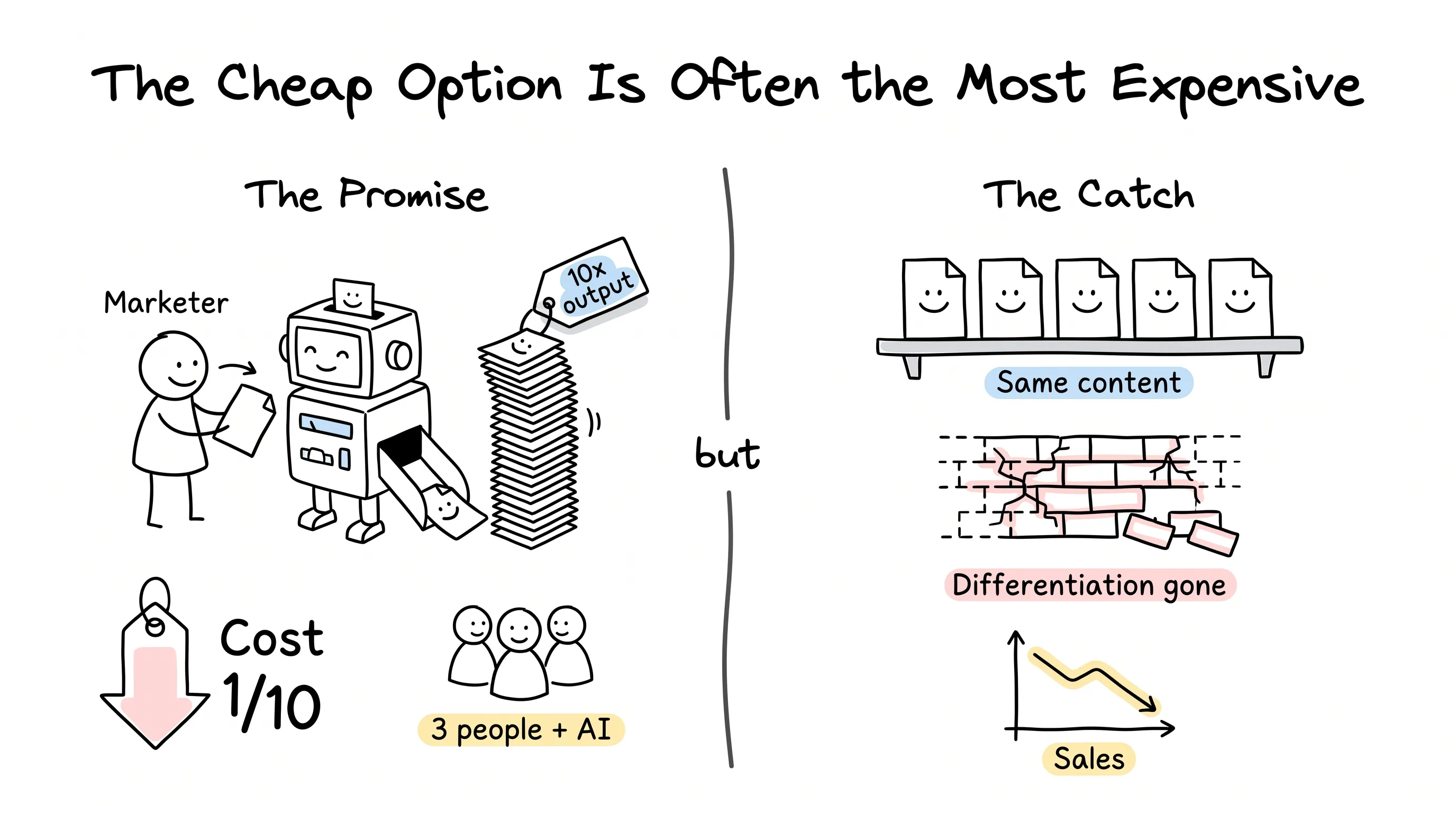
He was bursting with excitement. He told me: his company's content team used to be thirty people — writing copy, making graphics, shooting short videos — and after a month, they'd just barely managed to cover two platforms. And now? Three people, plus a pile of AI tools, producing ten times the output at one-tenth the cost.
When he finished, he waited for me to praise him.
I asked one question: So, did your sales grow tenfold?
He froze.
After a few seconds, he said: No. If anything... it actually dropped a little.
I said, congratulations — you've just experienced, first-hand, the most typical story of our era: generative AI has driven down the cost of marketing, and at the same time demolished the barrier to differentiation.
Today, let's take this thing apart piece by piece.
What Is Generative AI Marketing?
First, let's get the concept straight. What is generative AI?
AI in the past was about "recognition": you give it a photo, and it tells you whether that's a cat or a dog. Generative AI works the other way around. You tell it "I want a cat wearing sunglasses," and it draws you one. It can conjure new things out of thin air — text, images, video, code, all of it.
Applied to marketing, it comes down to one thing: AI used to help you "see." Now AI helps you "do."
Writing WeChat Official Account posts (a brand's publishing channel inside WeChat), writing ad copy, building landing pages, answering customer-service messages, analyzing user data — it can take on all of that work. And not in that "usable, but barely" way. In many scenarios, its output is already above the passing line.
What does that mean?
It means the entry fee for marketing has just collapsed.
Three Real Payoffs
I don't need to lecture you on the benefits — you're witnessing them every day. But three ledgers are worth walking through.
The first ledger is content.
To build a brand today, you have to simultaneously keep a website, a WeChat Official Account, WeChat Channels, Xiaohongshu (China's biggest lifestyle-and-shopping social app), community groups... no platform can go dark. Five years ago, that meant staffing a huge content team. Now, one AI plus one person who knows how to exercise judgment can maintain a presence on every platform.
For big companies, that's an efficiency gain. For mom-and-pop shops, it's a shot at a comeback.
Remember when a small merchant wanted personalized recommendations — showing different users different homepages? Don't even think about it. That was a game only the platform giants could afford to play. Now AI has driven the cost of it into the ground. On the very same e-commerce site, the homepage you see and the one your mother sees can be completely different.
The second ledger is trial and error.
Testing an ad used to go like this: write the plan, produce the creative, spend a small budget, wait two weeks, check the numbers. One cycle took half a month.
And now? AI can generate fifty versions of headlines, visuals, and selling-point combinations in a minute, and throw them all out to test at the same time. By the end of the day, you know which version users actually buy.
Trial and error went from "months" to "hours." That's the gap.
The third ledger is service.
An AI customer-service agent is online twenty-four hours a day, replies in seconds, keeps a consistent tone, and can recommend the right things based on your browsing history. At three in the morning you ask, "Where's my order?" — and it answers faster than a human would.
The saved labor is real. So is the lift in user experience.
At this point you might be thinking: so this thing is a sure bet?
Not so fast.
But Everything Has a Flip Side
That's the good stuff done. Now for the part that keeps me up at night.
The first problem, and the most deadly one: when everyone uses the same tools, all the content starts to look the same.
Think about it. Marketers across the entire industry are building on the same handful of foundation models, feeding them pretty much the same prompts. What comes out the other end?
Something identical.
Open the Official Accounts of ten different brands — the tone, the structure, even the jokes all carry a faint sense of déjà vu. Users are sensitive to this. They may not be able to say what's off, but they can feel that it's "flat." When all the content wears the same face, the brand's face is gone.
Why did my friend's costs drop tenfold while sales actually fell? Because his content got mass-produced, and the soul was gone. Users couldn't tell his copy apart from the store across the street's — couldn't say who wrote which.
Cheap things tend to be homogeneous. And in marketing, homogeneity is deadlier than a high price.
The second problem is the lies.
Generative AI has a flaw: it makes things up with a completely straight face. It "composes" content based on probability — fluent, confident, and possibly wrong. The data is outdated, bias is baked into the training data, and the facts are things it invented in its own head.
A botched social media post costs you some embarrassment at most. But if you're in finance, healthcare, or education, one false statement spun out by AI can mean a regulatory penalty — even a lawsuit.
So my advice has always been simple: every word AI produces must pass a pair of human eyes before it goes out. No exceptions.
The third problem is data.
The harder you push personalization, the more user data you consume. But data isn't yours to use just because you want it — where it came from, whether the user agreed, whether the law allows it: every single one is a red line. Data protection regulations around the world have been tightening up year after year, and the fines are real money.
Worse still: trust is the kind of thing that takes ten years to build and one news story to smash. The moment users discover they've been "played," they turn around and walk.
The fourth problem is copyright.
Who owns the copyright to AI-generated content? The person who used the AI? The company that built it? Or the original authors the AI "learned" from? Honestly, even the legal world hasn't finished arguing about this. The assets you worked so hard to make with AI may carry the shadow of someone else's work — and if someone comes knocking one day, you won't have a clean story to tell.
Before you use any of it, read the tool's licensing terms. Don't shrug it off as a chore.
What Truly Widens the Gap Is the Fourth Problem
The first three problems are, at bottom, risks — you can manage them with process. But there's a more hidden one: if every idea comes from asking AI, where has your judgment gone?
What is AI good at? Spotting patterns, boosting efficiency, recombining things that already exist.
What is AI bad at? Genuine originality, a fine-grained feel for culture, and — judgment. It doesn't know what's "right." It only knows what's "common."
So the teams that use AI best all share one trait: they treat AI as an intern, not a boss.
An intern can do the work, produce drafts, run the numbers. But setting direction, making trade-offs, making the final call — that has to be a human. Brand tone is a human matter. What can be said and what can't is a human matter. Where to go over the long run — that's even more a human matter.
I've seen two kinds of teams. One embraces AI with open arms — three months later, content volume is up fivefold and brand recognizability has dropped to zero. The other first writes a very thick brand handbook — what our tone is, what we never say, where our bottom line sits — and then feeds that handbook to the AI.
In the second kind of team, every single piece of AI output carries their own flavor.
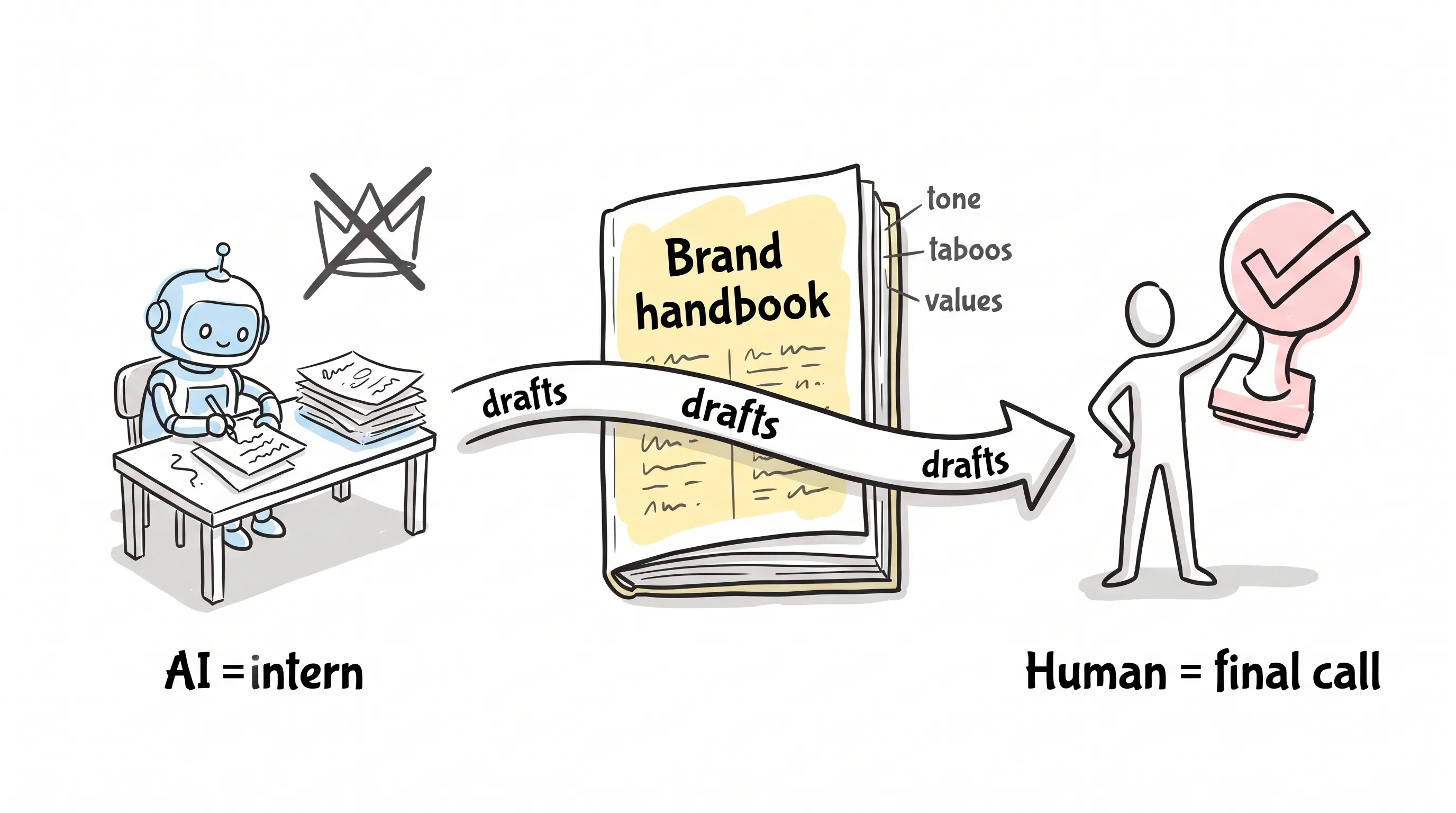
Same tools, worlds-apart results. The difference is that handbook.
One Move You Can Copy
If you're using AI in marketing too, there are four things — and you can't skip a single one:
- Goals. Before you reach for AI, be clear about what it's for. Efficiency? Testing? Saving headcount? Without a goal, AI will just help you produce noise — efficiently.
- A handbook. Write your brand voice, taboos, and values into a document, and feed it to the AI. This is the cheapest way to keep your content from turning into everyone else's.
- A gatekeeper. Every piece of AI output must be reviewed by a human before it's published. Check facts, check tone, check compliance. Who reviews, and who takes the blame when something slips — put a name on it.
- Reviews. Every quarter, look back: what did AI help with, and what did it hurt? Regulations change, tools change — and how you use them has to change along with them.
None of the four is hard. What's hard is sticking with them.
Finally, Back to That Dinner
After dinner that night, my friend went home and did one thing: he shut off AI's auto-publishing, rewrote his brand handbook from scratch, and ruled that all AI output must pass through a human first.
A month later, he reported back: content volume had dropped to half of what it was, but people had started messaging them to ask, "Who writes your copy? It's actually interesting."
See — AI can write you ten thousand sentences.
But what makes users remember you has always been that one sentence only you can say.
Tools handle fast. Humans handle right. Whoever gets those two jobs backwards gets averaged away by this era.
Here's wishing you this: use AI, but don't become AI.
Continue reading
Related articles

Cross-Border Business: Time to Upgrade Your AI Toolbox
A learn article explaining how AI tools help cross-border e-commerce sellers clear five hurdles: language, regulation, logistics, payments, and fraud. It outlines a five-compartment toolbox, a five-step adoption path, and metrics such as conversion rate and CLV, while cautioning against over-reliance on AI.

AI Is Taking Over the Dirty Work of Social Media Marketing, One Task at a Time
This learn article outlines four social media marketing tasks AI can handle — audience analytics, content drafting and design, ad targeting and creative testing, and spam moderation — and cautions that taste, judgment, and data security remain human responsibilities.

AI Is Already This Good — Why Is Your Social Media Marketing Still Pure Manpower?
An overview of 18 AI tools for social media marketing, organized into six categories covering audience research, content creation, scheduling, comment and DM handling, ad management, and visual production, plus notes on personalization, prediction, and emerging trends.