
From 6 Words to 24: AI Search Is Rewriting E-Commerce
An analysis of how AI assistants are shifting e-commerce search from short keyword queries to longer natural-language requests, covering what this means for product detail pages, rising bot traffic, and feeding structured product data and FAQs to AI platforms.
A few days ago, I was shopping for a massager for my mom.
Not long ago, I would have opened a search engine and typed in a few stiff keywords: seniors, knees, massager. Then I would have flipped through page after page of blue links, all on my own.
This time, I did no such thing. I opened an AI assistant and laid it all out, the way you'd ask a friend for a favor:
My mom is 68, her knees can't stand the cold, she has mild high blood pressure, my budget is under 1,500 yuan (about US$200), I want something simple to operate and not too noisy — what would you recommend?
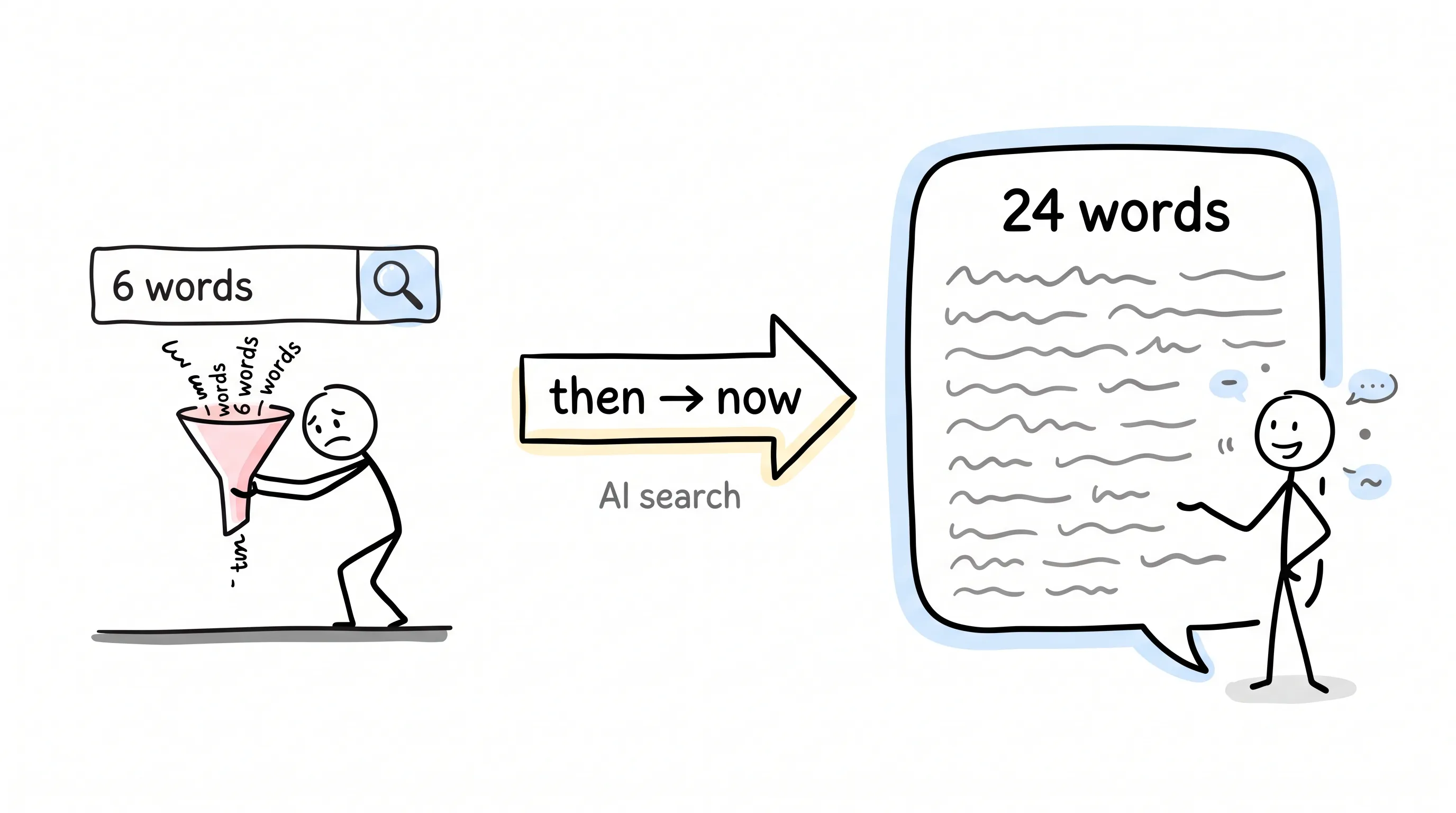
Only after typing it all out did it dawn on me: a message like that would have been flat-out heresy back in the day. That little search box was designed for six words.
Today, people average 24 words per query when they talk to an AI assistant. On Google, searches used to average just 6.
Why is everyone suddenly so talkative?
Because Consumers Finally Get to Stop Shrinking What They Say
Searching used to mean putting your needs through a round of "shrinking" first.
In your head, the full picture: Mom's knees ache in the cold, she has high blood pressure, she can't work complicated gadgets, the budget is 1,500 yuan. But by the time you reached the search box, only a few words had survived. For everything else, you were on your own — clicking links, combing through reviews, ruling options out one by one.
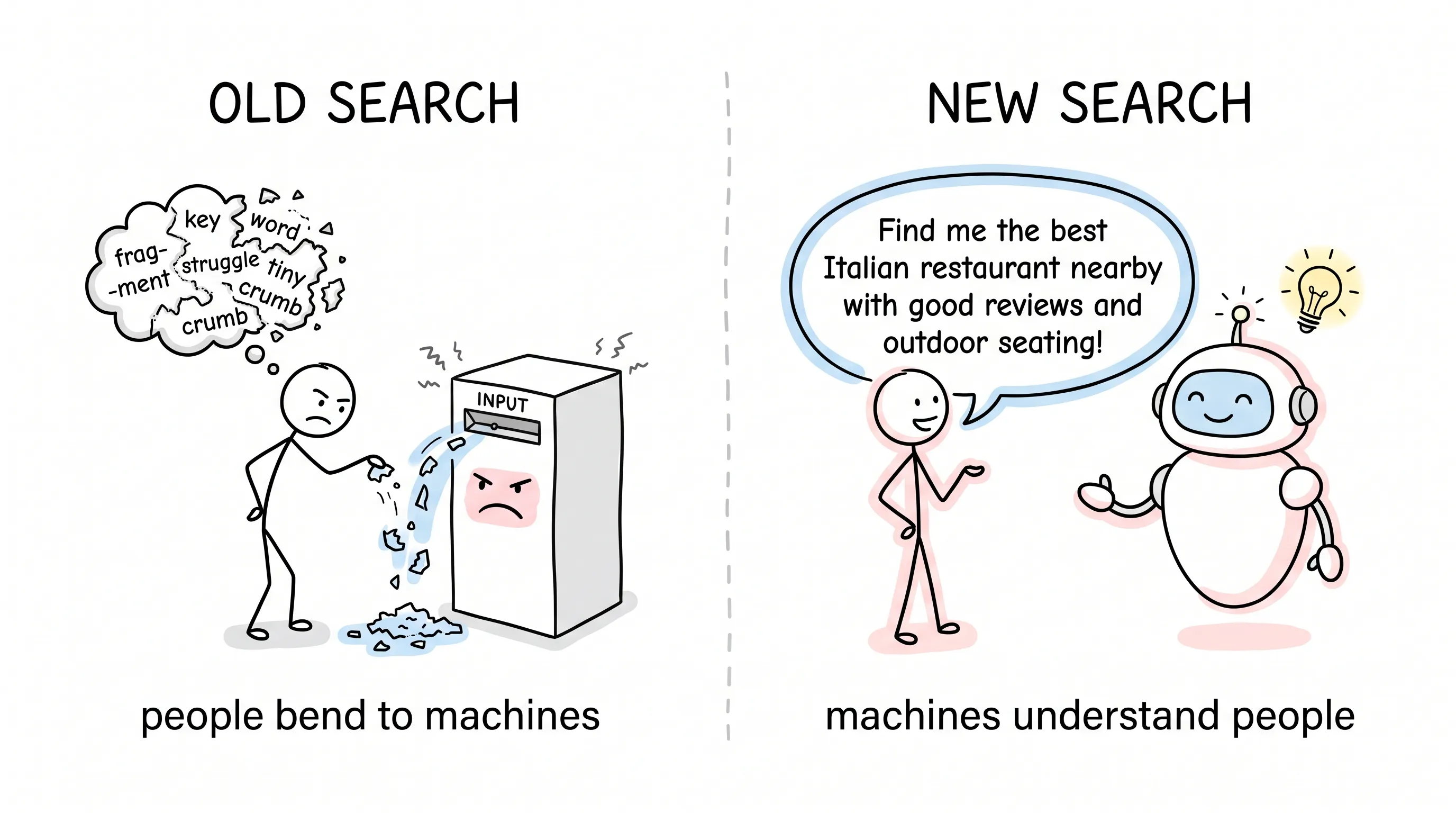
It's not that consumers love typing short phrases. It's that machines only ever understood short phrases, so people had to break what they wanted into crumbs and feed them to the machine.
Now that AI understands plain language, people dropped the act. What the product is for, which brands they prefer, how many people are in the household — everything comes pouring out in one go.
Consumers don't think of this as "searching." It's asking a knowledgeable friend for help.
On the surface, the only change is that sentences got longer. Look one level deeper, and it's the very foundation of e-commerce that's shifting.
Your Product Page Was Built for a Bygone Era
What is a product detail page, really?
It's one product with one fixed page of introduction. A title stuffed with keywords, photos posed at their best angles, selling points laid out in a neat list — and there it sits, waiting to be searched.
That whole setup was built for the "six-word era." Six words pointed to one page, and the page said its piece, once and for all: what this is, how much it costs, what it can do.
But the real puzzle of the AI era is this: the same product is a completely different thing depending on who's asking.
Take a coffee machine. One person asks, "What's a classy housewarming gift for a friend who just moved — a coffee machine a total beginner won't fumble?" Another asks, "I'm up late every night revising drafts — I need one that brews fast and cleans up easy." The product hasn't changed; the ways of asking it are all over the map.
Think about it: how is a single detail page supposed to catch a thousand different ways of asking?
It can't. And so legions of product pages are turning into "the one nobody mentions" in AI's answers.
So what do you do? Hire a thousand editors to write a thousand versions of every product? Back then, that was crazy talk, because the marginal cost of content was frighteningly high.
Now, large language models have driven the cost of producing content down to nearly zero.
Opiversal CEO and co-founder Lucas Tieleman has a way of putting it that I love: a website has gone from a printed product brochure to a living organism. When a new trend pops up on social media, when users start asking in a new way, the website grows new landing pages to catch that long-tail, natural-language demand.
With costs approaching zero, personalization at scale becomes, for the first time, a business that actually pencils out.
Bots Have Already Started Shopping for Us
At this point you might ask: so is AI about to place orders on consumers' behalf?
Not yet. Fully autonomous purchasing isn't mainstream at the moment.
But one thing has already happened: bot traffic is surging.
Why? Because before an AI can answer that 24-word question, it has to go "browse" the e-commerce sites on the user's behalf. Large language models crawl product pages, compare specs, read the reviews, pull the answer together, and serve it up.
Which means your store is now getting a whole wave of customers who never spend a dime — scouts, sent ahead by the people who do.
For marketers, this is a very real headache. That pile of impressions in your reports needs re-sorting: which ones were seen by humans, and which were bots asking on a human's behalf? The impressions you can see and the impressions that actually close a sale are now two different ledgers.
Want AI to Find You? Learn to Feed It
So what should e-commerce actually do?
Lucas's advice is blunt: re-feed your product data.
Structured data needs to be complete. Product attributes should be written the way customers actually talk — not "350 ml capacity," but "enough for two people in one go." And the questions customers keep asking should be compiled into detailed FAQs and fed straight to AI platforms and ad platforms.
Because from now on, visibility is no longer about how pretty your pages are. Your visibility equals how well the model understands you.
The Biggest Lie in Marketing
Near the end of the conversation, someone asked Lucas: what's the biggest lie in the marketing industry?
His answer has stayed with me: this industry keeps believing there's "one right answer" out there.
Is there a single best version of an ad creative? Is there a standard playbook for a media-buying strategy? How many marketers have argued about this until dawn?
But the technology is sitting right there: you can test ten paths at once, and switch the moment one fails. In his words, you can now "get it wrong more efficiently."
You don't have to get it right the first time. You can get it wrong more efficiently.
Oh, and here's another line of his worth quoting: Apple proved how much UX and design matter; Amazon proved that they don't matter all that much.
See? If even Apple and Amazon haven't argued their way to a standard answer, what are you so anxious about?
Back to That Massager
Finally, back to the massager from the beginning.
After listening to my rambling description, the AI came back with two recommendations, and even flagged which model runs loud and which keeps the buttons to a minimum. I ordered one of them. My mom has been getting good use out of it — her knees are toasty warm.
It ended up in our home not because of a flawless product page, but because something understood my mom's knees.
The old search made people bend to machines. The new search makes machines understand people.
Whoever grasps that first catches the next wave of customers.
May you, too, be understood — and soon.
Continue reading
Related articles

Cross-Border Business: Time to Upgrade Your AI Toolbox
A learn article explaining how AI tools help cross-border e-commerce sellers clear five hurdles: language, regulation, logistics, payments, and fraud. It outlines a five-compartment toolbox, a five-step adoption path, and metrics such as conversion rate and CLV, while cautioning against over-reliance on AI.

AI Is Taking Over the Dirty Work of Social Media Marketing, One Task at a Time
This learn article outlines four social media marketing tasks AI can handle — audience analytics, content drafting and design, ad targeting and creative testing, and spam moderation — and cautions that taste, judgment, and data security remain human responsibilities.

AI Is Already This Good — Why Is Your Social Media Marketing Still Pure Manpower?
An overview of 18 AI tools for social media marketing, organized into six categories covering audience research, content creation, scheduling, comment and DM handling, ad management, and visual production, plus notes on personalization, prediction, and emerging trends.