
From $23.6 Billion to $90 Billion: AI Is Remaking the Influencer Marketing Business
A learn article explaining what influencer marketing platforms do, citing market size projections, and describing how AI is reshaping influencer discovery, content production, predictive campaign planning, and fraud detection, with notes on segments, regions, and key vendors.
A while back, a friend of mine who runs a consumer brand came to me to vent.
He said that with the old way of buying ads, it felt like dumping money into the sea. Elevator screens, app splash ads, in-feed social ads — he ran a full round of placements, and at the review meeting nobody could say how many extra orders any of it had actually bought. So he bit the bullet and moved half his budget to a handful of short-video influencers. The results were surprisingly good: people were asking for links in the comments, and customer service could trace which influencer each order had come from.
But new trouble arrived almost immediately.
Five influencers became fifty. Contracts, scheduling, payments, post-campaign reviews — all shouldered by one intern armed with spreadsheets. His words: "It's not that I don't want to keep investing. I just can't manage it anymore."
I gave him just one line: What you're missing isn't influencers. It's a system.
Today, let's talk about the business behind that system: what it actually is, how big it is, why it keeps growing, and where the pitfalls lie.
What Exactly Is an Influencer Marketing Platform?
First, let's get the concept straight.
An influencer marketing platform is a tool that turns "finding people who can sell for you" into software. It filters candidates by audience profile, engagement rate, and content niche; manages contracts, scheduling, payments, and post-campaign reviews in one place; tracks impressions, engagement, conversions, and repeat purchases for every campaign; and, while it's at it, checks ad compliance too.
Simply put: what used to run on agencies, Excel, and manual chasing, one system now handles end to end.
How Big Is This Business?
Let's run the numbers.
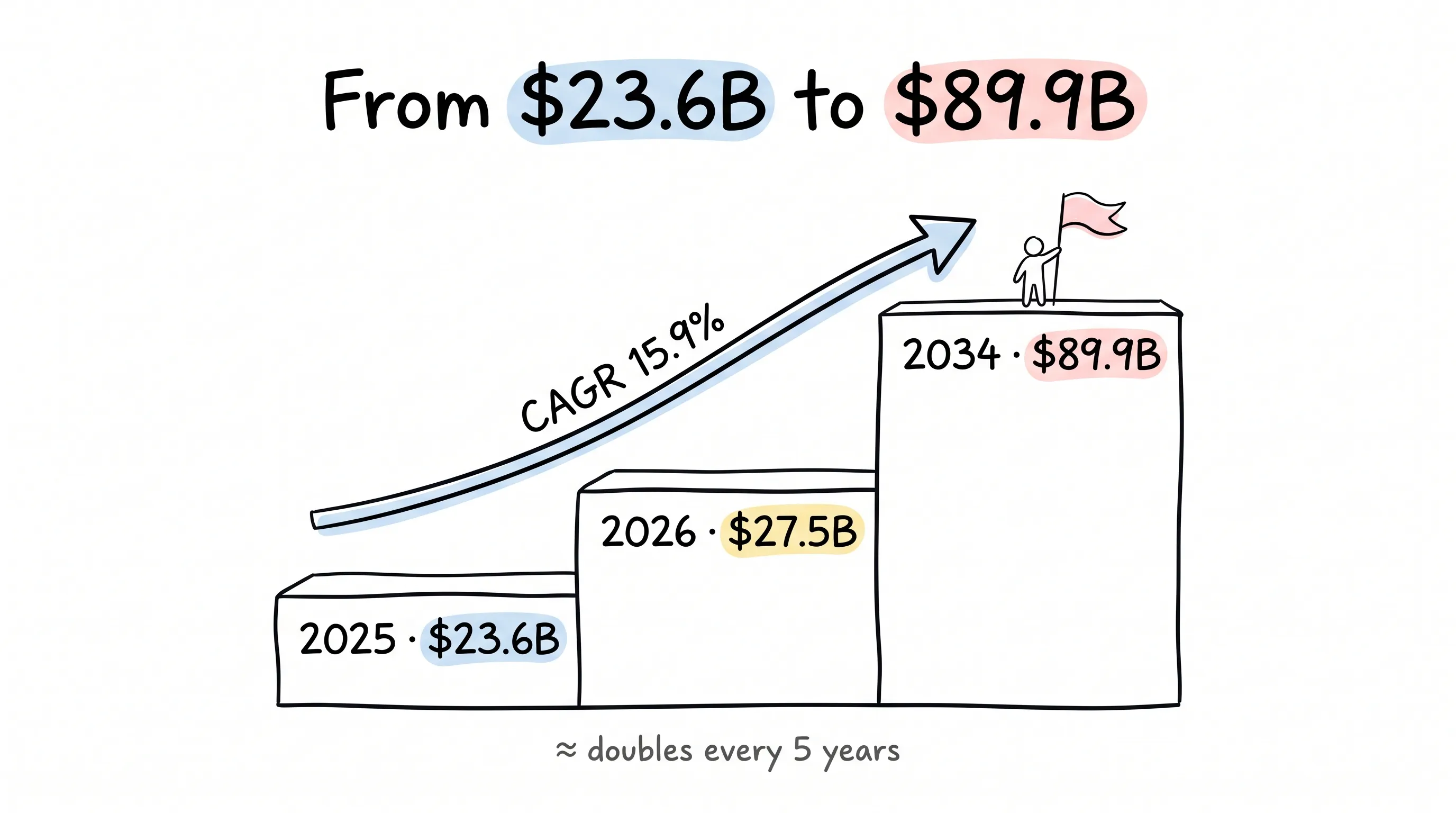
Market research firm Fortune Business Insights has published a set of figures: the global influencer marketing platform market was worth $23.59 billion in 2025, is projected to reach $27.54 billion in 2026, and will hit $89.9 billion by 2034. That works out to a compound annual growth rate of 15.9%.
What does 15.9% mean? Compounded, the entire market roughly doubles every four and a half to five years.
What kind of business doubles over and over like that?
My answer: a business that sells trust.
Why do I say that?
Sprout Social put a number on it: in 2025, 5.42 billion people worldwide use social media, and the average person browses 6.83 platforms a month. Where attention goes, advertiser money eventually follows. Meanwhile, OTT and social media keep slicing audiences into ever finer fragments, traditional placements cost more and more, and their results grow harder and harder to explain. Brands have had to think differently: instead of casting a wide net, put your money on the people their followers actually trust.
There's also a piece of history worth noting. During the pandemic, offline channels went silent, and for the first time many brands moved a full-scale budget online, onto influencers. Once they got a taste, there was no going back.
AI Is Rebuilding This Business From the Ground Up
This next part is, to me, the most interesting.
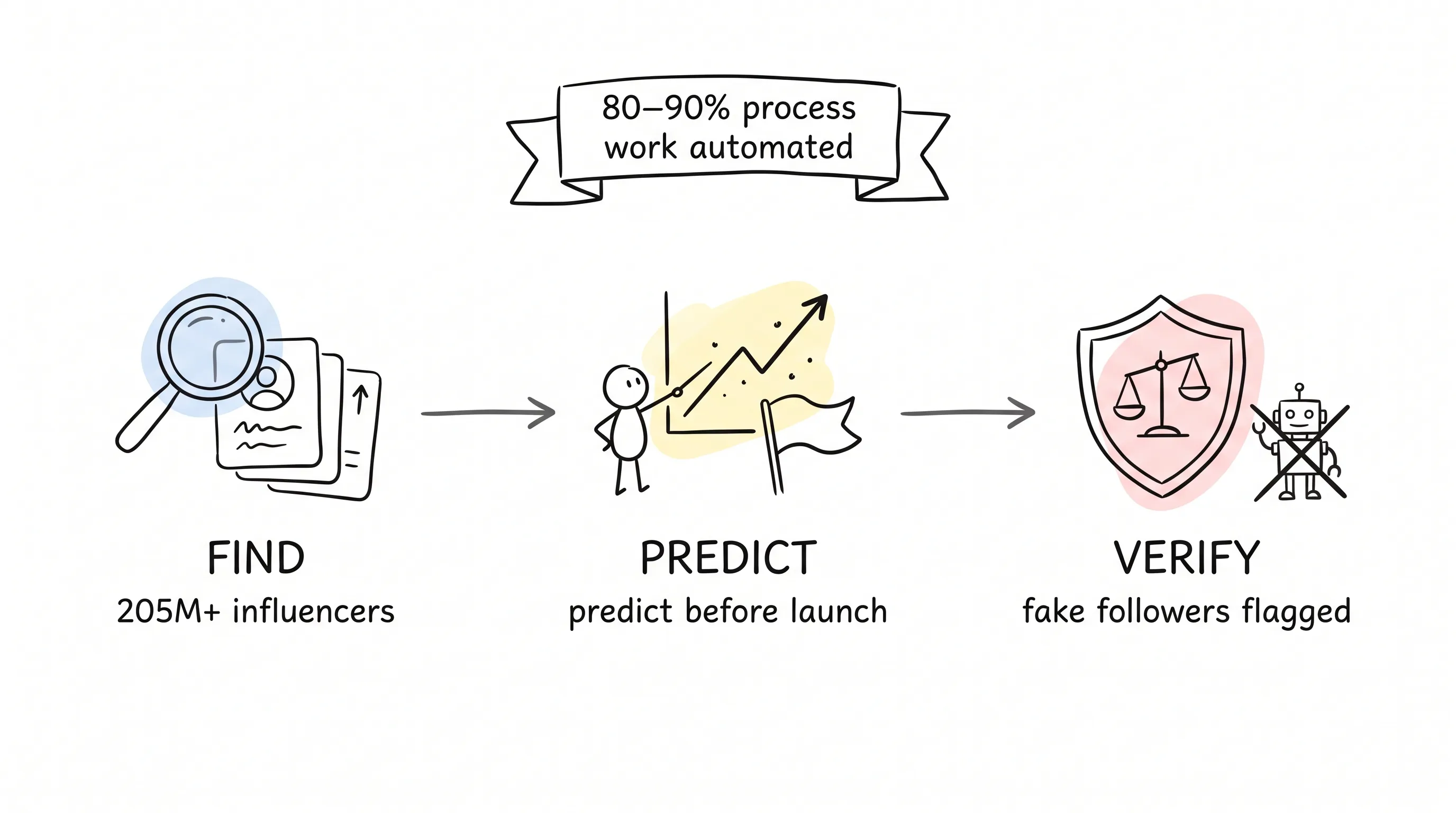
Start with content production. Since generative AI entered the picture, mass-producing content and predicting which influencer is likelier to drive volume have become standard platform features. A real case: a company called Dreamwell AI built an automated system that hands the process work — finding influencers, reaching out to them — over to machines. The company claims that in a single campaign, 80 to 90 percent of the process work can be taken over by automation.
My God — eighty to ninety percent. What's left for the people to do? The part machines can't: make judgment calls, build relationships.
Next, finding the right people. Picking influencers used to run on familiarity and referrals. Today, tools like HypeAuditor hold a database of more than 205 million influencers spanning Instagram, YouTube, TikTok, Twitter, and Twitch. You filter down layer by layer — audience profile, geography, follower scale — and run fake-follower detection while you're at it. Picking people is shifting from gut feeling to hard data.
Even more aggressive: platforms are starting to use predictive models and natural language processing to estimate, before a campaign even launches, how big a splash a given influencer-audience match will make. For the first time, budget allocation can run ahead of the results.
Finally, the old chronic problem. The deepest ailment in this industry is fake followers and engagement fraud. Platforms now use AI to flag abnormal data while bringing in blockchain to verify transactions, so every collaboration leaves a traceable record. The moment fake traffic becomes detectable, genuine engagement has a price for the first time.
Oh, and one new side quest: AR and VR. Influencers use AR filters to let fans try on makeup and outfits, and VR scenes for virtual showroom visits — gaming, fashion, beauty, and travel are already doing this. The more concrete the experience, the easier the conversion.
But There's Always a Flip Side
Time to pour a little cold water on all that.
First pitfall: crowding. The more players pile in, the thinner each campaign's impact gets. When one influencer is running 20 partnerships at once, followers go numb from seeing them all. An influencer's persona stands on credibility; take on too much, and you become a walking billboard.
Second pitfall: the math doesn't add up. This industry still has no unified measurement standard. The data is opaque, and platform algorithms change on a whim — when brands sit down to review, they often can't answer the simplest question: was this money actually worth it?
So you see, the biggest hidden cost of this business is trust depreciation. Whoever makes measurement standard and transparent wins the second half first.
Taking the Market Apart, Piece by Piece
Let's switch angles and take this machine apart.
By product type, software is the absolute mainstay, at 75.72% in 2026. The logic isn't complicated: brands want to find influencers themselves, and SaaS tools are ready the moment you log in. Services are a smaller slice, yet the fastest-growing, because brands increasingly want customized strategy — work software can't fully handle. That takes people.
By application, the biggest chunk is brand reputation management, 35.71% in 2026. Consumers today watch brands closely: are the ads telling the truth, is the supply chain clean. Hiring influencers is no longer just about driving sales — it's about protecting your name. That's why platforms are adding sentiment analysis and trust metrics to monitor public perception of brands in real time. The fastest-growing application is influencer management itself: contracts, settlement, performance analysis — helping brands turn one-off collaborations into long-term relationships.
Who's paying? Enterprises take the biggest share, 47.07% in 2026, as large companies fold analytics, content workflows, and campaign automation into one system. The fastest-growing buyers are e-commerce sellers: wherever the goods are headed, they find influencers in that region to pave the way.
Which industries can't live without it? Fashion and lifestyle holds the biggest share — it was already No. 1 in 2024. Outfits and beauty are born to live in pictures and video; product launches, livestream shopping, styling guides — all run on influencers. The fastest-growing is health and fitness: wearable data, online fitness communities, personalized health plans — breeding a crop of influencers with exceptionally sticky niche followings.
Where the Money Sits on the World Map
Now, geography.
North America is the leader. In 2025 it held 37.2% of the global market, $8.77 billion, projected to reach $10.12 billion in 2026; the US alone is worth roughly $6.65 billion in 2026. Platform penetration is high, the big players' playbooks are mature, and campaigns roll out one after another.
Europe is second, $6.55 billion, 27.7%. Interestingly, the European playbook was forced into shape by GDPR: strict data regulation pushed brands toward transparency and compliance, which turned influencer marketing into a values-driven business there. Sustainability and social responsibility are especially hot themes in European campaigns.
The fastest-growing region is Asia-Pacific: $5.11 billion in 2025, projected at $6.11 billion in 2026. In China, India, Indonesia, and the Philippines, social media users are still surging; short video, livestream selling, and localized playbooks keep pushing the market forward. By the report's reckoning, China's market will be about $1.86 billion in 2026, Japan's $1.45 billion, India's $1.39 billion.
The Middle East and Africa start at $1.89 billion, and in the GCC countries — young, phone-glued populations — brands are doing brisk engagement business. In South America, Brazil and Argentina lean on hosts of small-but-highly-trusted micro and nano influencers, turning localization into an art form.
What the Players at the Table Are Doing
One last look at the players.
Dentsu Group, Sprout Social, Grin, Upfluence, AspireIQ, Later, Traackr, Klear, CreatorIQ, Brandwatch, Captiv8, NeoReach... It's a long list, yet the playbook is remarkably consistent: acquire, partner, add features.
A few moves from the past couple of years, so you can feel the tempo.
May 2024: Meltwater folded its influencer marketing tool Klear into its own social media management platform Engage, so clients could get everything done in one dashboard.
April 2024: Later (backed by Mavrck) launched the podcast "Beyond Influence," dedicated to the industry's trends and tactics.
October 2023: Captiv8 signed an API partnership with Snapchat, securing access to the Creator Discovery API and piping cross-platform data into its own system.
Scroll back further: March 2022, Brandwatch acquired influencer marketing platform Paladin, rounding out its end-to-end capabilities; June 2023, AnyMind Group launched Social Hack, stringing TikTok, Instagram, and its own tools together; July 2022, Traackr rolled out an industry job board.
You notice what's going on? Nobody's resting on their laurels. The faster the business runs, the harder the players fight to weld data and relationships permanently into their own platforms.
A Final Word
Back to that friend from the opening.
He eventually got himself a platform tool. Contracts, scheduling, payments for all fifty influencers, all running in a single dashboard. Last month he told me that now, for every influencer he invests in, he can see exactly what that money bought back.
That hit me. This business looks like it sells software; what it really sells is a set of scales. The scales that weigh "trust" and put a price on it.
As for whether the market ends up stopping at $89.9 billion or blows past it early — honestly, that doesn't matter much.
What matters is who first weighs trust most accurately — that's who gets the boarding pass for the next leg.
And may you, too, soon find the person who will vouch for you.
Continue reading
Related articles

Cross-Border Business: Time to Upgrade Your AI Toolbox
A learn article explaining how AI tools help cross-border e-commerce sellers clear five hurdles: language, regulation, logistics, payments, and fraud. It outlines a five-compartment toolbox, a five-step adoption path, and metrics such as conversion rate and CLV, while cautioning against over-reliance on AI.

AI Is Taking Over the Dirty Work of Social Media Marketing, One Task at a Time
This learn article outlines four social media marketing tasks AI can handle — audience analytics, content drafting and design, ad targeting and creative testing, and spam moderation — and cautions that taste, judgment, and data security remain human responsibilities.

AI Is Already This Good — Why Is Your Social Media Marketing Still Pure Manpower?
An overview of 18 AI tools for social media marketing, organized into six categories covering audience research, content creation, scheduling, comment and DM handling, ad management, and visual production, plus notes on personalization, prediction, and emerging trends.