
From $2.5 Billion to $143 Billion: Just How Hot Is the Generative AI Boom in the US and Europe?
An overview of the generative AI market in the US and Europe, covering market size projections, user demographics, use cases in marketing and content production, and investment and regulatory trends.
A few days ago, I had dinner with a friend who runs a cross-border e-commerce business. He vented to me over the meal: for the same product, he has to tell two different stories — one to American customers, one to German customers. Copy, images, videos — everything has to be made twice, and his team has been working overtime until they're seeing stars.
I asked him: why not give AI a try?
He said: we did. And now we're hooked.
That got me curious. Where exactly has generative AI in the US and Europe gotten to? What are people actually using it for? And how do money and rules revolve around it?
Today, let me walk you through the research and numbers I've been seeing lately.
How Big Is This Market?
What does market maturity look like? It's when you don't have to educate users — they pay out of their own pockets.
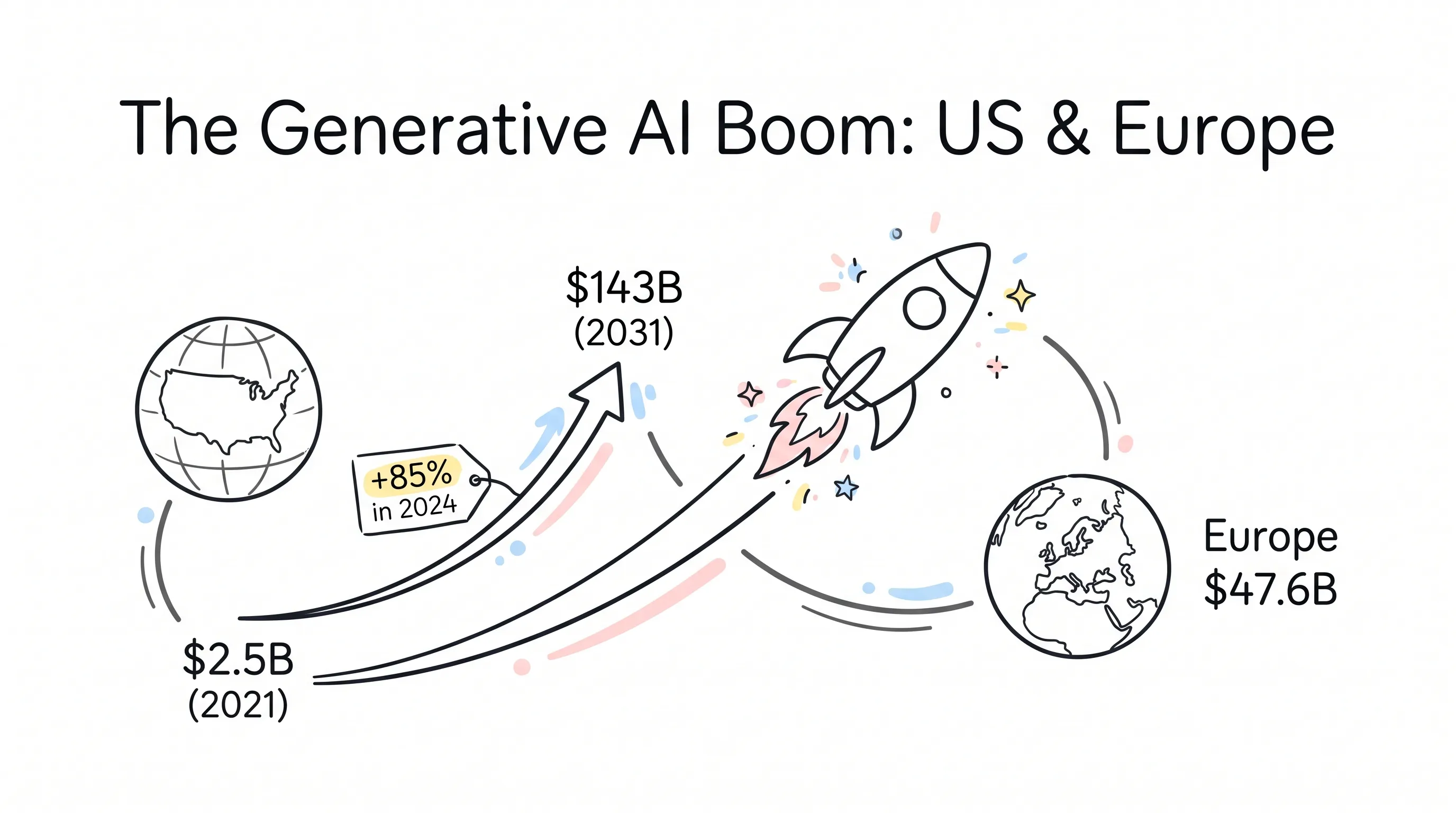
The US has a distinctive trait: it consistently takes about a third of the world's generative AI spending. According to Statista, the US generative AI market was just $2.5 billion in 2021 and is projected to exceed $143 billion by 2031. In 2024, midway through that climb, growth briefly surged to 85%. What does 85% mean? Plenty of industries will never touch that number in their entire lifetime.
This isn't growth. This is an eruption.
What about Europe? According to IDC's Worldwide AI and Generative AI Spending Guide, Europe's AI and generative AI market was closing in on $47.6 billion in 2024, with a compound annual growth rate of 33.7% from 2022 to 2027 — roughly one-fifth of the global AI market.
Zoom out globally, and the forecasts from various institutions show the generative AI market climbing from $7.69 billion in 2021 all the way to $442 billion by 2031.
Staggering. In about a decade, nearly sixtyfold.
McKinsey put out a report in 2023 estimating the economic value generative AI could create each year: $2.6 trillion to $4.4 trillion. Which industries does that cover? Finance, retail, manufacturing, healthcare — across 63 typical use cases.
And the US — with its highly digitized industries and rapid, aggressive AI adoption — is likely to be one of the biggest contributors to that value.
Who Is Actually Using It?
Guess who the main users of AI products are?
Not gray-haired veteran engineers. It's young people.
In the US and European markets, more than half of active users are millennials and Gen Z. Their studying, socializing, working — all of it is steeped in AI. This crowd is naturally quick to pounce on new technology. In other words, whoever wins the young wins the engine of AI adoption.
What Are They Using AI For?
Start with marketing — the area, I think, closest to everyday people.
91% of US advertising agencies are already using or actively trying AI marketing; the figure for European companies is about 67%. What does 91% mean? Nine out of ten companies. This stopped being a trend long ago — this is the status quo.
Why is the marketing industry so eager? Think about cross-border e-commerce: one product going global faces consumers in dozens of countries, each needing its own messaging. Produce it manually? The cost will crush you first. AI does this — multilingual, fast-iterating, and cheap.
That's how platforms like Runway, Synthesia, and Canva can act like catalysts, igniting the entire industry.
Now look at the layering within content production itself.
Text generation is the most mature. After ChatGPT lit up the market at the end of 2022, writing assistants, Q&A systems, and document tools quickly became the norm for individuals and businesses alike: writing emails, creating marketing copy, summarizing reports, drawing up legal documents. For companies, text generation has gradually grown into CRM (customer relationship management) and internal knowledge bases, becoming part of digital operations.
Image generation follows close behind. After breakthroughs in diffusion models (AI models that generate images by gradually refining random noise), tools such as MidJourney, Stable Diffusion, and DALL·E have been widely used in advertising design, brand marketing, game art, and film pre-production. Those eye-catching images you see on social media and e-commerce platforms increasingly come from AI.
The most interesting one is writing code.
Someone analyzed 80 million code commits on GitHub between 2018 and 2024 and found that by the end of 2024, roughly 30.1% of Python functions submitted by US developers were AI-generated. Asian developers? 11.7%.
Almost a threefold gap.
The more sobering number is this: when a developer's AI usage rate reaches 30%, their quarterly commit count rises by an average of 2.4%. See — AI doesn't just lower the barrier to coding; it converts directly into productivity.
Money and Rules
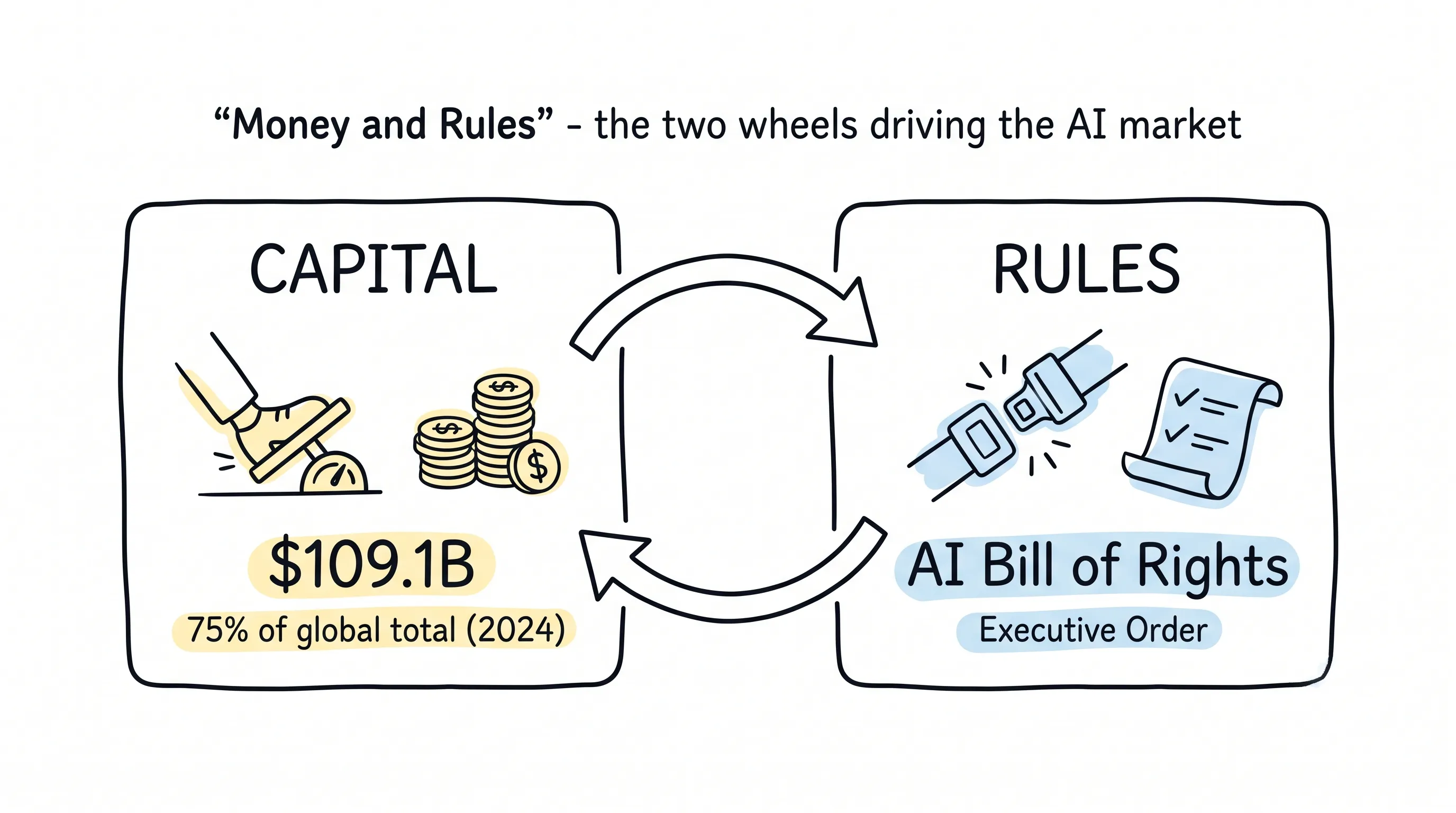
Why is this market moving so fast? Two wheels drive it: one is capital, the other is institutions.
Follow the money first. In 2024, US private AI investment reached $109.1 billion, about 75% of the global total. Seventy-five percent! Practically a consensus, voted into being by investors around the world with their feet. Around Microsoft, Google, and Amazon, an entire ecosystem has grown up.
Europe isn't slow either. By 2029, European AI investment is projected to reach $250 billion, with over 90% of it concentrated in Western Europe.
Now the rules. Through the Blueprint for an AI Bill of Rights and the Executive Order on the Safe, Secure, and Trustworthy Development and Use of Artificial Intelligence, the US has put together a regulatory framework that leans toward safety and transparency.
Capital steps on the gas; the rules fasten the seatbelt.
That's the underlying model of the US and European AI markets. And they are the two markets no AI company going global can get around.
Back to That Dinner
After dinner that day, my friend went back and approved the budget for his team's AI tools. He said something to me that stuck with me: "I used to chase the technology. I've stopped chasing now — I can't keep up. All I can do is learn to ride it."
The market has already voted with real money. $143 billion or $442 billion — the numbers will change; the direction won't.
Here's hoping you learn to ride it too.
Continue reading
Related articles

Cross-Border Business: Time to Upgrade Your AI Toolbox
A learn article explaining how AI tools help cross-border e-commerce sellers clear five hurdles: language, regulation, logistics, payments, and fraud. It outlines a five-compartment toolbox, a five-step adoption path, and metrics such as conversion rate and CLV, while cautioning against over-reliance on AI.

AI Is Taking Over the Dirty Work of Social Media Marketing, One Task at a Time
This learn article outlines four social media marketing tasks AI can handle — audience analytics, content drafting and design, ad targeting and creative testing, and spam moderation — and cautions that taste, judgment, and data security remain human responsibilities.

AI Is Already This Good — Why Is Your Social Media Marketing Still Pure Manpower?
An overview of 18 AI tools for social media marketing, organized into six categories covering audience research, content creation, scheduling, comment and DM handling, ad management, and visual production, plus notes on personalization, prediction, and emerging trends.