
From $16.2 Billion to $306.9 Billion: This Business Sells Trust
A while back, a friend of mine who runs an e-commerce business took me out to dinner.
A while back, a friend of mine who runs an e-commerce business took me out to dinner.
Halfway through the meal, he started venting. He'd sunk hundreds of thousands into ads. The click-through rates looked great — but nobody was buying. Then, almost as an afterthought, he found a blogger with fewer than 100,000 followers who posted a single video. Sold out that same day!
He asked me: is that crazy, or what? A big platform's ad slot, beaten by a blogger's casually shot phone video.
I told him: not crazy at all. What you paid for was exposure. But what makes customers hit "buy" is trust.
Behind this lies a big market that's off to the races.
What Is an Influencer Marketing Platform?
Let's get the concept straight first. What is an influencer marketing platform?
An influencer marketing platform is the software and services that help brands find bloggers, manage collaborations, and measure results.
Think of it as a matchmaking service. The brand is one side, desperate to find the right match; bloggers are the other, each with their own followers and their own style. The platform does three things: introduces you, helps the relationship work day to day, and tells you whether the whole thing was worth the bill.
That's the business. In November 2024, I came across an industry report on this market, and one number stopped me cold:
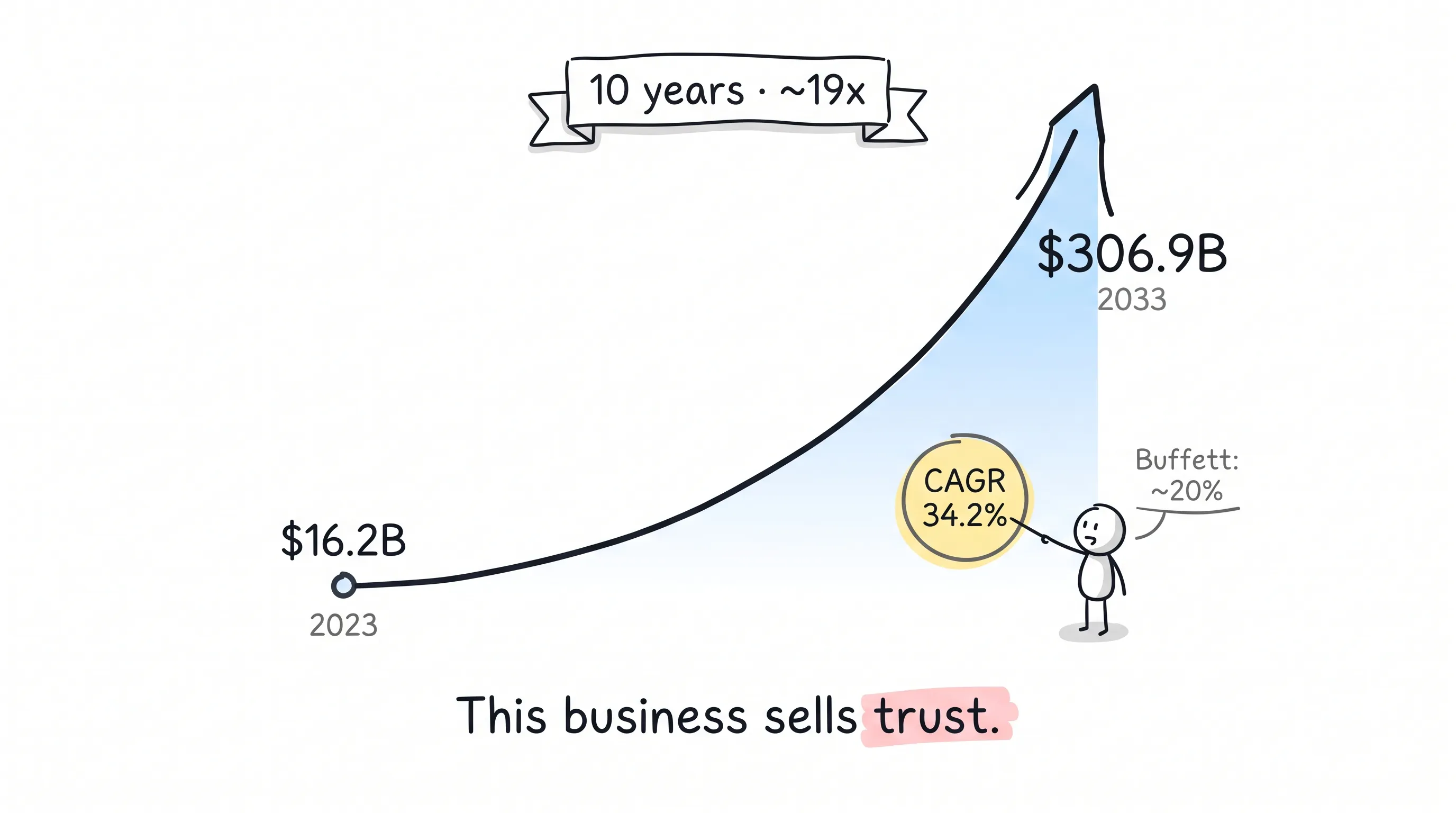
In 2023, the global influencer marketing platform market was worth $16.2 billion.
The report projected that by 2033, it would grow to $306.9 billion.
Ten years, nearly 19x. That works out to a compound annual growth rate of 34.2%.
What does 34.2% mean? Buffett spent his whole career compounding at roughly 20% a year.
Of course, it's a projection — take it with a grain of salt. But the direction? Hardly anyone would question that. At the time, the biggest share of this money sat in North America, 31.7%, about $5.14 billion. After all, social media's commercialization got running earliest over there.
Why?
Why can this business run so fast?
The answer, in four words: trust is moving house.
Think about it. How did advertising used to work? Brands shouted on TV, shouted on billboards, shouted in your feed. The more they shouted, the more they sold.
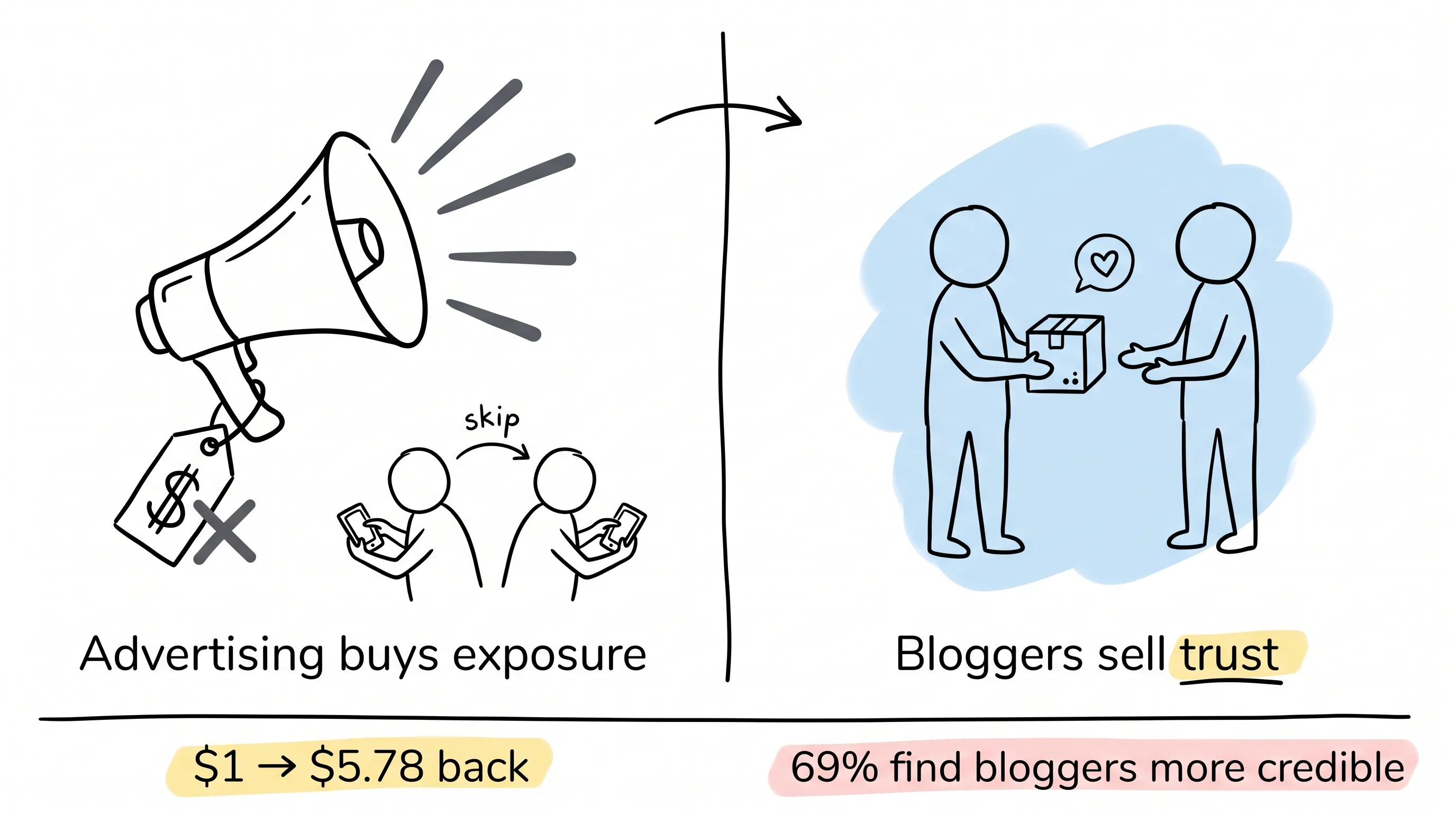
But consumers got smart. You shout yours; they scroll theirs. They can skip TV ads. They can swipe past feed ads. There's exactly one thing they can't skip: the person they chose to follow.
Back then, 61.4% of the world's population was on social platforms. Where the people gather, business must go.
One number from the report: 69% of consumers said blogger recommendations feel more credible than traditional ads.
The report also ran the math: every $1 spent on influencer marketing brought back $5.78 on average.
Advertising buys exposure. Bloggers sell trust.
So by then, 80% of companies had already written influencer marketing into their budgets. Influencer marketing spend in the US market was projected to hit $4.6 billion — double what it was five years earlier.
Where the money flows, the tools grow. Finding bloggers went from a side errand for the marketing department to a proper industry in its own right. And an industry needs equipment. With equipment comes this market.
What Does This Business Look Like?
The report slices the market a few ways, and every cut is interesting.
First, by product type. In 2023, software took 65%, services 35%. Why is software the bigger piece? Because once finding bloggers, managing them, and measuring results become repetitive work, people want to automate. Aggregating data on millions of bloggers and filtering out the right few — that's a job only software can do.
Next, by customer size. Large enterprises took 76%. Big budgets, many bloggers, messy data — without a platform, you simply can't play. But the interesting part is the other end: most brands spend less than $10,000 a year on influencer marketing, while about 11% of brands throw in more than $500,000 a year. Pricing for a single piece of content mostly lands between $100 and $499; that tier accounts for 19% of transactions.
See the shape? It's a dumbbell. Giant players on one end, a sea of small deals on the other — and the space in between is what keeps the platforms in business.
Then, by function. Among all features, "search and discovery" holds 35%, the largest chunk. No surprise: the hardest part of any campaign is the very first step — finding, among millions of bloggers, the one whose vibe matches your product. Pick the wrong person and everything after is wasted effort.
Finally, by industry. Retail e-commerce holds 59%, dominating alone. The reason is wonderfully plain: this industry sits closest to the point of purchase. A blogger drops a link, followers buy on impulse. Finance, healthcare, and B2B were only just entering the field back then.
Where Is the Battle Fought?
With this many platforms, the fight plays out mainly in three places: Instagram, YouTube, and TikTok.
Instagram is the home ground. At the time, 68% of marketers were using it for campaigns, and brands spent about $1.95 billion on blogger placements there. 83% of users said they discover new products on the platform. Blogger content pulled an average engagement rate of 3.21% — comfortably ahead of brand-owned accounts.
YouTube and TikTok each took roughly $986 million — a dead heat. And that tie is fascinating: one stands for long-form video, the other for short-form, and neither has swallowed the other.
What genuinely made me go "whoa" was TikTok's engagement rate: 15.86% — nearly 5x Instagram's! In 2023, 67% of marketers planned to run campaigns on TikTok. The year before, that number was just 45%.
But the fiercest change in the industry at the time wasn't the platforms. It was the people.
What do I mean? The bloggers brands hire keep getting smaller.
In 2023, micro-influencers captured 46.4% of total brand and agency spending. At the time, 60% of marketers believed that for reaching niche audiences, micro-influencers beat big celebrities. HubSpot's social media marketing report, published in 2024, put it this way: 64% of marketers had worked with micro-influencers, and 47% said this type of collaboration performed best.
Look at Instagram itself: nano-influencers, the ones with the fewest followers, make up 65% of all bloggers on the platform.
Why? Picture it. A blogger with 100,000 followers — the comment section is your actual neighbors. A blogger with 10 million — it's strangers from who-knows-where. The fewer the followers, the more it feels like a friend. And you only dare buy what a friend recommends.
Finding the right person matters far more than finding lots of people.
The report has one more number that pushes this logic to its limit: 53% of female consumers had made a purchase because of a single blogger post. Revolve, which sells womenswear, ran the numbers: more than 70% of its sales came from blogger collaborations on Instagram. Zara has gone deep down this road too.
That's the closed loop. Discovery, purchase — done on a single screen.
But Everything Has a Flip Side
This business carries three thorns.
Thorn one: fake data. Buying followers, inflating engagement — no secret in this industry. You think you're buying the influence of 100,000 fans; what shows up is 100,000 bots. Once the source is fake, every calculation downstream is self-deception.
Thorn two: the math won't add up. Traditional advertising has standardized ratings metrics; influencer marketing has none. This platform uses one algorithm, that platform uses another yardstick — a brand trying to compare two campaigns can't even line up the rulers.
Thorn three: regulation. The US Federal Trade Commission (FTC) requires bloggers to disclose commercial relationships. When the report was compiled, only 25% of Instagram bloggers actually did. The rules will only tighten. Playbooks that coast on fudging it will pay up sooner or later.
All three thorns stab the same spot: trust. A business that lives on trust has to settle its debts in trust.
Who's Leading the Race?
So in this business, who's out front?
The report named three names.
CreatorIQ, strong in data and blogger relationship management — the big brands' favorite. Upfluence, strong across the full chain: finding people, outreach, and order management in one pipeline, with especially deep roots in e-commerce. Traackr, strong on globalization, skilled at helping brands build long-term relationships with bloggers.
2023 also saw a few deals. In July, Triller acquired the veteran platform Julius. In August, Lectra — which builds industrial intelligence for the fashion industry — took a controlling stake in Launchmetrics. In October, CreatorIQ packed AI features into its own products.
See it? Even the M&A trail tells a story: everyone is piling into data and AI.
As for what AI can do in this industry, the report listed a string of things: filtering talent from massive blogger pools, predicting whether a campaign will land, automatically handling contracts, reviewing content, processing payments — and finally calculating ROI clearly.
Put bluntly, those three thorns — fake data, fuzzy math, unmanageable oversight — are exactly what AI is aiming at.
Back to My Friend
Later, I told him all of this.
He turned it over for a long while, then said: where I went wrong was only looking for crowded places to shout, instead of finding the right person to talk to.
Exactly.
In 2023, this market was $16.2 billion. The report guesses $306.9 billion by 2033. Whether that number turns out too high or too low, nobody can say. But one thing is certain: as long as people still trust a friend's advice, as long as they'd rather believe a living, breathing person than a perfectly polished ad, this business will keep growing.
Wherever trust moves, business should chase.
And my wish for you: the next time you spend money on a campaign, may you buy not the loudest megaphone, but the right person.
Continue reading
Related articles

Cross-Border Business: Time to Upgrade Your AI Toolbox
A learn article explaining how AI tools help cross-border e-commerce sellers clear five hurdles: language, regulation, logistics, payments, and fraud. It outlines a five-compartment toolbox, a five-step adoption path, and metrics such as conversion rate and CLV, while cautioning against over-reliance on AI.

AI Is Taking Over the Dirty Work of Social Media Marketing, One Task at a Time
This learn article outlines four social media marketing tasks AI can handle — audience analytics, content drafting and design, ad targeting and creative testing, and spam moderation — and cautions that taste, judgment, and data security remain human responsibilities.

AI Is Already This Good — Why Is Your Social Media Marketing Still Pure Manpower?
An overview of 18 AI tools for social media marketing, organized into six categories covering audience research, content creation, scheduling, comment and DM handling, ad management, and visual production, plus notes on personalization, prediction, and emerging trends.