
For Twenty Years, Media Transparency Has Meant Auditing the Money. The Next Battle Is Over the "Why."
An opinion piece arguing that media transparency must move upstream: as AI produces media plans in minutes, advertisers should question how audiences and recommendations are formed, not just audit spend. It cites the7stars' Gravity Connect platform connecting Samba TV viewing data for UK households.
A couple of days ago, I had dinner with an old friend who works in media buying.
Over the meal he said something odd: what scares him most these days isn't an audit — it's an audit that can't be done.
I asked what he meant.
He said: for the past twenty years, the harshest thing an advertiser could say was, "Where did my money go?" Rebates, margins — reconciled line by line. Yes, there was arguing — but the arguing produced rules. Now it's different. AI can spit out a media plan in minutes. The money hasn't been spent, and the ledger already exists. Except nobody can explain how that ledger was calculated.
My chopsticks froze midair.
This is more serious than you think.
The Old Problem Hasn't Gone Away — the New One Is Already at the Door
To be clear: the money problem is still with us. Fronting the cash, how margins are calculated — the arguments will go on, and they should.
But AI is now charging into media planning: work that used to take humans days of grinding analysis is now promised in minutes — turning a brief into audiences, into recommendations, into schedules.
The power is enormous; I don't doubt it for a second.
But fast is not the same as progress.
If a machine gets you to an answer faster while making it harder to see how the answer was reached, you've traded clarity for efficiency. Is that a good deal?
Ten More Years of Data — Any More Understanding?
This question actually predates AI.
Over the past decade, the data available to planners has exploded. Demographics, attitudes, purchases, mobile, TV viewing — everything is queryable. Sounds wonderful, right?
Ask planners on the front line, and most will tell you an awkward truth: more data, not more understanding.
The same consumer has ten different definitions across ten platforms.
Each system measures on its own. An insight wrestled out of system A doesn't travel well to system B. Worse, an algorithm now sits between the data and the recommendation: what planners receive has already been chewed over by a machine.
Here is the irony: an industry holding the most audience intelligence in its history sometimes struggles to explain its own audience.
AI can digest that complexity — or raise it another notch. Both outcomes are real possibilities.
So here is my judgment: when you judge the next generation of agency technology, don't count what it automates; count the clarity it delivers.
Transparency Needs to Move Upstream
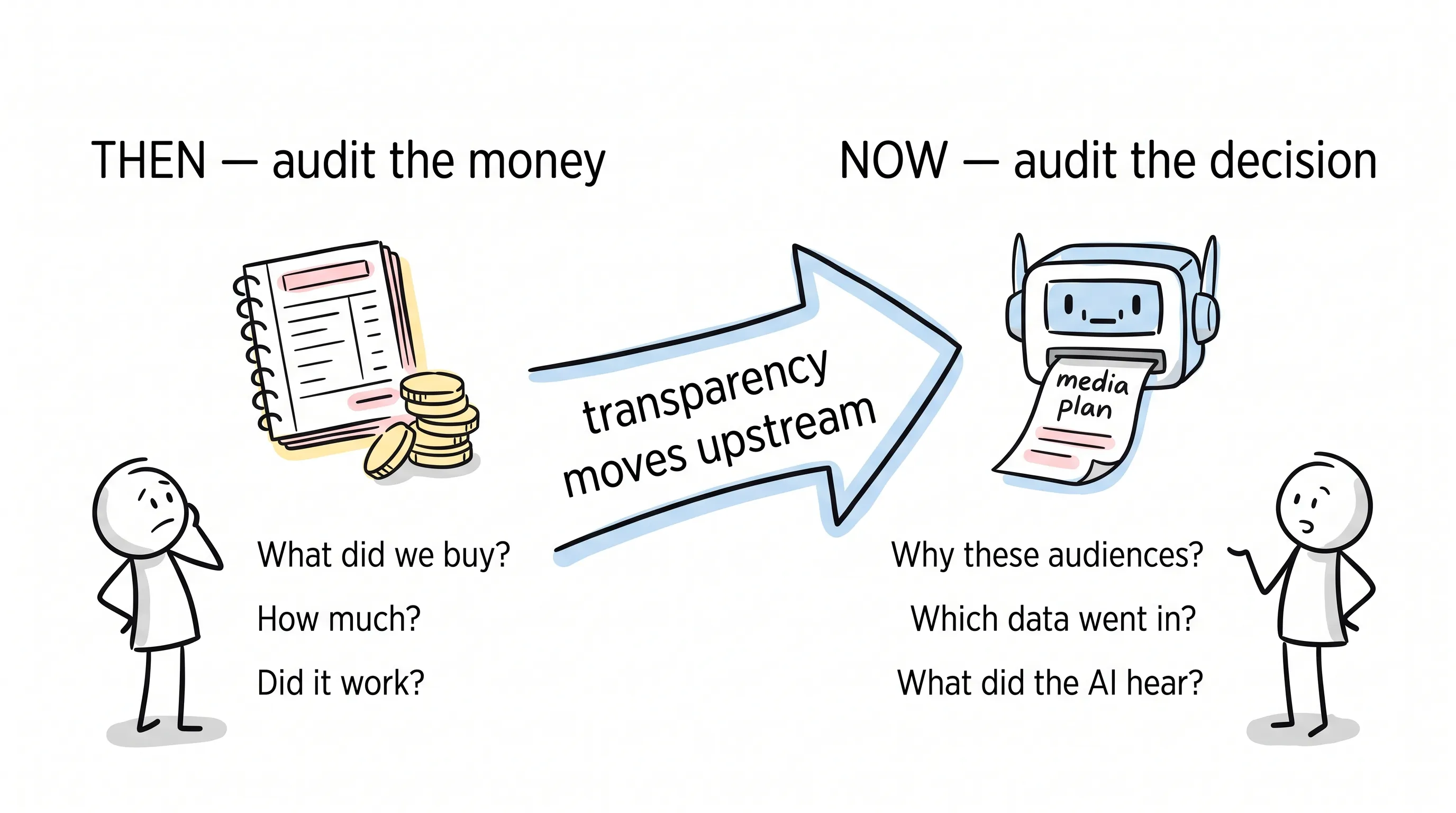
What is transparency? The way this industry has understood it, transparency was something you asked for after the fact: What did we buy? How much did it cost? Where did the money go? Did it work?
These questions still stand — every single one.
But today, advertisers should push the questions forward, to the moment of decision:
Why were audiences defined this way? Which data went in? Why was this group deemed the opportunity and that group not? If AI took part in the recommendation, what exactly did it hear before it spoke?
Transparency shouldn't begin at the transaction. It should begin at the decision.
A Practice Already Underway
This isn't just talk. The way the7stars goes about it, I think, is worth hearing about.
This agency's audience intelligence platform is called Gravity Connect, and it started out doing jigsaw work: piecing together audience data and media intelligence scattered everywhere. Recently they connected Samba TV's viewing data, covering 1.8 million UK households. Planners can see what a given audience is watching — which programmes, which channels, which genres, which dayparts — down to the postcode.
You might sneer: another dataset, what's the big deal?
The big deal is the wiring. Once viewing behaviour is connected to broader audience intelligence, planners no longer just know "these people watch this show." They can follow up: what does that taste have to do with their other traits, their other media habits? Opportunity often hides in those connections.
Accumulating data is one thing. Making data legible is another.
The Stronger AI Gets, the More Valuable the Question
Many people imagine AI usage as: throw in a brief, get back an audience, use it as is.
Frankly, that's the most wasteful way to use it.
Where AI gets truly interesting is helping with the hard, time-consuming work: connecting scattered threads, handing you a starting point.
A starting point exists to be questioned.
The industry is buzzing about agentic systems right now, and I get it — automation is hard to resist. But don't confuse two things: removing friction is not the same as removing judgment. The stronger the technology, the more valuable human questioning becomes.
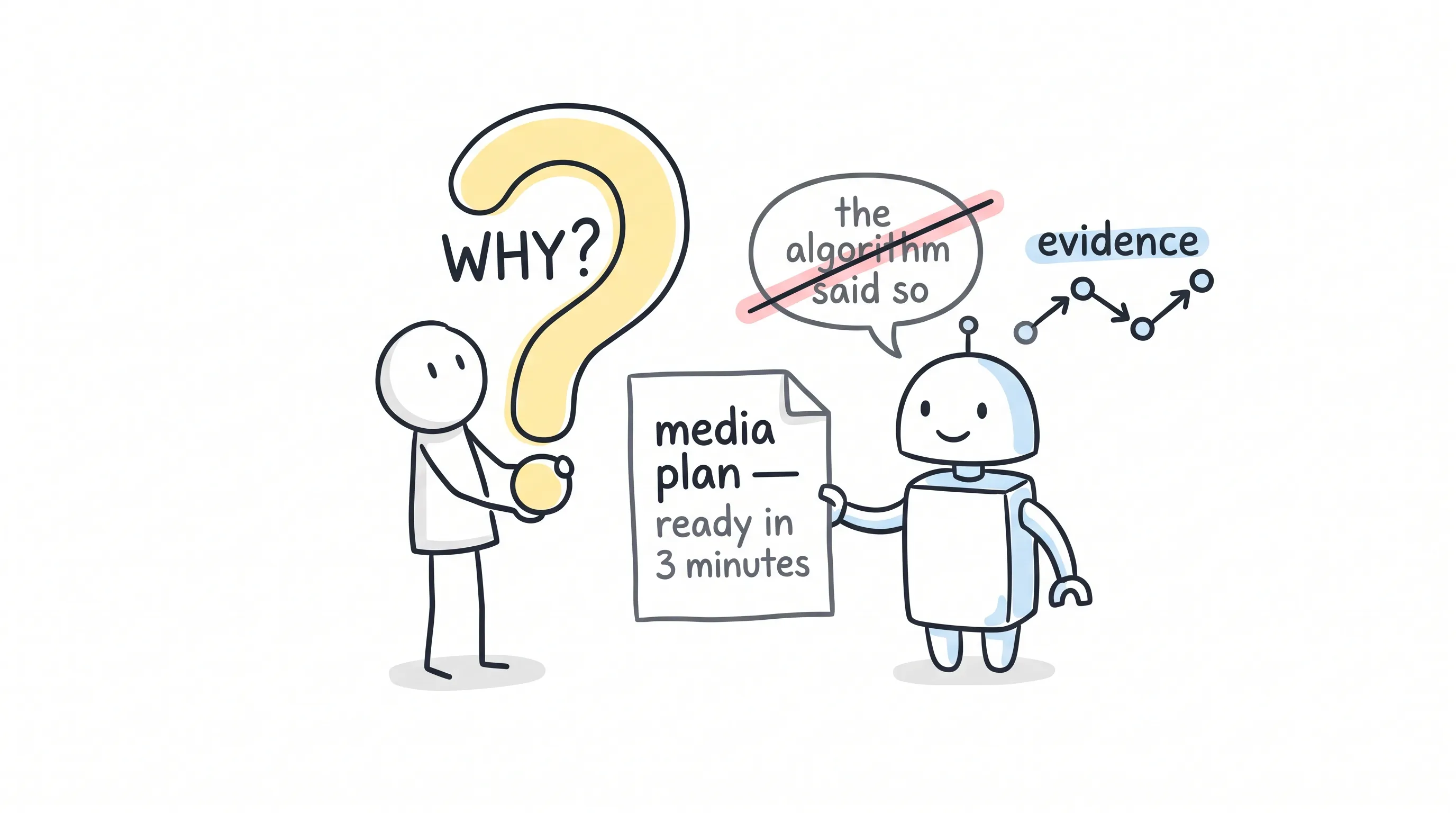
Going forward, planners must be able to challenge: why recommend this audience? Clients must be able to see: which signals drive this strategy? Agencies must be able to present evidence — not shrug and say "the algorithm said so."
Put simply: AI saves you the labour, but it can't save you the thinking. Outsource the muscle and you gain efficiency. Outsource the thinking too, and all that's left of you is a rubber stamp for the machine.
The Next Round of Competition Comes Down to the Understanding Advantage
This also means rethinking the industry's old view of proprietary agency technology.
For a long time, the advantage of agency technology was understood as access: more data, more tools, more private information.
Today, access isn't scarce. Advertising has never lacked data; what it lacks is the craft of connecting it.
Here is my assertion: the future winners will be whoever turns complexity into clarity — clear enough that clients and planners can question it, and act on it.
There is a trap worth calling out on its own: treating complexity as intellectual property.
A recommendation that nobody outside the system can understand doesn't become more valuable for that. Quite the opposite. Only when an advertiser can follow the audience logic, trace the data sources, and walk the whole path from insight to placement can they commit — and commit big.
A plan is only good planning when it is transparent enough to be questioned.
AI is growing into every stage of the media process, and the definition of transparency has to grow with it.
The money has to be traceable.
So does the thinking.
Next time I meet that friend for dinner, the first thing I want to ask is: that media plan that came out in minutes — did you get your "why" out of it?
Continue reading
Related articles

Cross-Border Business: Time to Upgrade Your AI Toolbox
A learn article explaining how AI tools help cross-border e-commerce sellers clear five hurdles: language, regulation, logistics, payments, and fraud. It outlines a five-compartment toolbox, a five-step adoption path, and metrics such as conversion rate and CLV, while cautioning against over-reliance on AI.

AI Is Taking Over the Dirty Work of Social Media Marketing, One Task at a Time
This learn article outlines four social media marketing tasks AI can handle — audience analytics, content drafting and design, ad targeting and creative testing, and spam moderation — and cautions that taste, judgment, and data security remain human responsibilities.

AI Is Already This Good — Why Is Your Social Media Marketing Still Pure Manpower?
An overview of 18 AI tools for social media marketing, organized into six categories covering audience research, content creation, scheduling, comment and DM handling, ad management, and visual production, plus notes on personalization, prediction, and emerging trends.