
Five Shifts in Social Media Marketing for 2026
An overview of five expected shifts in social media marketing for 2026, compiled from agency executives' annual outlooks. It covers AI content saturation, attention moving to closed communities, influencer marketing trends, industry professionalization, and ROI measurement approaches.
A few days ago, an old friend from the branding world invited me out for tea. The first thing they said the moment we sat down: "I don't even dare use AI for content anymore. But if I don't, I can't carry the costs. What do you think I should do?"
I told them: your question happens to be the single biggest anxiety gripping the entire social media industry in 2026.
As it happened, I'd been combing through the annual outlooks of social media agency executives — Flight Story, We Are Social, Billion Dollar Boy, plus people from the industry associations. Pieced together, their calls for this year are strikingly aligned.
I've organized them into five shifts. Let me walk you through them.
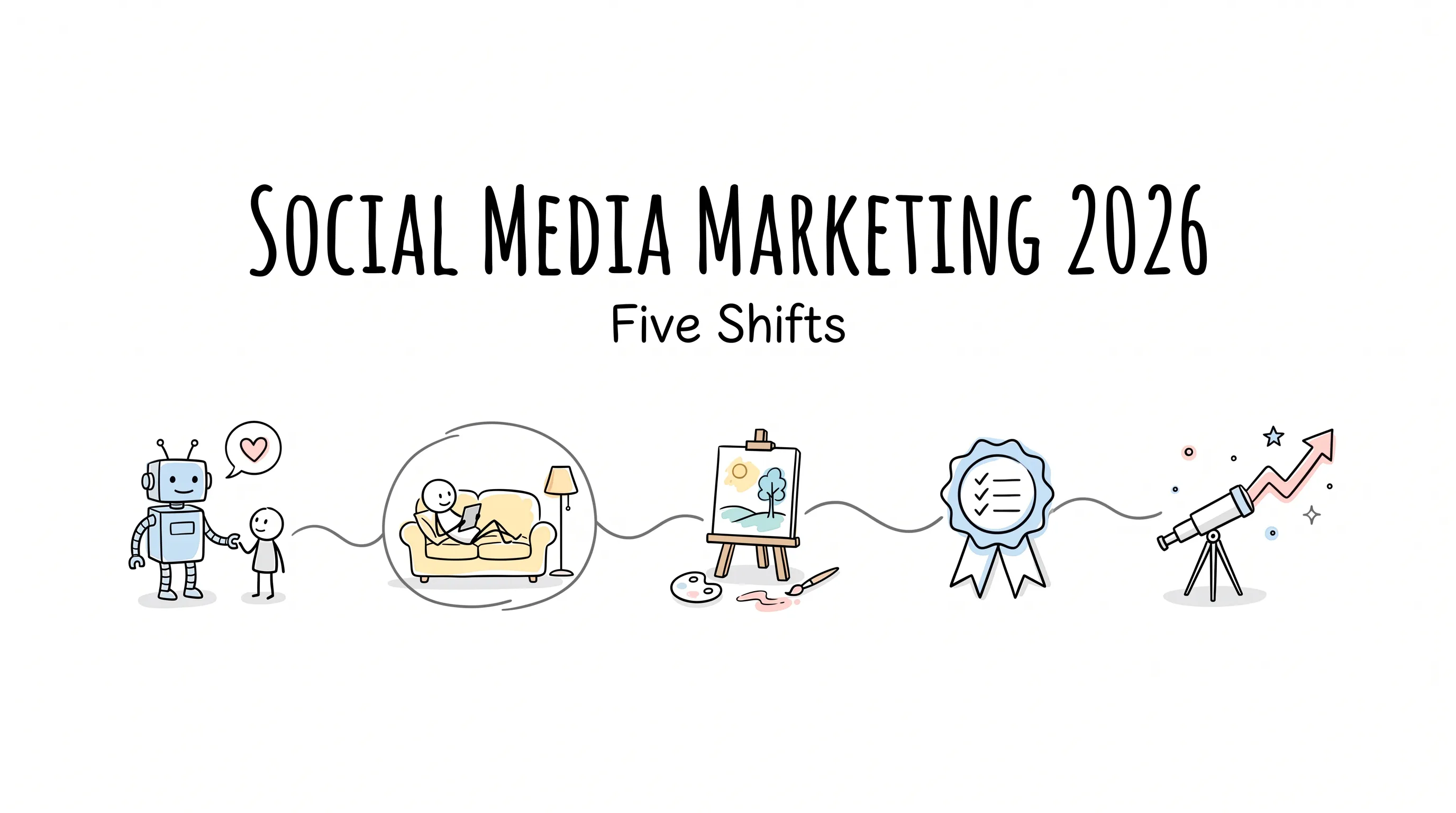
One: AI Content Is Flooding Everything, and "Feeling Human" Has Become the Luxury
Let's start with AI.
In 2025, AI-generated content was already spilling over everywhere. By 2026, the water only gets murkier.
Meanwhile, GWI analyzed the online habits of 250,000 adults across more than 50 countries and found that humanity's time on social media peaked back in 2022 — and has been sliding ever since.
Time has stopped growing, but content keeps exploding. What does that mean? Every piece of content gets a shrinking slice of attention.
So what should brands do?
Pollyanna Ward, Brand Strategy Director at Flight Story, has a word for it: mid-fi.
What is mid-fi?
It's the tier between cinema-grade production and a casual phone snap. Not polished to perfection — but instantly recognizable as something a real human actually made.
She gave an example. The promotional content for Wicked: For Good ahead of its release was all behind-the-scenes footage. No glossy hero spots — just the raw sight of "real people grinding away." Audiences bought it.
That's powerful. And the insight stings: what audiences actually resent isn't AI — it's the absence of any human touch.
Following that logic, Ward says brands need to invest more in "brand codes." What are brand codes? Those signature moves that tell you instantly who it is the moment they appear: the "Apple dance" Charli XCX turned into a viral hit, Apple's unmissable autumn keynote every year, Oreo's "Twist, Lick, Dunk."
These are rituals brands exclusively own, fused to the product itself — something AI can't copy.
She also predicts more "fringe" content and niche experts. The reason is simple: a touch of the unusual is what pulls your content out of the AI-flavored sameness.
Paul Greenwood, Global Head of Research at We Are Social, sees it the same way. Consumers have been force-fed AI content to the point of nausea; brands need the courage to tell real stories and show their rough edges — and lay off the antiseptic.
But sounding human isn't enough on its own.
Ward has spotted another shift: brands are moving away from the old three-stage playbook — "tease, launch, sustain" — toward a rolling content loop. Why? Media has fragmented, and you can't stage a "big premiere" anymore.
Social ads will change shape too: retreating into "six-second billboards." Social is the foyer, the entrance — its job is to walk people into the brand's world.
That world-building ability is something ChatGPT cannot give you.
Greenwood put it bluntly: time has peaked, so brands can only push harder on creativity.
But the coin has another side. Virtual influencers are sprinting down a different track. McKinsey predicts digital twin technology will grow 60% annually over the next five years, becoming a market worth roughly $73.5 billion by 2027. Meta and TikTok are both pushing AI creators. Scott Guthrie, Secretary-General of the IMTB (the UK influencer marketing industry association), says this playbook has already been proven in China: streamers go live by day, then hand over to their digital avatars at night — pocketing an extra stream of income.
Two: Where Attention Moves, Brands Should Follow
So where is people's attention going?
Greenwood's read: young people are moving house. Gen Z and Gen Alpha are relocating from the public square into the living room — closed communities like Discord and Substack.
Why?
Because there, creators and brands can genuinely "own" their own space. Long-form content on Substack gives users and brands "quality time" together — not the 0.3 seconds of a scroll-past.
TikTok's near-ban in the US in 2025 taught many brands another lesson: every piece of content you post lives on someone else's servers.
Ward put it precisely: "Social won't just be the destination — it's another route to owning an audience."
So in 2026, brands are splitting their forces: short video carries on as before, video investment doubles, while reaching out to Twitch, Discord, Patreon, and Substack — with dedicated team members keeping watch over YouTube Shorts, Substack, and Snapchat.
There's also a somewhat surprising comeback: YouTube has been rediscovered.
Marks & Spencer (M&S) launched a YouTube series called Love That, and it landed well. Greenwood says more brands will re-examine YouTube, because it builds "mental availability": people think of you before they've even reached for their wallet.
And with that, the path clicks into place.
Three: Influencer Marketing, From Chasing Trends to Crafting Work
The third shift is about influencer marketing.
Start with the numbers. Kolsquare's survey shows: 81% of UK brands plan to raise their influencer budgets in 2026, with 32% spending £100,000 to £499,000 a year. Meanwhile, 61% of brands are scaling up long-term partnerships.
The money is there to be spent. But how it gets spent has changed.
Simon Harwood, Global Effectiveness Director at Billion Dollar Boy, says the keyword for 2026 is "deliberate": slower, more refined, more like a crafted piece.
He points to Argos. The retailer's Arghaüs series doesn't chase the day's trending topics — it's produced like a series, built up patiently, episode by episode.
Why the slowdown?
Harwood has noticed an "anti-speed" mood rising on social media: users are drifting toward quieter spaces, longer content, and offline experiences. Consumers want "social with different flavors," not trend fast-food every day. That's why episodic content and creators from outside the usual circles are both on the rise.
There's one more concept I believe will get repeated mentions in 2026: digital availability.
What is digital availability?
Harwood explains: the old "always-on" meant a team on standby, pouncing the instant a trend jumped. The new "always-on" means that when users search for category-related terms, your content is already sitting there waiting — and smoothly walks them to your brand's front door.
One is chasing; the other is waiting. Chasing is a gamble. Waiting is strategy.
Social commerce is going through the same fast-to-slow turn. TikTok Shop-style impulse buying still exists, but Harwood cautions that much of creator marketing's sales impact actually lands months or more later — especially in categories where people deliberate long before checking out. Brands need to grab fast conversions with one hand while banking slow trust with the other.
Four: The Influencer Trade Is Going Professional
The fourth shift concerns the industry itself.
Start with a number: in 2025, the UK creator economy contributed £2.2 billion and sustained more than 45,000 jobs. How big is that? The UK Parliament set up a dedicated cross-party creator group (the APPG). YouTube also held its first-ever Creator Consultation in July 2025.
Influencing is no longer a "sideline hustle" — it's a proper profession now.
And a proper profession needs proper rules. In 2025, another batch of signatories joined the Influencer Marketing Code of Conduct. Guthrie says the UK and European influencer industries are "accelerating their professionalization" — partly through industry self-discipline, partly through constant back-and-forth with HMRC (the UK's tax and customs authority) and the CMA (Competition and Markets Authority). Creators' mental and physical wellbeing has also been put on the table.
One telling detail: the influencer compliance guide jointly issued by the ASA and the CMA has been the most-downloaded document on the ASA website for several quarters running.
Guthrie's read on that?
It shows that "influencers aren't unwilling to follow the rules — they just want to know what the rules actually are."
Sit with that line for a moment.
By revenue, the UK influencer market ranks third in the world, behind only China and the US. In Europe, the European Influencer Marketing Alliance has already connected 7 countries, 300 agencies, and 8,000 influencers; the IMTB has also formed an alliance with Australia's AIMCO, saying the two will "learn from each other."
Regulation will keep tightening too. European countries including France, the Netherlands, and Germany are already rolling out "influencer certification": an online course, an exam, then a one-year probation period. Guthrie predicts that some brands will eventually work only with certified influencers. Will the UK give it a try? He wouldn't be surprised.
Five: Time to Change How You Do the Math
The fifth shift is the most down-to-earth of all: how the math gets done.
In 2025, the IPA (the UK's association of advertising practitioners) published research showing that influencer marketing's ROI beats linear TV and paid social — with long-term returns especially strong. How strong? Harwood says most brand effects and sales effects land between three months and two years.
Three months to two years.
Yet how do we usually evaluate influencer campaigns? We watch the numbers for three days after launch: how many likes, how many shares, did the follower count move.
That's the mismatch: you're pointing a microscope at something that needs a telescope.
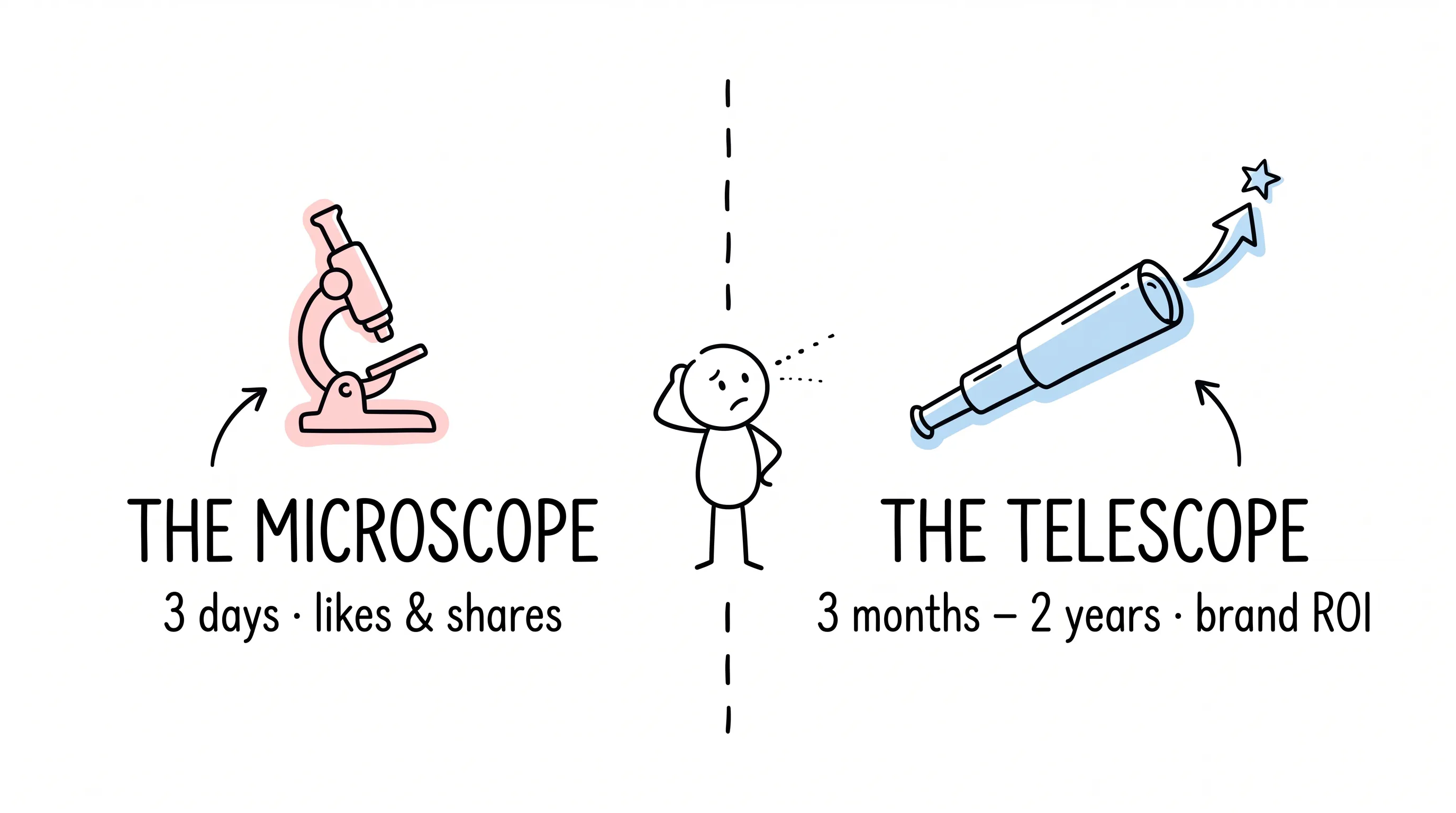
So Harwood recommends treating influencer marketing as a brand-building channel when doing the accounting — not just a short-term bet. And the measurement needle should move further upstream: beyond engagement and purchase intent, start measuring emotion. Because creators are, at their core, "brand entertainment," the thing that locks your brand into long-term memory. His own words are beautiful: "As long as you feel something about a piece of content, the next time you walk down the aisle, you're more likely to think of that brand."
Kolsquare's data shows 34% of UK brands are already tracking ROI, even though it remains hard. The IMTB also set up a dedicated measurement and evaluation committee in 2025.
Greenwood's methods are more engineering-minded. Three of them.
The first, conversion lift studies: look directly at how social actually moves hard-cash revenue.
The second, synthetic data. What is synthetic data? When you can't get real data, you use models to infer the missing pieces — and read off how much social contributed within the whole marketing mix. Fast and cheap.
The third, creative pre-testing. Test content against synthetic audiences first; only what performs deserves paid traffic. In Greenwood's words: "Let the budget follow the content that actually works."
On the social media side, Ward's call is this: follower counts and vanity metrics will be trusted less and less in 2026. Platform subscriptions will become the new hard metric.
Finally
Back to that friend from the beginning.
Later, I asked them: are you afraid of AI making content for you, or afraid that AI leaves your content unseen?
They thought about it, and said the latter.
The answer, really, is already hidden inside those five shifts: AI handles efficiency; humans make people willing to stop.
2026 is almost through, and your trial-and-error window is closing.
But don't panic. Change always claims the onlookers first, then the ones running in the wrong direction.
Here's to being the one who moves first — and the one headed in the right direction.
Continue reading
Related articles

Cross-Border Business: Time to Upgrade Your AI Toolbox
A learn article explaining how AI tools help cross-border e-commerce sellers clear five hurdles: language, regulation, logistics, payments, and fraud. It outlines a five-compartment toolbox, a five-step adoption path, and metrics such as conversion rate and CLV, while cautioning against over-reliance on AI.

AI Is Taking Over the Dirty Work of Social Media Marketing, One Task at a Time
This learn article outlines four social media marketing tasks AI can handle — audience analytics, content drafting and design, ad targeting and creative testing, and spam moderation — and cautions that taste, judgment, and data security remain human responsibilities.

AI Is Already This Good — Why Is Your Social Media Marketing Still Pure Manpower?
An overview of 18 AI tools for social media marketing, organized into six categories covering audience research, content creation, scheduling, comment and DM handling, ad management, and visual production, plus notes on personalization, prediction, and emerging trends.